I work in a CMS almost every day. A CMS, a content management system, is where a website's pages live, like Webflow, WordPress, or Contentful. I open a page, click a field, decide, save. Then the next page. And almost every time I publish, I have this feeling that I forgot something.
Lately a lot of people are saying the CMS is over. Cursor moved its website out of its CMS, Sanity, and into plain files its coding agents can edit. Sanity answered with a post called "You should never build a CMS." In my industry people say the same about the TMS, the translation management system teams use to run translation. It's over, they say. Agents will handle it.
I work at a TMS company, and honestly, I use a CMS a lot more than I use a TMS. So this is my angle as a CMS user. I don't think the system is what's ending. I think the clicking is.

The checklist lives in my head
When I publish by hand, the CMS shows me its paths. This screen, then that field, then that setting. My job is to walk them in the right order and remember everything along the way.
The meta description. The alt text on the image. The link on the button. The highlight I meant to add. And the other ten languages, because our site runs in eleven.
Nothing on the screen tells me when I skip one. I find out later. We once published legal pages that existed in English and in none of our other ten languages. Nobody decided that. Someone forgot a step.
This isn't about skill. Surgeons know their work better than anyone, and when eight hospitals started using a simple surgical safety checklist, deaths after surgery fell from 1.5% to 0.8%. Memory is a bad checklist, even for experts.
When I ask Claude, the checklist runs every time
Now the same CMS, but I ask Claude to do the work. I say what I want, and Claude translates my prompt into the paths the CMS requires. It goes through the points I always forget when I do it through the interface. Every time.
There's no magic in it. The checklist is written down. Everything I used to keep in my head sits in a file the agent reads before it touches the site. Which collections, which fields, all eleven languages on every new page, a screenshot of the live page before any edit. Each line is there because of a mistake. The legal pages are a line now.
The CMS is still there. But it feels like someone is dealing with it for me. Which really surprised me.
The change can be as big as the idea
The second thing surprised me more. In the CMS, everything is click, open, decide, save. One item, one language, one screen at a time. So I think small. I fix the page I'm on.
When I write a prompt, the size of the change is the size of what I have in mind. Change every call to action on the site. And in every language. That's one request.
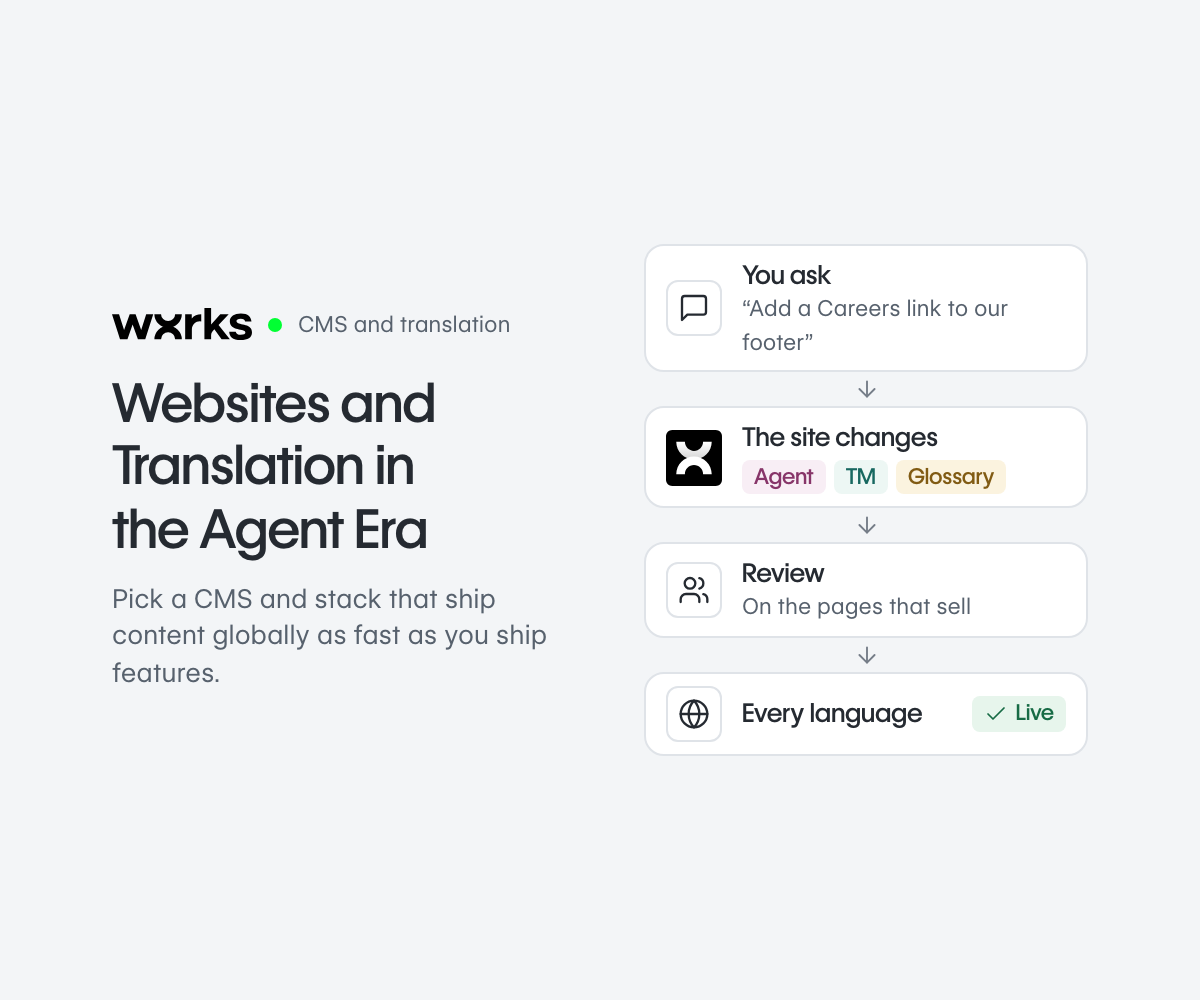
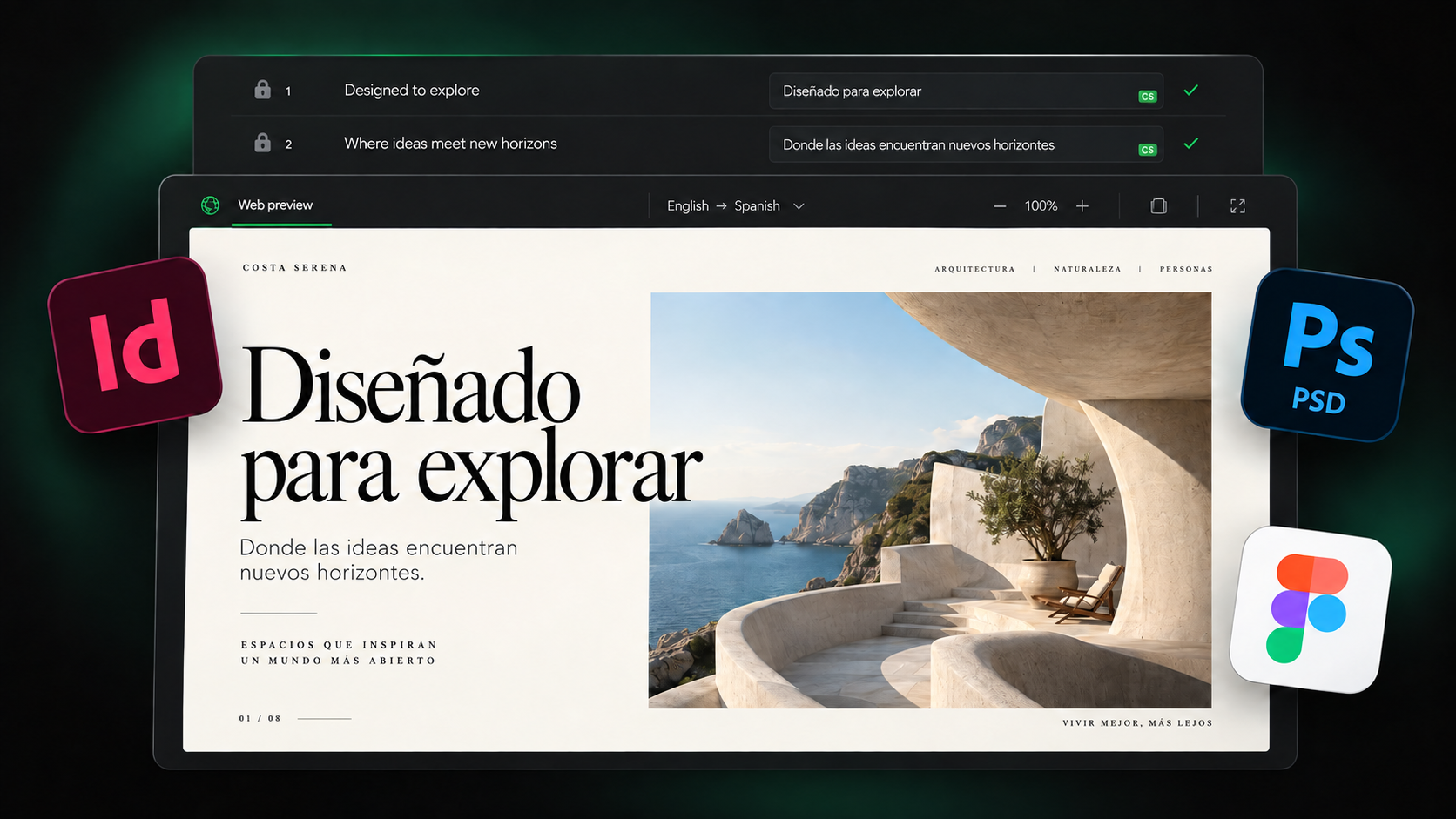
We felt it most on a project with no CMS at all. We built a set of country pages in Astro, a framework that builds a site from plain files. One English file went out to 49 languages, and a script checks every language for the same things every time, like missing text and broken placeholders. It felt connected. One thing instead of a hundred pages. I wrote more about choosing a stack for this in Websites and Translation in the Agent Era.

Drag and drop still asks you to draw every step
Some people answer all this with workflow tools, the drag-and-drop kind, like Zapier or n8n. You connect a box to a box and the work runs on its own. Those tools are useful, and so are the connectors that move content between your systems. But look at what you do while you build one. You place the same clicks, now on a canvas, and you still have to know every implication of every step. If you forget something in the CMS, you'll forget it in the diagram too.
Anthropic, the company behind Claude, draws the same line in its guide to building agents. A workflow follows paths someone set in advance. An agent works out its own steps from what you asked. That second part is what I feel when I prompt. I don't draw the path. I say where I want to go, and the agent finds the steps. Our own CLI, which runs translation from code and from AI agents, was built for exactly that kind of caller.
So what does agentic mean?
Here's how I put it to my team. What we're calling agentic is, in many cases, a smart go-between. It follows checklists, carries them out precisely across many cases, and takes the mental load off the person doing the work.
Vanilson Burégio, who leads software engineering at wxrks, mapped how agentic workflows actually run. The gains come from the structure around the model, the steps and the checks, more than from a smarter model.
That's less science fiction than the word suggests. It doesn't mean the agent decides what your site should say. As we wrote in AI Agents Are Not Autonomous, running the steps is one thing and owning the intent is another. The agent runs the steps, and it makes plenty of small decisions along the way. What the page should say, and whether it's ready, is still your call.
Is the CMS over? Is the TMS over?
I don't think so, and I'm not sure it's the right question. The agent doesn't remember anything between conversations. My checklist only exists because someone wrote it down after a mistake, and it lives in files, not in the model. Even Cursor's move kept a structure, just a different one, which is Sanity's whole point. And Sanity's answer, roughly, was to let agents into the CMS.
Translation makes this sharper. Your approved translations, your terminology, your tone, and who approved what have to live somewhere the agent can read and the team can trust. That's the job of a TMS now. It's the memory and the record the agent works from, with people reviewing what matters. It's what we mean by an operating system for global language.
It's also why wxrks has an MCP, a standard way to connect an AI assistant to other software. Claude, Cursor, Codex, or OpenCode can work with the translation memory, terminology, and context you already keep in wxrks. We said it in August and I still think it. Localization is moving past the localization interface.
And the bigger the change, the more review matters. A wrong click breaks one page. A wrong prompt can break every call to action in eleven languages. Most of those country pages are still waiting for a native speaker to read them. That part doesn't get faster, and it shouldn't. It's why we built Smells, the check that flags meaning problems like an omission or a distortion, so reviewers know where to look first. Agents won't replace translators. They change what translators spend their attention on.

What I'd do this week
Write your checklist down. Everything you check before you publish, in every language. Then ask an agent to run it on one page and see what it catches that you would have missed.
If your translations already live in wxrks, connect wxrks to the assistant you already use, and it starts from everything your team already knows.
Unlock the power of glocalization with our Translation Management System.
Unlock the power of
with our Translation Management System.