

I have come full circle on this myself. When I joined wxrks five years ago, our site ran on Forestry.io. I keep up with CMS news, so my first thought was: what is this? I had never heard of it. It felt too technical for me. You committed a change, pushed it with Git, and it went live. I asked us to move to WordPress, which I have used for 18 years. Later we moved to Webflow, and it has served us well. Now I want to go back to commit-and-push, this time with Astro.
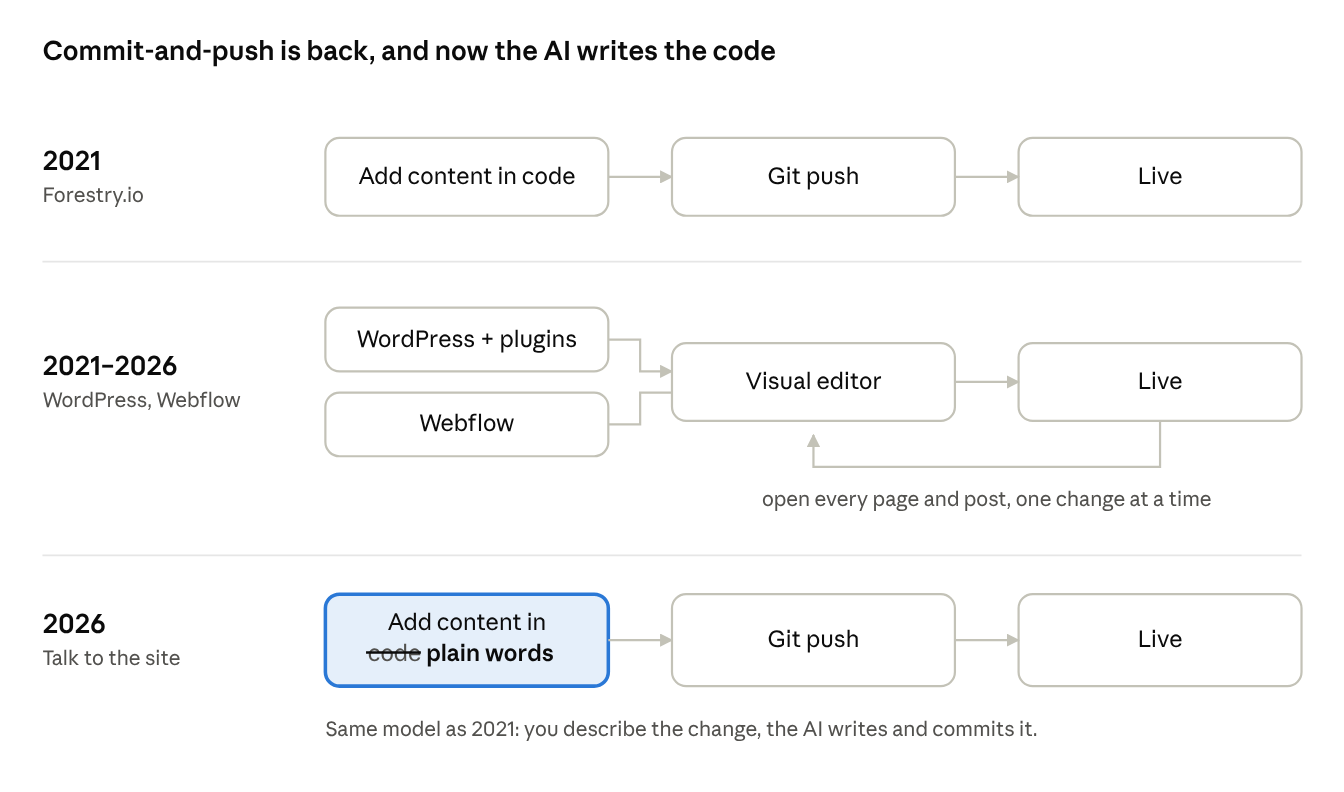
Now I am excited about the next step: talking to our site in plain language and having it commit and publish the change for me. Back then, commit-and-push felt awkward. Today AI handles that part behind the scenes, so the same model just works. My pick for it is Astro, my favorite stack so far. The tools changed; what changed most is who does the work.
What follows is the data I have been using in my own research. Use it, check it, and push back on it. It changes almost daily, so treat every number as a snapshot from September 30, 2026.
The map
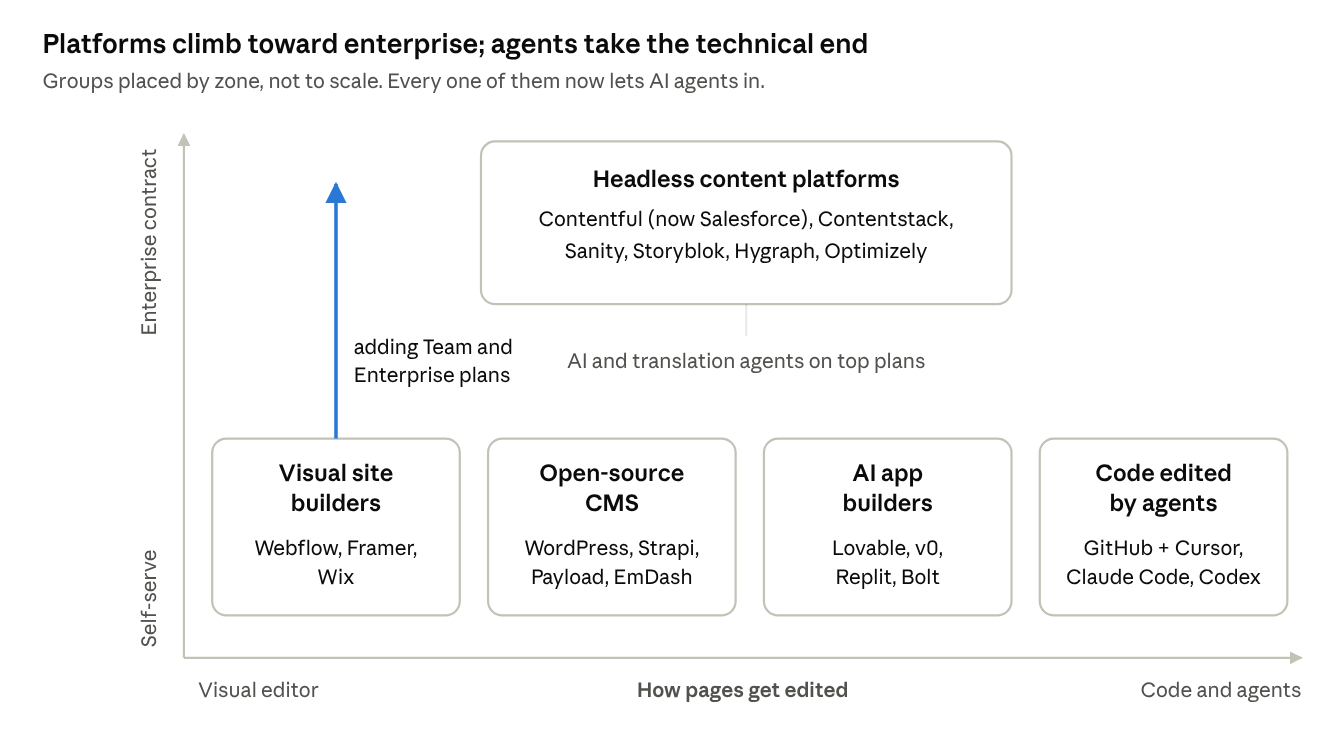
The visual builders and content platforms are moving up, toward team and enterprise contracts. The small, technical end is going to AI app builders and to code edited by agents.
Five moves every platform made
In 18 months, website platforms changed how they charge, what they include and who they let in. Five moves show up almost everywhere.
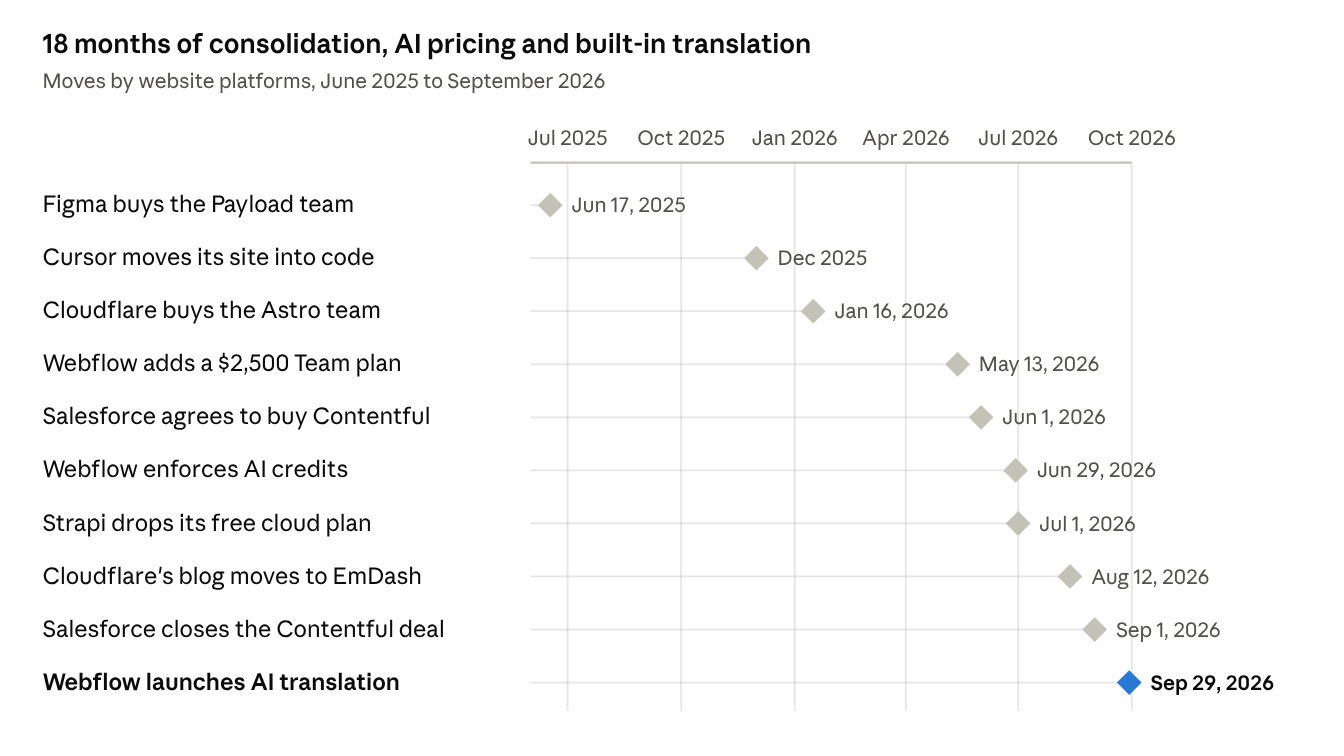
Acquisitions, credit pricing and built-in translation all landed within 18 months.
1. AI is now sold by the credit. Your bill moves with how much the AI works, not only with how many people log in.
- Webflow started enforcing AI credits on June 29, 2026, with extra packs of 2,000 credits at $20 to $25 a month.
- Sanity charges $0.05 per credit.
- Strapi, Storyblok, Framer, Builder.io, Contentstack and Optimizely meter AI the same way.
2. Translation is becoming a built-in AI feature. Most platforms now sell it, often limited to their top plans.
- Webflow launched automatic AI translation on September 29, 2026.
- Framer charges $20 per language plus credits.
- Sanity, Storyblok, Hygraph, Contentful and Optimizely all sell AI translation.
- Some pitch it against agencies. In a case study, Sanity says loveholidays went from paying an agency £200K to £300K a year to about £10,000 for DeepL's machine translation, and that "new market translations that took half a year now take a weekend."
3. Every platform opened its doors to AI agents. Agent access is free on most platforms; AI and governance cost extra.
- All the platforms we checked offer an MCP server, the standard way for tools like Claude, Cursor or ChatGPT to read and edit their content.
- Webflow went further with Source, which "makes code the foundation for everything that ships on your site".
4. Prices split in two. Entry plans held or got cheaper, while team and enterprise plans got pricier.
- Webflow folded its Business plan into a cheaper Premium plan and added a Team plan at $2,500 a month on an annual contract.
- Hygraph dropped its $799 plan and quotes enterprise deals at $32,000 to $300,000 a year.
- Builder.io made its CMS sales-only, and Strapi removed its free cloud plan.
- Salesforce bought Contentful to feed content to its Agentforce AI agents, closing the deal on September 1, 2026.
5. Some technical teams left the platform altogether. Their content now lives as plain files in code, edited by coding agents.
- Cursor moved its website off its headless CMS in December 2025, in three days and for $260 of AI usage.
- StackOne, ZenML and Opine left Webflow the same way in 2026.
Not every move points one way. Contentstack added plans at $0, $29 and $299 a month, and Framer halved its editor seat from $40 to $20. Cloudflare went the other way and assembled a whole stack. In January it bought the team behind Astro, the open-source framework that Unilever, Visa and NBC News use for fast content sites. Then it built EmDash, a CMS made to work with Astro, and moved its own blog onto it in August.
Astro also routes each language to its own URL, and can show a fallback page while a translation is missing. It does not translate anything itself: the words still come from a CMS or a translation platform.
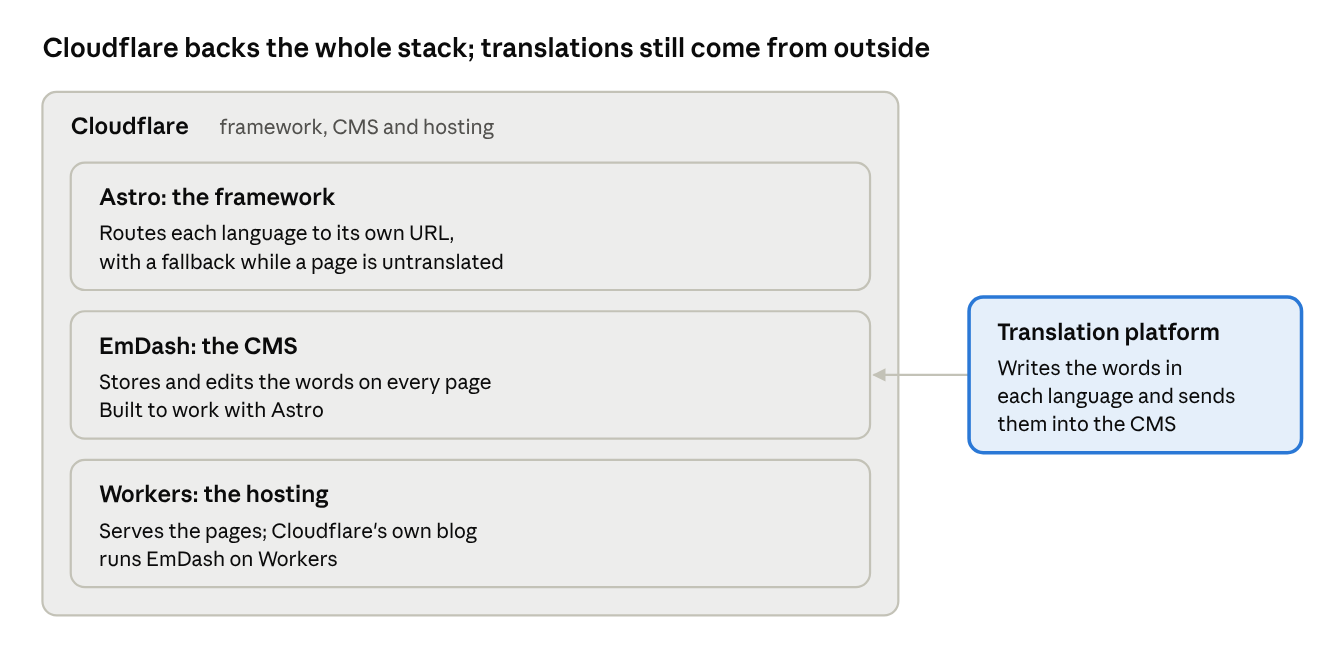
Astro, EmDash and Workers cover building, editing and serving the site. The words in each language still come from a translation platform.
What the homepages sell now
Webflow said it plainly when it announced Source on September 2, 2026: “As code continues to become commoditized, craft—and the teams who amplify it—will be what sets the best brands apart.” If anyone can prompt a page into existence, the editor stops being the product. We read the homepages on October 1, 2026, and almost none of them leads with its editor. They sell one of four things.
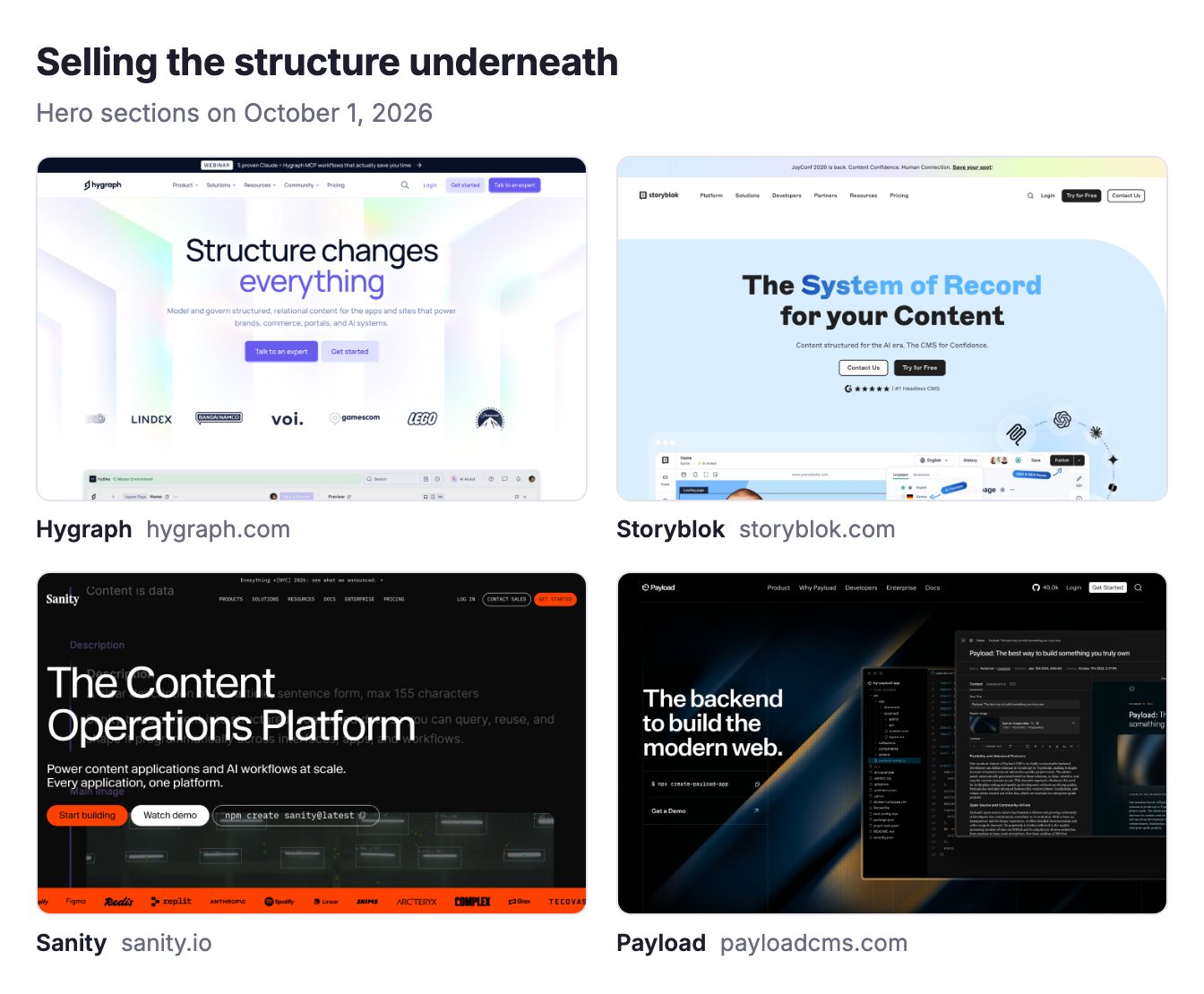
Headless and open-source platforms sell the layer under the page: content as structured data that a site, an app or an AI agent can query. Hygraph says “Structure changes everything”. Storyblok calls itself “The System of Record for your Content”, Sanity “The Content Operations Platform”, and Payload “The backend to build the modern web.” It is an infrastructure pitch, and developers set it up.

Prismic leads with “Prompt new pages. Build new journeys” and spells it out: “Connect Prismic to Claude, ChatGPT, or any MCP-enabled AI tool. Create new pages, rewrite existing ones, or make updates with a prompt.” Contentful is “Built for humans. Ready for agents.” Cloudflare’s EmDash is “The CMS for you and your agent”, and Framer calls itself “the design agent for every step from idea to launch”.
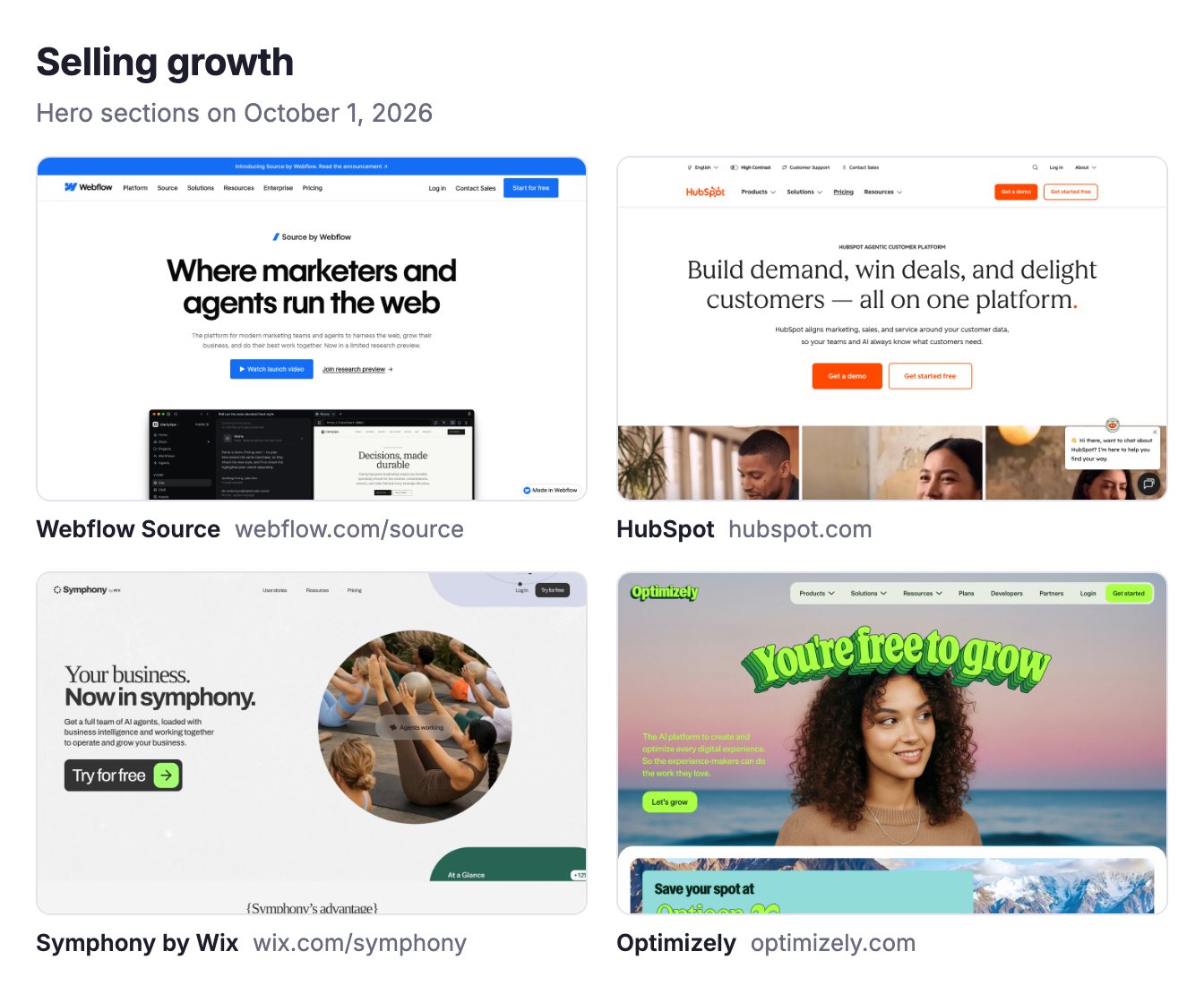
The third pitch barely mentions the website. HubSpot’s homepage reads “Build demand, win deals, and delight customers — all on one platform”, and on September 16 HubSpot rebuilt its platform around what it calls Growth Context: “everything HubSpot knows about your customers, your team, and your business.” Wix launched Symphony on August 11: “a full team of AI agents, loaded with business intelligence and working together to operate and grow your business”. Its paid plans come with a free year of a Wix website plan.
Webflow is heading the same way. Its homepage promises a website “that drives real revenue”, and Source, the code-based product above, is pitched as “Where marketers and agents run the web”. Even app builders are adding distribution: on September 9, Base44 put Google Ads campaigns inside its builder, because “the hardest part for many builders isn’t shipping their app – it’s getting the first wave of customers.”
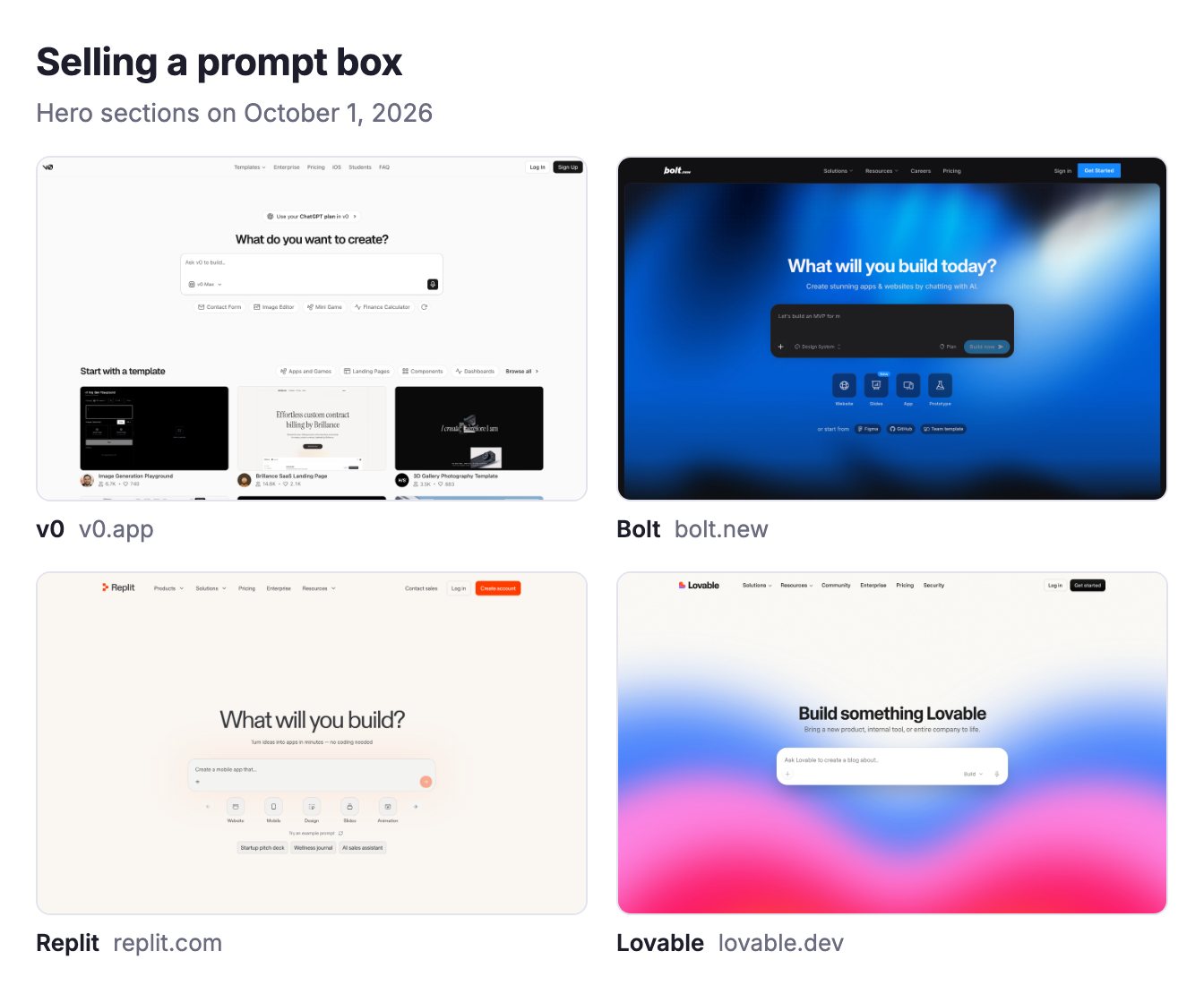
AI app builders hardly have a headline. Their hero is an input field: “What do you want to create?” on v0, “What will you build today?” on Bolt, “What will you build?” on Replit.
Which problem do you have?
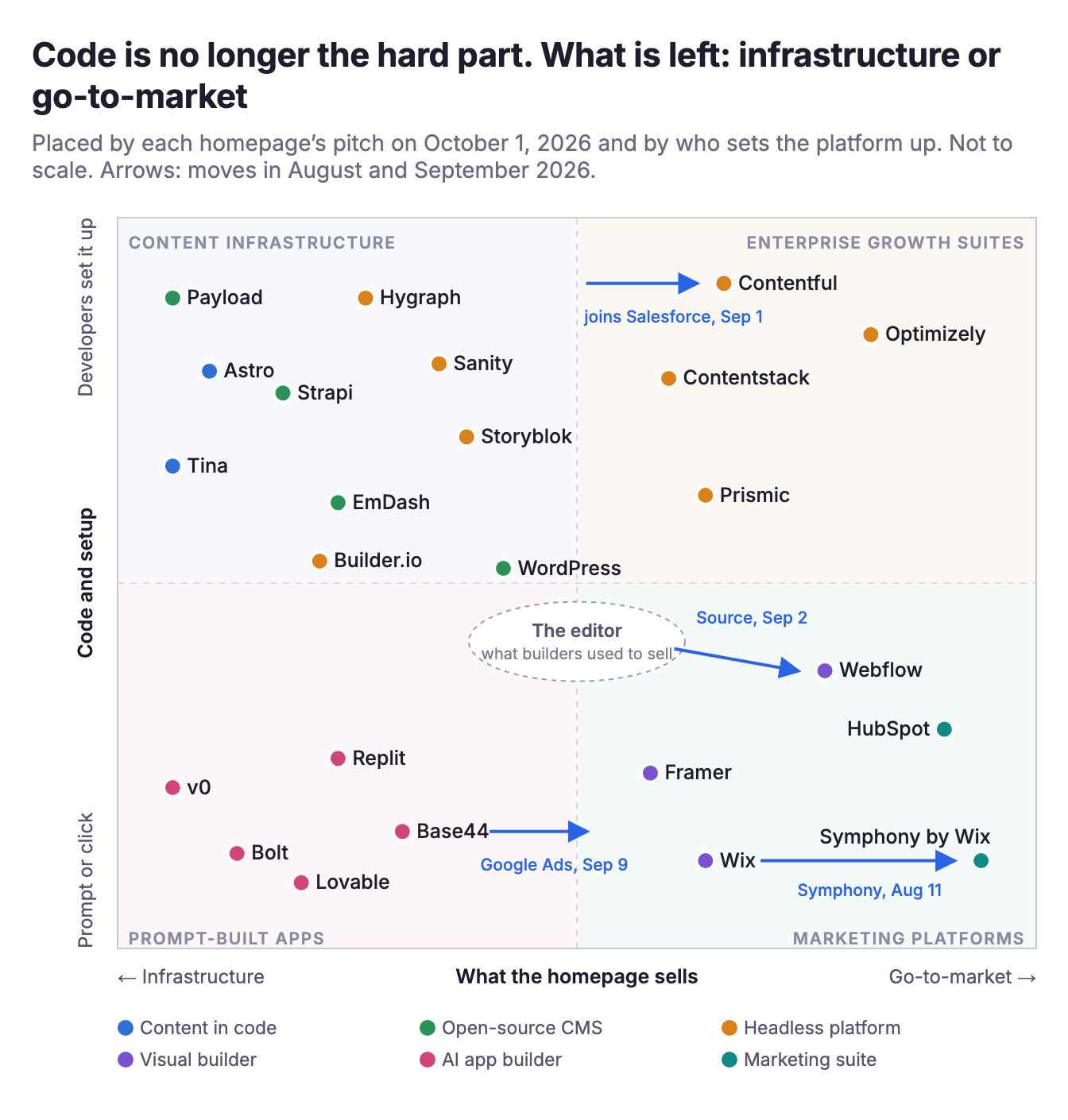
Put the pitches side by side and two questions sort them. What problem does the platform sell against: the infrastructure your content runs on, or the go-to-market work of getting it in front of people? And how much code and setup does it take before your team can use it? Code is no longer the bottleneck it was, so most teams are left with one of the other two problems. If you feed a site, an app, a help center and AI agents from one source, you have an infrastructure problem. If you need a new campaign in six markets every week, you have a go-to-market problem.
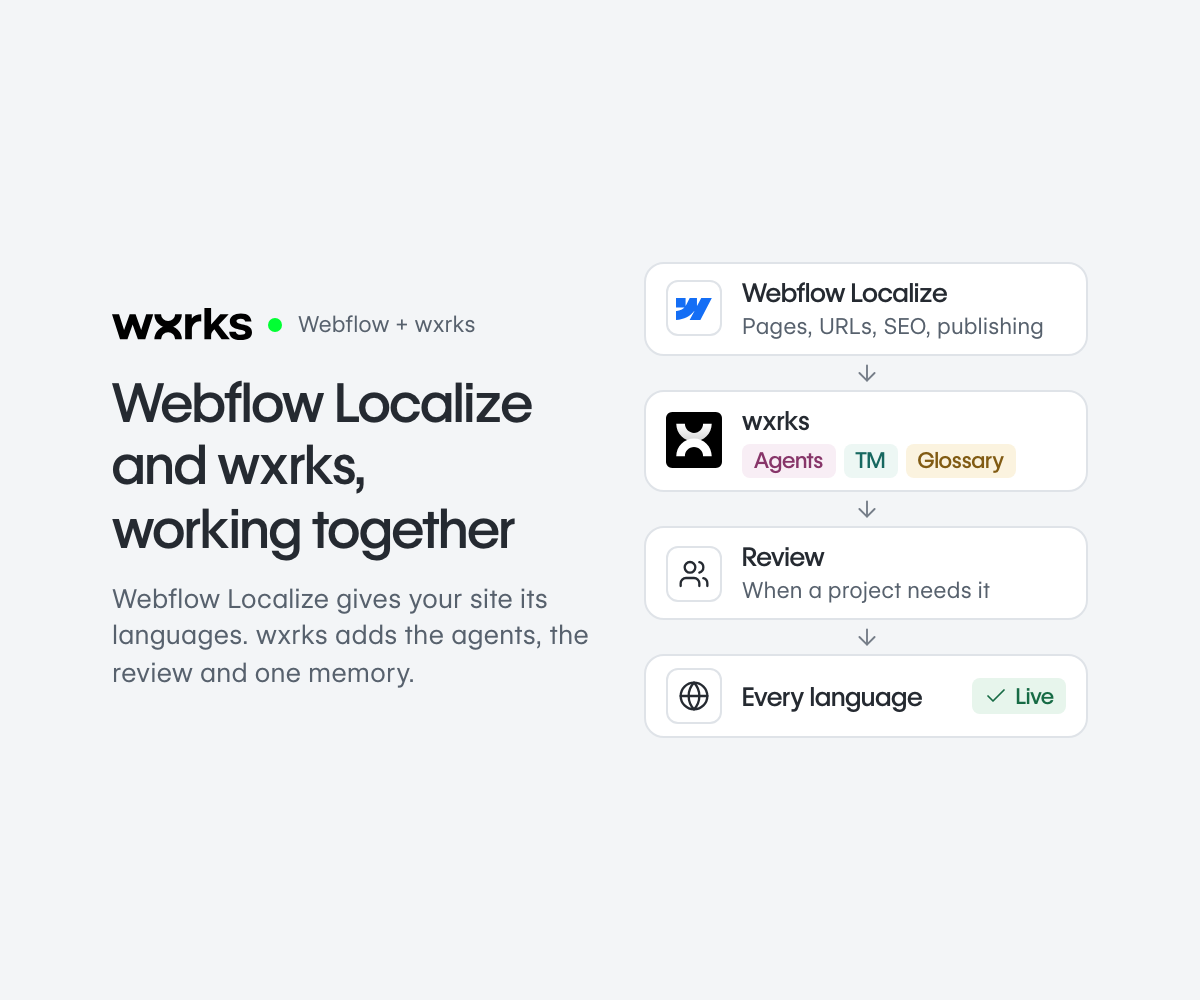
Translation sits inside both. On the infrastructure side it is a structure question: languages live as fields, and something has to fill them. On the go-to-market side it is a speed question: every campaign, in every market, this week. The platforms answer with their own AI. HubSpot translates pages with DeepL on Content Hub Professional and Enterprise, and Webflow with its own AI, metered in words and credits. Either way, the memory, glossary and review that keep your brand consistent should not be locked inside one platform. That is why we built wxrks as a translation operations platform: one memory across Webflow, Contentful, Optimizely, WordPress, Git repositories and the marketing tools around them, with a command line that coding agents can run.
How the work changes
The goal many teams are working toward: change the whole site, in every language, just by asking.
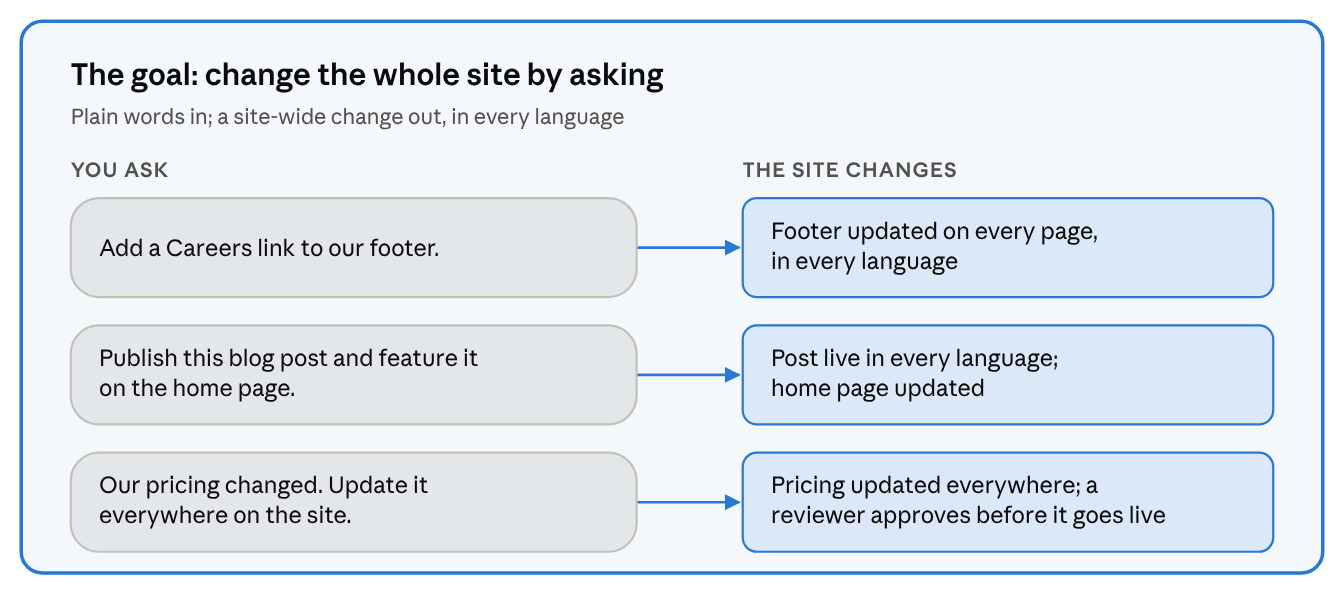
It sounds utopian, but some teams already work this way. Cursor and StackOne change their sites by asking coding agents. At scale, translation and review are what keep it safe.
Most teams sit somewhere on the way there. The same small change looks very different in each of three setups:
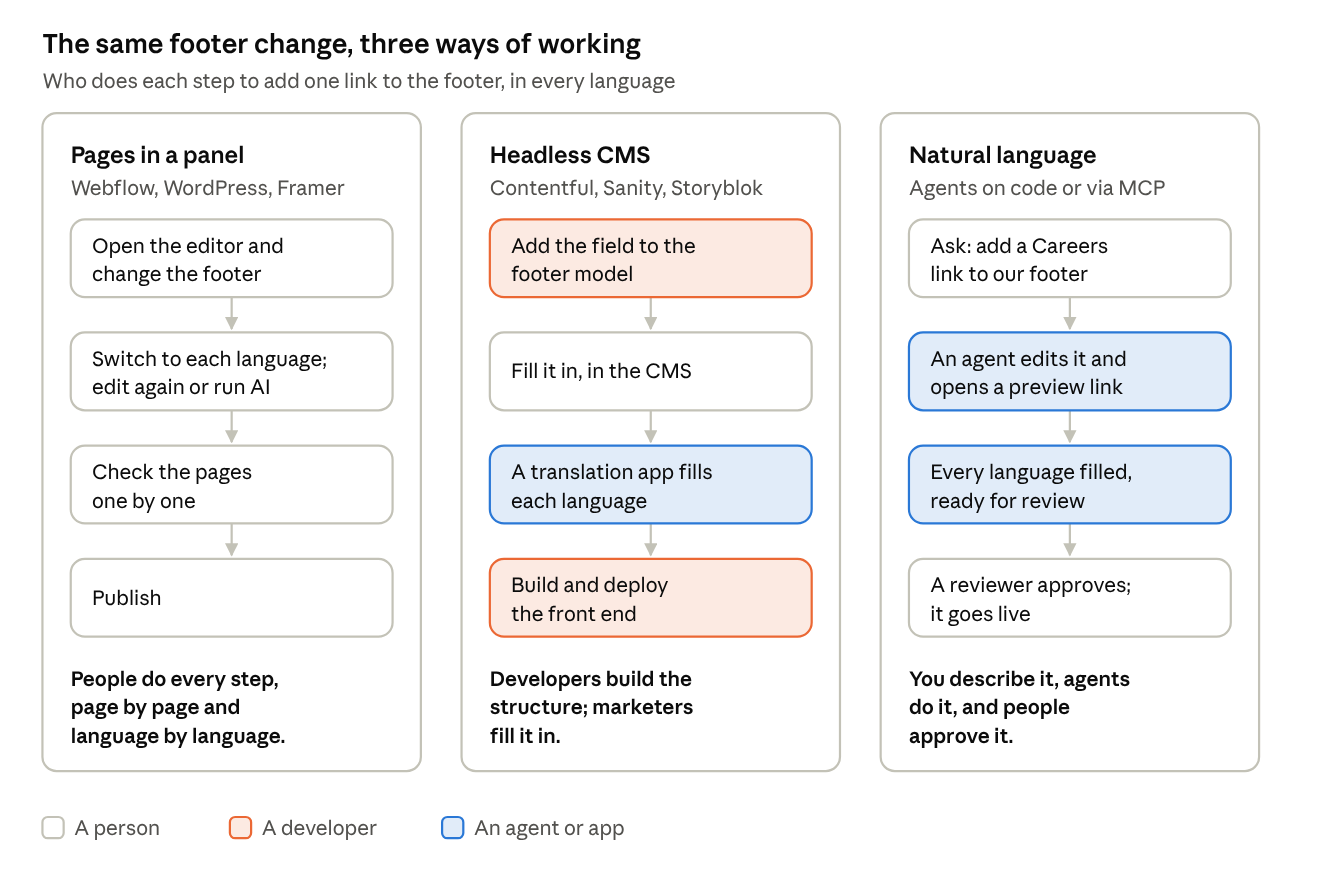
These are not separate camps. Panels and headless platforms are adding agents too, and even Cloudflare built a CMS, EmDash, so people keep an editor. What changes is who does the work: clicking, filling in fields, or describing and approving.
Road by road
Each group is heading somewhere different, and each fits a different kind of team. The hype and the installed base also differ: W3Techs finds WordPress on 40.2% of all websites, Wix on 4.2% and Webflow on 0.8%, while Lovable and v0 each run 0.1%.
| Group | Examples | Where it is heading | Entry price | Fits |
|---|---|---|---|---|
| Visual site builders | Webflow, Framer, Wix | Team and enterprise plans, AI credits, built-in translation, their own AI site building | Webflow Premium $25 a month per site; Webflow Team $2,500 a month | Marketing teams without developers running one main site |
| Marketing suites | HubSpot Content Hub, Symphony by Wix | The site becomes one part of a platform for CRM, campaigns and AI agents that share your business context | HubSpot free to start, AI translation from Content Hub Professional at $500 a month; Symphony free, then from $16 a month | Small businesses and marketing teams that want the site, CRM and campaigns in one place |
| Headless content platforms | Contentful (now Salesforce), Contentstack, Sanity, Storyblok, Hygraph, Optimizely | Enterprise contracts, "agentic" platforms, AI and translation agents on top plans | Sanity $15 per seat a month; Contentful Lite $300 a month; Hygraph enterprise $32,000 to $300,000 a year | Companies with developers, many channels and formal approvals |
| Open-source CMS | WordPress, Strapi, Payload (now Figma), EmDash, built for Astro (both Cloudflare) | Free core, paid cloud and AI, agent access built in | Free to host yourself; Strapi Cloud from $35 a month per project | Teams with developers who want to own the whole stack |
| AI app builders | Lovable, v0, Replit, Bolt, Base44 | The fastest growth; moving from apps into websites and marketing edits | $16 to $30 a month plus credits | Founders and small teams; campaign sites and prototypes |
| Code edited by agents | GitHub with Cursor, Claude Code or Codex | Spreading from engineering into design and marketing at technical companies | About $10 to $20 per person a month for the agent, plus hosting | Engineering-led companies where marketers work in Git |
Every tool, side by side
Ordered from the tools a developer runs every day, on the left, to the ones anyone can run by prompting, on the right. They sit in different categories, so read it as a map, not a scorecard; scroll sideways to see them all. Every cell comes from the vendor's own docs or pricing, and we left out claims we could not confirm.
| Code + agents | Astro | TinaCMS | Payload | Strapi | EmDash | WordPress | Contentful | Contentstack | Hygraph | Sanity | Storyblok | Prismic | Optimizely | Builder.io | Webflow | Framer | Wix | HubSpot | Lovable | v0 | Bolt | Replit | Base44 | |
|---|---|---|---|---|---|---|---|---|---|---|---|---|---|---|---|---|---|---|---|---|---|---|---|---|
| Group | Content in code | Content in code | Content in code | Open-source CMS | Open-source CMS | Open-source CMS | Open-source CMS | Headless platform | Headless platform | Headless platform | Headless platform | Headless platform | Headless platform | Headless platform | Headless platform | Visual builder | Visual builder | Visual builder | Marketing suite | AI app builder | AI app builder | AI app builder | AI app builder | AI app builder |
| What the homepage says (October 1, 2026) | — | “The web framework for content-driven websites” | “Sites, Docs and Llamas. No Dramas” | “The backend to build the modern web.” | “Open-Source Content Framework for AI-Powered … (the last word rotates)” | “The CMS for you and your agent” | “Meet WordPress” | “Built for humans. Ready for agents.” | “Humans and agents are both finding your brand now” | “Structure changes everything” | “The Content Operations Platform” | “The System of Record for your Content” | “Prompt new pages. Build new journeys” | “You’re free to grow” | “Build software with your team and agents” | “Build for what’s next” | “Framer is the design agent for every step from idea to launch” | “Create your future on the leading website builder” | “Build demand, win deals, and delight customers — all on one platform” | “Build something Lovable” | “What do you want to create?” | “What will you build today?” | “What will you build?” | “Every builder needs a base” |
| Who runs it day to day | Engineers, or marketers in Git | Developers | Developers set up; editors edit visually | Developers set up; editors use the admin | Developers set up; editors use the admin | Developers set up; editors use the admin | Marketers, with help for hosting and plugins | Developers build; marketers edit | Developers build; marketers edit | Developers build; marketers edit | Developers build; marketers edit | Developers build; marketers edit | Developers build; marketers edit | Developers build; marketers edit | Developers build; marketers edit | Marketers | Marketers | Marketers | Marketers | Founders and small teams | Founders and small teams | Founders and small teams | Founders and small teams | Founders and small teams |
| How a change goes live | Commit; it deploys | Commit; it builds and deploys | Save; it commits to Git | Publish in the admin | Publish in the admin | Publish in the admin | Publish in the admin | Publish in the CMS | Publish in the CMS | Publish in the CMS | Publish in the CMS | Publish in the CMS | Publish in the CMS | Publish in the CMS | Publish in the CMS | Publish in the editor | Publish in the editor | Publish in the editor | Publish in the editor | Prompt, then publish | Prompt, then publish | Prompt, then publish | Prompt, then publish | Prompt, then publish |
| Where content lives | Files in your repo | Files, or any CMS | Files in your Git repo | Your database | Your database | Your database | Your database | Their cloud | Their cloud | Their cloud | Their cloud | Their cloud | Their cloud | Their cloud | Their cloud | Their cloud | Their cloud | Their cloud | Their cloud | Generated app, on their hosting | Generated app, on their hosting | Generated app, on their hosting | Generated app, on their hosting | Generated app, on their hosting |
| Open source | Your own code | Yes, MIT | Yes | Yes, MIT | Yes, MIT core | Yes, MIT | Yes, GPL | No | No | No | Studio only | No | No | No | No | No | No | No | No | No | No | Core is open source | No | No |
| Languages | You build it | Routing built in | Patterns you set up | Built in | Built in | Not documented yet | Plugins such as WPML | Built in | Built in | Built in | Plugins | Built in | Built in | Built in | Built in | Webflow Localize | Built in | Wix Multilingual | Built in: 3 versions of a page on free tools, 50 on Starter, no limit on Professional | You prompt for it | You prompt for it | You prompt for it | You prompt for it | You prompt for it |
| AI translation | The agent translates when asked | No; words come from elsewhere | Not built in | Not built in | Yes, with Strapi AI credits | Not documented yet | Plugins | Enterprise, in AI Actions | AI agents | Enterprise translation agent | Yes, AI credits | Yes, AI credits | 5 free per repository | Yes | Through Phrase, Smartling or Crowdin | AI words per language, then credits | $20 per language plus credits | 3,000 free words | Content Hub Professional and Enterprise, powered by DeepL | When you prompt it | When you prompt it | When you prompt it | When you prompt it | When you prompt it |
The new roads: AI app builders and code edited by agents
AI app builders are the fastest-growing part of this market, and they are moving from apps into company websites. They are quick to start with and still weak where marketing teams live: many editors, many languages and review.
| Product | Scale, latest public figure | Entry price | Worth knowing |
|---|---|---|---|
| Lovable | $600 million annual revenue (September 2026) | $25 a month for 100 credits | A flaw left source code and database credentials exposed for 48 days in April 2026 |
| v0 by Vercel | More than 4 million people have used it | $30 per user a month | Edits go through code reviews, which suits teams that already work that way |
| Replit | Valued at $9 billion (March 2026) | $20 a month | Its agent deleted a user's production database in July 2025 |
| Bolt | No verified 2026 figures | $25 a month | Bigger projects burn more tokens per message |
| Base44 (Wix) | Past $200 million annual revenue (August 2026) | $16 a month, billed yearly | Wix reported near-zero gross margin entering 2026, so today's prices may not last |
| GitHub Copilot, Cursor, Claude Code, Codex | General coding agents; no website-specific figure | $10 to $20 per person a month | GitHub closed its own app builder, Spark, to new users in August 2026 |
What they do well is speed. Vercel pitches v0 so that "marketers turn ideas into site updates immediately … all without opening a ticket." Non-engineers are using coding agents too: Anthropic's data shows business, design and management roles among the largest groups using Claude Code, and Figma reports designers taking part in development doubled to 41%.
What they lack is what a marketing team needs once the site is live:
- A place for many people to edit. Most connect to a CMS for that; Sanity now offers connectors for Lovable, v0, Bolt and Replit.
- Languages. None of the five builders documents a translation or localization workflow of its own.
- Guard rails. Vercel itself warns that "vibe coding is now the world's largest shadow IT problem."
- Predictable cost. Every one of them bills by credits or tokens.
The teams that moved their site into code say the same. StackOne found that "performance took longer than the entire migration" and asks "Is this right for everyone? Probably not." Even inside Wix's own AI builder, 90% of users "still choose to edit the most brand-sensitive details by hand."
Languages: where the new costs hide
Translation is where the new pricing bites hardest. AI translation is now sold per language, per word or per credit, every month, and the best parts often sit on the top plan.
| Platform | How AI translation is charged | Limits worth knowing |
|---|---|---|
| Webflow | 10,000 or 50,000 AI words per language a month, at $9 or $29 per language; AI credits beyond that | Allowance resets monthly; custom glossary on Enterprise only; no published credit-per-word rate |
| Framer | $20 per language, plus credits for the translating | Many languages "may mean upgrading or topping up" |
| Sanity | AI credits at $0.05 each, on paid plans | Translating 3 documents into 2 languages uses about 76 credits |
| Storyblok | AI credits on every plan | Workflow automation is an Enterprise add-on |
| Hygraph | Translation agent on Enterprise; $150 per extra language a month | Agents quoted as an add-on at about $10,000 a year |
| Contentful | AI translation inside AI Actions, metered | Enterprise plans only |
| Prismic | Five free AI translations per repository | Unlimited means talking to sales |
| Code with agents | You pay the AI provider yourself; tools translate during the build | Someone has to own the setup and the review |
Three costs are easy to miss:
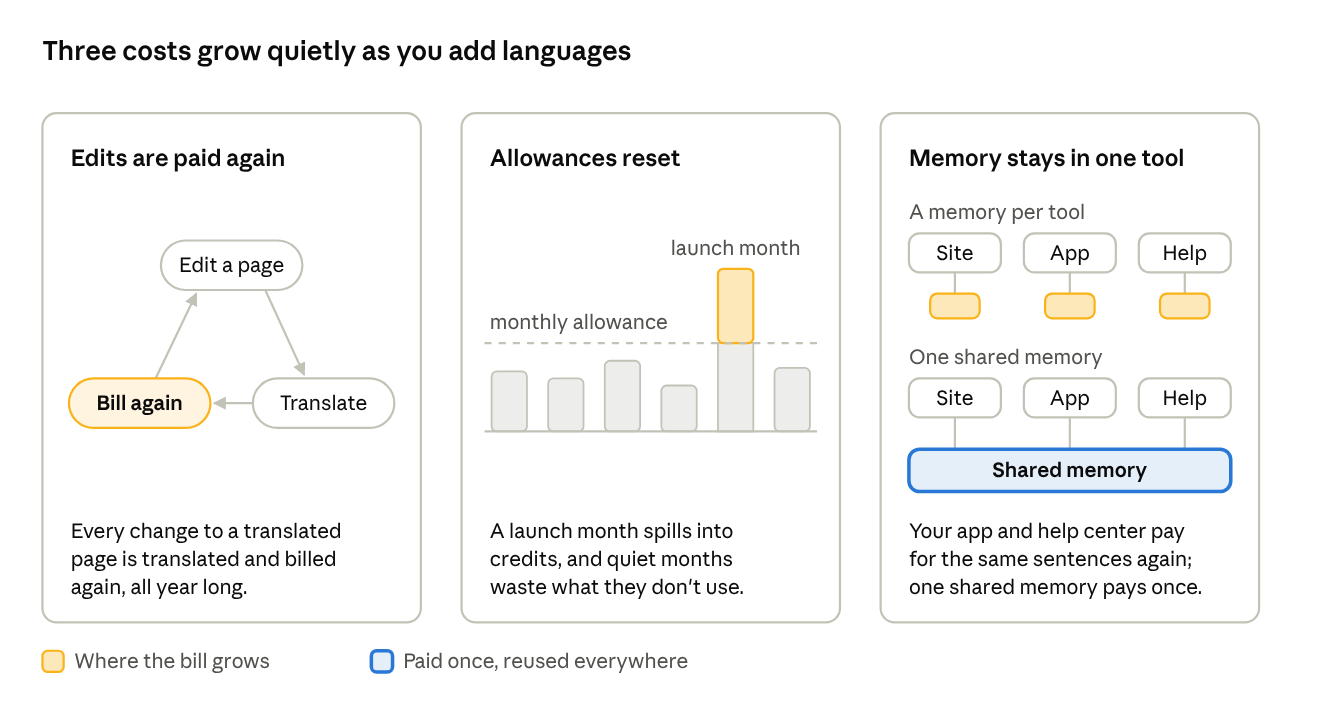
All three grow with every language you add.
- Edits are paid again. Every change to a translated page is translated again, so a busy site pays for the same page many times a year.
- Allowances reset. A launch month can blow through a monthly word allowance and spill into credits, while quiet months waste it.
- Translation memory stays inside one platform. A platform's memory covers that one site. If you also translate your app, help center or sales material, you pay to translate the same sentences again elsewhere, and your product names drift.
Platforms also struggle to fit an existing translation setup. Cursor said that with its CMS, "we actually had to hire contractors to help build a plugin system for the CMS to work with our localization tool."
When a person should still review: pages that sell, legal and pricing pages, regulated claims, and anything carrying your brand voice. AI alone is fine for long-tail blog posts, archives and support content. If you publish in Europe, know which pages were translated by AI alone: the EU AI Act's transparency rules began applying on August 2, 2026.
Running a Webflow site?
Webflow Localize alone, or with wxrks?
Compare features and yearly cost side by side, with a calculator for your languages and word volume, or see how the two work together.
Choose by scenario
Start from who edits your site and how many languages you run, not from the tool. Most companies fit one of four situations.
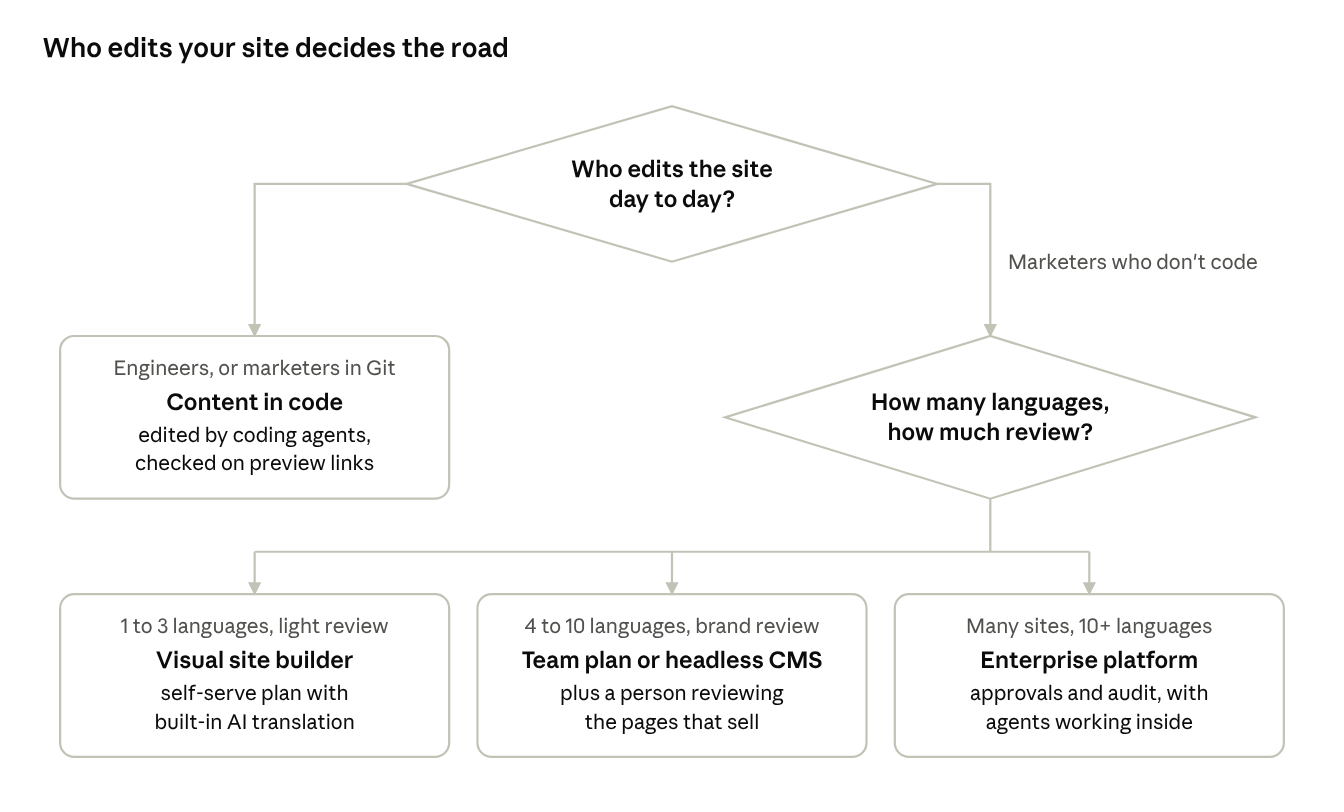
Read it top down: the first question is who edits, the second is how many languages you run and how much review they need.
The small company CEO: one marketer, no developer, one to three languages
Stay on a visual site builder such as Webflow or Framer. You get hosting, forms, search basics and a visual editor; Webflow's Premium plan is $25 a month per site on yearly billing. Built-in AI translation covers a small site: Webflow's Essential plan gives 10,000 AI words per language a month for $9 per language.
Use AI app builders for campaign pages and prototypes, not for the main site, unless someone can look after the code they produce. Watch for credits once you pass the allowance, and for features that only exist on the top plan.
The startup with a technical marketer
Consider content kept in code and edited by agents, as Cursor did. Pages live as files next to the product code; a marketer asks an agent for a change and checks a preview link before it goes live. Running costs are low: Cursor's move took three days and $260 of AI usage.
The real cost is people. Opine, which left Webflow in August 2026, said "the hardest part was helping the team get used to working with Git." Translation then happens during the build, so decide up front who reviews it. Walk away from this road if non-technical editors, legal or brand reviewers need to change pages every day.
The marketing director at a growing company: four to ten languages, brand and search matter
Keep a platform your team can edit, and add a review step for languages. That means a site builder's team plan, such as Webflow Team at $2,500 a month on an annual contract, or a headless CMS if you have developers.
Let AI translate the long tail. Send the pages that sell to a human reviewer, with one translation memory and glossary shared by the site, the product and the sales material. Check the plan first: glossaries and approvals often sit on enterprise tiers, and Webflow's custom glossary is Enterprise only.
The enterprise: many sites, more than ten languages, compliance
Buy governance, and let agents work inside it. Enterprise content platforms such as Contentful under Salesforce, Contentstack, Optimizely, Sanity and Webflow Enterprise sell approvals, audit logs, single sign-on and metered AI. Public reports put Webflow Enterprise contracts at about $40,000 to $50,000 a year to start, and Hygraph quotes $32,000 to $300,000.
Negotiate credit prices and overage before you sign, not after the first invoice. Keep translation in a system your reviewers, agencies and legal team already use and that connects to the platforms you use, so a future CMS switch never means redoing your languages.
Before you sign
The list price is no longer the bill. Ask every vendor these questions in writing, and keep the answers with the contract.
- ☐ What does one credit buy, in words translated or pages generated? Webflow, for one, does not publish its rate.
- ☐ What happens when credits run out mid-month: does work stop, go into overage, or top up automatically?
- ☐ Which features sit on the enterprise plan only: glossary, approvals, audit log, single sign-on, translation agents?
- ☐ Does letting AI agents in cost extra or use up credits? Webflow's ChatGPT app is free today but "may require AI credits in the future".
- ☐ Can an agent publish on its own, or does a person approve first? Who is accountable when it gets something wrong?
- ☐ Can we export all content and translations in a standard format, and what does leaving cost?
- ☐ How are AI-translated pages marked, and can we route key pages to a human reviewer?
- ☐ What can change at renewal: price, allowances, which features sit on which plan?
On translation, ask the same vendors:
- ☐ Can we choose the AI model for each task, and keep our quality when the vendor switches models?
- ☐ Does the AI build on our approved translations, glossary and style, or translate each text from scratch?
- ☐ When a page needs a person, can the system price the review and assign a linguist, or do we find and manage reviewers ourselves?
- ☐ Does the AI check its own work for meaning and terminology, and flag what a person should look at?
- ☐ Does one memory and glossary serve every channel we translate (site, app, help center, documents), on every plan?
- ☐ Which other platforms does it connect to: other CMSs, support tools, design files, code, AI assistants?
- ☐ How fast does the team ship? Ask for six months of release notes, and how long customer requests took to land.
What a marketing analyst should track. Agents and credits make costs move month to month, so measure the site like a channel:
| Metric | Why it matters |
|---|---|
| Cost per published page, per language | Platform, AI credits and review divided by pages shipped; the one number that compares any two roads |
| Credits used per month, and the trend | Usage creep shows up here before it shows up on an invoice |
| Days from draft to live | Agent workflows promise speed; check you got it |
| Share of pages live in every language | Pages missing in one language lose that market's search traffic |
| Fixes after publishing, per language | The simplest quality signal for AI-only translation |
| Organic traffic and leads per language | Tells you which languages pay for themselves |
Whatever you choose
Your translations travel with you
wxrks keeps one translation memory and glossary across your site, app, help center and documents, and connects to Webflow, Contentful, Optimizely, WordPress, Drupal and Git repositories.
Webflow · Contentful · Optimizely · WordPress · Drupal · All connectors →
Sources
Pages read between September 23 and September 30, 2026. Prices are list prices on those dates and change often.
Website builders
- Webflow: simplified plans and pricing, AI credits, automatic AI translation, Source, Webflow Localize
- Framer: AI credits, simpler plans and lower prices
- Wix: State of Websites
- Shadow Digital: Webflow Enterprise pricing explained
Content platforms and open-source CMS
- Salesforce to acquire Contentful
- Sanity: how AI credits work, You should never build a CMS, AI app builder connectors, loveholidays case study
- Contentstack pricing
- Storyblok pricing plans
- Hygraph pricing
- Prismic localization
- Builder.io pricing
- Strapi: removing the free Cloud plan
- Figma: Payload joins Figma
- Cloudflare: our blog now runs on EmDash
- Cloudflare acquires Astro (January 16, 2026)
- Astro: internationalization routing
AI app builders and coding agents
- Lovable: revenue, plans, security incident
- v0: introducing the new v0, pricing
- Replit: Design Mode, pricing, $9B valuation, database incident
- Bolt pricing
- Base44: pricing, Wix second-quarter 2026 results
- GitHub: Copilot plans, Spark
- Anthropic: Claude Code across professions
- Figma: 2026 AI report
Teams that left their CMS
- Lee Robinson, Cursor: Coding Agents & Complexity Budgets
- StackOne: rebuilding our marketing site with Claude Code
- Opine: we switched from Webflow to Claude
Market data and regulation
Side-by-side table
- TinaCMS: Forestry.io and TinaCMS, internationalization
- Cloudflare: Introducing EmDash
- Strapi: internationalization and AI translation
- Wix: Wix Multilingual
- Builder.io: localization
- Contentstack: localization without the translation tax
Homepages and go-to-market moves (read October 1, 2026)
- Homepages: Hygraph, Storyblok, Sanity, Payload, Prismic, Contentful, EmDash, Framer, Webflow, HubSpot, Optimizely, v0, Bolt, Replit, Lovable, and the other tools in the side-by-side table
- Webflow: Webflow Conf 2026 announcements, Source by Webflow
- Wix: Wix launches Symphony, Symphony pricing
- HubSpot: Fall 2026 Spotlight, pages in multiple languages, automatic translation, Content Hub
- Base44 adds Google Ads campaign management
Unlock the power of glocalization with our Translation Management System.
Unlock the power of
with our Translation Management System.