Is machine translation post-editing worth the extra cost?


Yes—machine translation post-editing is worth the extra cost when you need publishable, accurate content and the machine-generated draft reduces the work required to reach that standard. It is not worth paying to polish disposable text, or to repair a draft that takes more effort than translating from scratch. For your 2026 localization plan, compare the full workflow—including editing, review, and corrections—not just the initial translation step.
TL;DR
- Is machine translation post-editing worth the extra cost? Yes, when editing produces approved content with less total effort.
- Use light post-editing for comprehension; use full post-editing for content that must meet publication standards.
- Wxrks supports translation management, quality management, and cost tracking; qualified reviewers still decide whether content is ready.
- Compare post-editing with human translation using the same source, acceptance criteria, and review requirements.
Is machine translation post-editing worth the extra cost?
Pay for post-editing when the corrected output meets your requirements with less total effort than the alternative. Do not treat machine translation plus editing as an automatic saving. A fluent draft can still contain omissions, incorrect terminology, or a changed meaning.
Start with these 3 workflow options. Each serves a different purpose; none deserves a blanket recommendation across all your content.
Unedited machine translation
- Best for: Low-consequence comprehension where imperfect wording is acceptable
- Main advantage: Avoids a dedicated editing stage
- Main limitation: Leaves translation errors unchecked
- Decision rule: Use only when the intended use tolerates errors
Machine translation post-editing
- Best for: Content where a usable draft can be corrected to a defined standard
- Main advantage: Retains useful draft wording while correcting problems
- Main limitation: Requires source comparison and qualified judgment
- Decision rule: Use when the complete workflow reduces effort
Human translation from source
- Best for: Content where the machine draft is unsuitable or extensive adaptation is required
- Main advantage: Starts from the source without requiring repair of a machine draft
- Main limitation: Still needs a clear brief and appropriate review
- Decision rule: Use when drafting directly is the better route
The question is not whether an editor improves machine output. The question is whether that output gives the editor a useful starting point. For the distinction between drafting and professional responsibility, see whether machine translation can replace human translators entirely.
Why this matters
A translation job is not finished when the target-language text appears. It is finished when the text meets the requirements of its intended use. That includes meaning, terminology, readability, and any checks required before release.
If you compare raw machine output with reviewed human translation, you are comparing different deliverables. The apparent saving excludes the work needed to bring the draft to an equivalent standard.
For your 2026 evaluation, write down the acceptance criteria before discussing the workflow. An internal research note and a public help-center article do not necessarily need the same treatment. Neither does a slogan and a procedural instruction.
Match the review requirement to the consequence of an error. A slightly awkward internal sentence is different from an instruction that tells a customer to take the wrong action. Your workflow should reflect that distinction, not just the amount of text.
Light post-editing: prioritize meaning over polish
Light post-editing aims to make a machine-translated text understandable and correct enough for its specified purpose. It does not automatically include rewriting every awkward sentence into polished prose. Define that boundary in the brief.
Best for: internal reference material where readers need the meaning, but publication-quality style is unnecessary. Examples include background documents or working notes, provided the intended use allows this level of treatment.
The benefit is a narrower editing task. The limitation is that the result can remain stylistically uneven. If the reader expects natural, brand-aligned writing, light post-editing is the wrong acceptance standard.
A useful brief tells the editor which problems must be corrected: missing meaning, mistranslated terms, confusing sentences, and source-target inconsistencies. It also states which stylistic imperfections are acceptable.
Do not use the label as permission to leave consequential errors untouched. A text requiring specialist scrutiny does not become low-risk because you call the service light post-editing. Choose light post-editing only when the finished text's limitations fit its use.
Full post-editing: meet the publication brief
Full post-editing aims to bring machine output to the agreed quality standard for the finished translation. That can include accurate meaning, consistent terminology, natural phrasing, and the required tone. State these requirements explicitly rather than assuming everyone interprets full post-editing identically.
Best for: customer-facing content where the draft is useful but the final text must read clearly and withstand review. Product documentation and support articles are examples when the source and machine output suit this workflow.
The benefit is that editors can retain correct wording instead of rebuilding every sentence. The limitation is that apparently polished output still requires careful comparison with the source. Good grammar is not proof of correct meaning.
Keep 2 review stages distinct in your brief: language review and functional review. Language review checks the translation; functional review checks its use in the document, interface, or publishing environment. These are recommended responsibilities, not a mandatory staffing model.
Choose full post-editing when the machine draft helps you reach the publication standard—not when the label merely makes the workflow sound efficient.
Human translation: skip a draft that creates more work
Human translation is the better route when the machine draft obstructs the job. An editor who must repeatedly untangle incorrect meaning, rebuild sentence structure, or replace inappropriate wording is doing more than making small corrections.
Best for: content requiring substantial adaptation, or source material that produces an unsuitable machine draft. Creative messaging is one example; a technically complex passage with persistent mistranslations is another.
The benefit is freedom to build the target text directly around the source and brief. The limitation is that human translation does not remove the need for terminology guidance, context, or review. Changing the drafting method does not fix an unclear source.
Allow the linguist to reject a poor draft. A process that forces every segment through post-editing can preserve the wrong workflow simply because the project started that way.
For your 2026 workflow, make the switch an explicit decision rather than an exception that requires a long approval chain. Use human translation when repairing the draft is less useful than starting from the source.
Why post-editing effort varies
The same editing label can describe very different jobs. These factors determine what the editor actually needs to do:
- Source clarity: ambiguous instructions and inconsistent wording leave the translator resolving the source as well as correcting the target text. Fix source problems before treating them as translation problems.
- Draft quality: a useful draft preserves meaning and provides wording worth retaining. A poor draft creates repeated correction work, even when individual sentences sound fluent.
- Subject complexity: specialist material requires the editor to understand the concepts and distinguish acceptable terminology from plausible but incorrect substitutions.
- Available context: screenshots, surrounding paragraphs, and explanations of intended use help an editor interpret short or ambiguous strings. Without context, clarification becomes part of the job.
- Acceptance standard: comprehension, publication quality, and creative adaptation are different deliverables. A brief that leaves the standard undefined makes the scope difficult to control.
- Review scope: language approval, layout checks, and stakeholder changes add work beyond editing the initial draft. Include them when comparing workflows.
Resolve the brief before trying to reduce editing effort. Otherwise, you risk making the task smaller on paper while leaving the actual release requirements unchanged.
How do you decide whether post-editing pays off?
Use a matched comparison in your 2026 planning. You need evidence from your content and your acceptance criteria—not a general productivity claim applied to every language and document.
1. Define acceptance
Write a brief that specifies audience, purpose, terminology, tone, and release checks. Give the same brief to both workflows. If one route delivers publication-ready content while the other delivers a rough draft, the comparison cannot answer your question.
Name 1 approval owner for the evaluation. This is a process recommendation: someone needs authority to decide whether each result satisfies the brief and whether further corrections are required.
2. Select content
Choose material that reflects the work you intend to send through the process. Include difficult passages, not only clean prose that makes the machine draft look good. Keep the source version fixed so differences do not come from changing requirements.
Assess different content types separately. A favorable result for support articles does not establish the same result for marketing copy or legal material.
3. Compare workflows
Evaluate post-editing and human translation against the same brief. Have qualified reviewers assess the finished outputs against that brief. Preserve the reasons for rejection or revision; those reasons explain where the work went.
Ask the post-editor whether the machine draft helped or hindered. Pair that assessment with the recorded work rather than treating an impression as a measured result.
4. Record effort
Record editing, review, clarification, project coordination, and corrections after review. Keep categories consistent across both routes. If a workflow requires an additional approval step, include it rather than leaving it outside the comparison.
Also distinguish source changes from translation corrections. Rewriting the source halfway through a job creates new work, but it does not demonstrate that the original translation method failed.
5. Choose workflow
Select the route that meets the standard with the better overall result for that content type. If the results differ by language or subject, retain separate decisions. You do not need a single policy for every job.
Document when editors should stop repairing a draft and request a different approach. A clear escalation rule protects both quality and the time spent achieving it.
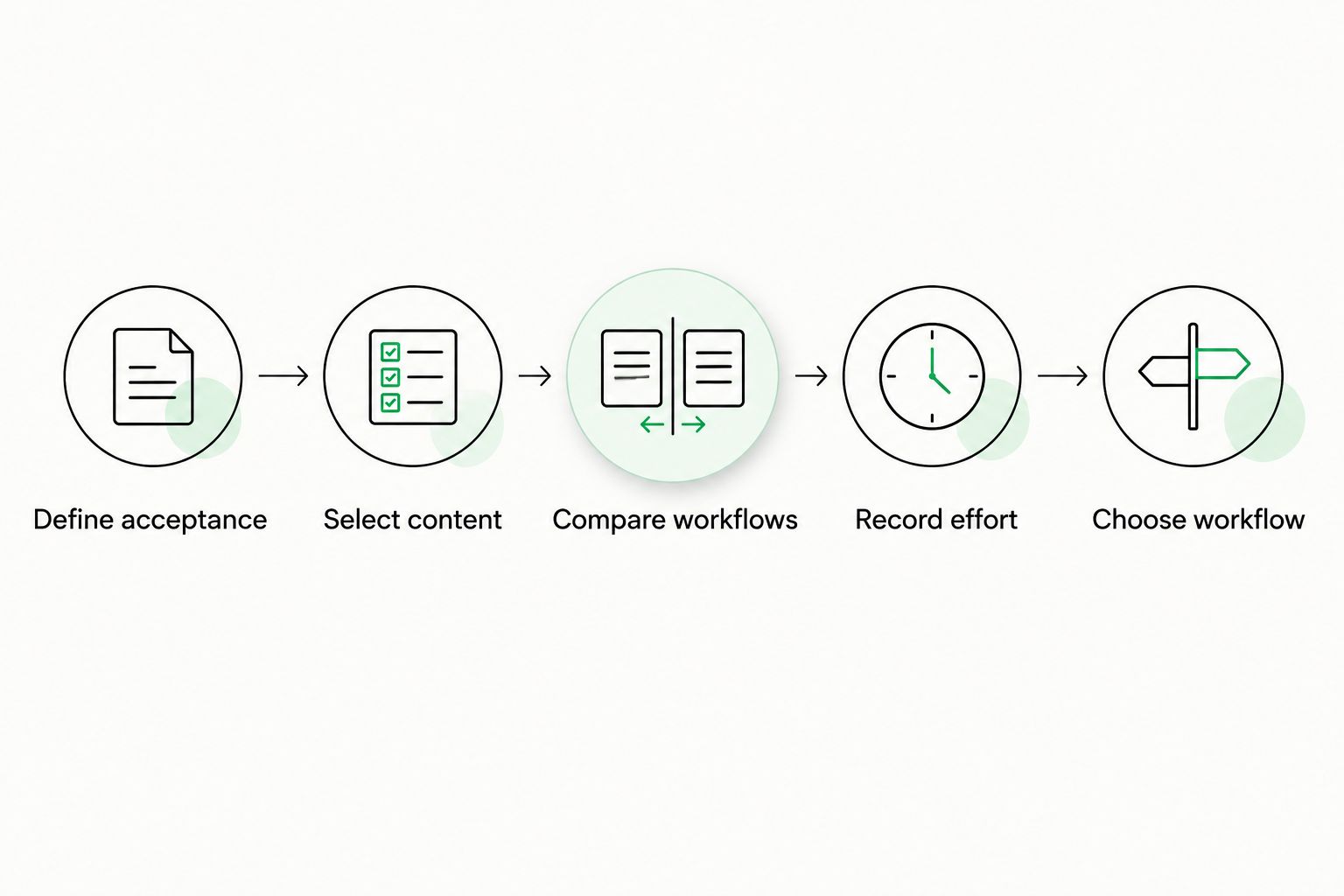
Compare complete workflows, not a machine draft against an approved translation.
A successful evaluation gives you a routing decision, not just an editing result. Repeat the assessment when the source material, quality requirements, or translation setup changes enough to make the previous comparison unsuitable.
Does fluent machine translation still need post-editing?
Fluent machine translation still needs checking when correctness matters. Natural phrasing can coexist with missing qualifications, incorrect terminology, or a reversed instruction. Readability and fidelity are separate requirements.
Ask the reviewer to compare meaning against the source, not merely smooth the target text. An editor who sees only the translation cannot reliably detect information that disappeared from the original.
Should every machine-translated document get full post-editing?
Full post-editing belongs where the intended use requires its quality standard. Apply a lighter workflow only when its limitations are acceptable; use human translation when the draft is unsuitable. Assign treatment by content purpose rather than by file type alone.
Keep that routing decision visible to project stakeholders. Otherwise, a text prepared for internal comprehension can be reused publicly without the review its new purpose requires.
Where a translation management system fits
Wxrks is best for teams that need translation management, quality management, and cost tracking in one workflow. Its translation management system supports translators, developers, enterprises, and translation agencies managing localization work.
The benefit is workflow support across those tasks. The boundary is linguistic judgment: a translation management system does not, by itself, establish that a sentence preserves the source meaning or that a particular review standard is appropriate.
Use Wxrks to support the process; give qualified people responsibility for the acceptance decision. Keep the distinction between managing quality checks and approving the translation clear.
Your approved edits also deserve a reuse policy. The guide to updating translation memory when edits are approved addresses that next workflow question. Save corrections for reuse only after approval, rather than treating every draft change as trusted language.
FAQ
Is machine translation post-editing worth the extra cost in 2026?
Yes, when post-editing reaches your required quality standard with less total effort than the alternative. Compare editing, review, coordination, and corrections—not just the initial draft.
What's the difference between light and full post-editing?
Light post-editing prioritizes understandable, correct meaning for a defined use; full post-editing targets the agreed finished-translation standard. Specify the requirements in the brief rather than relying on the labels alone.
Is post-editing always cheaper than human translation?
No, post-editing is not automatically the lower-effort workflow. A poor machine draft can require extensive repair, so compare complete workflows using the same acceptance criteria.
Can I publish machine translation without an editor?
Do not publish unchecked machine translation when errors would violate your content requirements. Fluent wording does not establish accuracy, terminology consistency, or suitability for the audience.
Who should post-edit specialist content?
Use a qualified linguist with the subject knowledge needed to evaluate the content. Provide the source text, terminology guidance, and context needed to check meaning.
Does Wxrks replace human translation review?
Wxrks supports translation management, quality management, and cost tracking; human reviewers remain responsible for linguistic acceptance. Software support and approval judgment serve different roles.
How do I measure whether post-editing is worthwhile?
Compare post-editing and human translation on the same content with the same brief and approval criteria. Record the work required through acceptance, including review and corrections.
One last thing
The most useful correction can be a source correction. If an instruction is ambiguous before translation, polishing its translated version does not resolve the underlying uncertainty. Clarify the source and then recheck the target text.
For your next 2026 project, require editors to separate source problems from translation problems in their feedback. That gives you a practical decision: improve the original, change the drafting route, or strengthen the review—not simply request more polishing.
Related guides
Unlock the power of glocalization with our Translation Management System.
Unlock the power of
with our Translation Management System.