Can machine translation replace human translators entirely?


No, machine translation cannot replace human translators entirely in 2026. It can produce drafts and handle selected low-risk translation tasks, but it does not remove the need for human judgment about meaning, context, audience, and consequences. Fluent wording is not proof that a translation is accurate or suitable for publication.
TL;DR
- Can machine translation replace human translators entirely? No: generating text does not replace judging its meaning or consequences.
- Wxrks supports translation management; software does not eliminate the need for human quality decisions.
- Machine translation with post-editing suits workflows where translators can verify meaning and correct terminology.
- Use translation memory and glossaries to support consistency, not to excuse unreviewed publication.
Can machine translation replace human translators entirely?
Machine translation can replace some translation tasks, not every responsibility a human translator carries. The distinction is between producing target-language text and accepting that text as correct for its intended use. Your review requirements should follow the consequences of an error, not how polished the output looks.
Support content illustrates that distinction. A reader trying to understand a routine message has different needs from a customer following account-recovery instructions. The guide to machine translation software for support teams addresses that specific workflow.
Unreviewed machine translation
- Best for: Low-risk internal gist reading
- Main advantage: Produces text without a separate human drafting step
- Main limitation: Errors can remain undetected
- Recommendation: Keep it away from consequential publication
Machine translation with human post-editing
- Best for: Content with clear requirements and an accountable reviewer
- Main advantage: Gives translators a draft to assess and revise
- Main limitation: Poor drafts can require extensive correction
- Recommendation: Test it against your actual content
Human-led translation
- Best for: Sensitive, ambiguous, or voice-dependent content
- Main advantage: Makes interpretation and audience choices explicit
- Main limitation: Requires skilled human effort
- Recommendation: Use it when judgment drives quality
These are workflow choices, not a ranking of translation quality. A human-led process still needs checks. A machine-assisted process still needs someone who understands both the source and the intended result.
Why this matters
In 2026, the practical question is not whether software can generate convincing sentences. It is whether you can trust those sentences for the job they must perform. A translation can read naturally while reversing a condition, losing a qualification, or choosing the wrong technical meaning.
That matters because your reader usually sees only the translated version. They cannot compare it with the source, identify missing context, or distinguish a deliberate wording choice from an error. Your publication process must do that work before the reader depends on the text.
Automate production where it helps; keep responsibility for acceptance explicit. Removing repetitive work is useful. Removing the person responsible for deciding whether the work is correct is a different decision.
When is unreviewed machine translation appropriate?
Unreviewed machine translation is appropriate for selected tasks where an imperfect understanding is acceptable and the reader knows the text is machine-generated. Internal gist reading is the clearest example: you want to understand the broad subject, not publish authoritative wording.
A colleague scanning an incoming message can use a machine translation to decide whether a qualified translator needs to examine it. That is a triage task. It becomes a different task when the translated message determines a contractual obligation, a medical decision, or access to a service.
Best for: low-risk orientation, not final wording. The advantage is a direct path from source text to an initial understanding. The disadvantage is that you have no bilingual review to catch a plausible but incorrect interpretation.
Before accepting unreviewed output, ask 3 questions:
- Can the reader act safely if a detail is wrong?
- Does the reader know the translation has not been checked?
- Is there a clear route to human review when the meaning matters?
Treat these as decision questions, not a quality score. If the answer reveals a consequential risk, change the workflow rather than adding a disclaimer and publishing anyway.
When should a human post-edit machine translation?
Human post-editing fits content where you can define a usable result and give the reviewer enough context to verify it. The reviewer checks the draft against the source, corrects errors, and brings terminology and style into line with the brief.
The benefit is not guaranteed time savings. It is an alternative starting point. Whether that starting point helps depends on the draft and the work required to make it acceptable.
For your 2026 evaluation, compare 2 versions of the same representative passage: a machine draft after post-editing and a human-led translation. Judge both against the same requirements. Do not assume the machine-assisted version wins because the first draft appeared sooner.
Best for: repeatable content with clear acceptance criteria. Product documentation and help content can be candidates when reviewers have the subject knowledge and context needed to verify instructions. Sensitive passages within those documents still deserve separate treatment.
The limitation is anchoring your review to a flawed draft. A reviewer who merely smooths the language can preserve an incorrect interpretation. Post-editing must include source comparison, not just target-language proofreading.
Set the brief before assigning the work:
- Specify whether the text supports internal understanding or publication.
- Identify terminology that must remain consistent.
- Explain the audience and the action the reader should take.
- State which ambiguities require questions rather than guesses.
- Define who approves the final version.
When should human translators lead the work?
Human translators should lead when interpretation, reader impact, or subject expertise determines whether the translation succeeds. That includes ambiguous source text, sensitive instructions, and writing whose tone carries part of the message.
Best for: work where a technically plausible sentence is not enough. A translator can question the source, discuss competing interpretations, and make a deliberate choice for the audience. The process gives those decisions an accountable owner.
Human-led does not mean software-free. Translators can use translation memory, glossaries, automated checks, or machine suggestions while remaining responsible for the wording. The important distinction is who controls the decision, not whether a tool appears anywhere in the workflow.
Human work also has limitations. A translator without the right subject knowledge can misunderstand specialized content. A translator without product context can choose the wrong meaning for an interface label. Human involvement is necessary for some decisions, but involvement alone is not a quality guarantee.
Give translators access to the information they need: source references, intended audience, product behavior, approved terminology, and a person who can answer questions. Review their work against the same acceptance criteria you would apply to a machine-assisted translation.
Why the need for human review varies
The amount and type of review should follow the content. Do not apply a single automation rule to every document, language, and destination in your 2026 localization program.
- Consequences of error. A mistranslated internal note and a mistranslated safety instruction require different acceptance decisions.
- Source ambiguity. Incomplete sentences, unclear references, and unexplained abbreviations leave interpretation work unresolved.
- Subject terminology. A familiar word can carry a specialized meaning that requires domain knowledge.
- Audience and tone. The same literal meaning can sound reassuring, dismissive, formal, or inappropriate in context.
- Available context. Screenshots, surrounding paragraphs, and product explanations help reviewers resolve meaning.
- Language-specific performance. Evaluate the actual language pair and content rather than treating one successful example as proof for everything.
These factors interact. A short sentence is not automatically low risk, and a long document is not automatically unsuitable for machine assistance. Decide at the level where the meaning and consequences become clear.
How do you decide what to automate?
Build your 2026 workflow around acceptance, not around a blanket promise to replace translators. The following sequence separates draft production from the decision to publish.
1. Classify content
Separate internal gist reading from customer-facing publication. Flag material where errors affect safety, obligations, access, or essential instructions. Do this before choosing a translation route.
Keep mixed-risk documents mixed in your assessment. A routine introductory paragraph does not make the warning below it routine. Route sensitive passages according to their own requirements.
2. Provide context
Give the translator or reviewer the audience, purpose, terminology, and surrounding material. For interface text, explain where the string appears and what action it controls. A word list alone often leaves essential meaning unresolved.
Fix unclear source wording when possible. Asking a translator to resolve an ambiguity that the author can clarify adds avoidable uncertainty to the workflow.
3. Choose a route
Select unreviewed output, machine translation with post-editing, or human-led translation according to the content classification. Document why the selected route is acceptable. The decision should survive scrutiny without relying on claims that the output sounds natural.
Use representative samples when evaluating a route. Include the difficult terminology and awkward source passages your team actually handles, not only clean examples chosen for a demonstration.
4. Review meaning
Check the translation against the source and intended use. Review omissions, additions, conditions, terminology, and instructions. Then assess readability and tone.
Automated checks support this work but do not settle every question of meaning. Passing a formatting or terminology check is not the same as confirming that the reader receives the correct message.
5. Approve publication
Assign 1 accountable approval owner for each publication decision. That owner needs a clear basis for acceptance and a way to resolve questions. Ownership should not disappear because several people or systems touched the file.
Preserve approved language for appropriate reuse, while keeping context visible. A previously accepted sentence still needs reassessment when its meaning or intended use changes.
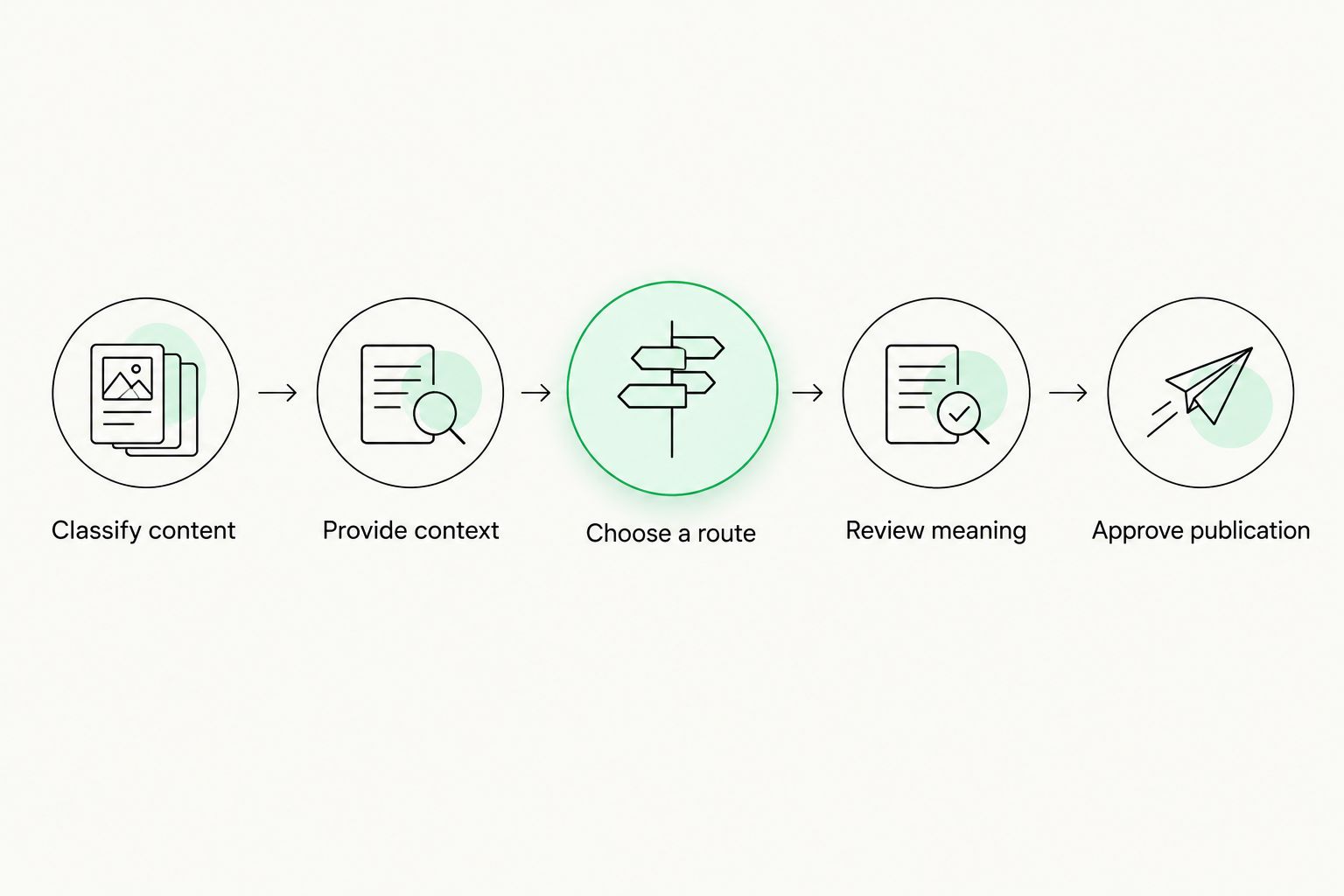
Choose the translation route before drafting, and make approval a separate decision.
Where does a translation management system fit?
A translation management system organizes the work around translation: workflows, reusable language, quality management, and cost tracking. It does not make every linguistic decision correct simply by putting the work in one place.
Wxrks is best for translators, developers, enterprises, and translation agencies managing localization workflows. Wxrks provides translation management software for workflow automation, translation memory, quality management, and cost tracking. Those functions address coordination around translation rather than remove the need to judge the result.
The benefit of a managed workflow is a defined process for the work. The limitation is equally clear: you still need suitable source content, review criteria, and people responsible for acceptance. Select software for the workflow you need, not as proof that human review is unnecessary.
Will translators still be needed in 2026?
Human translators are still needed in 2026 for interpretation, post-editing, terminology decisions, and audience-sensitive writing. Machine-generated drafts change how some assignments begin; they do not eliminate those responsibilities.
Evaluate the role by the decisions it carries. If the assignment requires resolving ambiguity or accepting consequential wording, someone qualified must do that work.
Is post-editing the same as proofreading?
Post-editing is not the same as proofreading. Post-editing requires checking machine-generated text against the source, while proofreading typically focuses on errors in the target-language text.
A fluent sentence can survive proofreading and still express the wrong meaning. Specify bilingual verification when accuracy is the requirement.
Does translation memory make human review unnecessary?
Translation memory does not make human review unnecessary. It stores previous translations for reuse, but previous approval does not prove that a segment fits a new context.
Review reused wording when the surrounding meaning, terminology, or intended action changes. Consistency helps only when the repeated wording is appropriate.
FAQ
Can machine translation replace human translators entirely in 2026?
No, machine translation cannot replace human translators entirely in 2026. It can handle selected tasks, but interpretation, contextual review, and acceptance of consequential wording still require human judgment.
What's the best use of machine translation without human review?
Low-risk internal gist reading is the best fit for unreviewed machine translation. The reader should know the output is unchecked and seek qualified review before relying on consequential details.
Is human translation always better than machine translation?
Human translation is not automatically better in every instance. Quality depends on subject knowledge, context, the brief, and review; neither a human origin nor a fluent machine draft proves accuracy.
Can I publish machine-translated website copy without checking it?
Do not treat machine-generated website copy as publication-ready solely because it reads naturally. Check meaning, terminology, instructions, and audience suitability before your customers rely on it.
How do I know whether post-editing is worthwhile?
Compare a post-edited machine draft with human-led translation using representative content and the same acceptance criteria. Assess the correction work and final quality rather than only the speed of draft generation.
Can a translation management system replace a translator?
A translation management system does not replace a translator's linguistic judgment. Wxrks supports localization workflows, translation memory, quality management, and cost tracking, while your team remains responsible for acceptance.
Do I need a translator if I already have a glossary?
A glossary does not replace a translator when the task requires interpretation or contextual judgment. Approved terms support consistency, but they do not settle sentence meaning, tone, or suitability for the audience.
One last thing
Your shortest strings can deserve your closest review. An interface label gives the translator little context, yet it can control a consequential action. Before automating short text, provide the screen, explain the action, and identify who approves the wording.
That is a better replacement strategy: replace avoidable manual handling, not the judgment your reader depends on.
Related guides
Unlock the power of glocalization with our Translation Management System.
Unlock the power of
with our Translation Management System.