How to speed up time-to-market for multilingual launches


To speed up time-to-market for multilingual launches, start localization before the source release is finished, send only changed content for translation, and give reviewers the context and authority to approve it. Automate repeatable handoffs, reuse approved translations, and test translated content in the product before release. For your 2026 launch plan, remove waiting and rework—not the checks that protect meaning and functionality.
TL;DR
- How to speed up time-to-market for multilingual launches: translate stable content early and review changes continuously.
- Wxrks suits teams seeking translation management software for workflow automation, translation memory, quality management, and cost tracking.
- Reuse approved translations, but check context before accepting matches.
- Release each locale against explicit language, functional, and approval gates.
How to speed up time-to-market for multilingual launches
Move localization into the release workflow instead of treating it as the final task. Translation, review, and testing need defined inputs and owners; otherwise, finishing the source content simply starts another queue.
Use these steps to build a repeatable process. The software localization guide for product teams provides related guidance for organizing the work around product delivery.
1. Define scope
List the user journeys, languages, and content required for launch. Separate release-critical material from content that can follow without breaking the promised experience.
For example, account creation, purchase instructions, and error messages belong in the launch discussion—not just the main marketing page. Assign 1 accountable owner per locale to resolve scope and approval decisions; contributors can be shared, but final responsibility should be explicit.
2. Prepare context
Give translators stable string identifiers, screenshots, terminology, and an explanation of where each message appears. Explain placeholders and formatting constraints before translation starts.
A short label such as “Open” needs context: it can describe a status or instruct someone to perform an action. Resolving that ambiguity before translation avoids sending the same question through separate language review chains.
3. Translate changes
Send stable content into localization while development continues elsewhere. When the source changes, identify the affected strings and return those changes to the workflow rather than restarting the entire package.
Reuse approved translation memory matches where their meaning and context still apply. A matching sentence is a candidate for reuse, not proof that its translation fits every screen.
4. Review in context
Have language reviewers assess the translated experience, not just a column of text. Screenshots and test builds reveal issues that isolated segments conceal, including clipped labels and instructions attached to the wrong action.
Group feedback into language corrections, source problems, and implementation defects. Assign each issue to the person who can resolve it instead of asking translators to diagnose every failure.
5. Gate release
Use 3 release gates: language approval, functional validation, and release-owner approval. Define the evidence required for each gate before the deadline approaches.
Keep the approval attached to the version that was reviewed. A source change after sign-off needs an impact check; otherwise, the released content and the approved content are no longer the same deliverable.
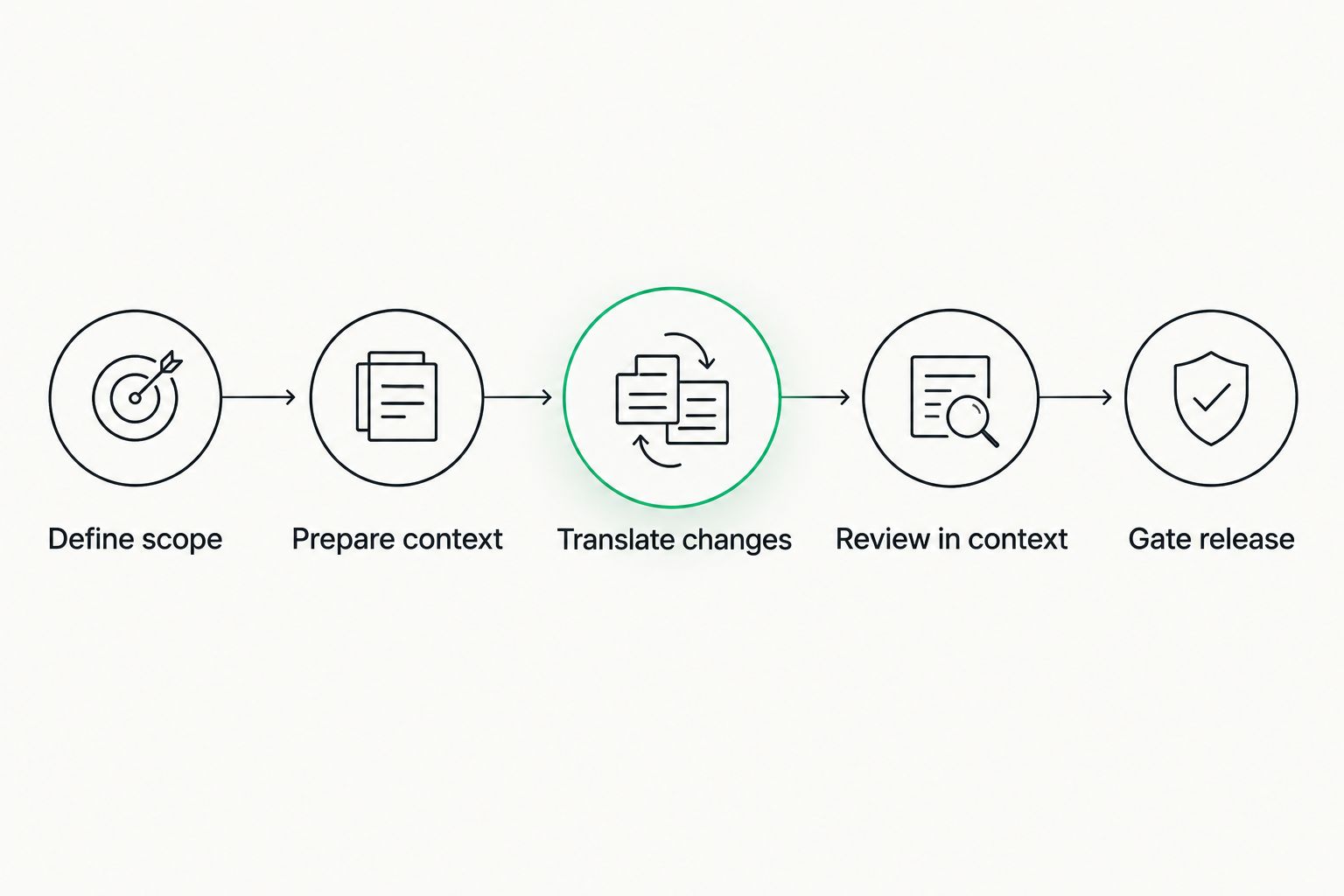
Translation starts before release, while approval stays tied to the content version being shipped.
Why this matters
A launch deadline covers more than translation production. It also includes decisions about terminology, unanswered context questions, review queues, content imports, and checks inside the finished experience.
If your 2026 schedule records only the date translation begins and ends, those dependencies stay hidden. The practical question is not simply whether translators can work faster; it is which unresolved dependency prevents the next stage from starting.
Protect review time by making the work ready for review. A reviewer should receive the correct version, supporting context, and a clear decision—not an invitation to reconstruct the project.
Choose continuous localization or a batch workflow
Continuous localization fits content that changes alongside regular product releases. A batch workflow fits a defined package that needs coordinated review and publication.
Neither approach removes the need for ownership or testing. Choose the workflow that matches how your source content changes, then account for its main limitation.
Continuous localization
- Best for: Products with recurring string changes
- Practical advantage: Moves stable changes through translation before the release deadline
- Main limitation: Requires change tracking and disciplined approval handling
Batch localization
- Best for: Defined campaigns or coordinated content packages
- Practical advantage: Gives reviewers a bounded scope and shared approval point
- Main limitation: Late source edits can reopen the package
Continuous localization: keep the queue release-aware
Send content when it is stable enough to translate, rather than waiting for every feature to finish. Mark which changes belong to the upcoming release so reviewers can distinguish urgent work from future scope.
The drawback is coordination. Frequent updates create confusion when string versions, review status, and release assignments are unclear. Keep those records connected before increasing the frequency of handoffs.
Batch localization: protect the approved source
Establish an agreed source version and a clear cutoff for changes. Collect review feedback in a shared record so conflicting edits do not travel through separate files or messages.
The drawback is sensitivity to late changes. If a source correction arrives after translation, identify the affected content and approvals rather than assuming the original sign-off still applies.
Why multilingual launch timelines vary
Build your 2026 schedule around the work required, not a universal duration. These factors change the tasks and dependencies your launch must cover:
- Source stability: Changing source copy creates translation and review work after the original assignment.
- Content context: Ambiguous labels and undocumented placeholders require clarification before a translator can make a reliable decision.
- Language requirements: Text direction, grammatical variation, and local formatting affect implementation and testing.
- Content risk: Legal, safety, or contractual language needs the relevant specialist approval before publication.
- Review ownership: Unclear decision rights leave corrections waiting for agreement rather than completion.
- Release coupling: A shared launch date makes every required locale part of the release decision.
Treat these as planning inputs. Adding languages changes the scope, but the language count alone does not describe source readiness, review requirements, or technical dependencies.
Use automation without removing accountability
Automate repeatable transfers and checks, while keeping editorial and release decisions assigned to people. A successful transfer tells you that content moved; it does not tell you that the translation expresses the intended meaning.
Wxrks is best for teams seeking translation management software that brings workflow automation, translation memory, quality management, and cost tracking together. Those capabilities support a coordinated process, but they do not supply missing source context or decide whether a release is ready.
For a 2026 platform evaluation, use a representative content change from your own workflow. Follow it from source update through translation, correction, approval, and delivery, then check where your team still needs to intervene.
Evaluate these decisions explicitly:
- Which source changes should create translation work?
- Which approved translations are eligible for reuse?
- Who resolves terminology disagreements?
- What happens when the source changes after approval?
- Who can stop publication when a release gate fails?
Do not infer integration behavior from a feature label. Confirm the workflow your team needs before making it part of the launch dependency chain.
Measure waiting separately from translation work
Record 2 timestamps per stage: when work becomes ready and when work finishes. Where possible, also record when someone begins working, so you can distinguish queue time from active work.
For example, a review stage that waits for an owner requires a different fix from a review stage repeatedly correcting misunderstood terminology. Increasing translation capacity does not resolve an approval queue.
Use the following measurements in your 2026 release review:
Source-ready to locale-ready elapsed time
- What it tells you: How long the complete localization path takes
- Decision it supports: Whether localization fits the release window
Time waiting for assignment or approval
- What it tells you: Where work stops without active processing
- Decision it supports: Which ownership or scheduling problem to address
Content reopened after approval
- What it tells you: Where completed work returns to the queue
- Decision it supports: Whether source control or review instructions need correction
Defects found in the release build
- What it tells you: What earlier checks failed to catch
- Decision it supports: Which validation step needs adjustment
Compare similar releases before judging a change. A release containing new workflows and specialist review is not equivalent to a small wording update, even if both reach the same languages.
For a closer look at acceptance criteria, use the guide to measuring translation quality accurately. Speed needs a clear definition of acceptable output, or the team simply moves unfinished work downstream.
How do you prevent late source changes from delaying launch?
Track source versions and assess each late change for translation impact before publication. Return affected strings to translation and review while preserving valid approvals for unchanged content.
Give the release owner a clear choice: include the correction with its required checks, or defer it when the release requirements allow that decision. Do not silently replace approved source content and leave its translations untouched.
Should every language launch at the same time?
Launch every required language together when your release commitment demands it. Otherwise, assess locale readiness separately and publish only where the complete promised journey has passed its gates.
A phased launch still needs explicit boundaries. Tell internal teams which locales and content are included so a partially localized experience is not mistaken for a finished release.
Can machine translation remove the review stage?
Machine translation does not establish that content is ready to publish. Assign review according to the consequences of an error and the checks required for that content.
Use terminology, context, and human judgment to assess meaning. Automated checks can flag defined problems, but passing those checks is not the same decision as approving language for release.
FAQ
What's the fastest way to launch a product in multiple languages?
Start localization on stable content before the source release is complete, then process changes without restarting the full package. Keep language approval and functional testing inside the release workflow.
How early should localization start before launch?
Start when content has enough stability and context for meaningful translation. Do not wait for the whole release to finish if individual user journeys are already ready.
Is continuous localization better than translating everything at the end?
Continuous localization fits products with recurring changes because translation can progress alongside development. It also requires reliable version tracking and clear rules for reopening approvals.
Can translation memory speed up a multilingual launch?
Translation memory supports reuse of approved translations instead of translating repeated content from scratch. Check whether each match still fits the current meaning, terminology, and interface context.
How many approval checks should a multilingual release have?
Use 3 release gates: language approval, functional validation, and release-owner approval. Define the evidence for each gate and connect approval to the version being released.
What should a team evaluate in Wxrks for multilingual launches?
Evaluate how Wxrks translation management software fits your workflow automation, translation memory, quality management, and cost-tracking requirements. Test a representative content change through correction and approval before making the platform part of your release plan.
How do you know whether localization is getting faster?
Compare source-ready to locale-ready elapsed time across similar releases, and separate waiting from active work. Check reopened content and release-build defects so a shorter schedule does not hide unfinished work.
One last thing
A translation can be correct while the localized experience is broken. A label can express the intended meaning yet be clipped, disconnected from its control, or displayed beside untranslated instructions.
Before signing off, complete a critical user journey in each required locale using the release build. That final check connects language approval to what your customer actually receives.
Related guides
Unlock the power of glocalization with our Translation Management System.
Unlock the power of
with our Translation Management System.