How to measure translation quality accurately


To measure translation quality accurately, compare the translation with its source and intended use, classify errors consistently, and report their severity against a defined review scope. Combine bilingual review, automated checks, and in-context testing; a fluent translation can still change meaning or fail inside your product. Use the same rubric and sampling rules whenever you compare results.
TL;DR
- How to measure translation quality accurately: use bilingual review, severity rules, and consistent review scope.
- Wxrks suits teams managing translation workflows, quality management, and cost tracking together.
- Compare error rates only when language direction, content type, review scope, and scoring rules match.
- Treat release-blocking errors separately; an average score must not hide a dangerous mistranslation.
How do you measure translation quality accurately?
Define what counts as an error before you calculate a score. Then assess meaning, terminology, readability, locale conventions, and the translated content in its actual setting. Record each finding against the source version you reviewed.
For teams managing this process in a translation management system, Wxrks supports translation workflows, translation memory, quality management, and cost tracking. The measurement rules still need to come from your content requirements.
Use this sequence for your 2026 quality baseline:
- Define acceptance. State who will use the translation, what they need to do, and which failures prevent release.
- Select the scope. Identify the language direction, content type, source version, and material included in review.
- Review meaning. Have a qualified bilingual reviewer compare the source and target with the relevant context.
- Classify findings. Assign an error category and severity, supported by a specific explanation.
- Check function. Test the translated content where users will encounter it, not only inside a translation editor.
- Resolve findings. Confirm corrections, settle disputed classifications, and record the release decision.
This produces more useful evidence than a single satisfaction rating. You can see what failed, how serious it was, and whether the correction actually resolved it.
Why this matters
Translation quality is not the same as grammatical polish. A sentence can read naturally while reversing a condition, dropping an exception, or naming the wrong product action.
The reverse also matters. A reviewer can prefer different wording without identifying an actual defect. If you count every preference as an error, your score measures reviewer taste alongside translation quality.
For a useful 2026 reporting baseline, separate objective failures from optional improvements. Your dashboard should distinguish content that misleads users from content that simply has another acceptable phrasing.
Measure fitness for use, not resemblance to a reviewer's preferred wording. That distinction makes corrective action clearer and supplier comparisons fairer.
Define the rubric before reviewing
Use a written rubric that explains each category, its boundaries, and the evidence needed to apply it. The Multidimensional Quality Metrics framework, commonly called MQM, provides an established vocabulary for organizing translation errors; your project still needs explicit acceptance rules.
Keep the working rubric readable. A reviewer should be able to choose a category without guessing which overlapping label the project manager expects.
Accuracy
- What you assess: Whether the target preserves the source meaning
- Evidence to record: The omitted, added, or changed meaning
Terminology
- What you assess: Whether required terms are used correctly
- Evidence to record: The applicable glossary entry or approved term
Fluency
- What you assess: Whether the target follows the language's grammar and usage
- Evidence to record: The specific linguistic defect
Style
- What you assess: Whether the target follows documented audience and voice requirements
- Evidence to record: The relevant instruction, not personal preference
Locale conventions
- What you assess: Whether dates, units, punctuation, and other conventions fit the locale
- Evidence to record: The convention and affected text
Functional quality
- What you assess: Whether translated content works in context
- Evidence to record: The broken interaction, display, or content behavior
Do not count the same defect repeatedly under different labels. A wrong glossary term that also changes meaning needs a consistent classification rule, not duplicate penalties chosen after review.
Treat source problems separately, too. If an ambiguous source prevents a reliable translation, record the ambiguity and request clarification rather than silently assigning blame to the translator.
Choose severity by consequence
Severity describes the effect of an error, not how much the reviewer dislikes it. Write definitions that connect findings to user understanding, task completion, and documented release requirements.
A practical rubric can distinguish:
- Minor: A local defect that does not materially change meaning or prevent the intended task.
- Major: A defect that changes important meaning, causes substantial confusion, or prevents the intended task.
- Critical: A defect with unacceptable consequences under the project's safety, legal, or operational requirements.
These are working definitions, not universal thresholds. Decide how they apply to your content before review begins.
For example, inconsistent punctuation and an incorrect instruction should not receive the same treatment merely because each occupies a single segment. Explain the consequence in the finding so another reviewer can inspect the judgment.
A release-blocking error stays release-blocking even when the rest of the translation reads well. Record that decision separately from any aggregate score.
Combine review methods instead of choosing a winner
Different checks answer different questions. Automated checks inspect defined patterns; bilingual review assesses meaning; in-context testing examines the translated experience.
Automated checks
- Best for: Repeatable checks against explicit rules
- Strength: Flags configured issues such as missing placeholders or inconsistent terminology
- Limitation: Does not establish that the whole translation conveys the right meaning
Bilingual review
- Best for: Meaning, terminology, and language quality
- Strength: Compares the source and target with linguistic judgment
- Limitation: Requires reviewer calibration and access to context
In-context testing
- Best for: Interfaces, layouts, and user tasks
- Strength: Reveals problems that isolated segments do not show
- Limitation: Does not replace a full source-to-target assessment
User feedback
- Best for: Finding friction after real use
- Strength: Connects translated content with actual user problems
- Limitation: Does not provide a controlled or complete quality assessment
Run automated checks before linguistic review so reviewers can focus on unresolved meaning and language issues. Then validate the translated experience before release when the content has functional or visual dependencies.
For a closer look at the automated layer, read about catching translation errors early with quality management tools.
Use this distinction when selecting software in 2026: a tool's ability to flag an issue is different from evidence that the translation is acceptable.
Build a review sample you can compare
A sample supports conclusions about the material it represents. Reviewing only short, familiar strings does not establish the quality of long instructions or specialized content elsewhere in the delivery.
Define the review population first. Then select material across the relevant content types, risk levels, and workflow stages. Keep newly translated content distinguishable from reused translations when you need to understand where errors originate.
For routine monitoring, use a documented selection method rather than letting reviewers choose whichever passages look easiest. Add targeted review for content whose failure has serious consequences, and report that targeted review separately.
Record the boundaries of the exercise:
- Source and target language, including locale.
- Content type and intended audience.
- Source version and translation version.
- Reviewed source word count or another explicitly defined denominator.
- Selection method and any excluded material.
- Reviewer role, rubric version, and review stage.
Do not present a sample result as a whole-delivery guarantee. If the reviewed material excludes a content category, the conclusion excludes that category too.
Calculate scores without hiding the evidence
Start with counts by category and severity. If you need a normalized measure, use a declared formula:
Error density = confirmed errors ÷ reviewed source words.
State the denominator beside the result. A count without review volume makes a larger project look worse merely because it contains more material.
If your rubric uses severity weights, document those weights before scoring. A weighted measure divides the sum of assigned error penalties by the reviewed volume. It is a project scoring method, not an objective percentage of linguistic correctness.
Keep these measures separate:
- Error density: How frequently confirmed defects occur within the reviewed scope.
- Severity distribution: How consequential those defects are under the rubric.
- Release status: Whether the content satisfies the acceptance rules.
- Correction effort: The work required to resolve findings, if you track it consistently.
Avoid comparing weighted scores from different rubrics. Changing weights, category boundaries, or denominators changes the meaning of the result.
Freeze those definitions for your 2026 reporting period, or clearly mark where they change. Otherwise, a score improvement can reflect a scoring change rather than better translation.
Calibrate reviewers before comparing performance
Start calibration with 2 reviewers independently assessing the same passage. Compare which defects they identified, how they classified them, and why their severity judgments differ. This is a recommended calibration exercise, not a statistical reliability threshold.
Use 1 shared rubric and 1 source version for that exercise. Resolve disagreements against the brief, glossary, context, and severity definitions rather than seniority alone.
The process should produce reusable decisions:
- Independent review: Each reviewer records findings without copying the other's judgments.
- Compare findings: Identify missed defects, duplicate counts, and conflicting classifications.
- Resolve differences: Decide which finding the evidence supports.
- Update rubric: Add clarification where the existing rule was ambiguous.
- Recheck examples: Confirm that the clarified rule produces a consistent judgment.
Keep accepted examples and rejected examples together. Reviewers need to see both what counts as an error and what should remain an optional suggestion.
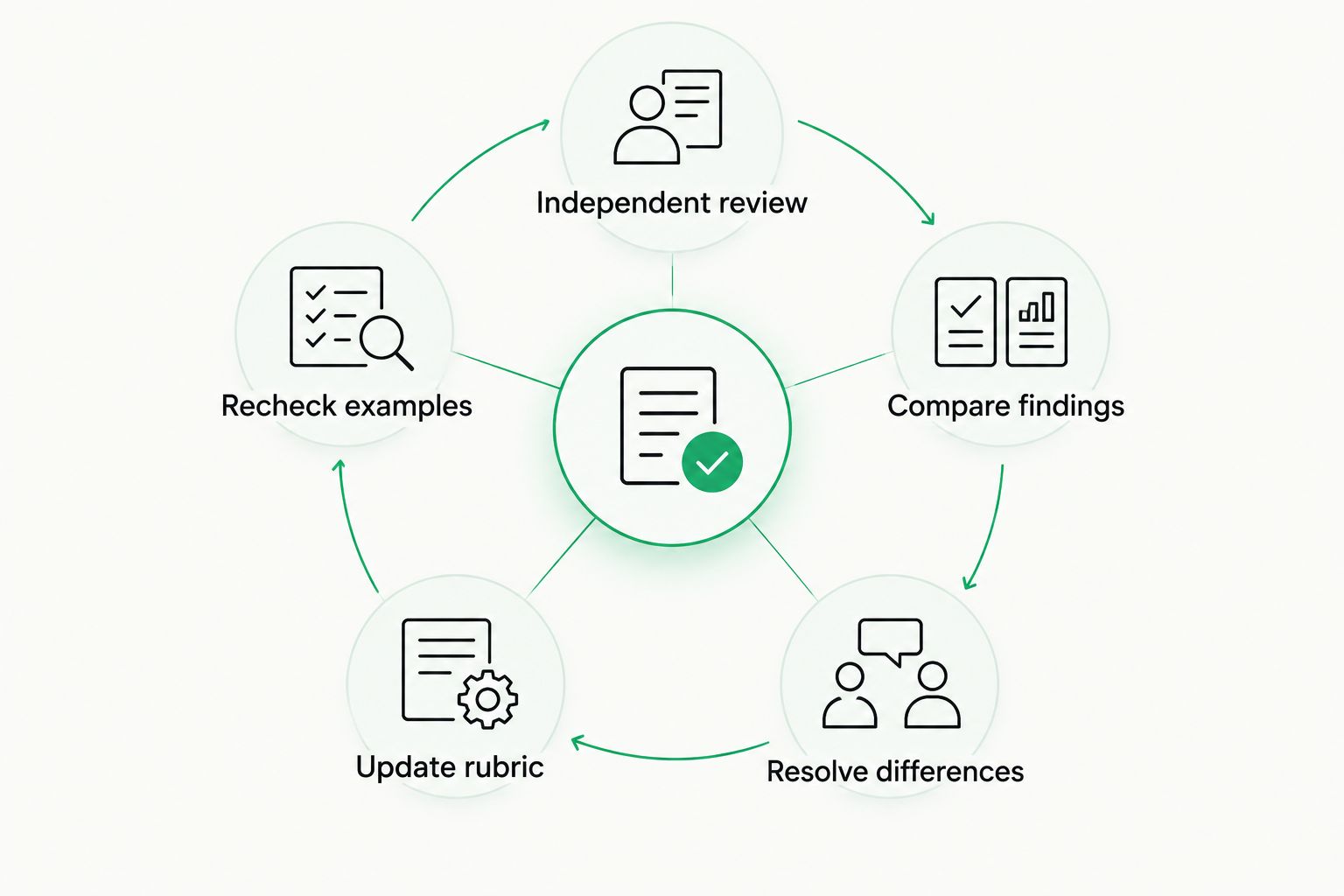
Resolve disagreements against shared evidence before comparing translation scores.
Repeat calibration when you introduce a new content type or materially change the rubric. A shared spreadsheet does not, by itself, establish shared judgment.
Why translation quality scores vary
A score reflects both the translation and the assessment conditions. Investigate these factors before concluding that a translator, supplier, or workflow has improved or deteriorated:
- Content difficulty: Specialized terminology and ambiguous source text change the assessment task.
- Language direction: Results from different language directions describe different bodies of work.
- Context access: Reviewers need the relevant brief, references, and product setting to judge fit.
- Review selection: Targeted inspection of risky passages is not equivalent to general sampling.
- Rubric changes: Different severity definitions or weights alter the resulting score.
- Review stage: Draft quality and final approved quality answer different operational questions.
Compare like with like. If conditions differ, separate the results or explain the difference beside the comparison.
Turn findings into workflow changes
A quality report should end with an action, not merely a score. Group confirmed findings by the change needed: clarify the source, update terminology, correct a translation, improve context, or adjust a review rule.
Wxrks translation management software is best for teams coordinating translation workflows, quality management, and cost tracking. Those functions support the operational side of measurement; they do not replace a qualified judgment about meaning.
Keep approved corrections connected to the relevant language resources. Update a glossary when terminology guidance changes, and review translation-memory entries when an accepted translation is corrected.
Track recurrence using the same definitions. If an issue returns, inspect the source of reuse or the approval process instead of repeatedly fixing only the visible sentence.
For your 2026 quality review, distinguish initial findings from confirmed final defects. Otherwise, successful corrections disappear inside a report that still describes the draft.
Can I measure quality without a reference translation?
You can assess translation quality without a separate reference translation when a qualified reviewer has the source, target, and necessary context. An approved reference is useful evidence, but different wording is not automatically an error.
Is a fluent translation necessarily accurate?
A fluent translation is not necessarily accurate. Review meaning against the source before judging readability; polished wording can still omit a condition or change an instruction.
Should every translation receive the same review?
Every translation should follow explicit acceptance rules, but review depth should reflect intended use and consequences of failure. Define the review policy before production so less intensive review is a deliberate decision, not an unnoticed gap.
FAQ
What's the most accurate way to assess translation quality?
Combine qualified bilingual review, a documented error rubric, and checks in the intended context. Keep the review scope and severity rules consistent when comparing results.
Can automated checks replace a human translation reviewer?
Automated checks do not replace a qualified bilingual reviewer for assessing meaning. Use them to flag configured issues, then review accuracy, audience fit, and unresolved context.
How do I calculate a translation error rate?
Divide confirmed errors by the reviewed source word count to calculate an error density. State your counting rules, denominator, and severity distribution alongside the result.
What counts as a critical translation error?
A critical translation error has unacceptable consequences under the project's documented requirements. Define those consequences before review and treat release-blocking findings separately from average scores.
How much translated content should I review?
Choose review coverage according to content risk, variation, and the decision the assessment must support. Document the selection method and do not claim that a sample guarantees unreviewed content.
Should reviewers count stylistic preferences as errors?
Reviewers should count a style issue as an error only when it violates a documented requirement. Keep equally valid alternative wording separate from confirmed defects.
Can I compare quality scores across different languages?
Cross-language comparisons require explicit limits because language direction, content, and reviewer conditions differ. Report those differences rather than treating every score as interchangeable.
One last thing
A corrected translation and a corrected workflow are different outcomes. Fixing the delivered sentence resolves the immediate defect; correcting the glossary, source ambiguity, or approval rule addresses why it happened.
Whether you manage review in Wxrks or another system, preserve that distinction. Close the individual finding only after checking the correction, and assign a separate action when the underlying cause remains.
Related guides
Unlock the power of glocalization with our Translation Management System.
Unlock the power of
with our Translation Management System.