Can quality management tools catch translation errors early?


Yes. Quality management tools can catch translation errors early by checking terminology, missing content, numbers, and formatting before delivery. In 2026, the strongest workflow combines automated checks with human review: a tool can flag a suspicious segment, but a reviewer must decide whether its meaning fits the context.
TL;DR
- Can quality management tools catch translation errors early? Yes, especially rule-based errors detected before approval.
- Automated translation QA identifies potential defects; human review determines whether meaning and context are correct.
- Translation memory preserves approved wording, but incorrect entries can spread mistakes across projects.
- Wxrks supports translation quality management within a TMS; evaluate specific checks against your own content.
Why this matters
A translation error caught during editing stays inside the review workflow. The same error discovered after publication requires you to correct the published content and check where else the wording appears. Early detection gives you a chance to fix the source of the problem, not just its latest occurrence.
Treat quality checks as approval gates, not a final cleanup task. When comparing translation quality management tools, focus on the errors each check detects, the context reviewers receive, and what happens to unresolved findings.
Can quality management tools catch translation errors early?
Yes, when checks run before a translation moves into approval or publication. Rule-based checks work well for conditions you can define explicitly, such as a required term, a missing placeholder, or an unexpected difference between source and target numbers. Meaning errors need a different approach because a grammatically correct sentence can still communicate the wrong instruction.
No single review method covers every error type. Use this comparison to assign each method a clear job rather than treating them as interchangeable.
Rule-based QA
- Best for: Numbers, tags, placeholders, required terms
- Strength: Flags defined inconsistencies during editing or review
- Limitation: Cannot establish whether the complete meaning is correct
Terminology review
- Best for: Approved vocabulary and prohibited wording
- Strength: Makes terminology decisions explicit
- Limitation: Requires maintained terms and rules for valid exceptions
Bilingual human review
- Best for: Meaning, omissions, ambiguity, tone
- Strength: Interprets source and target together
- Limitation: Needs reviewer expertise and sufficient context
In-context review
- Best for: UI fit, surrounding text, visual order
- Strength: Shows how translated content works in its destination
- Limitation: Does not replace a full linguistic review
A passed automated check is evidence that configured rules passed—not proof that a translation is correct. Keep that distinction visible in approval instructions and reporting.
Automated checks: catch defined inconsistencies
Automated checks are useful when you can describe an error without interpreting the entire message. A missing variable, an empty target segment, or an unclosed formatting tag gives the checker something specific to examine.
Configure checks around your content instead of enabling every warning indiscriminately. For example, a rule that flags every source word retained in the translation needs exceptions for product names and other terms that should remain unchanged. Otherwise, reviewers spend their attention dismissing predictable warnings.
Useful checks to assess include:
- Missing content: Empty targets, untranslated passages, or content omitted during file handling.
- Number mismatches: Differences between source and target numerals that need explanation.
- Terminology conflicts: Missing required terms or use of prohibited alternatives.
- Structural errors: Missing placeholders, altered tags, or broken markup.
- Consistency issues: Repeated source text translated differently without a contextual reason.
Not every difference is an error. A locale can require different punctuation or number formatting, and the same source phrase can need different translations in different contexts. Give reviewers a way to explain valid exceptions rather than forcing mechanically identical output.
Human review: catch errors that still read fluently
Human review answers the question automated rules cannot settle: does this translation communicate the intended meaning here? A sentence can contain the right terminology and intact placeholders while reversing an instruction or assigning an action to the wrong person.
Give reviewers more than isolated segments. Include the content's purpose, intended audience, surrounding text, and relevant terminology decisions. For interface content, show the screen or explain what the control does; for support content, identify the problem the reader is trying to solve.
Best for meaning and context: bilingual review supported by the actual use case. Its limitation is that expertise alone does not compensate for missing information. When the source is ambiguous, the right action is to ask the content owner, not guess confidently.
For content with legal, medical, or safety implications, assign review to someone qualified for the subject matter. A clean QA report cannot establish that specialized advice or instructions are correct.
A 2026 workflow with 5 review stages
Use these 5 review stages as a starting workflow. Each stage has a distinct output, so you can see where an error entered and who is responsible for resolving it.
1. Prepare context
Resolve unclear source wording before translation begins. Attach the intended audience, relevant reference material, terminology guidance, and any constraints that affect the target text.
The output is a translation-ready brief. If the source contains an ambiguous instruction, record the clarification where translators and reviewers can both find it. A private explanation in a separate conversation does not help the next person handling the segment.
2. Check drafts
Run supported automated checks while the translation is still editable. Review missing content, terminology conflicts, structural changes, and number differences before submitting the draft for approval.
The output is a draft with findings either corrected or explained. Do not dismiss a warning solely because the sentence reads naturally; structural defects and fluent prose can exist in the same segment.
3. Review meaning
Compare the target against the source and its intended use. Check instructions, negation, omissions, references, and terminology in context rather than assessing fluency alone.
The output is a linguistically reviewed translation. When the reviewer changes a sentence, rerun applicable automated checks: an edit that improves meaning can accidentally remove a variable or introduce inconsistent terminology.
4. Test context
Inspect the translation in its destination wherever practical. For software, that means checking surrounding labels, layout, variable substitution, and the behavior of the localized interface.
The output is content checked in use. A correct translation can still fail as an interface label if the surrounding screen makes its purpose unclear. Resolve that with the product or content owner rather than shortening text without considering meaning.
5. Approve reuse
Approve the final text only after blocking findings are resolved. Then decide which corrected segments and terminology decisions belong in shared resources.
The output is approved content and controlled reuse. Translation memory should reflect accepted wording, not every intermediate edit. Keep context attached to decisions that would otherwise look like unexplained inconsistencies.
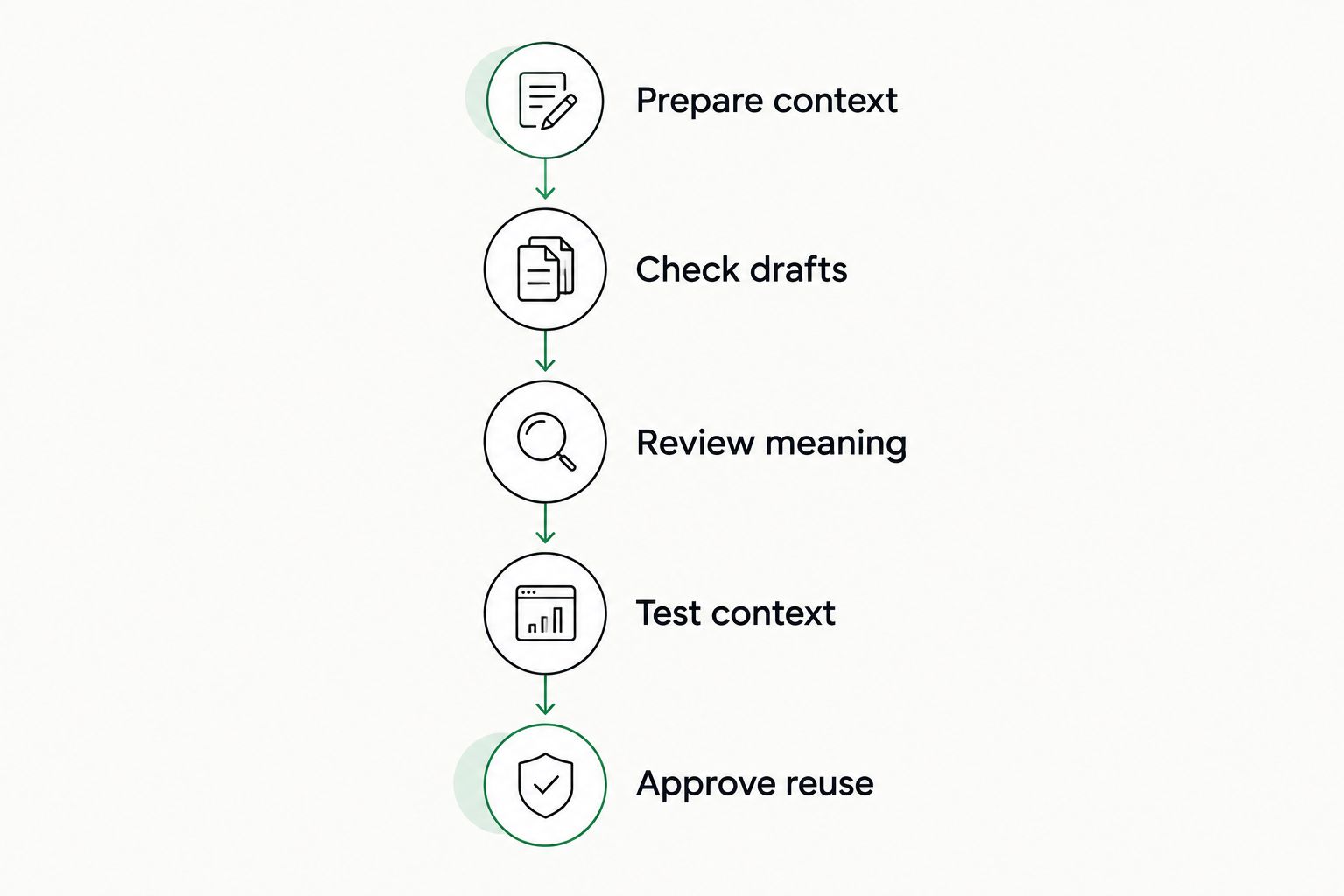
Check drafts early, then verify meaning and context before approving content for reuse.
The workflow is the requirement; the software supports it. Wxrks is a translation management system for teams managing localization workflows, translation memory, quality management, and cost tracking together. When evaluating Wxrks, use representative content to assess how its quality management fits your approval process rather than assuming any particular check or release gate.
Why early error detection varies
For a 2026 localization workflow, detection quality depends on how you configure checks and organize review. Buying a quality management tool does not define your terminology, resolve ambiguous source text, or assign approval responsibility.
- Rule coverage: A checker only evaluates conditions it supports and that your configuration enables. Match checks to the defects your content can contain.
- Source clarity: Unclear source instructions create interpretation problems. Clarify the source instead of expecting target-language review to reconstruct the author's intent.
- Terminology maintenance: Required terms need usage guidance, not just a bilingual word list. Record exceptions where grammar or context changes the correct form.
- Reviewer context: Isolated strings hide relationships between labels, actions, and surrounding content. Provide reference material that answers those questions.
- Reuse controls: Translation memory carries wording into later work. Review corrections before sharing them and inspect existing matches when a recurring error appears.
- Approval ownership: A warning needs an accountable decision-maker. Define who fixes the text, who accepts exceptions, and who authorizes publication.
These factors also explain why a long warning list is not automatically a useful quality result. Findings must lead to decisions. Otherwise, the workflow produces alerts without establishing that anyone resolved the underlying issues.
How should you prioritize translation QA findings?
Use 3 severity levels as an internal starting policy: critical, major, and minor. Define them with examples from your content so reviewers classify issues consistently; the labels alone do not create a shared standard.
- Critical: The error creates a safety, legal, or essential functional problem. Stop publication until the responsible reviewer resolves it.
- Major: The error changes meaning or prevents the content from serving its intended purpose. Correct it before approval.
- Minor: The error affects presentation or style without changing the intended message. Handle it according to your documented acceptance policy.
Treat these as your proposed workflow categories, not a claim about a particular product's built-in scoring. Your organization must decide which findings block release and which exceptions require specialist approval.
Before approval, ask 2 approval questions: has every blocking issue been resolved, and has the translation been checked in its intended context? Record the answers with the content version being approved.
Can translation memory stop the same mistake from returning?
Translation memory supports consistent reuse, but it can also preserve an incorrect translation. A match tells you that wording exists in the memory; it does not establish that the wording is appropriate for the current context.
When you correct a recurring error, inspect the shared entry and other affected content. Fixing only the current segment leaves the original wording available for reuse. Where an existing translation remains valid in another context, document the distinction rather than replacing it blindly.
For your 2026 process, make approved corrections the basis for shared updates. Separate draft changes from accepted decisions, and assign responsibility for maintaining terminology and translation memory.
Does a clean QA report mean a translation is ready to publish?
A clean QA report means the configured checks found no reportable issues in the checked content. It does not establish that the translation preserves meaning, suits the audience, or works in its published layout.
Publish only after the required linguistic and contextual reviews are complete. If the source or target changes after approval, assess the changed content again instead of carrying the earlier approval forward automatically.
FAQ
Can quality management tools catch translation errors before publication?
Yes, quality management tools can flag translation errors before publication when checks run during drafting and review. Automated checks are useful for defined inconsistencies; human review is still needed for meaning and context.
What translation errors are suitable for automated checks?
Missing content, terminology conflicts, number mismatches, and damaged placeholders or tags are suitable for automated checks. Detection depends on the checks your software supports and how you configure them.
Can a fluent translation still be wrong?
Yes, a fluent translation can change meaning, omit a condition, or reverse an instruction. Bilingual review must compare the translation with the source and its intended use.
Should every translation QA warning block publication?
No, every translation QA warning should receive an appropriate decision, but not every warning identifies a genuine error. Define blocking conditions and require explanations for accepted exceptions.
Does translation memory guarantee accurate translations?
No, translation memory stores reusable translations, including incorrect wording if it was accepted into the resource. Maintain approved entries and check whether each match fits its new context.
Can Wxrks help teams manage translation quality?
Wxrks includes quality management within its translation management system, alongside localization workflows, translation memory, and cost tracking. Evaluate the specific checks and review process against representative content.
How should a team assess translation QA software in 2026?
Assess translation QA software in 2026 with representative files containing known defects and valid exceptions. Check which findings it flags, what context reviewers receive, and how your team records resolution.
One last thing
Test a quality workflow with valid exceptions as well as deliberate errors. Include approved untranslated names, legitimate formatting differences, and context-dependent wording. A useful evaluation shows whether reviewers can distinguish problems from acceptable variation—not just whether the tool produces warnings.
For your 2026 evaluation, define the expected decision for each test case before reviewing the results. That gives you something concrete to assess: whether the workflow leads to the right correction, explanation, or approval.
Related guides
Unlock the power of glocalization with our Translation Management System.
Unlock the power of
with our Translation Management System.