How to cut translation costs without losing quality


Cut translation costs by removing duplicate work, translating only what changed, and matching review effort to the consequences of an error. Keep quality checks tied to explicit acceptance criteria; a lower translation invoice is not a saving if your team spends the difference fixing published content.
TL;DR
- How to cut translation costs without losing quality: reuse approved translations, control source changes, and measure accepted output.
- Translation memory reduces repeated work, but reused segments still need context checks.
- Machine translation post-editing belongs in workflows where reviewed output meets your acceptance criteria.
- Wxrks fits teams seeking translation memory, quality management, and cost tracking in a translation management system.
Why this matters
Your translation invoice captures only part of the work. Internal review, terminology disputes, file preparation, and corrections after publication also consume your budget. Cutting the supplier rate leaves those activities untouched.
For your 2026 localization budget, separate necessary language work from avoidable repetition. The practical starting point is how translation memory lowers localization costs: reuse approved language, then check that it still fits the current context.
Protect the quality standard. Change the work required to meet it. That distinction keeps cost reduction from becoming an instruction to rush translators or remove review indiscriminately.
How to cut translation costs without losing quality
Use a repeatable process: establish the full cost of accepted work, improve the source, reuse approved translations, select the right production route, and feed corrections back into your language resources. Apply the process to a defined content category before expanding it.
1. Establish the baseline
Record what it takes to get content accepted, not just what it takes to produce a first translation. Include translation, editing, internal review, project coordination, file handling, and corrections. Keep software expenditure visible rather than treating automation as cost-free.
For a 2026 baseline, compare like with like: the same language pair, content category, and acceptance standard. A short interface label and a technical explanation create different review demands, even when their word counts match.
Record reviewer time and the reasons content gets returned. Separate preference changes from errors in meaning, terminology, completeness, or function. Otherwise, your cost report treats an avoidable style debate and a serious mistranslation as the same problem.
2. Clean the source
Remove duplicated passages, resolve inconsistent terminology, and settle product wording before translation starts. Give translators the intended audience, purpose, and relevant context. An ambiguous source sentence creates a question that someone must resolve in every affected language.
For software strings, explain where the text appears and what the user is doing. Identify placeholders and text that must remain unchanged. Keep unrelated uses of the same English word distinguishable when they require different translations.
Do not send unfinished wording into an otherwise efficient workflow. Late source edits trigger additional translation and review. When a late change is necessary, identify exactly what changed instead of asking reviewers to inspect the entire asset again.
3. Reuse approved translations
Check translation memory before commissioning new work. Reuse approved segments when their meaning, terminology, and context remain appropriate. Inspect differences rather than accepting a match solely because the wording looks familiar.
Translation memory is not a glossary. Translation memory stores source and target segments; a glossary records preferred terminology and its usage. Maintain both so that a previously approved sentence does not perpetuate a term your team has since retired.
Assign ownership for updating these resources. A reviewer correction that stays in an email or spreadsheet does not improve the next assignment. Save the approved wording and document whether the correction applies broadly or only in that context.
4. Assign the workflow
Choose the production route by content requirements, not by a blanket instruction to automate everything. Test machine translation with post-editing on representative material. Compare the effort required to reach the same acceptance standard against human translation with review.
Keep difficult examples in the evaluation: ambiguous strings, terminology-heavy passages, and content whose meaning depends on surrounding text. A test containing only straightforward sentences does not establish that the workflow suits the rest of your content.
Retain human translation where machine output demands extensive rewriting or fails the agreed standard. Keep human responsibility for the final decision regardless of how the draft was produced. Automation changes the starting point; it does not define acceptable quality.
5. Close the loop
Classify corrections and return approved changes to translation memory, terminology resources, and instructions. Look for recurring causes rather than treating every correction as an isolated event. Repeated terminology errors call for a different fix than missing source context.
Compare the new workflow with the baseline after content has passed review. Check total effort, acceptance results, and corrections after release. A faster draft does not establish a better workflow if it creates more work downstream.
Keep a process change only when it reduces effort without weakening the acceptance standard. Document the content types and language pairs for which it worked so that a useful result does not become an unsupported rule for every project.
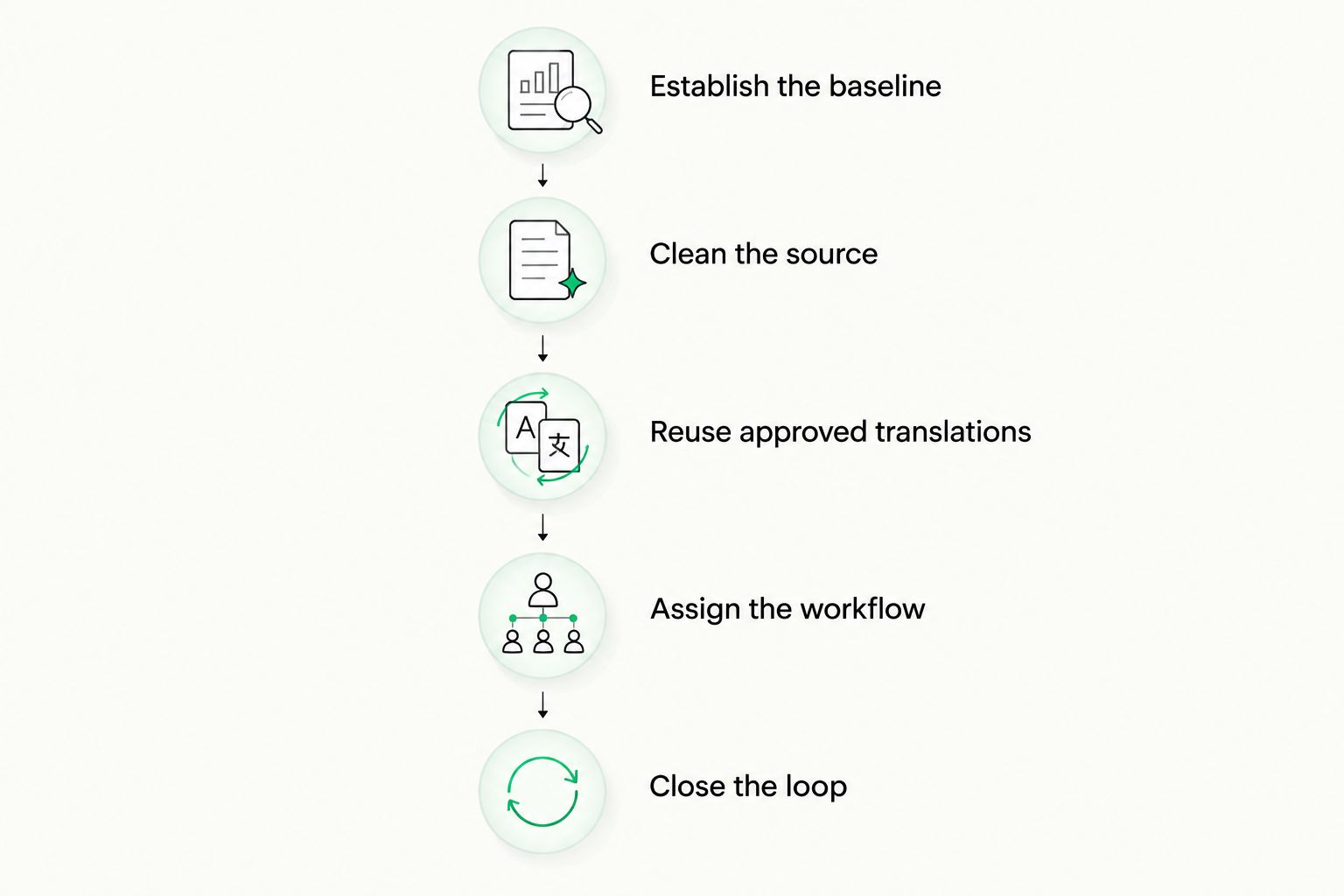
Measure the full workflow and return approved corrections to the resources used on the next assignment.
Which translation workflow should you use?
For a 2026 workflow decision, compare routes against the same definition of finished work. The table below describes selection criteria, not guaranteed savings. Each route still needs suitable source material and a clear acceptance decision.
Translation memory reuse with review
- Best for: Repeated or updated content with approved translations
- Advantage: Avoids translating suitable existing language again
- Limitation: Old wording can be wrong in a new context
Machine translation with post-editing
- Best for: Content that passes a representative evaluation
- Advantage: Gives an editor a draft to assess and correct
- Limitation: Rewriting and verification can outweigh the drafting benefit
Human translation with review
- Best for: Content requiring substantial interpretation or adaptation
- Advantage: Starts with human judgment about meaning and audience
- Limitation: Does not remove the need for context, terminology, or review
Translation memory reuse: check context before acceptance
Best for: recurring content with maintained, approved translations. Start with release updates, repeated documentation, and other material where you can identify unchanged language. Check whether the earlier approval still applies to the current audience and use.
The limitation is inherited error. An outdated translation can look authoritative simply because it already exists in memory. Remove obsolete entries and resolve conflicting versions instead of asking each translator to make that decision again.
Machine translation with post-editing: evaluate finished output
Best for: content where an evaluated draft helps a qualified editor reach the required standard. Define whether the editor must correct meaning, terminology, style, formatting, or all of these. Do not leave the scope implicit.
The limitation is hidden editing effort. A fluent sentence still needs checking against the source, and an unsuitable draft can require a rewrite. Judge this route by accepted output and total effort, not the speed at which text first appears.
Human translation with review: preserve judgment where it matters
Best for: content where intent, ambiguity, or adaptation requires close human judgment. Give the translator a usable brief and allow questions before review. Clear instructions support this route just as much as they support automation.
The limitation is that human production does not fix a disorganized process. Unstable source text, conflicting reviewers, and missing terminology still cause rework. Improve those inputs before deciding that the translation method itself is the problem.
Why translation costs vary
Use these factors to explain differences in your 2026 translation spend. Compare them within your own projects rather than assuming every language or content category should have the same cost structure.
- Source stability: edits after translation begins create additional work and require decisions about what needs another review.
- Reusable content: approved translations help only when their meaning and context still fit the current assignment.
- Subject matter: specialist terminology and ambiguous language require appropriate expertise and reference material.
- Language pair: reviewer availability and suitability are specific to the languages involved; evaluate each pair separately.
- Review requirements: linguistic review, subject-matter approval, and functional checks address different failure modes.
- Workflow handling: copying files, reconciling versions, and clarifying ownership add work beyond translating sentences.
Before changing suppliers, identify which factor explains the cost you want to remove. A different supplier does not settle your internal terminology dispute or stop your source team from changing approved copy.
Where does a translation management system help?
A translation management system brings workflow activities into a managed process. Wxrks supports translation workflow automation, translation memory, quality management, and cost tracking. Those functions are relevant when you need to connect language work with its review and expenditure.
Wxrks is a fit for teams that need translation memory, quality management, and cost tracking in a TMS. The limitation is procedural: software does not decide your acceptance criteria or resolve conflicting instructions from reviewers. Assign those responsibilities before evaluating the workflow.
When assessing Wxrks, use representative content and follow it through approval. Check how the process supports your actual handoffs, corrections, and cost records. Evaluate the work your team completes, not just the initial translation output.
Can you reduce translation costs without changing translators?
Yes. Start by reducing duplicated assignments, clarifying source text, and making approved terminology available to the translators you already use. Those changes target avoidable work without requiring a change in language expertise.
Ask translators which recurring questions delay assignments. Resolve those questions in the source brief or shared resources rather than paying for the same investigation on subsequent projects.
Is machine translation always cheaper after review?
No. Machine translation with post-editing is a cost-reduction option only when the complete workflow requires less effort while meeting the same acceptance criteria. Include verification, rewriting, and internal review in that comparison.
Keep the decision specific to the tested language pair and content category. A successful documentation workflow does not establish that the same route suits advertising copy or context-dependent interface text.
What should you measure before reducing review?
Measure acceptance results, error types, reviewer effort, and corrections after publication. Use those records to identify repeated checks that add no distinct decision, rather than removing review because a draft reads smoothly.
Preserve checks for consequential errors. Meaning, omitted content, incorrect terminology, and broken placeholders require attention even when the surrounding language sounds natural.
FAQ
What's the best way to cut translation costs without losing quality?
Remove repeated work before reducing review. Reuse approved translations, stabilize source content, and compare workflows using the same acceptance criteria and total effort.
Does translation memory eliminate the need for a translator?
No. Translation memory supplies previously translated segments, but someone still needs to assess context, changes, and suitability. An approved sentence can become inappropriate when its use changes.
Should I use machine translation for every language?
No. Evaluate machine translation with post-editing for each relevant language pair and content category. Keep it only where the finished output meets your standard with less total effort.
How do I stop reviewers from making conflicting edits?
Assign a final decision owner and document terminology, style, and acceptance criteria. Distinguish factual corrections from preferences so that the same wording does not cycle through competing versions.
How do I know whether translation automation is saving work?
Compare the full workflow before and after automation, including setup, editing, review, coordination, and corrections. Faster draft production alone does not demonstrate a reduction in total work.
Can I reuse translations after changing my product terminology?
Reuse them only after checking them against the current terminology rules. Update affected translation memory entries so that retired terms do not return in later assignments.
Which translation quality checks should I keep?
Keep checks tied to your acceptance criteria and the consequences of an error. Meaning, completeness, terminology, placeholders, and context need explicit treatment rather than a general instruction to check quality.
One last thing
For your next 2026 project, ask where the final approved translation ends up. If it remains only in a delivered file while your translation memory retains the rejected version, you have closed the project without improving the next one.
Make the approved correction reusable. Save it in the appropriate language resource, identify its scope, and give someone responsibility for maintaining it. That is a concrete cost-control step you can take without lowering your quality standard.
Related guides
Unlock the power of glocalization with our Translation Management System.
Unlock the power of
with our Translation Management System.