How does translation memory lower localization costs?


Translation memory lowers localization costs by reusing previously approved translations instead of translating repeated content from scratch. In 2026, the savings still depend on usable matches, agreed billing rules, and review effort: a matching sentence can require changes when its context, terminology, or meaning has changed.
TL;DR
- How does translation memory lower localization costs? Reuse approved translations, then measure the review work that remains.
- Exact matches reduce new translation work; fuzzy matches provide editable drafts rather than finished translations.
- Wxrks suits teams seeking translation memory, quality management, and cost tracking within a translation management system.
- Match counts are not savings: billing rules, context checks, and corrections determine the financial result.
How does translation memory lower localization costs?
Translation memory reduces the work required to translate content you have already translated. It stores source segments alongside their translations, then retrieves matching or similar segments when new content enters the workflow. Translators reuse a suitable result or edit it instead of starting with an empty target field.
The financial benefit comes from less new translation work, less repeated terminology research, and fewer avoidable corrections. The guide to updating translation memory after approval explains the workflow behind keeping reusable content current.
Here is how the main match categories affect work. These are translation-memory concepts, not a promise that every system handles context or billing identically.
Exact match
- Best for: Repeated text with unchanged meaning
- Work it reduces: Retranslating the same source segment
- Remaining work or limitation: Check context, terminology, and whether the saved translation remains valid
Context match
- Best for: Repeated text in a recognized surrounding context
- Work it reduces: Rechecking previously approved wording in that context
- Remaining work or limitation: Context recognition depends on the system and project configuration
Fuzzy match
- Best for: Edited versions of existing content
- Work it reduces: Drafting the entire translation again
- Remaining work or limitation: Identify changes and edit the target text accordingly
No useful match
- Best for: Genuinely new content
- Work it reduces: No direct reuse benefit
- Remaining work or limitation: Translate and review the content, then save approved work for later
A segment match is an opportunity to reduce effort, not proof that the segment needs no attention. Your cost calculation must include the work left after reuse.
Why this matters
Repeated localization creates an expensive habit: commissioning work that your organization has already approved elsewhere. Product interfaces, help articles, policy language, and documentation can contain reusable content, but reuse only works when translators can find the right version.
For your 2026 localization plan, separate the cost of creating translations from the cost of validating existing ones. That distinction helps you decide whether a translation-memory workflow is reducing labor or merely changing how work gets classified on an invoice.
Consistency matters too. Reusing an approved term avoids reopening the same terminology decision, while retrieving an outdated translation spreads the wrong decision across new content. The asset needs maintenance, not just storage.
Exact matches: reuse without redrafting
An exact match means the incoming source segment matches a stored source segment. The translator receives the saved target text rather than having to write another translation of the same sentence.
That is useful for repeated instructions, interface labels, and stable documentation. It removes redrafting, but it does not establish that the saved target text is appropriate everywhere the source appears.
Consider a short label such as Open. The source text can stay identical while its grammatical role or intended action changes. A translator still needs enough context to choose suitable wording in the target language.
Best for: repeated source text with the same intended meaning. The benefit is direct reuse; the limitation is that source-text identity alone does not establish contextual suitability. Keep screenshots, descriptions, or surrounding text available wherever ambiguity affects translation.
Context matches: stronger evidence for reuse
A context match adds contextual information to the source-text match. Depending on the system, that information can include surrounding segments or identifiers associated with the content.
This gives reviewers more evidence that the saved translation belongs in the current location. It is especially useful when the same source sentence appears in different places but only some occurrences share the same meaning.
Context is not a substitute for current approval. A sentence can match its previous surroundings while referring to a policy, feature, or process that has changed outside the segment.
Best for: stable content returning in a recognized context. The benefit is more informed reuse; the limitation is dependence on the context captured by your workflow. Confirm what your system recognizes before treating this category differently from an ordinary exact match.
Fuzzy matches: edit the difference
A fuzzy match retrieves a similar source segment and its saved translation. The translator uses that translation as a starting point, then updates it to reflect the new source.
This is useful when documentation changes incrementally. A revised instruction can retain its structure and terminology while changing a condition, action, or object.
The trap is assuming a small textual change means a small review task. Adding a negation or changing an obligation can alter meaning substantially even when most words stay the same.
Best for: revisions that retain useful wording from an earlier version. The benefit is an editable starting point; the limitation is that similarity does not measure linguistic risk. Review the source change explicitly rather than reading only the suggested target text.
Why translation-memory savings vary
Translation memory does not produce a universal savings percentage. Its value depends on the content you submit, the translations you store, and the commercial arrangement governing reuse.
- Content repetition. Repeated or incrementally revised text offers more reuse opportunities than wholly new material.
- Memory quality. Approved, current translations provide useful starting points; outdated or inconsistent entries create correction work.
- Context availability. Clear context helps reviewers determine whether identical wording also carries identical meaning.
- Language pair. Reuse requires relevant source-and-target entries; a memory for one target language does not supply approved translations for another.
- Billing rules. Match categories only reduce your invoice when the agreed charging model recognizes the reduced work.
- Review requirements. Legal, technical, or other consequential content still needs review appropriate to its intended use.
Use these factors together. A large memory filled with obsolete translations is not necessarily more valuable than a smaller, well-maintained memory relevant to the current project.
How do you turn translation-memory matches into savings?
Build the workflow around approved reuse, then measure the labor and expenditure it actually changes. For a 2026 evaluation, use real project records rather than applying an assumed discount to every match.
- Define scope. Select the content, source language, target languages, and review requirements you will compare. Keep those requirements consistent when assessing results.
- Clean memory. Identify outdated terminology, conflicting translations, and entries that do not belong to the project. Preserve useful distinctions between products or content types.
- Analyze matches. Review the incoming content against the relevant memory. Separate reusable matches from suggestions that require substantial correction.
- Agree billing. Establish how reuse, editing, review, and project work are charged. Do this before approving the assignment.
- Review context. Give translators the surrounding information needed to validate matches. Record corrections instead of silently accepting a suggestion.
- Save approvals. Return approved translations and corrections to the appropriate memory. Otherwise, the next project starts from an outdated asset.
The steps form a repeatable cycle: approved work becomes the starting point for the next release. Saving unreviewed drafts instead weakens that cycle because future translators inherit unresolved decisions.
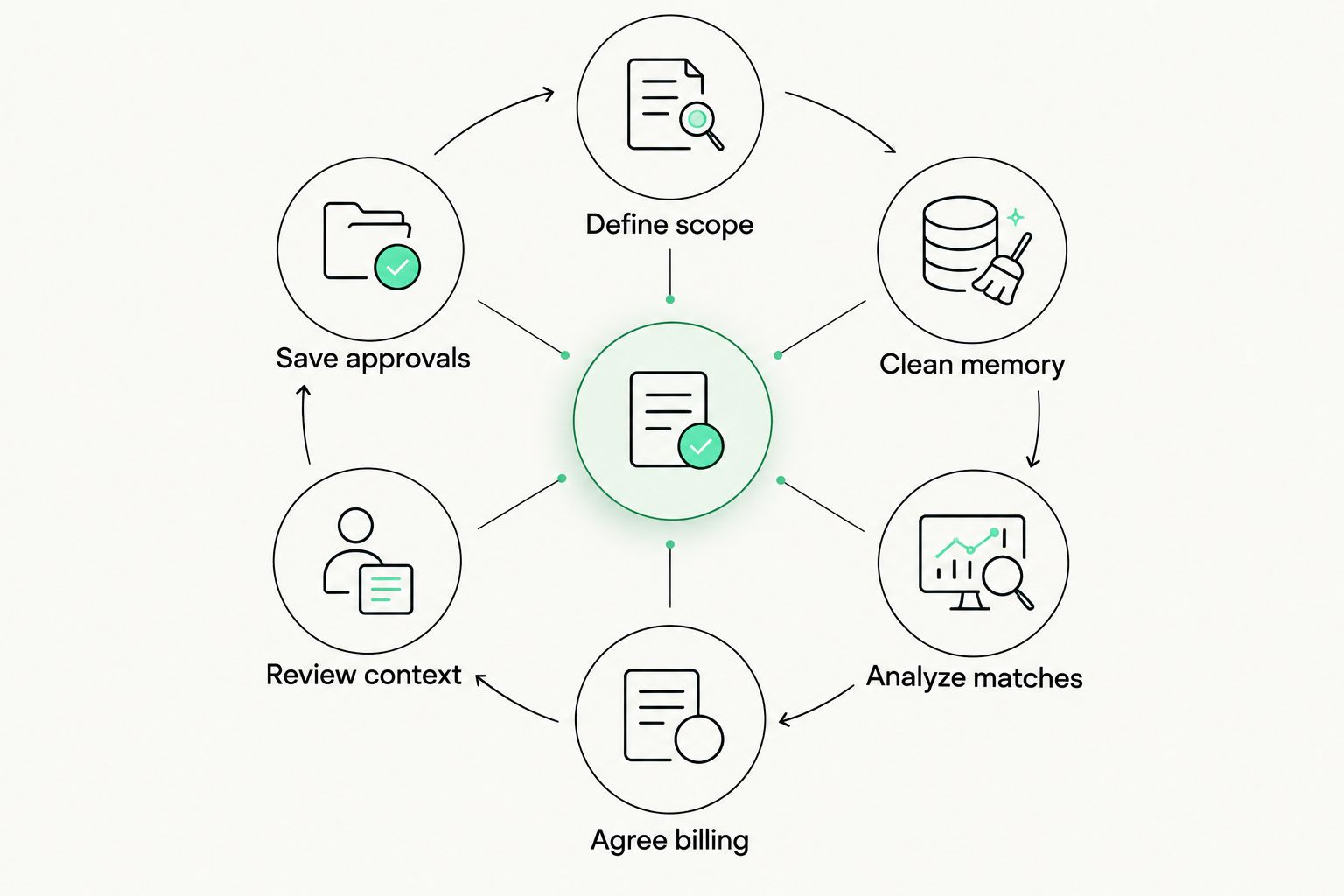
Only approved corrections should become the starting point for future reuse.
Assign responsibility for memory maintenance. Translators can correct individual segments, but your workflow also needs someone accountable for retiring obsolete content and resolving conflicting entries.
How do you measure the savings accurately?
Measure reduced expenditure and reduced effort separately. An internal team can spend less time translating without a corresponding invoice reduction, while a vendor discount can reduce charges without eliminating your internal review work.
For each comparable project, record the content scope, match categories, new translation work, review effort, correction effort, and project-management effort. Use actual invoices for expenditure and recorded work for effort; do not convert a match count directly into money.
Compare equivalent deliverables. Adding a target language, changing review requirements, or expanding the content scope makes a simple before-and-after invoice comparison misleading.
Your 2026 reporting should also distinguish initial setup from recurring work. Cleaning an inherited memory is different from reviewing matches during a normal release, even though both consume resources.
A useful decision rule is straightforward: keep the workflow when reusable content reduces total work without weakening the required quality checks. Investigate it when high match counts coexist with repeated corrections or unchanged total effort.
Does a translation-memory match automatically lower the invoice?
A translation-memory match does not automatically lower the invoice. Your agreement determines whether matched content receives different treatment from new translation work.
Ask how the provider handles exact matches, fuzzy matches, repetitions, and review. Also establish whether project-management work and other required tasks remain separate from segment-based translation charges.
Do not interpret a match report as a commercial commitment. Agree the charging rules before assigning the project, then check the completed invoice against those rules and the delivered scope.
Is translation memory the same as machine translation?
Translation memory retrieves stored translations; machine translation generates target text from source text. They address different parts of the workflow.
Translation memory is useful when approved work already exists. Machine translation provides a draft for text without a suitable stored translation, but that draft needs review appropriate to the content.
Translation memory
- Best for: Reusing approved translations
- Main benefit: Preserves decisions from earlier work
- Main limitation: Depends on relevant, current stored entries
Machine translation
- Best for: Producing drafts for new text
- Main benefit: Provides target text without an existing match
- Main limitation: Generated text still needs suitable quality checks
New human translation
- Best for: Content requiring fresh linguistic decisions
- Main benefit: Addresses meaning, context, and wording directly
- Main limitation: Requires new translation effort
These approaches can coexist. The important boundary is approval: a newly generated draft should not become trusted reusable content simply because it has entered the system.
Where does a TMS fit into the cost equation?
A translation management system organizes the work around translation memory: assignments, review, quality checks, and cost records. Reuse alone does not resolve a fragmented process if teams still exchange conflicting versions or cannot trace approved changes.
Wxrks is best for teams seeking translation memory, quality management, and cost tracking within a translation management system. Wxrks provides those functions alongside localization-workflow automation for translators, developers, enterprises, and translation agencies.
The benefit is bringing these related activities into a TMS. The limitation is that software does not remove the need to maintain approved content, provide context, or define billing rules. Evaluate the workflow against your own recurring projects rather than treating the presence of translation memory as proof of savings.
FAQ
How does translation memory lower localization costs?
Translation memory lowers localization costs by retrieving previously approved translations for repeated or similar source text. Savings depend on how much work remains for editing, review, and project management, plus the billing rules you agree.
Do exact translation-memory matches need review?
Exact matches need validation appropriate to the content because identical source text does not guarantee identical context. Check that the stored translation still reflects the intended meaning and current terminology.
Does translation memory save money on a first project?
Translation memory helps a first project when relevant approved translations already exist or content repeats within the project. New content without useful matches requires new translation work and creates reusable material for later assignments.
Is translation memory better than machine translation?
Translation memory is better suited to retrieving approved wording, while machine translation is suited to generating new drafts. Choose based on whether relevant approved content exists and what review the resulting text requires.
Can I use translation memory across different target languages?
Translation memory requires translations for the relevant language pair. Approved translations into one target language do not provide approved translations into another.
Can Wxrks help manage translation-memory costs?
Wxrks provides translation memory, quality management, cost tracking, and localization-workflow automation within its TMS. Use those functions alongside clear review responsibilities and agreed charging rules.
What should I track when evaluating translation memory in 2026?
Track comparable project scope, usable matches, translation effort, review effort, corrections, and actual expenditure. Separate setup work from recurring work so the comparison reflects the workflow you intend to repeat.
One last thing
A correction that stays outside your translation memory is a correction your team can encounter again. Before approving your next 2026 localization release, verify that accepted edits reach the memory used by subsequent projects.
The next move: trace an approved correction from review into later reuse. That check tells you whether your workflow preserves the decisions you paid to make—not just whether it stores translations.
Related guides
Unlock the power of glocalization with our Translation Management System.
Unlock the power of
with our Translation Management System.