How long does it take to build a translation memory from scratch?


Building a translation memory from scratch takes as long as you need to produce, approve, and save translations that match your future content; there is no universal completion time. Creating the empty memory is a setup task, but building useful coverage depends on your translation workload, review process, and access to existing bilingual material.
TL;DR
- How long does it take to build a translation memory from scratch? Useful coverage depends on approved translations and recurring content.
- Start with reviewed source–target pairs, not an arbitrary segment target or deadline.
- Existing bilingual documents can seed a memory, but alignment needs checking before reuse.
- Wxrks fits teams managing translation memory alongside localization workflows, quality management, and cost tracking.
How long does it take to build a translation memory from scratch?
A translation memory becomes useful when it retrieves approved translations for the content you actually need to translate. It does not need to cover your entire content library before you use it.
For your 2026 rollout, separate database creation from content preparation and review. The setup milestone tells you that the memory exists; the reuse milestone tells you whether it helps translators.
Your starting material determines the work involved:
New approved translations
- Best for: Teams without reusable bilingual material
- What builds the memory: Saving reviewed source–target segments during translation
- Main advantage: Clear approval history from the start
- Main limitation: Coverage grows with completed work
Existing bilingual documents
- Best for: Teams with matching source and translated files
- What builds the memory: Aligning corresponding segments, then reviewing them
- Main advantage: Reuses previous translation work
- Main limitation: Missing passages and version differences require checking
Existing memory import
- Best for: Teams with a reusable translation memory
- What builds the memory: Importing and validating compatible memory data
- Main advantage: Preserves previously stored translations
- Main limitation: Old terminology and metadata need review
Importing an existing memory is not starting from scratch. If you discover a usable export during your inventory, follow the translation memory migration guide rather than recreating approved work.
Why this matters
A deadline for “building the memory” is incomplete unless you define what finished means. An empty database, a reviewed bilingual collection, and a memory that returns useful matches are different deliverables.
Treating those deliverables as interchangeable creates a bad handoff. The project owner sees a populated database, while translators still spend time rejecting irrelevant suggestions or correcting inherited terminology.
Set the acceptance condition before setting the deadline. Your condition should describe the content covered, the approval standard, and the retrieval behavior you expect—not merely the size of the database.
Starting without translated content
Best for: teams creating their first approved translations. If you have no reusable bilingual material, build the memory through normal translation work rather than delaying production until a separate database-building project is complete.
Start with content that represents your recurring workload. A help center team should prioritize the kinds of instructions and support explanations it will translate again. A product team should focus on recurring interface language and messages, with enough context for reviewers to judge meaning.
The advantage is control: you can establish terminology and review rules before storing material for reuse. The limitation is coverage. A new memory cannot retrieve approved translations that nobody has produced yet.
Keep that distinction clear in your 2026 project plan. Translators can begin working with a new memory before that memory contains useful matches for every document.
Starting with existing bilingual documents
Best for: teams with approved translations but no structured memory. Matching source and target documents provide material for alignment, which pairs corresponding source and translated segments.
First confirm that the files represent the same content version. A translated manual and a newer source manual are not automatically a reliable pair. Added paragraphs, deleted passages, and reordered sections need attention before you accept the alignment.
The advantage is access to work already completed. The limitation is that document-level approval does not prove every automatically aligned pair is correct.
Review the pairs before making them generally reusable. A fluent target sentence attached to the wrong source sentence is still a defective memory entry, and ordinary spelling checks will not resolve that mismatch.
How do you build a useful translation memory?
Use this sequence for a new memory or a collection assembled from existing documents. Each stage has a different completion condition, which makes scheduling and ownership clearer.
Define scope
Specify the source language, target language, subject area, and content you want to support. Distinguish regional language variants where the work requires them.
Write down what belongs outside the initial scope. Combining unrelated content simply to increase the entry count makes the database larger without establishing that the added material is useful.
Prepare material
Collect approved translations with their corresponding source text. Check versions, remove material you do not have permission to reuse, and identify documents whose approval status is unclear.
If you are starting without historical translations, select representative production content instead. The goal is a repeatable path from a translation task to a reviewed memory entry.
Validate pairs
Check that each source segment corresponds to the correct target segment. Review terminology, missing content, formatting markers, and language direction as part of that validation.
Do not approve an entire aligned collection solely because the documents look similar. Structural changes can shift the relationship between sentences even when the overall topic remains unchanged.
Test retrieval
Run representative content against the memory in your chosen translation environment. Inspect the suggestions in context rather than judging usefulness from the total number of stored entries.
Record why suggestions fail: unrelated subject matter, outdated terminology, incomplete context, or incorrect alignment. Those findings tell you whether to change the memory, its scope, or the source material.
Maintain approvals
Assign responsibility for corrections and decide when reviewed translations become reusable. The approval point should be explicit, especially when several translators and reviewers contribute to the same work.
Also define how rejected or superseded translations are handled. Saving a corrected entry does not, by itself, establish that every conflicting older entry has been resolved.
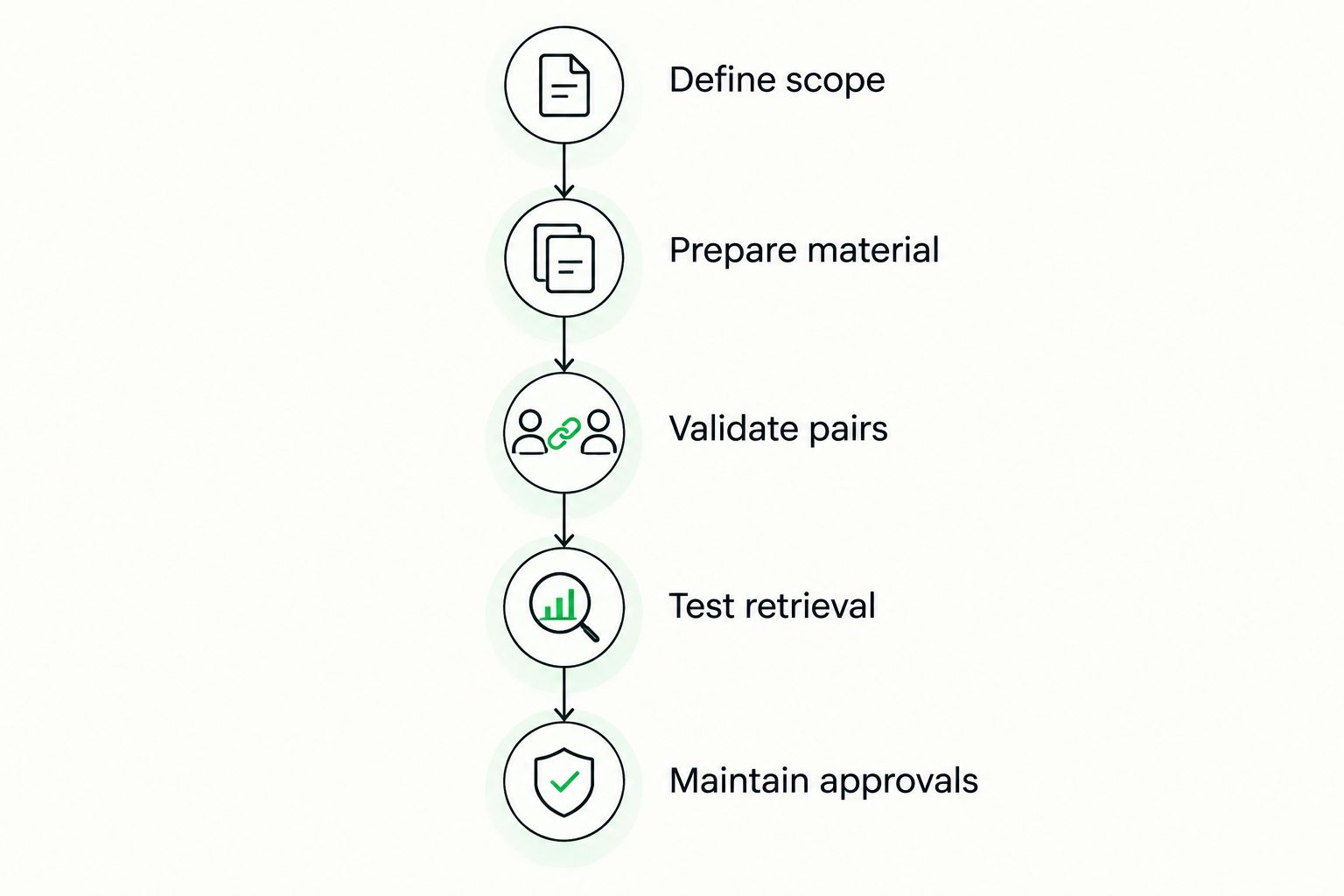
A populated memory still needs retrieval testing and an ongoing approval process.
A handoff after each stage makes the work easier to schedule. The person preparing files should know what the reviewer accepts, and the reviewer should know how translators will test the resulting memory.
Why translation memory build time varies
These factors determine the work between your starting point and a useful memory. Assess them before committing to a 2026 completion date.
- Starting material: Existing approved bilingual content changes the task from creating translations to preparing and validating reusable pairs.
- Version consistency: Matching document versions support alignment; additions, omissions, and reordered sections require reconciliation.
- Language coverage: Each required language direction needs suitable source–target material and review rather than an assumption that another language's coverage transfers.
- Approval ownership: A named reviewer and clear acceptance rules make the handoff explicit. Unresolved terminology decisions leave entries awaiting approval.
- Content relevance: A memory built from unrelated material does not establish coverage for your current workload, regardless of its size.
- System preparation: Import compatibility, segmentation settings, and available metadata affect how material enters the working translation environment.
Estimate the work you can identify, not a generic industry duration. Separate file preparation, alignment, linguistic review, correction, and retrieval testing so that an unresolved task does not disappear inside a single setup estimate.
How do you estimate your own completion date?
Use a representative pilot to establish your planning assumptions. Choose material with the same document structure, terminology, and review requirements as the larger collection; an unusually clean file will not expose the work in a messy archive.
Track preparation effort separately from linguistic review. Also record time spent resolving version differences and approval questions. Elapsed delivery time includes those handoffs, not just the time a translator spends editing.
For a defensible 2026 estimate, use this sequence:
- Inventory the material and classify its approval status.
- Process representative files through the complete workflow.
- Record the actual work and unresolved issues by stage.
- Apply those observations only to comparable material.
- Confirm reviewer capacity and dependencies before setting the delivery date.
Do not turn the pilot into a permanent productivity promise. A new content type, language direction, or approval requirement changes the basis of the estimate and deserves a separate assessment.
What counts as a usable translation memory?
A usable memory returns relevant, approved translations without hiding their context. That is a stronger acceptance test than “the import completed successfully.”
Before you accept the initial collection, check that:
- Source and target languages are correctly assigned.
- Stored pairs preserve the intended meaning.
- Terminology follows the current approved decisions.
- Formatting markers remain intact where required.
- Reviewers can distinguish approved material from unresolved work.
- Representative content retrieves appropriate suggestions.
A match score is not a quality certificate. It describes a matching relationship in the translation environment; it does not independently approve terminology, factual accuracy, or suitability for the current context.
Keep the acceptance record attached to your 2026 rollout documentation. That gives future contributors a clear explanation of what was checked and what remains outside scope.
Where does a translation management system fit?
Wxrks fits teams that need translation memory, localization workflows, quality management, and cost tracking in the same system. Its role is to support the translation process, not to make the need for approved bilingual content disappear.
The benefit of a translation management system is coordinating work that otherwise needs separate handoffs. The limitation remains linguistic: software cannot make a wrongly paired or outdated translation suitable merely by storing it.
When evaluating Wxrks for translation memory management, test your own material and approval process. Verify the import behavior, review controls, and retrieval results you need rather than assuming a feature label answers those operational questions.
Can I use translation memory before it is complete?
You can use a translation memory as approved entries accumulate. A complete archive is not a prerequisite, but translators still need to review suggestions against the current source and context.
Does a larger translation memory become useful faster?
A larger translation memory is not automatically more useful. Relevance, correct alignment, and approval status determine whether the additional entries help your current work.
Can machine translation fill an empty memory?
Machine translation can produce draft target text, but draft output is not equivalent to approved memory content. Review it through your quality process before treating it as reusable translation.
FAQ
How long does it take to build a translation memory from scratch?
There is no universal build time: useful coverage depends on producing, approving, and saving translations relevant to your future content. Separate database setup from content preparation, review, and retrieval testing when planning the work.
Can I start a translation memory without old translations?
You can start a translation memory without old translations by saving newly approved source–target pairs as translation work progresses. Its initial coverage will reflect the work you have completed, not your entire future content library.
Can I turn existing translated documents into a translation memory?
Existing source and translated documents can seed a translation memory through alignment. Confirm that the versions correspond and review the paired segments before approving them for reuse.
How many segments do I need before a translation memory is useful?
There is no universal segment threshold for usefulness. Test whether the memory retrieves relevant, approved translations for representative content instead of setting an arbitrary entry target.
Is translation memory the same as a glossary?
Translation memory stores source–target segments, while a glossary records terms and their approved equivalents. Use terminology decisions when reviewing memory entries so repeated sentences do not preserve outdated wording.
Does translation memory replace a translator?
Translation memory does not replace a translator's judgment. Retrieved text still needs checking for meaning, terminology, context, and suitability for the current document.
Can Wxrks help manage a translation memory?
Wxrks is a translation management system that supports translation memory, localization workflows, quality management, and cost tracking. Evaluate it with representative content to establish whether the workflow meets your requirements.
One last thing
Your best starting material is not necessarily your largest archive. Prioritize approved translations that resemble the work coming next, then test whether translators can retrieve and use them correctly.
That decision gives your 2026 launch a concrete acceptance test: relevant translations are available, reviewed, and reusable. Everything else belongs in the next expansion of coverage.
Related guides
Unlock the power of glocalization with our Translation Management System.
Unlock the power of
with our Translation Management System.