How to keep terminology consistent across translators


Keep terminology consistent across translators by giving everyone the same approved termbase, assigning an owner for terminology decisions, and checking translations against those decisions before publication. Define terms by concept and locale, not just by word, and record exceptions where context requires different wording. Translation memory supports reuse, but it does not replace terminology rules or human review.
TL;DR
- How to keep terminology consistent across translators: share approved terms, assign ownership, and check usage before publication.
- Wxrks supports translation memory and quality management; terminology decisions still need an accountable owner.
- Use a termbase for approved vocabulary, translation memory for reusable segments, and a style guide for writing rules.
- Allow documented grammatical and contextual exceptions instead of forcing identical wording everywhere.
Why this matters
A translation can read naturally and still name the wrong concept. If your interface, help center, and onboarding emails use different translations for the same feature, readers must work out whether those labels refer to the same thing.
Treat terminology as a shared editorial decision, not an individual translator preference. Your 2026 localization brief should explain which terms are fixed, which allow variation, and who resolves disagreements. Include terminology in your approach to measuring translation quality accurately, rather than treating it as a separate cleanup task.
How do you keep terminology consistent across translators?
Use a repeatable approval process that connects terminology decisions to the work translators actually receive. A glossary sitting outside the production workflow is a reference document, not an enforced agreement.
1. Identify concepts that need controlled terminology
Start with vocabulary whose meaning matters across content: product features, interface actions, technical concepts, and organization-specific language. Do not turn every common word into a mandatory term.
Group candidate terms by concept before translating them. A source word used for different concepts needs separate entries; different source words referring to the same concept need an explicit relationship.
For each candidate, ask:
- Does inconsistent wording change the meaning?
- Does the reader need to recognize this label elsewhere?
- Does the word have a specialized meaning in this context?
- Is this a name that should remain untranslated?
Prioritize terms that answer those questions. A focused termbase is easier to maintain than a collection of unexplained word pairs.
2. Build entries that explain decisions
Give translators enough information to select the right term without guessing. Include the source term, concept definition, target locale, preferred translation, usage context, approval status, and relevant restrictions.
A translation equivalent without a definition leaves the original ambiguity intact. Where useful, add an example sentence, an interface reference, or a note distinguishing a nearby concept. Mark rejected alternatives explicitly so translators can tell an omission from a prohibition.
Use named approval states, such as proposed, approved, and deprecated. These are suggested workflow labels, not a reason to treat unreviewed entries as authoritative.
3. Assign approval authority by locale and subject
Name the person who approves a target-language term and the subject expert who resolves questions about meaning. One person can hold both responsibilities, but neither responsibility should disappear into a general project inbox.
Translators should propose changes without silently replacing approved entries. Require a short rationale: the existing term is inaccurate, the context has changed, or the preferred wording conflicts with established usage.
For your 2026 terminology policy, document the escalation route alongside the approval rules. An unresolved disagreement needs a decision owner, not another parallel spreadsheet.
4. Put approved terminology into the working environment
Give every translator and reviewer access to the same current terminology source. Include external vendors and occasional contributors; a shared rule fails when only the core team can see it.
Where your translation tools support terminology lookup or checking, configure the approved resources for the relevant project and language. Otherwise, provide a controlled reference and a defined review procedure. Verify the actual setup instead of assuming that uploading a file makes it visible during translation.
5. Review exceptions before delivery
Check for missing approved terms, prohibited alternatives, and inconsistent treatment of recurring concepts. Then have a reviewer distinguish genuine terminology errors from valid grammatical variation.
For example, an inflected form can be correct even when it differs from the dictionary form stored in the termbase. Record accepted exceptions with their context rather than disabling the rule across the whole project.
6. Publish decisions back to shared resources
After approval, update the termbase and review any affected reusable translations. Tell translators what changed and whether the decision applies only to future work or also to existing content.
Close the loop before starting another assignment. Otherwise, reviewers correct the same issue while translators continue receiving the old guidance.
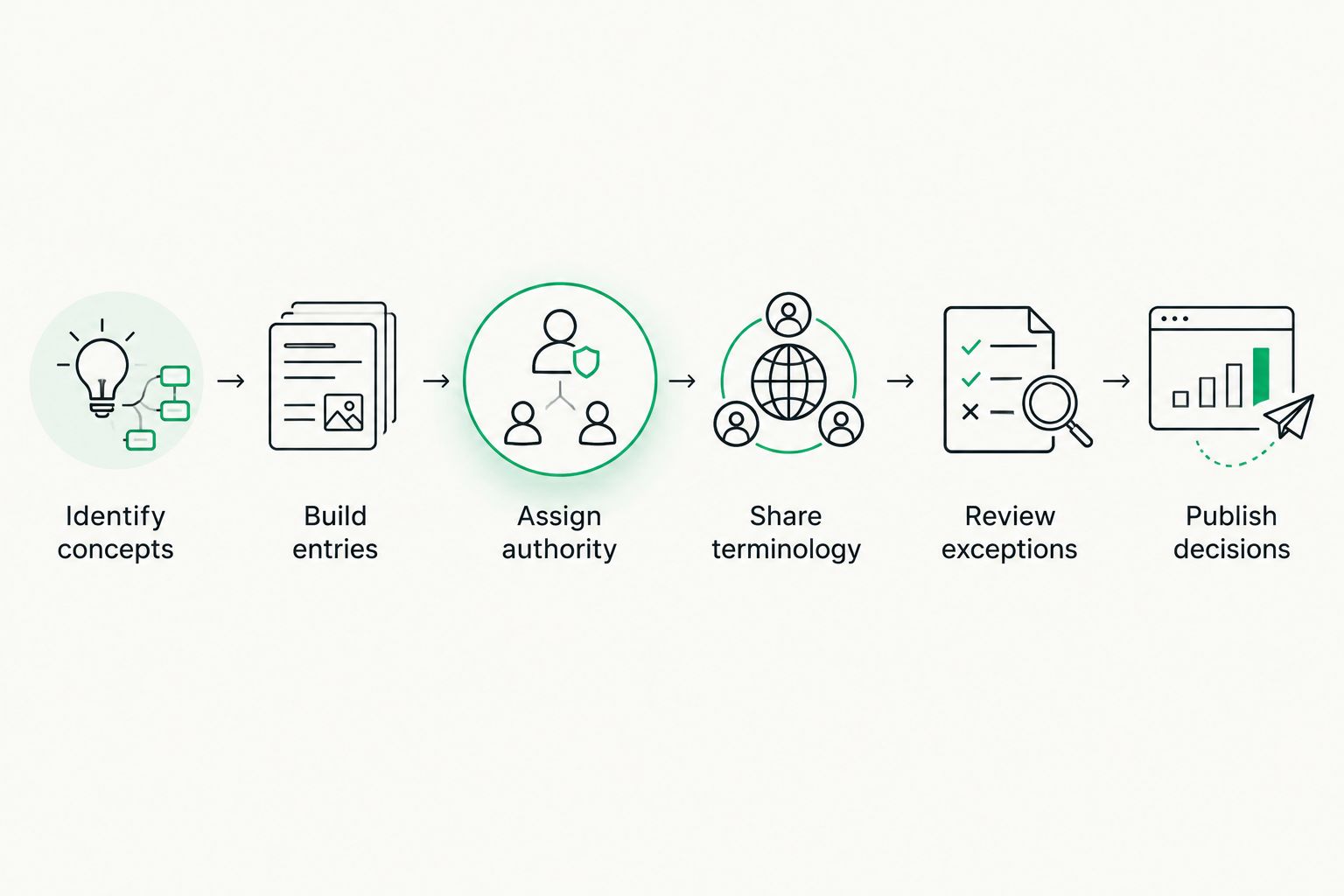
Approved decisions must return to the resources translators use for their next assignment.
Which resource should hold your terminology rules?
A termbase, translation memory, and style guide serve different purposes. Use them together, but give each resource a clear job so translators know which instruction governs a disagreement.
Termbase
- Best for: Controlling recurring concepts and approved vocabulary
- Main benefit: Connects a term to its meaning, locale, and usage rules
- Limitation: Needs active ownership and maintenance
Translation memory
- Best for: Reusing previously translated segments
- Main benefit: Preserves approved wording in repeated or similar content
- Limitation: Can repeat obsolete terminology if entries remain unchanged
Style guide
- Best for: Defining voice, formatting, and writing conventions
- Main benefit: Explains how translations should read
- Limitation: Does not replace concept-level terminology decisions
Use the termbase to decide what a concept is called; use translation memory to reuse how it was expressed. A style guide explains broader choices, such as capitalization or formality, without trying to list every approved term.
When these resources conflict, investigate the conflict rather than automatically trusting the oldest translation. Your 2026 review instructions should identify the current approved terminology source and explain how reviewers report outdated memory entries.
What should a useful terminology entry include?
A useful entry answers the translator's immediate question: does this approved term apply to this meaning, in this locale, in this context? Build your template around that decision.
Concept definition
- What to record: The meaning being named
- Why it matters: Separates concepts that share a source word
Source term
- What to record: The approved source-language expression
- Why it matters: Connects the entry to incoming content
Target locale
- What to record: The language and regional context
- Why it matters: Prevents regional preferences becoming universal rules
Preferred translation
- What to record: The approved target-language expression
- Why it matters: Gives translators a clear default
Usage context
- What to record: Where and how the term applies
- Why it matters: Distinguishes interface labels from explanatory text
Restrictions
- What to record: Prohibited alternatives or nontranslation instructions
- Why it matters: Makes boundaries explicit
Status and owner
- What to record: Approval state and responsible person
- Why it matters: Shows whether the entry is authoritative
Change record
- What to record: The decision and its rationale
- Why it matters: Helps reviewers understand later revisions
As a hypothetical example, an English word such as “account” can refer to a user profile or a financial record. A word-pair list cannot explain that distinction; separate concept definitions can.
Keep examples tied to actual source content when you build your own entries. Invented context is no substitute for the screen, sentence, or document the translator must interpret.
Why terminology consistency varies across projects
Terminology control depends on more than translator attention. These factors change what your workflow needs to address:
- Source ambiguity: An undefined source term leaves translators to infer meaning independently. Resolve the concept before debating the target word.
- Locale differences: Regional vocabulary and conventions require locale-specific approval rather than a single rule for every speaker of a language.
- Grammar: Inflection, agreement, and word order affect how an approved term appears in a sentence. Define acceptable variation.
- Content context: An interface label and a full explanatory sentence can need different treatment. Record where a rule applies.
- Resource conflicts: An old translation-memory entry can disagree with a newly approved term. Assign responsibility for reconciliation.
- Decision ownership: Unreviewed suggestions and undocumented reviewer changes create competing instructions. Publish a clear approval state.
The practical response is not to demand identical strings everywhere. Require consistent concepts and documented language rules. That preserves meaning without forcing unnatural target-language sentences.
Where does a translation management system fit?
A translation management system helps organize the work around terminology: assignments, reusable translations, review, and quality management. It does not decide whether a disputed word expresses the intended concept.
Wxrks is a translation management system best suited to teams seeking workflow automation, translation memory, quality management, and cost tracking together. Those are relevant capabilities when terminology decisions need to sit within a broader localization process.
The limitation remains editorial: software cannot replace your designated terminology approver. When evaluating a platform in 2026, ask how translators access approved vocabulary, how reviewers handle exceptions, and how changed decisions reach reusable content. Confirm those details for your intended setup rather than assuming every platform handles them identically.
How do you prevent terminology drift after approval?
Prevent terminology drift by making changes visible and checking affected content when approved vocabulary changes. Approval is a checkpoint, not a permanent guarantee that every resource remains aligned.
Use a change record that states what changed, why, which locale it affects, and which content needs review. Separate a correction to an inaccurate term from a preference change; they need different publication decisions.
Give translators a way to flag questionable terms during an assignment. A controlled exception process preserves the approved baseline while allowing experts to improve it.
Can translators use different forms of an approved term?
Translators can use different forms when grammar or a documented context rule requires them. Consistency means preserving the approved concept, not copying a dictionary form into every sentence.
Have a qualified reviewer assess inflection, agreement, capitalization, and related variations. Store recurring exceptions as usable guidance so the same valid form does not trigger repeated disputes.
Should you update translation memory after terminology changes?
Update affected translation-memory entries after a terminology change has been approved and its scope established. Otherwise, reused translations can reintroduce the wording you just retired.
Do not apply an unreviewed global replacement. Find affected segments, check the concept and context, and approve the revised translations before returning them to reuse.
FAQ
What's the best way to keep terminology consistent across freelance translators?
Give freelance translators access to the same approved termbase and a named decision owner. Include context, locale rules, and a way to request exceptions before delivery.
Is a glossary enough to keep translations consistent?
A glossary alone is not enough when it lacks definitions, ownership, and review rules. Connect approved entries to the translation workflow and check their use before publication.
Is translation memory the same as a terminology database?
Translation memory stores reusable translated segments; a terminology database records terms and their meanings. Use the terminology database to govern vocabulary and review memory entries when approved terms change.
Can automated terminology checks replace a language reviewer?
Automated terminology checks do not replace a language reviewer. Reviewers must assess meaning, grammatical variation, and context before accepting or rejecting a flagged occurrence.
Who should approve terminology changes?
A designated target-language approver should approve terminology changes, with subject-matter input where meaning is disputed. Record the rationale and publish the decision to everyone using the affected resources.
Can Wxrks help organize terminology-related translation work?
Wxrks provides translation workflow automation, translation memory, and quality management. Keep terminology ownership and approval rules explicit, and confirm the platform setup required for your review process.
How should a new translator learn approved terminology?
Give a new translator the current terminology reference, relevant context, and a clear escalation route before assigning work. Review an initial sample for terminology decisions before the translator continues with the remaining content.
One last thing
An approved term can be wrong for a particular sentence without being wrong for the concept it names. Your strongest control is therefore not an absolute ban on variation; it is a clear distinction between an error and an authorized exception.
For your next 2026 assignment, ask a translator and reviewer to resolve an ambiguous term using only the existing entry. If they need separate explanations, improve the entry before distributing more work.
Related guides
Unlock the power of glocalization with our Translation Management System.
Unlock the power of
with our Translation Management System.