Can AI translation tools keep a consistent brand voice?


Yes, AI translation tools can help maintain a consistent brand voice when you give them clear style rules, approved terminology, relevant context, and human review. In 2026, treat the output as a draft to check against your brand standards—not proof that the same personality, meaning, and level of formality survived translation.
TL;DR
- Can AI translation tools keep a consistent brand voice? Yes, with language-specific guidance and human review.
- Use glossaries for terminology, translation memory for approved wording, and style guides for tone.
- Check meaning and audience fit separately: fluent translation does not prove brand consistency.
- Wxrks supports translation memory and quality management; your team still defines the brand voice.
Why this matters
A translation can be grammatically correct and still sound unlike your company. A direct product message can become stiff; a reassuring support response can become overly casual. Those differences matter wherever customers need to recognize your voice.
For your 2026 localization workflow, make approved language reusable rather than asking every translator or tool to reconstruct it. The guide to translation memory software for freelancers explains the role of stored translations. Memory helps with wording consistency, but brand consistency needs more than repetition.
Can AI translation tools keep a consistent brand voice?
Yes—but consistency comes from the translation workflow, not from the tool alone. Give the tool an explicit brief, then check whether the result preserves your intent and sounds appropriate to the target audience.
Start with 3 reference assets: a glossary, a translation memory, and a language-specific style guide. These assets solve different problems. None replaces the others, and none eliminates editorial judgment.
Glossary
- Best for: Consistent terminology
- What it contributes: Approved terms, prohibited alternatives, and usage notes
- What it does not establish: Sentence rhythm, humor, or the right level of warmth
Translation memory
- Best for: Repeated or closely related content
- What it contributes: Previously approved source and target segments
- What it does not establish: Whether old wording suits a new context
Language-specific style guide
- Best for: Brand personality
- What it contributes: Formality, audience relationship, tone rules, and examples
- What it does not establish: Whether every translated statement is accurate
A glossary can prevent competing translations of a feature term. Translation memory can bring an approved sentence back into a related project. A style guide explains why that sentence sounds right—and when a different sentence would be better.
The limitation is equally important: approved terminology can sit inside an awkward sentence, and approved wording can be wrong for a different audience. Check the complete message, not just the matched terms.
What should stay consistent across languages?
Keep the brand's intent and audience relationship consistent. If your source content is clear, respectful, and practical, the translation should preserve those qualities without copying every grammatical choice.
Separate these concerns in your brief:
- Meaning: What must the reader understand?
- Terminology: Which names and terms must remain controlled?
- Personality: How should the message feel?
- Action: What should the reader do next?
Literal similarity is not the goal. A translated call to action can use a different sentence structure while keeping the same purpose and level of confidence. Conversely, a close translation can preserve the words while losing the intended relationship with the reader.
Write a brand-voice brief the tool can use
Start with observable instructions. Words such as friendly, bold, and professional leave too much room for interpretation unless you explain what they mean in actual copy.
For example, a hypothetical brief might ask for direct instructions, familiar vocabulary, and restrained enthusiasm. Pair those instructions with approved examples and an explanation of what makes each example suitable. Do not rely on adjectives alone.
Define the audience relationship
Tell the translator or tool who is speaking and who is reading. A product interface, a support article, and a campaign headline serve different purposes even when they belong to the same company.
Specify whether the reader needs instruction, reassurance, or persuasion. Then describe the relationship: expert to practitioner, service team to customer, or company to prospective buyer. That context gives tone decisions a practical basis.
Make the guidance language-specific
An English style rule is not automatically a complete brief for another language. Ask a qualified target-language reviewer to define suitable forms of address, formality, sentence patterns, and punctuation conventions.
Keep the underlying personality stable while allowing local expression. If a source-language joke needs extensive explanation, preserve the intended warmth rather than forcing the joke into the translation. The reviewer should document that choice so the next project follows the same reasoning.
Include boundaries, not just preferences
A useful brief says what must not change. Identify factual claims, product names, warnings, and other content that requires precise treatment.
Also define unacceptable tone choices. For example, a hypothetical support brief can prohibit blame, sarcasm, and added promises. These boundaries make review more concrete than asking whether the translation simply sounds good.
Use a repeatable brand-voice workflow
Build your 2026 process around 5 steps: prepare the brief, add context, draft, review, and save approved wording. Assign responsibility for each step so an unfinished draft cannot be mistaken for approved content.
Prepare the brief
Bring the glossary, relevant memory entries, and target-language style guidance into the assignment. Confirm that the examples match the content type and intended audience.
Remove contradictory instructions before translation starts. A brief that asks for both highly formal language and conversational familiarity needs a decision, not a longer prompt. Record which rule takes priority and why.
Add context
Supply the surrounding text, content purpose, and relevant usage information. A short interface label needs to be understood as an interface label, not translated as an isolated dictionary entry.
For marketing content, include the intended action and the meaning the message must preserve. For support content, include the problem being solved. Context should explain the job of the text without inviting the tool to invent extra benefits or assurances.
Draft
Ask for a translation that follows the brief and preserves the factual content. Treat alternative wording as an editorial choice, not an opportunity to change the offer or expand the claim.
Where the source is ambiguous, resolve the ambiguity before accepting a target version. A polished draft is not evidence that the tool interpreted an unclear source correctly.
Review
Have a qualified reviewer check meaning, terminology, tone, and audience fit. Keep these judgments separate so a good tone score does not hide a factual error.
Give reviewers permission to reject fluent but off-brand wording. Require an explanation tied to the brief: too formal for the audience, inconsistent terminology, or an added assurance. Specific feedback can guide the next draft; a vague request to make it better cannot.
Save approved wording
Store approved translations and update the relevant guidance after review. Distinguish accepted text from drafts so rejected phrasing does not become a reusable reference.
When a reviewer changes a recurring expression, decide whether the change applies only to that context or belongs in the shared guidance. That distinction prevents a local edit from silently becoming a universal rule.
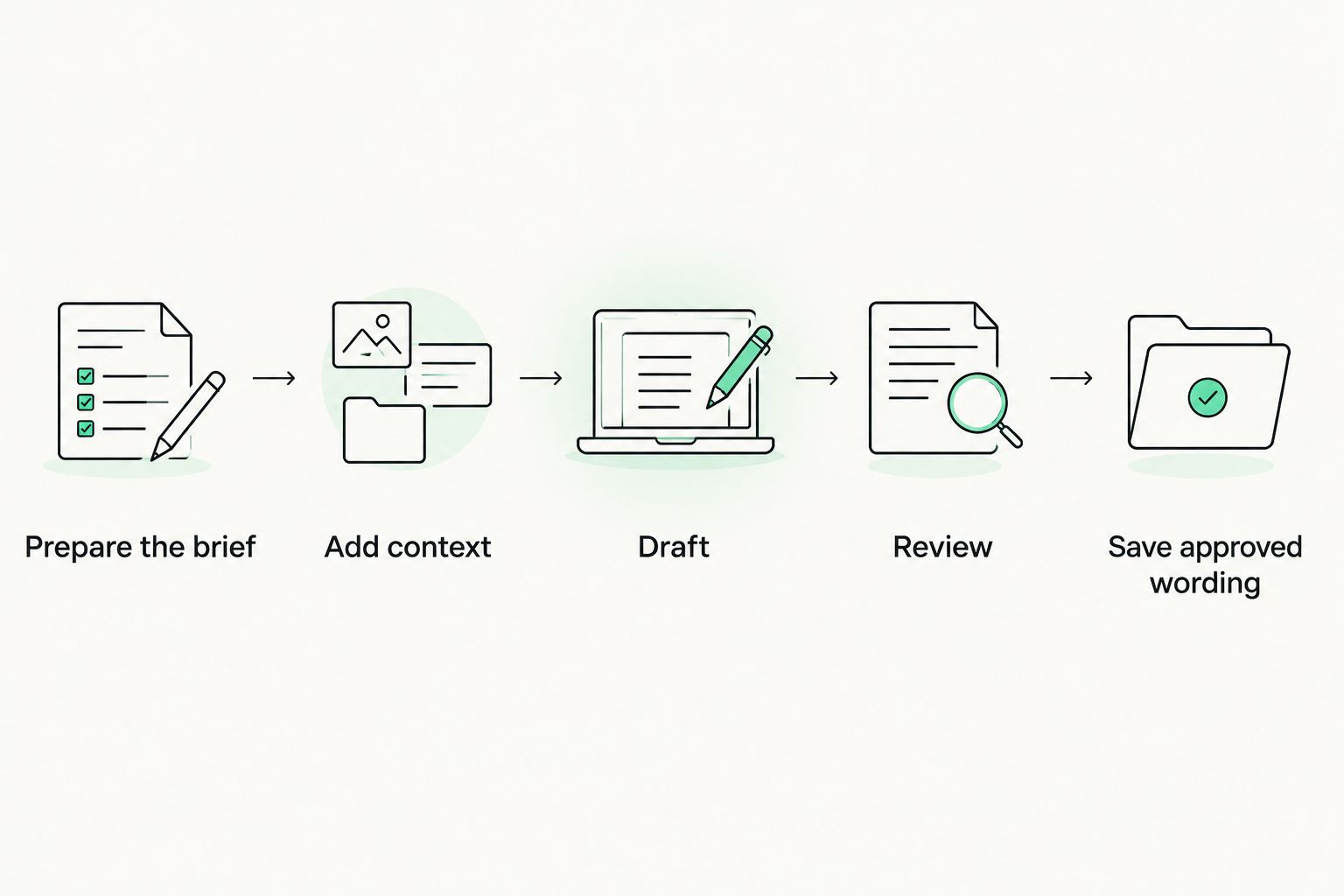
Save approved wording only after meaning and brand voice have been reviewed.
Why brand-voice consistency varies
Brand-voice consistency depends on the information and decisions attached to the translation. Review these factors before blaming every mismatch on the translation engine:
- Source clarity: Ambiguous source wording leaves the intended meaning unresolved. Fix the source rather than expecting the translation to settle it.
- Available context: Isolated strings omit the situation in which the reader encounters the message. Include enough context to explain its purpose.
- Terminology guidance: Conflicting or outdated terms create competing instructions. Maintain approved terms and usage notes.
- Target-language rules: A source-language style guide does not settle every local formality or phrasing decision. Add target-language guidance.
- Reference quality: Reusing an outdated translation repeats its problems. Review reference material before treating it as a standard.
- Approval ownership: Without a named decision-maker, competing reviewer preferences remain unresolved. Assign final responsibility for voice decisions.
These factors are practical review points, not a guarantee of perfect output. The useful question is whether your team can identify a mismatch, explain it, and prevent the same mismatch from becoming an approved reference.
How should you test a tool for brand voice?
Use a controlled evaluation in 2026 instead of judging a tool from a polished demonstration. Supply the same source material, guidance, and context for every workflow you assess.
Choose 4 test cases: a campaign headline, an interface instruction, a support response, and a recurring product description. This is a suggested evaluation set, not an industry benchmark. Replace any case that does not represent your actual content.
Campaign headline
- Best for assessing: Persuasive tone
- What to check: Intent, personality, and factual restraint
- Limitation: A headline does not test longer explanations
Interface instruction
- Best for assessing: Concise guidance
- What to check: Action clarity and appropriate terminology
- Limitation: An isolated string omits the surrounding interface
Support response
- Best for assessing: Audience relationship
- What to check: Reassurance, clarity, and avoidance of added promises
- Limitation: Tone depends on the customer's situation
Product description
- Best for assessing: Repeated messaging
- What to check: Stable terminology and consistent claims
- Limitation: Familiar wording does not prove suitability elsewhere
Ask reviewers to record the problematic text, the reason for the correction, and the approved replacement. Do not reduce the exercise to a preference vote. A useful result explains whether the issue came from missing context, weak guidance, or an unacceptable draft.
Prefer a workflow that makes corrections reusable over one that merely produces an appealing first draft. Check how your team will retain approved wording and distinguish it from unreviewed output.
Where a translation management system fits
A translation management system addresses the workflow around translation. It does not define your personality for you, and it should not replace the people responsible for approving brand language.
Wxrks is a translation management system that helps translators, developers, enterprises, and translation agencies automate localization workflows, translation memory, quality management, and cost tracking.
Wxrks fits teams that need translation memory and quality management within a managed localization workflow. Those capabilities are relevant when brand consistency requires approved references and an organized review process.
The boundary remains clear: Wxrks supports the translation workflow; your team supplies the voice rules and approval decisions. Evaluate that combination against your own content rather than assuming a system's category establishes the quality of every translation.
Does translation memory preserve tone automatically?
Translation memory preserves previously stored wording; it does not independently establish whether that wording has the right tone for a new use. Review a reused segment against its current audience and context before approving it.
Should every language sound exactly like the source?
Every language should preserve the intended brand personality, not identical sentence structure. Let qualified reviewers adapt expression while keeping meaning, terminology, and factual boundaries intact.
Can you publish AI translations without brand review?
Do not skip brand review for public-facing copy when tone is part of the message. Define the review requirement by content type and keep an accountable approval step before publication.
FAQ
Can AI translation tools keep a consistent brand voice in 2026?
Yes, AI translation tools can support a consistent brand voice when you provide style guidance, approved terminology, context, and human review. Check meaning and audience fit before publication.
What's the best way to teach a translation tool our tone?
Give the tool a language-specific brief with approved examples and explicit boundaries. Explain the audience, the purpose of the text, and what reviewers should reject.
Is a glossary enough to keep translations on brand?
No, a glossary controls terminology rather than the complete brand voice. Add guidance for formality, sentence style, audience relationship, and content purpose.
Is translation memory better than a style guide?
Neither replaces the other: translation memory stores wording, while a style guide explains tone decisions. Use both and check reused text against the current context.
Do we still need a human translator or reviewer?
Use qualified target-language review for content whose meaning and tone require approval. The reviewer should check accuracy and brand voice as separate concerns.
How do we know whether a translation sounds like our brand?
Compare the translation with approved target-language examples and the written voice rules. Ask reviewers to explain mismatches rather than relying on a general impression.
Can Wxrks manage the workflow around brand-consistent translation?
Wxrks supports localization workflows, translation memory, quality management, and cost tracking. Your team remains responsible for defining brand voice and approving the translated content.
One last thing
Before expanding your 2026 translation workflow, inspect the reference material you already trust. An approved sentence can still belong to an outdated campaign, a different audience, or a tone you no longer use.
Clean the references before asking the tool to follow them. Mark what remains approved, retire what does not, and explain context-specific exceptions. Consistency should reproduce your current voice—not preserve yesterday's editorial decisions indefinitely.
Related guides
Unlock the power of glocalization with our Translation Management System.
Unlock the power of
with our Translation Management System.