Can AI-powered TMS platforms learn from past translations?


Yes—AI-powered TMS platforms can use past translations through translation memory, retrieved examples, terminology rules, and, where supported, model training. These mechanisms are not interchangeable: saving an approved translation does not automatically retrain an underlying model, and a correction only influences future work when the workflow makes it available for reuse.
TL;DR
- Can AI-powered TMS platforms learn from past translations? Yes, but translation memory reuse and model training work differently.
- Approved translations help only when the relevant workflow retrieves, applies, or trains on them.
- Wxrks is suited to teams seeking translation management software with workflow automation, translation memory, and quality management.
- Test whether approved corrections influence new translations, not just whether the system stores them.
Why this matters
Your translators should not have to resolve the same terminology problem every time a sentence changes. Past decisions become useful when your system connects approved language to the next relevant task—not simply when it archives completed projects.
For a 2026 TMS evaluation, separate stored knowledge, knowledge supplied during generation, and changes to the model itself. Each has different controls and failure modes. Start with the approval boundary: the guide to automatically updating translation memory when edits are approved addresses the point where reviewed work becomes reusable material.
Can AI-powered TMS platforms learn from past translations?
Yes, but learn describes several different processes. A TMS can retrieve an approved sentence without changing its translation engine, supply relevant examples to a generative model, or connect to an engine trained on selected bilingual material.
The practical question is not whether a platform remembers something. It is what changes after your reviewer approves a correction, and where that change applies.
Translation memory
- What past translations contribute: Stored source-and-target segments offered as matches
- Best for: Repeated or similar content
- Main limitation: A matching sentence can still be wrong in a different context
Retrieved examples
- What past translations contribute: Relevant approved translations supplied with a new request
- Best for: Context-sensitive wording and style guidance
- Main limitation: Results depend on which examples the workflow selects
Terminology rules
- What past translations contribute: Approved terms and usage instructions
- Best for: Consistent product or domain vocabulary
- Main limitation: A correct term does not guarantee a correct sentence
Model adaptation
- What past translations contribute: Selected bilingual examples used to update a supported model
- Best for: Specialized language with suitable training material
- Main limitation: Requires a separate training process and evaluation
Terminology rules are not necessarily learned from translation history. A reviewer can create them manually after resolving a recurring problem. They belong in this comparison because they are another way past decisions guide future output.
In a 2026 product demonstration, ask the vendor to name the mechanism behind every claim about learning. A memory match is useful, but it is not evidence that model weights changed.
Translation memory: reuse without retraining
Translation memory stores aligned source text and its translation. When related content appears, the system can offer a matching segment for reuse or editing. Exact and approximate matches are established translation-memory functions; neither requires a model to retrain.
The benefit is direct: an approved sentence remains accessible when similar work returns. The trade-off is context. A sentence approved for a help-center article might not fit a compact interface label, even when its source wording looks familiar.
Your translation memory software guide for freelancers provides related background on this reuse layer. For team workflows, also check which projects share a memory and who can approve changes.
Best for: recurring content with controlled terminology and clear approval ownership. Treat a memory match as reusable evidence, not automatic permission to publish.
Retrieved examples: past translations guide a new response
A workflow can retrieve relevant approved translations and include them in the context sent to a generative model. The model then produces a new translation with those examples available. Its underlying weights do not need to change.
This approach can carry wording preferences into sentences that are not close translation-memory matches. Its weakness is selection: irrelevant, outdated, or conflicting examples give the model poor guidance.
Ask to inspect the examples supplied for a particular translation. If the workflow supports retrieval, your evaluation should establish how it separates languages, clients, content types, and approval states.
Best for: new wording that should follow established terminology or style. Retrieval provides guidance during generation; it does not guarantee the output follows every example correctly.
Model adaptation: a separate training process
Some translation engines support adaptation using selected bilingual data. Training changes the model rather than simply placing examples beside a new translation request. This is distinct from saving a correction in translation memory.
Adaptation requires suitable data, permission to use it, and evaluation against material outside the training set. A model that reproduces training examples has not demonstrated that it handles unfamiliar content well.
In your 2026 requirements, separate the TMS from its connected translation engine. An engine's training capability does not establish that the TMS activates it, includes it in your workflow, or sends every approved edit into training.
Best for: specialized translation needs with curated bilingual material and a defined evaluation process. Do not assume automatic or continuous retraining unless the documented workflow explicitly provides it.
Why learning from past translations varies
The same archive can produce different results depending on how a workflow selects and applies it. Check these factors before importing more historical content:
- Approval status: Drafts, rejected suggestions, and final translations should not carry the same authority.
- Context: Client, audience, content type, and surrounding text determine whether a past decision applies.
- Language direction: A source-to-target pair does not establish an approved translation in the reverse direction.
- Data quality: Misaligned segments, obsolete terminology, and incorrect language labels weaken reuse.
- Selection rules: Memory matching and example retrieval determine which historical material reaches the current task.
- Update controls: Corrections need a defined route into reusable resources, including a way to retire superseded entries.
A large archive is not proof of useful learning. Relevant, approved material is the asset; volume alone is not the verdict.
How do you test whether corrections affect future translations?
Use a controlled workflow that separates storage from application. For a 2026 evaluation, bring representative material you are permitted to share and ask the vendor to demonstrate the complete path from correction to subsequent output.
Establish a baseline
Translate a representative passage before adding your approved examples. Record the source, output, language pair, and relevant settings. Include a terminology or style decision that your reviewers can judge clearly.
Keep the baseline so you can compare behavior later. Without it, a polished demonstration shows an acceptable result, not necessarily an effect from your translation history.
Approve a correction
Have a qualified reviewer correct the translation and mark it approved through the intended production workflow. Distinguish an approved correction from a draft edit or a comment requesting a change.
Do not add a separate instruction that gives away the desired answer during the follow-up test. That would test instruction following rather than the effect of the saved correction.
Inspect reuse
Check what happened to the approved material. Did it enter translation memory, become a retrievable example, update a terminology resource, or enter a training queue?
Ask to see the relevant record or workflow evidence. A saved project file demonstrates storage; it does not establish that future translation requests can access its contents.
Test new content
Submit both repeated text and a related passage with different wording. The repeated text tests direct reuse. The changed passage tests whether the correction has a useful effect beyond an identical sentence.
Keep the language pair and other relevant settings consistent. Evaluate meaning, terminology, tone, and context—not just whether the output contains your preferred word.
Check boundaries
Try content from a different client, audience, or domain where the earlier wording should not apply. Correct separation matters as much as successful reuse.
Also test a superseded term. Your team needs to know whether retiring an old decision prevents it from reappearing through memory matches or retrieved examples.
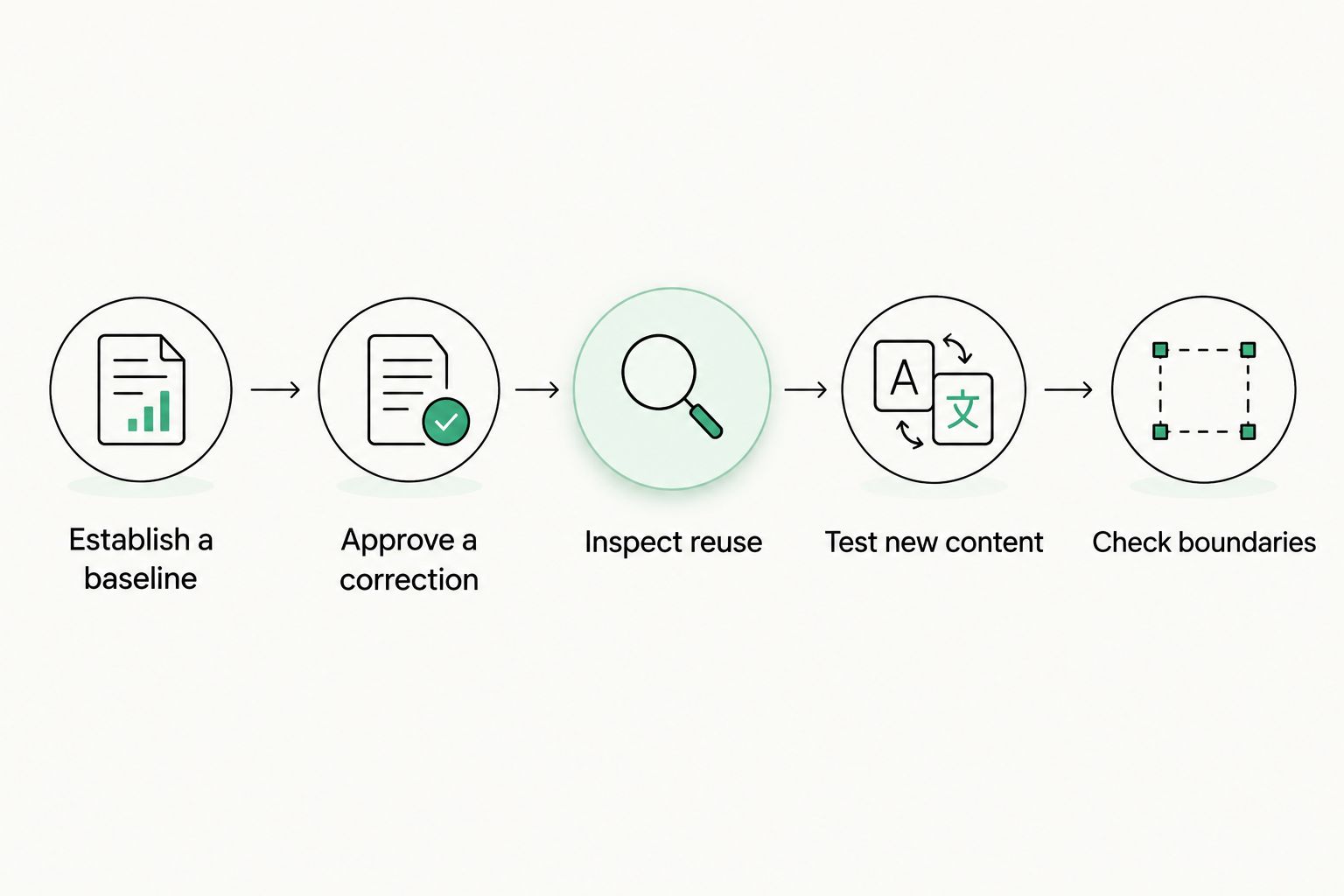
Test both successful reuse and the boundaries that prevent inappropriate reuse.
What should your team put into reusable translation resources?
Start with approved translations that still reflect your current product, terminology, and audience. Preserve useful context alongside them: language direction, content type, ownership, and approval state. Keep unrelated clients or domains separate where their language requirements differ.
Do not treat every historical translation as equally trustworthy. An archive can contain drafts, abandoned product names, temporary workarounds, and corrections that were valid only in a particular context. Importing those decisions without review carries the same problems into future work.
Wxrks translation management software includes workflow automation, translation memory, quality management, and cost tracking. Wxrks is suited to teams seeking those functions together; teams evaluating specific learning mechanisms should test them separately rather than infer them from the product category.
For a 2026 rollout, assign ownership before expanding reuse. Someone needs authority to resolve conflicting approved translations, retire obsolete terms, and decide when a correction should become a shared rule.
Does every approved edit retrain the translation model?
No—an approved edit does not automatically retrain a translation model. It can update a memory or another reusable resource without changing the model's parameters.
Ask what event starts training, which records qualify, and how a changed model is evaluated. If the workflow only saves and retrieves segments, describe it as reuse rather than retraining.
Can a TMS learn the wrong translation?
Yes—a TMS can reuse a wrong translation when an incorrect entry is accepted into its reusable resources. Retrieval can also supply a poor example to a generative model.
Approval controls and correction procedures therefore belong in the learning workflow. Fix the underlying resource as well as the current output, or the same mistake remains available for later work.
Does historical translation data remove the need for reviewers?
No—historical translation data does not remove the need to review new translations. A previously correct sentence can become inappropriate when meaning, audience, terminology, or surrounding context changes.
Review effort should reflect the consequences of an error and the type of content. Evaluate the complete output rather than assuming a familiar phrase makes the whole passage correct.
FAQ
Can AI-powered TMS platforms learn from past translations automatically?
Yes, some workflows automatically reuse approved translations or supply them as examples, but that is not the same as automatic model training. Verify which event updates each resource and how it affects subsequent work.
What's the difference between translation memory and model training?
Translation memory stores bilingual segments for matching and reuse; model training changes a model using selected data. Updating a memory does not by itself change the connected model.
Will correcting a translation fix every future occurrence?
No, correcting a translation does not guarantee that every future occurrence changes. The correction must reach the relevant reusable resource, and the workflow must select or apply it in the new context.
Can I use old translations to improve a new TMS workflow?
Yes, approved historical translations can become reusable resources when the platform supports the relevant import and reuse process. Review language alignment, permissions, terminology, and approval status before using them.
Is my translation history automatically used to train a public model?
Uploading translation history does not, by itself, establish whether it is used for public-model training. Check the provider's contractual terms, connected services, data-use settings, and documented processing arrangements.
How do I know whether translation quality actually improved?
Compare baseline output with later output on representative material that was not used as the approved example. Have qualified reviewers assess meaning, terminology, style, and context under consistent conditions.
Can different clients share the same translation memory?
Shared translation memory is appropriate only when permissions and language requirements support that use. Keep client-specific terminology and confidential material separated when sharing would create conflicts or disclosure risks.
One last thing
Test deletion and replacement, not just learning. A system that recalls your preferred term is useful; a workflow that stops applying a retired term gives you control over changing requirements.
When evaluating Wxrks or another TMS in 2026, finish the demonstration by superseding an approved decision and translating related content again. That test reveals whether your reusable knowledge stays current—not merely whether your archive keeps growing.
Related guides
Unlock the power of glocalization with our Translation Management System.
Unlock the power of
with our Translation Management System.