Can a TMS track translator productivity and cost per word?


Yes. A translation management system can track translator productivity and cost per word when it captures word counts, attributable work time, workflow stages, and the costs you include. The useful comparison is accepted work against effort and total cost—not raw words completed. Reporting capabilities vary by platform, so verify time capture, review attribution, and exportable calculations before choosing a TMS in 2026.
TL;DR
- Can a TMS track translator productivity and cost per word? Yes, with defined word counts, time records, and cost boundaries.
- Measure accepted words per working hour; keep review effort and waiting time separate.
- Compare cost per source word alongside quality, translation memory reuse, and workflow stage.
- Wxrks combines translation memory, quality management, workflow automation, and cost tracking; verify reporting details against your requirements.
Why this matters
A translator handling new technical content and a translator checking repeated text are doing different jobs. Ranking them by completed words alone confuses task difficulty with performance. The same problem appears in cost reporting: a low translation-only figure leaves you blind to review and rework.
Your 2026 reporting plan should connect output, effort, and acceptance. Start with a shared definition of quality; this guide to measuring translation quality accurately explains the companion discipline. Productivity without an acceptance rule rewards completion, not usable translation.
Can a TMS track translator productivity and cost per word?
Yes, provided the TMS records the necessary inputs or lets you combine its exports with approved time and cost records. A word-count dashboard is not enough. You need to know who performed the work, which stage they completed, what counted as finished, and which expenses belong in the calculation.
Use these definitions before comparing people, vendors, or projects:
Translator throughput
- Calculation: Accepted words ÷ recorded working hours
- Best for: Comparing similar translation assignments
- Limitation: Depends on reliable time records and equivalent tasks
Review throughput
- Calculation: Reviewed words ÷ recorded review hours
- Best for: Planning reviewer capacity
- Limitation: Does not describe the severity of corrections
Translation-only cost per word
- Calculation: Translation charges ÷ agreed word count
- Best for: Reconciling translation charges
- Limitation: Excludes review and other delivery work
Fully loaded cost per word
- Calculation: Included project costs ÷ agreed word count
- Best for: Understanding delivery economics
- Limitation: Requires an explicit cost boundary
End-to-end turnaround
- Calculation: Acceptance timestamp minus intake timestamp
- Best for: Tracking delivery commitments
- Limitation: Includes waiting, not just productive work
These measures answer different questions. Use throughput to examine effort, turnaround to examine delivery, and fully loaded cost to examine economics. Keep quality beside all three rather than treating it as an optional filter.
Define what a word means
Choose source words or target words as the denominator and keep that choice visible. Different languages produce different word counts, and tokenization rules also matter. Switching denominators between projects makes a cost trend difficult to interpret.
For procurement and project reconciliation, use the counting basis agreed with the supplier. For internal analysis, document how you treat repeated segments, translation memory matches, excluded strings, and changed source text. Preserve the original analysis so later updates do not silently rewrite the baseline.
Define what completed means
Decide whether productivity counts submitted, reviewed, or accepted words. Submitted output measures handoff; accepted output measures work that passed your chosen quality gate. Neither definition should change halfway through a report.
Keep reopened work visible. Otherwise, a translator's initial completion appears in one period while the effort needed to correct it disappears into another. Record revision effort against the same assignment wherever your reporting system permits it.
How do you set up reliable TMS productivity reporting?
Build the measurement rules before building a leaderboard. For a 2026 evaluation, ask the platform provider to demonstrate the following sequence using a representative assignment, including a correction after review.
- Define scope. Record the language pair, content type, source version, and counting basis. Separate new translation from translation memory reuse and machine translation post-editing so the workload remains interpretable.
- Capture effort. Identify how working time enters the system: an editor timer, a timesheet, or an external record. Establish whether research, terminology work, and review are included. Do not substitute elapsed project time for working time.
- Separate stages. Track at least 3 workflow stages in your reporting design: translation, review, and acceptance. Assign responsibility for each stage rather than crediting every completed word to the last person who touched the file.
- Apply acceptance. Connect completed work to your documented quality gate. Preserve correction reasons so you can distinguish a translation error from a source change or a revised instruction.
- Reconcile costs. Compare calculated totals with approved project records. Confirm that included charges, excluded work, and the word-count denominator remain consistent across the report and its export.
A demonstration should reveal both the calculation and the underlying records. If a chart cannot be traced to assignments, timestamps, time entries, and cost inputs, you cannot resolve a disputed result from the chart alone.
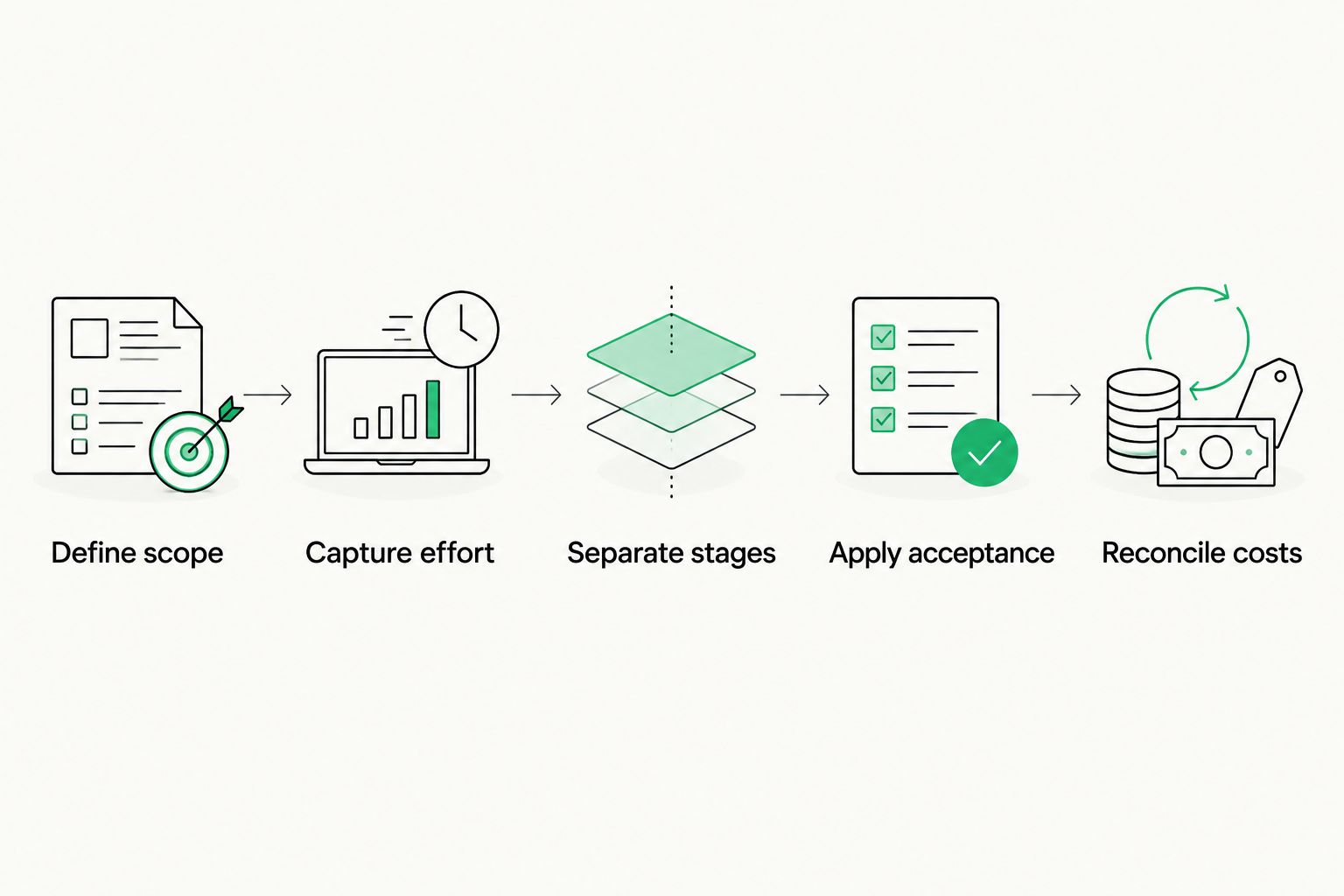
Define the measurement rules before comparing translator performance.
Ask for 2 reporting views: an assignment-level view for checking individual records and an aggregate view for planning. The assignment view explains an unusual result; the aggregate view shows patterns across comparable work. Both should use the same definitions.
What should the demonstration prove?
Request a walkthrough from the original source analysis to the final accepted deliverable. Ask the presenter to identify the source of every field used in the productivity and cost calculations. A manually entered value is not automatically wrong, but it needs an owner and a correction process.
Then change the scenario. Reopen a segment, replace part of the source, and move a task between contributors. Check whether the report preserves attribution and distinguishes new work from corrections. This tests reporting logic without relying on a polished sample dashboard.
How should you calculate cost per word?
Cost per word equals the costs inside your chosen boundary divided by the agreed word count. State the boundary beside the result. Without it, the label hides more than it explains.
A translation-only calculation includes translation charges. A fully loaded calculation includes the additional delivery costs you decide to allocate, such as review, project coordination, terminology work, and platform usage. Do not call a figure fully loaded while leaving those decisions undocumented.
Keep operational and billing counts separate
A billing analysis can weight translation memory matches according to an agreement. That does not make the weighted count a neutral measure of translator output. Discounted billing units and actual words describe different things.
Keep both fields when they serve different purposes. Use agreed billing units to reconcile charges and a documented operational count to study effort. For the reuse side of that distinction, see how translation memory lowers localization costs.
Keep shared costs visible
Shared expenses need an allocation rule. Decide whether project coordination and platform usage belong to a project, language, department, or reporting period. Apply the rule consistently rather than moving expenses to whichever category makes the result look better.
Your 2026 cost report should also distinguish planned amounts from approved actuals. A budget describes an expectation; an approved actual describes recorded expenditure. Mixing them in the same trend obscures whether a difference came from delivery or estimation.
Why translator productivity and cost per word vary
Differences are useful only when you can explain their causes. Group comparable assignments first, then inspect the factors below rather than treating every deviation as a performance issue.
- Content difficulty. Specialist terminology, ambiguous source text, and missing context require different work from straightforward content. Tag those conditions before interpreting a low throughput result.
- Translation memory reuse. New segments and reused segments create different editing tasks. Report their mix so reuse does not masquerade as an individual productivity gain.
- Workflow stage. Translation, post-editing, review, and final acceptance have different responsibilities. Compare like stages instead of collapsing them into a single speed ranking.
- Quality requirements. Acceptance criteria determine how much checking and correction the assignment needs. Record the quality gate alongside the output measure.
- Cost boundaries. Translation-only and fully loaded calculations include different expenses. A changed allocation rule can change cost per word even when the translation task stays the same.
When a result changes, investigate the assignment mix before changing a target. Use 1 reporting period consistently across the comparison, and disclose incomplete work carried into or out of that period. Otherwise, timing differences can distort the apparent relationship between effort and accepted output.
Can a TMS measure productivity without tracking active time?
A TMS can report completed words and task turnaround without active-time records, but it cannot calculate defensible words per working hour from timestamps alone. An assignment can sit open while its owner waits for context, handles another task, or takes a break.
Treat timestamp-based reporting as workflow reporting. It is useful for finding queues and late handoffs, but it is not evidence of how continuously someone worked.
Is a lower cost per word always better?
A lower cost per word is not automatically better because the figure depends on scope, acceptance, and included expenses. Compare the same counting basis and cost boundary before deciding that a supplier or workflow is more economical.
Check rework alongside the initial figure. A calculation that excludes corrections cannot show the full effort needed to deliver accepted content.
Can you compare translators working in different languages?
You can compare their records, but raw words per hour is not a fair standalone ranking across different language pairs and assignments. Language-specific counting, content difficulty, translation memory reuse, and review requirements change the task.
Start with each contributor's results on comparable work. Use cross-language reports for capacity planning with the differences visible, not as an automatic performance league table.
Where Wxrks fits in the reporting workflow
Wxrks is a TMS for teams that need workflow automation, translation memory, quality management, and cost tracking together. That combination is relevant when productivity questions cross both operational and financial records.
For a 2026 evaluation, test the reporting details separately. Confirm active-time capture, attribution across review stages, configurable word-count calculations, and access to underlying records rather than assuming those capabilities from the category label. The trade-off is clear: bringing workflows together helps organize the work, but it does not remove the need to define your metrics.
Use the same requirements whether you are a translation agency tracking delivery economics, an enterprise planning localization capacity, or a translator examining your own workload. Wxrks belongs on that evaluation list when the stated workflow and cost-tracking functions match your needs; the reporting demonstration determines the fit.
FAQ
Can a TMS track translator productivity and cost per word automatically?
A TMS can automate those calculations when it captures the required word counts, time records, and cost inputs. Verify which inputs are automatic, which are entered manually, and whether the calculations are traceable.
What's the best metric for translator productivity?
Accepted words per recorded working hour is useful for comparing similar translation assignments. Keep content type, language pair, translation memory reuse, and quality requirements visible alongside it.
Should cost per word use source words or target words?
Use the word-count basis agreed for the project and keep it consistent. Label source-word and target-word calculations explicitly rather than combining them in a single trend.
Does translation memory make a translator more productive?
Translation memory provides previous translations for reuse, but a report must separate reused and new content to interpret productivity. Reused text still needs checking against the current context.
Can a TMS tell whether a translator is working the whole time?
Project timestamps alone cannot establish active working time. Even recorded editor activity needs a documented definition of included research, review, and other work.
How do I check whether a TMS cost report is accurate?
Reconcile the report with the original word analysis and approved project cost records. Confirm its counting basis, allocation rules, and treatment of corrections before relying on the total.
One last thing
Keep the metric definition next to the metric. A report labelled cost per word is incomplete without its denominator and cost boundary; a productivity report is incomplete without its time and acceptance rules.
Before adopting a 2026 dashboard, ask someone outside the localization team to explain a result using only the report. If they cannot tell what was counted, what was excluded, and what passed review, fix the labels before using the numbers to make staffing or supplier decisions.
Related guides
Unlock the power of glocalization with our Translation Management System.
Unlock the power of
with our Translation Management System.