How to calculate ROI on a translation management system


Calculate translation management system ROI by subtracting the total TMS investment from the measurable benefits attributable to it, dividing that net benefit by the investment, and expressing the result as a percentage. Compare the same workload, quality standard, and reporting period; include implementation, training, administration, and review effort rather than counting subscription costs alone.
TL;DR
- How to calculate ROI on a translation management system: divide net attributable benefits by total investment.
- Separate cash savings from recovered capacity; saved hours do not automatically reduce spending.
- Wxrks fits teams evaluating workflow automation, translation memory, quality management, and cost tracking together.
- Compare equivalent workloads and accepted translations, not raw output or translation memory matches alone.
Why this matters
A faster translation workflow is not automatically a profitable one. If coordination time falls but review effort rises, your business case needs both changes—not just the favorable result.
Build your 2026 evaluation around a defined workload and an agreed quality threshold. Before setting the measurement window, account for how long TMS implementation takes: setup effort belongs in the investment, while routine operating performance needs separate measurement.
The decision is whether the TMS creates enough attributable value to cover its full cost—not whether it produces more translated words.
How to calculate ROI on a translation management system
Use this formula for the period you are evaluating:
TMS ROI (%) = [(attributable benefits − total TMS investment) ÷ total TMS investment] × 100.
Attributable benefits include verified spending reductions and separately identified economic benefits. Total investment includes the incremental software, implementation, training, integration, and operating costs required to achieve those benefits.
An ROI of 0% means measured benefits equal investment. An ROI of 100% means net benefit equals the original investment. Neither result tells you when the investment pays back; that requires a separate cash-flow calculation.
Follow the steps below to build a calculation that finance and localization teams can both check.
1. Define the decision and measurement period
Write down what you are evaluating: adopting a TMS, replacing an existing platform, or expanding an established workflow. Each decision has a different counterfactual—the process you would use without the proposed change.
For a 2026 business case, use a 12-month planning horizon if your organization budgets annually. This is a planning choice, not an industry benchmark. Record the start date and distinguish implementation from normal operation.
Keep the time basis consistent. Do not compare annual benefits against monthly investment or assume a workflow delivers benefits before the team starts using it.
2. Establish a comparable baseline
Record the work your current process requires, including preparation, translation, review, coordination, and publishing. Use invoices, time records, accepted deliverables, and correction logs wherever those records exist.
A fair baseline preserves the workload characteristics that affect effort. Compare equivalent language pairs, content types, repetition levels, and review requirements—not an easy batch against a difficult one.
Accepted output
- Current workflow: Completed work meeting your quality standard
- TMS workflow: Equivalent accepted work
- What the comparison establishes: Whether output is comparable
Translation effort
- Current workflow: Recorded translation and editing time
- TMS workflow: Recorded translation and editing time
- What the comparison establishes: Change in production effort
Coordination effort
- Current workflow: File handling, assignments, and status updates
- TMS workflow: Remaining coordination plus system administration
- What the comparison establishes: Net workflow change
Review effort
- Current workflow: Review, corrections, and repeat checks
- TMS workflow: Review, corrections, and repeat checks
- What the comparison establishes: Whether effort shifted downstream
External spending
- Current workflow: Relevant invoices and contracted services
- TMS workflow: Equivalent spending after adoption
- What the comparison establishes: Realized spending change
Operating overhead
- Current workflow: Existing tools and administration
- TMS workflow: TMS-related tools and administration
- What the comparison establishes: Incremental investment
Treat this table as a measurement specification. Assign an owner and an evidence source to each row before the evaluation starts.
3. Calculate the full investment
Separate one-time implementation work from recurring operating expenses. Include internal labor as well as external spending, but label them separately so decision-makers can distinguish cash requirements from staff allocation.
Your investment register should cover:
- Software: the subscription and applicable usage charges in your agreement.
- Implementation: configuration, migration, and preparation of existing language assets.
- Integration: development, testing, and maintenance needed for your actual workflow.
- Training: onboarding and learning time for translators, reviewers, developers, and administrators.
- Administration: ongoing access management, workflow maintenance, and support effort.
Only include costs relevant to the decision. If an existing expense continues unchanged under either approach, it does not create an incremental difference; document it without presenting it as a new investment.
4. Measure benefits without counting them twice
Calculate benefits from observed changes, not feature lists. Translation memory, workflow automation, and quality controls are mechanisms; the financial benefit is the verified change they produce.
If translation memory reduces a vendor invoice, record the invoice reduction. Do not also count an estimated reduction in that vendor's working hours as another benefit to your business.
For internal staff, calculate recovered capacity as recorded hours saved multiplied by the relevant loaded hourly labor cost. Label that result as capacity value unless spending actually falls. Time released for other work is not the same as cash returned to the budget.
5. Subtract added effort and quality costs
Automation can remove manual handling while leaving review, exceptions, and maintenance behind. Measure those remaining tasks rather than assuming they disappear.
Count post-editing and corrections wherever they occur. If a reviewer spends longer repairing a translation, that effort belongs in the TMS workflow even when the initial translation was quick.
Maintain the same acceptance standard throughout the comparison. A lower-cost output that fails your required quality checks is not an equivalent deliverable.
6. Calculate ROI and payback separately
Apply the ROI formula after you have reconciled the benefit and investment registers. Use consistent accounting treatment so the same expense does not appear both as a reduction in benefits and again as an investment cost.
For payback, track cumulative attributable cash benefits against cumulative cash investment. Payback occurs when cumulative net cash flow reaches break-even. If recurring cash benefits do not exceed recurring cash costs, there is no cash payback under that scenario.
Avoid presenting a capacity-based ROI beside a cash-based payback without explaining the difference. They answer different questions.
7. Validate the result against actual use
Compare the approved business case with actual results after implementation. Record deviations in workload, adoption, review effort, and operating costs rather than changing the baseline to make the forecast look correct.
Keep the evidence trail simple: each claimed benefit needs a source, an owner, and a calculation. Preserve those records alongside the assumptions used in your 2026 forecast.
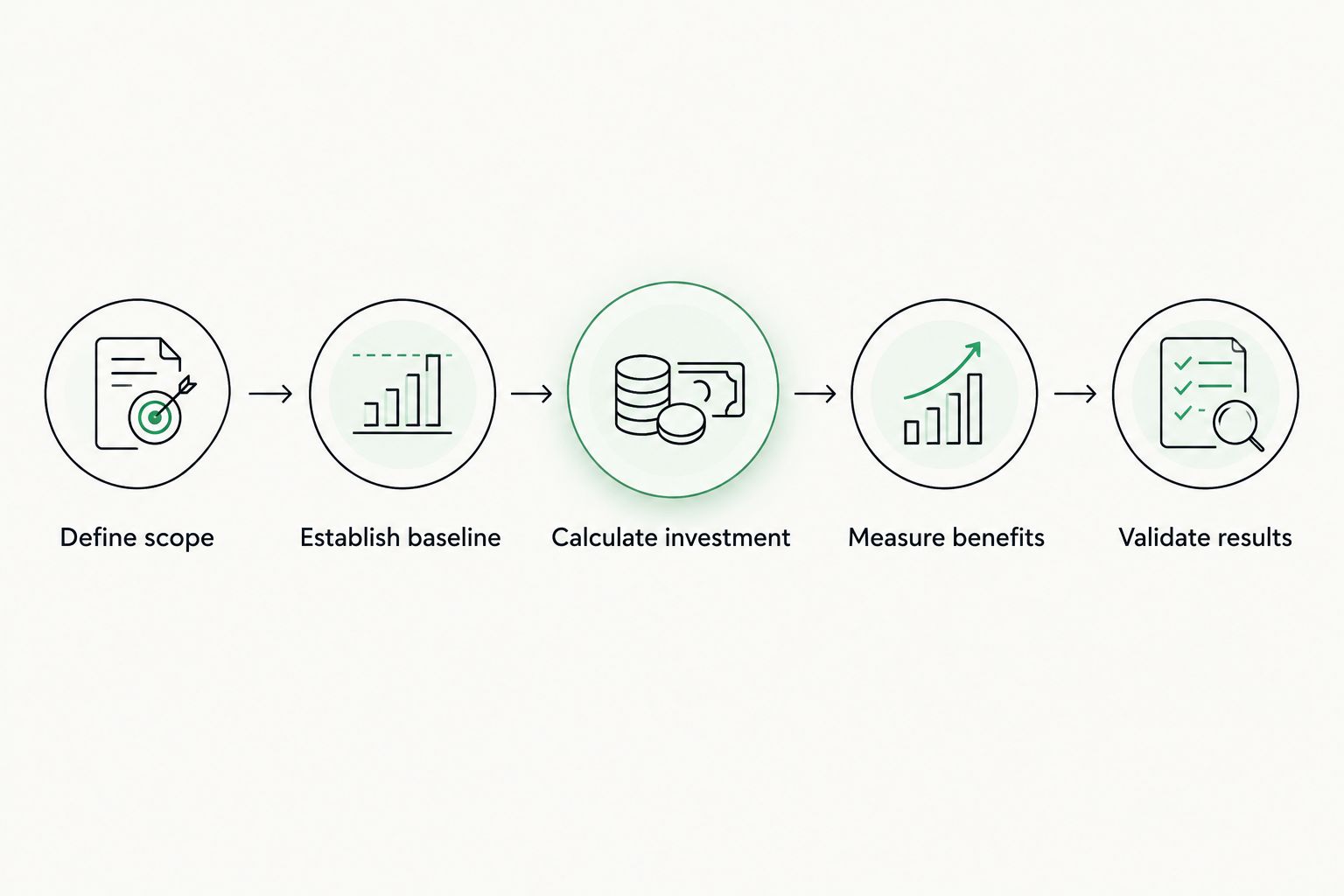
Define the comparison before assigning financial value to workflow changes.
Why translation management system ROI varies
TMS ROI depends on the work entering the system and the effort required to deliver accepted translations. Use these factors to explain differences between your forecast and your results:
- Translation memory reuse: reusable content changes the work required, but matches still need the appropriate checks.
- Workflow automation: removing file transfers and status chasing creates value only when those tasks actually disappear.
- Review requirements: terminology, context, and content sensitivity affect the human effort needed before acceptance.
- Implementation effort: migration, configuration, and integration work increase the investment before routine benefits begin.
- Adoption: benefits depend on teams using the intended workflow rather than maintaining parallel processes.
- Cost visibility: incomplete time records and invoices make it harder to separate genuine savings from shifted effort.
Do not assume the strongest factor is the same across departments. A development team can focus its measurement on release handoffs, while a translation agency can examine project coordination, review effort, and delivery costs.
Which benefits belong in your ROI calculation?
Separate benefits by how they become economic value. This prevents a promising operational result from being presented as a verified financial return.
Cash savings
- Evidence to retain: Reduced invoices, retired expenses, or documented spending changes
- Best for: Budget decisions
- Limitation: Does not capture all operational value
Recovered capacity
- Evidence to retain: Recorded time reductions and labor-cost assumptions
- Best for: Staffing and workload planning
- Limitation: Does not automatically reduce payroll
Incremental contribution
- Evidence to retain: Attributable additional activity and contribution calculation
- Best for: Growth decisions
- Limitation: Requires evidence linking the change to the TMS
Quality improvement
- Evidence to retain: Accepted-output records, corrections, and related effort
- Best for: Operational evaluation
- Limitation: Needs a defensible financial connection before monetization
Keep cash savings and capacity value visible as separate subtotals. You can present both, but a combined headline without that distinction obscures how the investment pays for itself.
For growth claims, use attributable contribution after relevant delivery costs—not total revenue. If you cannot establish the connection, report faster delivery or added capacity as an operational result instead.
How should you evaluate Wxrks in an ROI business case?
Wxrks is a translation management system for teams that need workflow automation, translation memory, quality management, and cost tracking together. Those capabilities match the areas an ROI evaluation needs to examine; they do not establish a financial return by themselves.
When evaluating Wxrks, map each relevant capability to a measurable workflow change. For example, connect translation memory to accepted reuse and related effort, or connect workflow automation to recorded coordination time.
The advantage of evaluating Wxrks across these functions is a business case tied to your localization process rather than an isolated feature. The limitation remains the same: your team must validate adoption, review effort, implementation work, and actual spending before claiming savings.
Is a positive TMS ROI enough to approve the purchase?
A result above 0% means measured benefits exceed the investment within the chosen period. Approval still depends on evidence quality, cash timing, and whether the workflow meets your operational requirements.
Use a conservative decision case built from verified spending changes. Show capacity value and unproven growth assumptions separately, so approval does not depend on treating every saved hour as cash.
Can you calculate TMS ROI before implementation?
You can forecast TMS ROI before implementation, but a forecast is not a realized return. Use your current workload, documented implementation assumptions, and an explicit plan for validating benefits.
For a 2026 approval, identify which assumptions would change the decision if they proved wrong. Test those assumptions first—for example, review effort or the amount of manual coordination actually removed.
FAQ
What's the formula for translation management system ROI?
TMS ROI is attributable benefits minus total TMS investment, divided by total TMS investment, multiplied by 100. Use benefits and investment from the same reporting period and comparable workloads.
Should I include implementation in TMS ROI?
Yes, include implementation costs attributable to the TMS decision. Configuration, migration, integration, training, and internal setup time belong in the investment when they are required to achieve the benefits.
Do saved translator hours count as cash savings?
Saved translator hours are recovered capacity unless they produce an actual spending reduction. Report capacity value separately from reduced invoices or other verified cash savings.
How do I account for translation memory in the calculation?
Count translation memory benefits through verified reductions in spending or effort while maintaining the required quality standard. Do not treat match volume alone as financial savings.
What does a TMS ROI of 100% mean?
A TMS ROI of 100% means net benefit equals the investment over the measurement period. Total measured benefits therefore equal twice the investment; the result does not specify the payback date.
Is TMS payback the same as ROI?
No, payback measures when cumulative net cash flow reaches break-even, while ROI measures net return relative to investment. Keep cash benefits separate from capacity value when calculating payback.
How long should I measure translation management system ROI?
Choose a period that matches your decision and budgeting cycle. A 12-month planning horizon supports an annual business case, but implementation timing and the point when benefits begin must remain explicit.
One last thing
A TMS can improve productivity without reducing your translation budget. If your team uses recovered capacity to translate more content, total spending can stay unchanged while output rises.
For your 2026 review, report spending and accepted output together. That distinction prevents a useful operational improvement from being mislabeled as a failed savings project—or an unsupported cash return.
Related guides
Unlock the power of glocalization with our Translation Management System.
Unlock the power of
with our Translation Management System.