How long does it take to implement a TMS?


Implementing a translation management system takes as long as your team needs to configure the workflow, prepare language assets, test content handoffs, and approve a working pilot—not just create an account. Set separate dates for pilot readiness and production rollout, because a successful translation test does not establish that permissions, publishing, quality review, and ongoing ownership are ready.
TL;DR
- How long does it take to implement a TMS? Scope and acceptance criteria determine the schedule, not account setup.
- Separate pilot readiness, production readiness, and wider rollout before committing to an implementation date.
- Test translation memory, quality review, and content handoffs with representative work before expanding.
- Wxrks serves translators, developers, enterprises, and translation agencies managing localization workflows.
Why this matters
A TMS implementation changes how content moves between people and systems. If you define completion as uploading a file, you leave the difficult questions unanswered: who reviews the translation, where approved content goes, and what happens when the source changes.
For your 2026 implementation plan, start with an operational finish line. The system is ready when your team can complete the agreed workflow and handle its exceptions, not when every possible feature has been configured.
Wxrks is a translation management system for translators, developers, enterprises, and translation agencies managing workflow automation, translation memory, quality management, and cost tracking. Those capabilities define useful evaluation areas; they do not replace testing your own content and approval process.
How long does it take to implement a TMS?
The implementation schedule depends on the work required between choosing the system and running an accepted production workflow. Build the estimate around 6 implementation stages, each with a named owner and an observable exit condition.
Do not assign a launch date by counting configuration tasks alone. Include the time your team needs to make decisions, grant access, resolve failed tests, and approve the result.
- Define scope. Identify the content, languages, people, and destination included in the first rollout. Finish with an agreed pilot boundary.
- Prepare assets. Review translation memories, terminology, source files, and relevant context. Finish with assets approved for use in the pilot.
- Configure workflow. Assign responsibilities, access, review steps, and exception handling. Finish with a documented route from submission to approval.
- Test handoffs. Check how content enters the system and how approved translations return to their destination. Finish with a repeatable round trip.
- Run pilot. Process representative content with the people who will do the work. Finish with accepted output and a resolved issue list.
- Approve rollout. Confirm training, ownership, support arrangements, and the fallback process. Finish with authorization to use the workflow in production.
A failed exit condition changes the schedule. Adding more content does not fix an unresolved publishing handoff or unclear reviewer responsibility.
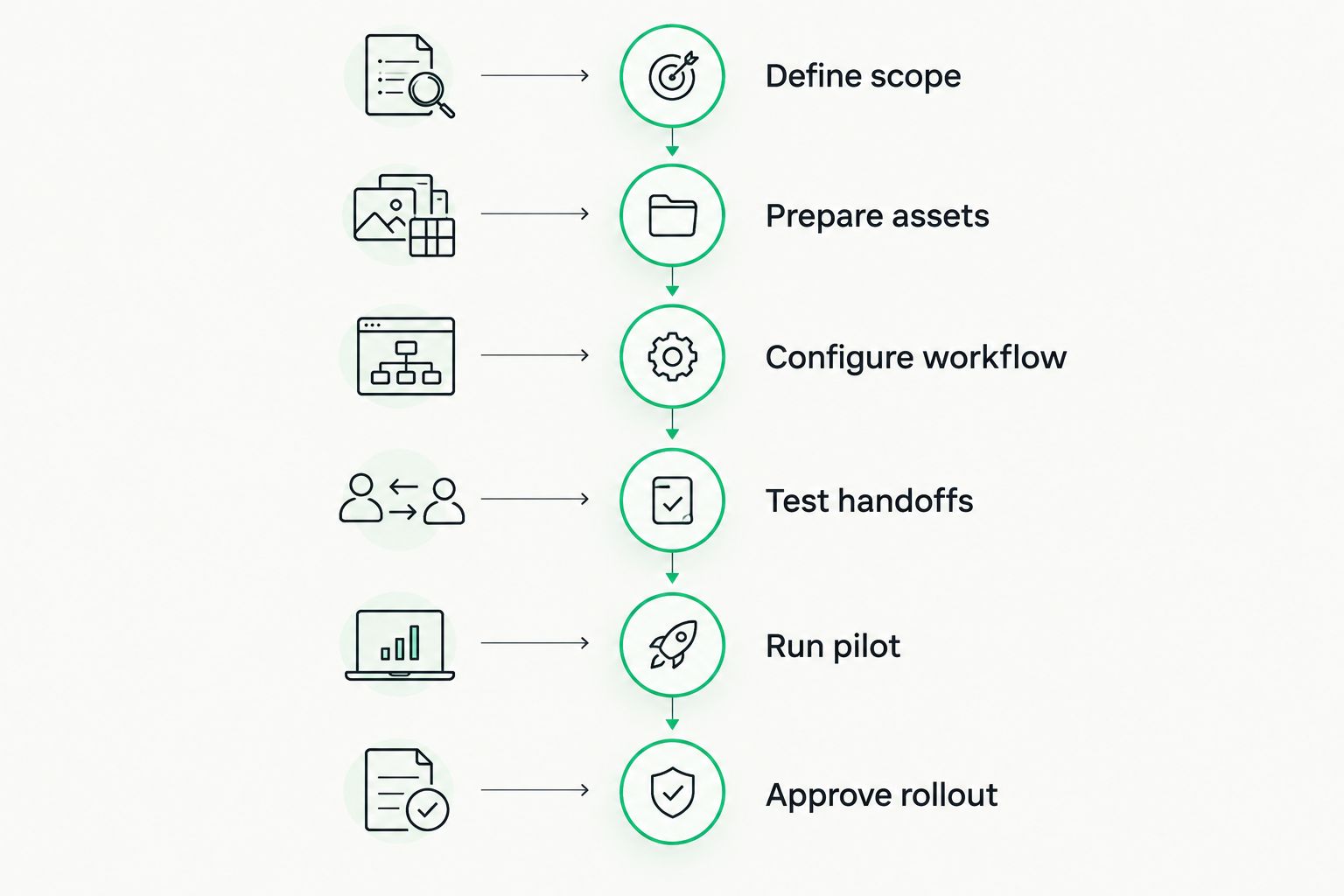
Each implementation stage needs an exit condition before the rollout advances.
Separate pilot readiness from production readiness
Use 3 milestones in your 2026 implementation brief: pilot readiness, production readiness, and wider rollout. Give each milestone its own acceptance criteria rather than treating them as interchangeable launch dates.
Pilot readiness
- What it establishes: Selected users can test the agreed workflow with prepared content
- What it does not establish: All teams, content sources, and exceptions are ready
- Best for: Checking the initial configuration
Production readiness
- What it establishes: The agreed workflow passes acceptance checks and has an owner
- What it does not establish: Every additional workflow is configured
- Best for: Starting controlled operational use
Wider rollout
- What it establishes: Additional teams or content streams meet their own acceptance criteria
- What it does not establish: Future changes need no further testing
- Best for: Expanding an accepted process
Pilot readiness gives you an early checkpoint, but a narrow pilot can leave important exceptions untested. Production readiness supports real work, but only within the accepted scope. Wider rollout extends coverage, but every added workflow creates another set of decisions and checks.
Keep the milestone name attached to every date. A statement such as “ready for the pilot” is more useful than “implemented” when stakeholders need to know what they can actually do.
Define scope before asking for a timeline
Your implementation brief should describe the first operational workflow, not your entire localization wish list. Name the content source, target languages, reviewer, destination, and owner responsible for accepting the result.
For a 2026 rollout, also state what stays outside the first release. Excluding a content stream is a planning decision; forgetting it is a scope problem.
Use these prompts to make the brief actionable:
- Content: Which source files or content types must pass through the pilot?
- People: Who submits, translates, reviews, approves, and publishes?
- Assets: Which translation memories and terminology resources belong in the workflow?
- Handoffs: How will source content arrive and approved translations return?
- Acceptance: Who decides that the workflow works, and what evidence will they inspect?
Avoid descriptions such as “connect everything” or “automate localization.” They do not tell an implementation owner what must be ready before launch.
Prepare translation memory before treating it as ready
An imported translation memory is not automatically an approved translation memory. Review its language assignments, source relevance, duplicates, and conflicting translations before relying on it in production.
The benefit of reusing approved language assets is continuity. The limitation is equally important: inherited errors and outdated terminology still need decisions from someone who understands the content.
Choose who can approve changes and which approved edits should enter the memory. Your implementation test should demonstrate that rule, rather than simply confirm that an import completed.
For the ongoing workflow, use the guide to automatically updating translation memory when edits are approved. Treat approval and reuse as connected responsibilities, not separate setup boxes.
Test the complete content round trip
A connection is useful only when the resulting workflow behaves as intended. Test content submission, translation, review, approval, and return to the destination—not just whether a connection accepts credentials.
Include 2 test cases in your acceptance plan: an initial content submission and a later source edit. This is a recommended minimum test design, not a claim about how many tests your implementation requires.
The initial submission checks the basic route. The later edit checks whether your team can distinguish changed content, review the appropriate translation, and publish the accepted version without confusing it with an earlier one.
Record the expected behavior before testing. Otherwise, a technically completed transfer can conceal a workflow that the editor or developer cannot use.
For your 2026 acceptance checklist, include:
- Source content reaches the intended project or workflow.
- Translators and reviewers receive enough context to make decisions.
- The approval state is clear to the person responsible for publishing.
- Returned translations preserve the required content structure.
- A failed handoff has an owner and a documented recovery action.
These checks are acceptance criteria, not assertions that every TMS provides the same functionality. Confirm each requirement in the system you select.
Why TMS implementation time varies
TMS implementation time varies because teams arrive with different assets, dependencies, and definitions of completion. Use the following 5 planning factors to explain your schedule and identify the decisions that block progress.
- Workflow scope: Each additional content route needs its own responsibilities, acceptance criteria, and handoff checks. Limit the pilot to a clearly described process.
- Asset readiness: Translation memories and terminology require review before the team treats them as approved resources. Assign someone to resolve conflicts.
- Content connections: Access, content structure, import behavior, and return paths must work together. A successful login is not a completed workflow test.
- Approval ownership: A configuration decision stays open until the responsible person accepts it. Name reviewers and approvers before the pilot starts.
- Operational readiness: Users need instructions for normal work and failed handoffs. Confirm who handles questions and who authorizes changes after launch.
Keep these factors visible in your project plan. A schedule becomes actionable when a delay points to a specific unresolved decision, not a vague statement that setup is taking longer.
How do I estimate our TMS implementation schedule?
Estimate your TMS implementation schedule from the 6 implementation stages: define scope, prepare assets, configure workflow, test handoffs, run pilot, and approve rollout. Ask each owner for the work duration and the dependencies that must finish before that work can begin.
Keep work time separate from waiting time. A short configuration task can still depend on an access request, terminology decision, or reviewer approval that has not been completed.
Build the schedule in dependency order. Where independent tasks can run together, show that explicitly; where one task requires an accepted result from another, preserve that sequence.
Your planning document should record the task, owner, required input, completion evidence, and unresolved dependency. Update the forecast when those inputs change rather than keeping a launch date disconnected from the work.
Can we launch a TMS before every workflow is configured?
Yes—use the 3 milestones to distinguish a controlled production launch from wider rollout. Launch only the workflow that has passed its acceptance checks, and keep unfinished workflows outside that production scope.
A phased approach gives you a contained place to resolve issues. Its trade-off is that your team must maintain clear boundaries between the accepted process and work still using the previous process.
Do not expand merely because the pilot translated successfully. Confirm that reviewers can approve the work, publishers can use the output, and the operational owner can handle exceptions.
For a 2026 launch, write down the expansion trigger before production begins. That trigger should describe accepted behavior and ownership, not just a calendar date.
What should we test before replacing our current process?
Start with the 2 test cases: an initial submission and a later source edit. Then add scenarios that reflect the actual exceptions in your content workflow, such as rejected translations, incomplete context, or a failed return handoff.
Keep the previous process available until the accepted workflow has a clear recovery path. A fallback is useful only if someone knows when to invoke it and how to reconcile the resulting work.
Test user instructions alongside the software configuration. Ask a translator, reviewer, and publishing owner to perform their assigned actions using the documented process; unresolved questions belong in the implementation issue list.
Accept the process your team can operate, not just the configuration someone can demonstrate. That distinction prevents a successful presentation from becoming an unfinished operational handover.
FAQ
How long does it take to implement a TMS in 2026?
TMS implementation time depends on workflow scope, asset preparation, content handoffs, testing, and approval. Estimate those tasks with their owners, and give pilot readiness and production readiness separate dates.
Is creating a TMS account the same as implementing it?
No. Implementation includes configuring responsibilities, preparing language assets, testing content movement, and accepting an operational workflow; account creation does not establish those outcomes.
Can we start using a TMS before migrating all our translation memory?
You can define a pilot around selected, approved language assets rather than the entire archive. Document the pilot boundary and do not treat excluded assets as tested or ready for production.
Who should own a TMS implementation?
Name an operational owner who can coordinate scope, decisions, and acceptance. Translators, reviewers, content owners, and technical contributors still need responsibility for their specific implementation tasks.
Does automation remove the need for implementation testing?
No. Automated workflows still need checks for content movement, review states, approved output, and recovery from failed handoffs.
Is Wxrks relevant to translation agencies as well as developers?
Yes. Wxrks is a translation management system serving translators, developers, enterprises, and translation agencies, with workflow automation, translation memory, quality management, and cost tracking.
One last thing
Before accepting the launch, ask what happens when an approved source text changes. That question tests whether the implementation covers ongoing localization or only the first delivery.
Write down who identifies the change, who reviews the updated translation, and who authorizes publication. The next content update is part of your implementation design, not a problem to postpone until after launch.
Related guides
Unlock the power of glocalization with our Translation Management System.
Unlock the power of
with our Translation Management System.