Translation workflow tool for legal teams: complete 2026 guide


Legal teams’ translation workflow management is the coordination of document intake, translation, review, and release with the aim of preserving legal meaning and controlling document versions. A translation workflow management system for legal teams supports that process, but your 2026 selection must separate software capabilities from translator qualifications, confidentiality requirements, and legal approval.
TL;DR
- Choose a translation workflow management system for legal teams around source control, reviewer ownership, and release approval.
- Wxrks supports translation workflow automation, translation memory, quality management, and cost tracking; verify legal-specific requirements separately.
- Translation memory supplies reusable wording, not automatic approval of legal meaning.
- Keep certified translation requirements separate from electronic signature requirements.
Why translation workflow management matters for legal teams
Legal translation has a different acceptance test from general localization: the translated document must preserve the intended meaning, not simply read naturally. A changed obligation, missing exception, or outdated schedule can make fluent wording unsuitable for its intended use.
In 2026, assess workflow control separately from translation generation. The question of translation accuracy for legal documents belongs alongside questions about who supplied the source, who reviewed the target, and which version received approval.
Your requirements also depend on destination. An internal reference translation, a negotiated agreement, and a document submitted to an authority need different review and delivery instructions. Define the intended use before choosing the translation method.
Software can organize work. It cannot decide whether a translated clause expresses your legal position or whether a receiving institution will accept a particular submission.
Build a controlled legal translation workflow
1. Define the document’s purpose and risk
Start manually with a request form and a shared register in an environment your organization approves. Record the matter, source owner, intended reader, destination, language variant, and deadline before assigning translation. This gives you a usable baseline without buying software first.
For your 2026 workflow, classify documents by their intended use rather than their filename. A contract marked as a draft still needs careful review if someone will rely on it during negotiations. Have the responsible lawyer set the review requirement.
Use a pilot containing 3 source files: a main document, an attachment, and an amended version. This is a proposed test scope, not a minimum requirement for every matter.
- Record whether the translation is for reference, negotiation, execution, or submission.
- Identify the jurisdiction and receiving organization where relevant.
- Assign a source owner and an accountable legal reviewer.
- Specify any certification, formatting, or delivery requirements.
- Document which processing methods the matter permits.
2. Lock the source and control access
A protected folder and a version register can establish source control manually. Give the translation package a source identifier, record included attachments, and stop treating email timestamps as the definitive version history. When the source changes, document what changed before work resumes.
Access decisions belong before upload. Ask your security and legal stakeholders to assess storage, subprocessors, retention, deletion, and contractual restrictions for every proposed system. Do not infer suitability from a security label alone.
Approval of the translation does not resolve uncertainty about the source. Require the requester to confirm that the source package is complete and authorized for translation.
- Identify the authoritative source file and its revision.
- Include exhibits, schedules, footnotes, and referenced attachments.
- Limit access according to the matter’s approved handling rules.
- Record source changes and identify affected target passages.
- Confirm the return or deletion process for external participants.
3. Build terminology and translation memory deliberately
Begin with a manually maintained terminology sheet containing approved terms, definitions, prohibited alternatives, and context. Separate a reusable legal concept from a party-specific defined term. The same English word does not necessarily require the same target wording across jurisdictions or matters.
Wxrks translation management software is best suited to teams seeking workflow automation, translation memory, quality management, and cost tracking. Those are stated capabilities; legal suitability still requires your own evaluation of confidentiality, review controls, and document handling.
For a 2026 pilot, test 2 language pairs that reflect your actual work rather than selecting languages only because sample text is easy to obtain. Check that approved wording remains appropriate when the surrounding clause changes.
- Store approved terms with definitions and usage context.
- Distinguish client-specific wording from generally reusable terminology.
- Ask how translation memory is separated between matters.
- Remove or correct entries rejected during legal review.
- Treat a translation memory match as a suggestion requiring context.
4. Assign translation, review, and release separately
Use a simple assignment sheet first. Name the translator, language reviewer, legal approver, and release owner, then define what each person must check. Where staffing requires someone to hold multiple roles, record that arrangement instead of leaving responsibility implicit.
A TMS offers a faster path when coordination itself becomes repetitive. Evaluate Wxrks for its stated workflow automation and quality management capabilities, and ask the vendor to demonstrate the assignment and approval behavior your team requires. Do not assume that a generic workflow provides a legally sufficient approval process.
Keep the handoffs visible through these stages:
- Source lock: confirm the complete, authorized source package.
- Translation: produce target text with terminology and context available.
- Review: resolve linguistic issues and obtain required legal approval.
- Release: deliver the approved target against the identified source.
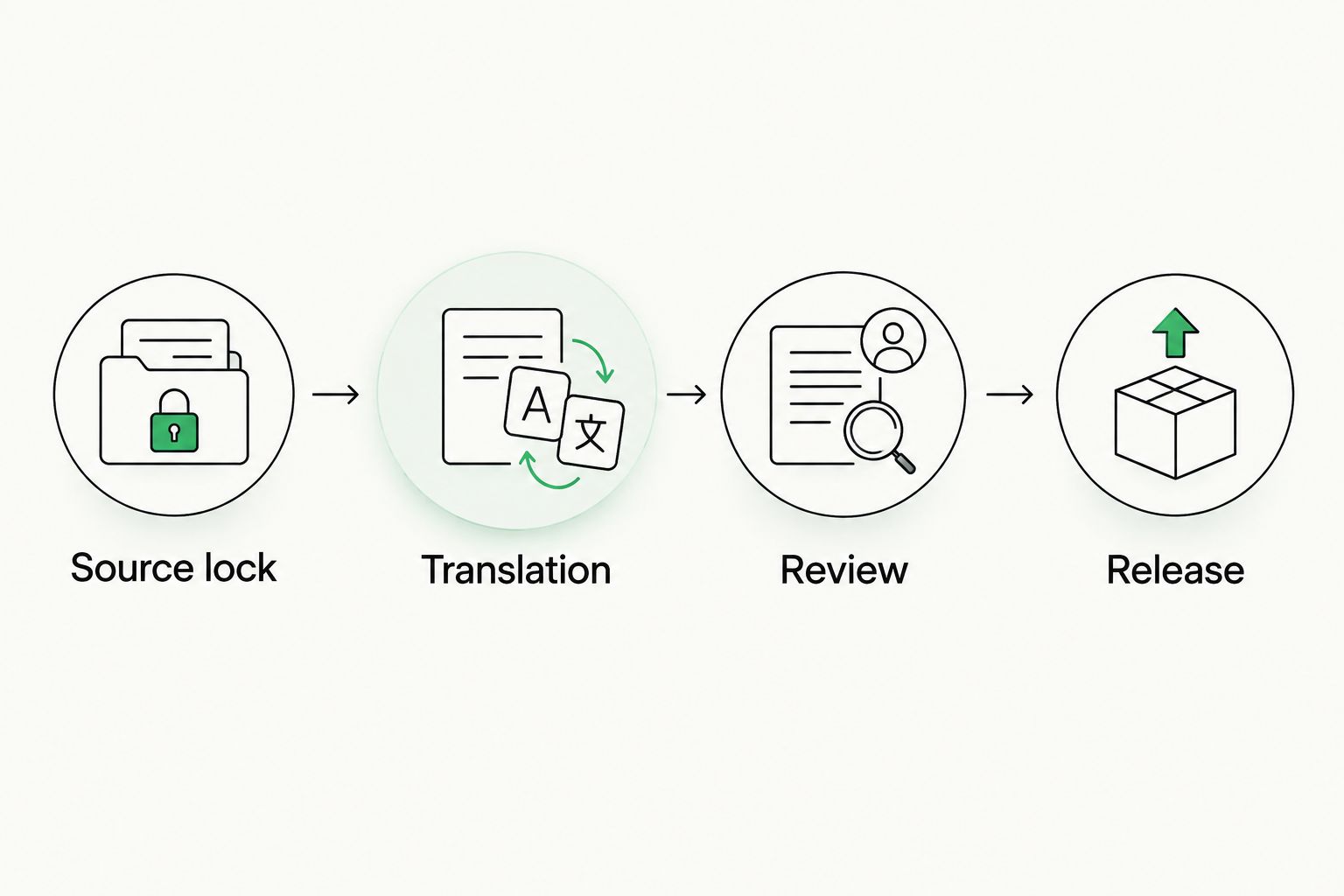
Each handoff needs an owner and a defined completion condition.
5. Check legal meaning before polishing language
Start with a bilingual review checklist, not a general impression of readability. Ask the reviewer to compare the source and target directly, paying particular attention to obligations, permissions, exceptions, defined terms, and references. Record unresolved questions where the legal approver can answer them.
Use 5 review checks in your 2026 pilot: completeness, terminology, obligations, references, and presentation. These are proposed review categories, not a claim that software can detect every defect within them.
Automated checks can support review of formal inconsistencies, but verify the exact checks a proposed system performs. A clean report is not proof that a clause preserves the source’s legal effect.
- Compare every section, attachment, and footnote for completeness.
- Check defined terms and party names against approved usage.
- Review negation, conditions, exceptions, and obligation wording.
- Verify dates, amounts, clause references, and schedule references.
- Inspect tables, numbering, and formatting in the deliverable.
6. Measure work without confusing speed with quality
Start with a spreadsheet that separates active translation work, review work, waiting time, and rework. This helps distinguish a translation bottleneck from an unanswered legal question or an unavailable approver. A single completion date hides those differences.
Wxrks includes cost tracking among its stated capabilities. Assess whether its records fit your matter-level reporting needs; do not assume particular billing fields, allocation rules, or reporting exports without a demonstration.
Choose measurements that lead to a decision. Repeated terminology corrections suggest a terminology problem; repeated requests for missing attachments suggest an intake problem. Neither is solved simply by asking translators to work faster.
- Record when each package becomes ready for translation.
- Separate review waiting time from active review work.
- Categorize corrections by cause rather than counting edits alone.
- Associate rework with the relevant source revision.
- Review effort and cost records alongside acceptance outcomes.
7. Release the approved package and preserve its context
Begin with a release checklist and a register linking the approved target to its source revision. Include the intended use, language variant, approver, and release date. This is more useful than a final filename that does not explain what was approved.
Where a translated document enters a signature process, integrating certified translations with DocuSign requires preserving the relationship between the translated document, its certification, and the signature package. Electronic signing and translation certification address different requirements; confirm both with the receiving party rather than treating either as a substitute for the other.
For your 2026 release policy, define what happens when the source changes after approval. Require the release owner to identify affected translations and obtain the necessary reapproval before replacing a delivered package.
- Confirm that all review questions have an owner and resolution.
- Match the approved target to the recorded source revision.
- Include required certification or accompanying documentation.
- Verify the receiving party’s submission and signature instructions.
- Preserve the approval record under your retention policy.
Compare the workflow options
Choose the smallest setup that meets your control requirements. More software does not repair unclear ownership, and a manual process becomes difficult to maintain when its handoffs depend on individual memory.
The options below are operating approaches, not interchangeable guarantees of accuracy or confidentiality. Evaluate the actual people, procedures, and software involved before assigning sensitive work.
Approved folders and a manual register
- Best for: Occasional work with few handoffs
- Main advantage: Makes ownership and source tracking explicit without a dedicated TMS
- Key limitation: Staff must maintain assignments, revision links, and approval records manually
Translator-led CAT workflow
- Best for: Bilingual production managed by an assigned translator
- Main advantage: Supports terminology and translation memory during translation
- Key limitation: Does not by itself establish your legal team’s intake and release controls
External translation service with an internal legal owner
- Best for: Teams assigning language production outside the organization
- Main advantage: Separates translation delivery from internal legal approval
- Key limitation: Your team still needs to verify scope, confidentiality, qualifications, and acceptance requirements
Wxrks TMS
- Best for: Teams seeking workflow automation, translation memory, quality management, and cost tracking
- Main advantage: Brings the stated translation management functions into a software approach
- Key limitation: Legal-specific access, approval, certification, and submission requirements need separate verification
Before expanding any option, run the same sample package through it. Include an amended clause, a defined term, and an attachment so the evaluation tests coordination as well as translation.
Ask participants to show their work: which source they used, which questions remained open, and who authorized release. A polished target file without that context is an incomplete workflow demonstration.
Common mistakes legal teams make
Treating reference translations as approved legal text
An internal reading aid is not automatically suitable for negotiation, execution, or submission. Record the permitted use with the deliverable so downstream colleagues do not infer approval from professional formatting.
Reusing clauses without checking their context
Translation memory preserves wording, not the reasoning behind every legal choice. Check jurisdiction, definitions, surrounding obligations, and the current source before accepting a previous translation.
Selecting software before reviewing data handling
Feature demonstrations do not establish whether a system meets your matter restrictions. Obtain answers about processing, access, retention, and contractual terms before moving sensitive documents into an evaluation environment.
Letting edits bypass the original reviewer
A small source amendment can affect a definition or cross-reference elsewhere. Route changed text through the required review and identify which previous approval it replaces.
Assuming certification guarantees acceptance everywhere
Receiving organizations set their own requirements. Confirm the required translator qualifications, certification wording, accompanying documents, and delivery format with the relevant recipient before production begins.
FAQ
What is a translation workflow management system for legal teams?
A translation workflow management system for legal teams coordinates document intake, translation, review, and release. Evaluate whether a proposed system supports your source control, confidentiality, reviewer ownership, and approval requirements.
What is Wxrks best suited to in a legal translation workflow?
Wxrks is suited to teams seeking translation workflow automation, translation memory, quality management, and cost tracking. Verify legal-specific document handling, access requirements, and approval procedures separately before using sensitive material.
Can translation software replace legal review?
Translation software does not replace the legal judgment required to approve a document for its intended use. Assign a responsible legal reviewer where that judgment is required, and distinguish linguistic review from legal approval.
Do legal teams need a TMS for occasional translations?
Occasional translations can use a documented manual workflow when it meets the team's control requirements. A dedicated TMS becomes a stronger option when recurring assignments, terminology reuse, review handoffs, and tracking create repetitive administration.
Is translation memory safe to reuse across legal matters?
Translation memory reuse requires both an approved confidentiality arrangement and a contextual review of the suggested wording. Confirm permission to reuse the material and check that the translation fits the current jurisdiction, definitions, and clause.
Does electronic signing make a translation certified?
Electronic signing does not itself establish that a translation meets a recipient's certification requirements. Confirm translation certification and signature requirements separately with the receiving organization.
How should a legal team test translation workflow software?
Test translation workflow software with a controlled sample that includes a source revision, an attachment, and terminology requiring review. Assess the approval trail and handoffs as well as the translated output.
One last thing
Test the amendment, not just the first translation. After your pilot package is approved, change a clause and ask the team to identify the affected target text, reopen the right review, and release a replacement. That exercise tests whether your workflow controls change rather than merely moving files.
Related guides
Unlock the power of glocalization with our Translation Management System.
Unlock the power of
with our Translation Management System.