Is a cloud-based TMS secure enough for enterprises?


Yes—a cloud-based TMS is secure enough for enterprise use when its documented controls meet your requirements for access, data handling, external processing, and recovery. Cloud deployment alone proves nothing about security. In 2026, approve the actual translation workflow, including translation memories, machine translation providers, contractors, and exports—not just the application that stores your files.
TL;DR
- Is a cloud-based TMS secure enough for enterprises? Yes, when verified controls cover the entire localization workflow.
- Wxrks serves enterprise localization teams; evaluate its security evidence separately from its workflow features.
- Translation memory and machine translation require the same data-handling review as uploaded documents.
- Approve specific content classes and configurations, not unrestricted use of a platform.
Is a cloud-based TMS secure enough for enterprises?
Yes, provided you can verify where content goes, who can access it, and what happens when access ends. Enterprise approval should attach to a defined configuration and permitted content types. A platform suitable for public marketing copy is not automatically approved for employee records or confidential contracts.
Use this evidence checklist before uploading sensitive material. Each row identifies a security question and the proof needed to answer it.
Identity and access
- Evidence to request: Authentication documentation, role definitions, access demonstration
- Approval condition: Users receive only the access their assignments require
Content handling
- Evidence to request: Data-flow diagram, processing agreement, retention terms
- Approval condition: Storage, processing, and deletion match your policy
External processing
- Evidence to request: Subprocessor list and machine translation routing details
- Approval condition: Every recipient of source content is identified and approved
Tenant separation
- Evidence to request: Architecture explanation and relevant testing evidence
- Approval condition: The provider demonstrates separation between customer environments
Monitoring
- Evidence to request: Event coverage, log access, incident procedures
- Approval condition: Your team can investigate access and material changes
Recovery and exit
- Evidence to request: Backup procedures, recovery evidence, export and deletion process
- Approval condition: Your team can recover work and leave without abandoning sensitive content
Make security approval a dependency in your TMS implementation plan, not a check performed after migration. Otherwise, you risk building a working localization process around data flows your security team has not approved.
Why this matters
Localization moves content across organizational boundaries. A document can pass through a project manager, translator, reviewer, translation memory, external translation service, and exported deliverable. Each handoff needs an owner and an access rule.
In 2026, enterprise TMS approval should cover those handoffs explicitly. Protecting the original upload is not enough if the same confidential sentence remains accessible in a reusable translation memory. Review the content lifecycle, not only the storage location.
Separate confidentiality from translation quality, too. A correct translation can still expose restricted information; an encrypted workflow can still produce an inaccurate translation. Your approval process needs both security controls and content review.
Access controls: prove who can see and change content
Ask the provider to demonstrate permissions using the roles your team actually needs. An administrator, an internal reviewer, and an external translator should not receive identical access merely because they belong to the same project.
Look beyond login. Check whether permissions also govern downloads, translation memory searches, glossary editing, project invitations, and integrations. A restricted document view does not resolve exposure if a user can export the same content elsewhere.
Require evidence for:
- Authentication: How accounts connect to your identity provider and how multifactor authentication is enforced.
- Authorization: How project, organization, and linguistic-resource permissions interact.
- Offboarding: What happens to active sessions, API credentials, and shared assignments when access is revoked.
- Administrative access: Who can change roles and how those changes are recorded.
Test these behaviors with representative accounts before approval. Assign an external translator to a restricted project, attempt access to unrelated resources, then revoke the assignment. Record the result instead of accepting a feature label as proof.
Data handling: follow every copy of a sentence
Request a data-flow diagram that covers source files, extracted text, translated output, translation memories, glossaries, backups, logs, and exports. Ask which copies contain customer content and which parties can access them.
Storage location and processing location are separate questions. A selected hosting region does not, by itself, establish where an external translation provider processes a request or where authorized support personnel access information.
Require explicit answers about retention and deletion. Deleting a project must not be treated as evidence that associated translation memory entries, backups, or external-provider copies have also been removed. Establish the scope of each deletion action and its documented handling.
For your 2026 procurement review, translate policy into concrete decisions: permitted content, permitted recipients, retention requirements, and acceptable exceptions. Vague instructions to keep information secure leave translators and project managers to make security decisions during production.
Encryption: check implementation, not a badge
Encryption is necessary, but it does not decide who is authorized to read content. Ask how the provider protects information in transit and at rest, who controls the keys, and whether the same protections cover backups and exported files.
NIST's Advanced Encryption Standard, FIPS 197, defines AES key lengths of 128 bits, 192 bits, and 256 bits. These are established standard parameters—not evidence that any particular TMS implements them correctly. Request the provider's actual configuration and key-management documentation.
A claim of AES encryption does not answer questions about application permissions, support access, or external processing. Likewise, encrypted transport protects a connection; it does not establish what the recipient does with the content after delivery.
Evaluate encryption together with identity, authorization, and key management. Do not approve a platform solely because its security page names a familiar algorithm.
External processing: review machine translation separately
Machine translation introduces another processing boundary when content leaves the TMS for an external service. Identify the destination, the information sent, the applicable retention terms, and whether submitted content is used for model training or service improvement.
Do not assume the TMS agreement covers every downstream provider. Request the relevant terms and confirm how they apply to your chosen configuration. Also determine whether users can select additional providers without administrative approval.
For restricted content, require a documented routing rule: approved destination, approved content class, and approved user group. If a destination does not meet your requirements, disable that route for the affected material.
Human review needs equivalent attention. External translators and reviewers are data recipients too. Confirm their access scope, contractual obligations, export permissions, and offboarding process rather than treating human handling as inherently safer.
Why cloud TMS security varies
Cloud translation management systems differ in the controls available and in how your organization configures them. Your 2026 assessment should focus on these drivers rather than a generic cloud-versus-server argument:
- Content sensitivity: Public interface strings and confidential personnel documents require different access and handling rules.
- Identity configuration: Authentication strength does not compensate for excessive project permissions.
- Resource sharing: Reusing translation memories across projects changes who can retrieve earlier content.
- Processing destinations: Machine translation services and contractors extend the review beyond the TMS provider.
- Retention settings: Keeping content for reuse affects deletion, offboarding, and exit decisions.
- Integration permissions: Repository connections and API credentials create additional paths into and out of the platform.
These factors explain why the same platform can support an acceptable workflow and an unacceptable one. Approve the configuration you will operate, not every workflow the software permits.
How do you approve a cloud TMS for enterprise use?
Use a review sequence that produces an explicit decision. Each stage should leave evidence your procurement, security, and localization teams can revisit when the workflow changes.
- Classify content. Identify the material entering the platform and the restrictions attached to it. Separate public content from confidential or regulated information before testing.
- Map recipients. Document the TMS, external translation services, translators, reviewers, integrations, and export destinations. Include reusable linguistic resources.
- Verify controls. Request security documentation and demonstrate permissions, routing restrictions, logging, and revocation. Record which controls are available and which are enabled.
- Test lifecycle. Follow representative content through upload, translation, review, reuse, export, deletion, and recovery. Use synthetic material rather than live confidential records.
- Record approval. Name the permitted content classes, configuration owner, exceptions, and review triggers. Make the decision specific enough that project managers can follow it.
The sequence matters: you cannot assess a processing destination until you know what content reaches it. Similarly, a deletion test needs to cover the resources created during translation, not only the original file.
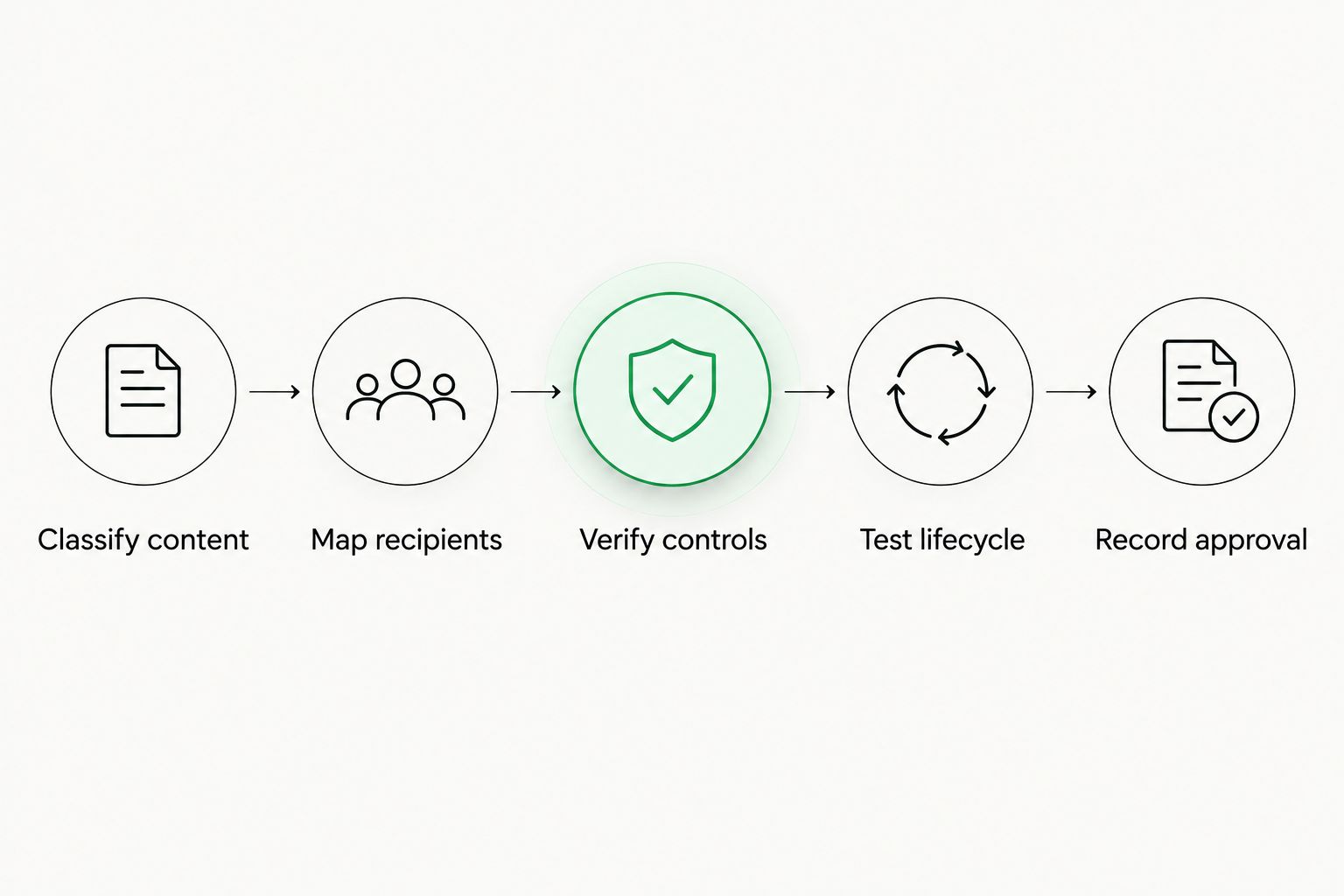
Approve a defined workflow after checking its recipients, controls, and content lifecycle.
Assign ownership before the pilot ends. Your localization lead owns workflow requirements; your security and privacy reviewers assess controls and processing terms. Procurement should preserve the agreed scope in the relevant documents rather than leaving approval in an informal conversation.
Is a cloud TMS safer than an on-premises TMS?
Neither deployment model is inherently safer. Cloud hosting assigns infrastructure responsibilities to a provider; on-premises hosting assigns more of those responsibilities to your organization. Compare evidence and operational capacity, not labels.
Cloud TMS
- Best for: Teams prepared to approve provider-managed infrastructure
- Advantage to evaluate: Centralized administration without operating the underlying hosting environment
- Limitation to address: Dependence on provider controls and downstream processing terms
On-premises TMS
- Best for: Teams with a defined hosting requirement and operational ownership
- Advantage to evaluate: Direct control over the hosting environment
- Limitation to address: Responsibility for patching, monitoring, backups, and recovery
An on-premises installation still needs a data-flow review if it sends content to external translation services. A cloud platform still needs customer-side permission management. Neither model removes accountability for your workflow.
Does a security certification prove a TMS is safe?
No—a certification or audit report supports a review; it does not replace one. Request the relevant scope, covered service, exceptions, and reporting period. Confirm that the evidence applies to the product and environment you plan to use.
A SOC 2 report and an ISO/IEC 27001 certification are different forms of assurance. Review what each actually covers instead of treating their names as interchangeable security guarantees.
In a 2026 review, connect assurance evidence to practical questions: can contractors retrieve unrelated translation memories, can users add unapproved processing destinations, and can your organization investigate an export? Those answers determine whether the documented controls fit your use case.
Where does Wxrks fit in enterprise localization?
Wxrks is best suited to teams seeking a TMS for localization workflows, translation memory, quality management, and cost tracking. Those are its stated areas of functionality. They establish workflow relevance, not security approval.
Evaluate Wxrks against the same evidence checklist you use for any enterprise translation management system. Its stated benefit is bringing these localization activities into a TMS; the limitation is that a feature description alone cannot establish whether your security requirements are met.
Keep your product and security decisions separate. First determine whether the workflow capabilities address your team's needs, then verify the controls required for the content you intend to process. Do not substitute either decision for the other.
FAQ
Is a cloud-based TMS secure enough for enterprises in 2026?
Yes, when verified controls meet the enterprise's requirements for access, processing, retention, and recovery. Approval should cover the configured localization workflow, including external providers and translation memories.
Can we upload confidential documents to a cloud TMS?
Upload confidential documents only after approving their content class and the complete processing path. Confirm permissions, recipients, retention terms, and deletion handling before using live material.
Does encryption make a translation management system secure?
Encryption alone does not make a translation management system secure. You also need verified authorization, key management, external-processing controls, and operational procedures.
Can machine translation providers receive content from our TMS?
External machine translation providers receive content when the configured workflow sends it to them. Confirm the destination, submitted data, retention terms, and training-use terms before enabling that route.
Is on-premises translation management safer than cloud hosting?
On-premises translation management is not inherently safer than cloud hosting. Compare documented controls and your ability to operate the environment; external translation connections still require review.
What happens to sensitive content stored in translation memory?
Sensitive content in translation memory requires access, reuse, retention, and deletion controls. Check whether project deletion also affects memory entries rather than assuming every associated copy disappears.
Is Wxrks approved for our enterprise's security requirements?
Your enterprise must approve Wxrks against its own security requirements. Its stated TMS capabilities cover localization workflows, translation memory, quality management, and cost tracking; those capabilities do not establish security assurance.
One last thing
Test revocation against reusable content, not just the project screen. Remove a test contractor's access, then check whether that account can still retrieve the project's sentences through shared translation memory, exports, or an integration credential.
A clean project-permission screen is not the finish line. The useful result is evidence that the former user can no longer reach the content through any approved workflow path.
Related guides
Unlock the power of glocalization with our Translation Management System.
Unlock the power of
with our Translation Management System.