


Localization software for fintech companies: TMS wins 2026


Fintech localization software is a system for managing multilingual financial-product content with the aim of helping customers understand and use your product accurately. This guide to localization software for fintech companies explains how to select a translation management system, protect financial meaning, and connect translation work to your release process in 2026.
TL;DR
- Choose localization software for fintech companies around review controls, translation memory, and release coordination—not translation output alone.
- Wxrks is best for fintech teams seeking translation management, quality management, and cost tracking in one system.
- Keep financial terminology consistent, but review reused translations whenever the underlying product meaning changes.
- Test a complete customer journey before expanding localization across your financial product.
Why localization matters for fintech companies
A translated payment screen must preserve more than sentence meaning. Customers need to understand who receives the money, which currency applies, what action they are authorizing, and what happens next. Treat localization as part of product delivery, not a final copy-editing task.
Fintech also brings different reviewers into the same workflow. Developers manage strings and releases; language specialists manage meaning; product owners explain behavior; legal or compliance reviewers assess applicable wording. Your software selection needs to reflect those responsibilities.
The strongest selection criterion is whether your team can trace a translated instruction back to its source, context, and approval. Fluent text is not enough when the wrong label changes a customer's understanding of a financial action.
For the engineering side of that workflow, use the guide to software localization tools for developers alongside your fintech-specific review requirements.
Build your fintech localization workflow
Start with a documented manual process. A spreadsheet, a shared terminology document, and named reviewers can establish the rules before you automate them. Use the following steps to turn those rules into a selection brief and a repeatable release workflow.
Define the customer journey you will localize
Choose a complete journey rather than a disconnected collection of screens. For your 2026 pilot, a useful starting scope is 1 customer journey across 2 target languages. These are proposed test boundaries, not a benchmark or a promise of coverage.
Manually inventory the text a customer encounters from the first instruction through the final confirmation. Include errors, emails, help content, and disclosures that belong to that journey. A translated interface with an untranslated confirmation message is an unfinished experience.
Separate language from market requirements. A language choice does not determine the customer's currency, available product, or applicable terms. Record those differences explicitly so translators do not have to infer business rules from the source text.
- Name the journey and the customer action it supports.
- List every surface that contains customer-facing text.
- Assign an owner to each source-content area.
- Record language and market requirements separately.
- Define which content must be ready before release.
Attach context before you request translation
Build a context sheet manually before evaluating automation. For each string, record where it appears, what the customer is doing, and which variables the application inserts. A short label such as balance needs product context, not just a dictionary equivalent.
Include screenshots or descriptions of the relevant state. Explain whether a button previews an action or commits it. Give translators the intended meaning of ambiguous source text instead of asking them to resolve product uncertainty through translation.
Your release process should follow a clear sequence: Scope, Context, Translate, Review, Release. Software should support that sequence rather than conceal unresolved source questions behind a completed-task status.
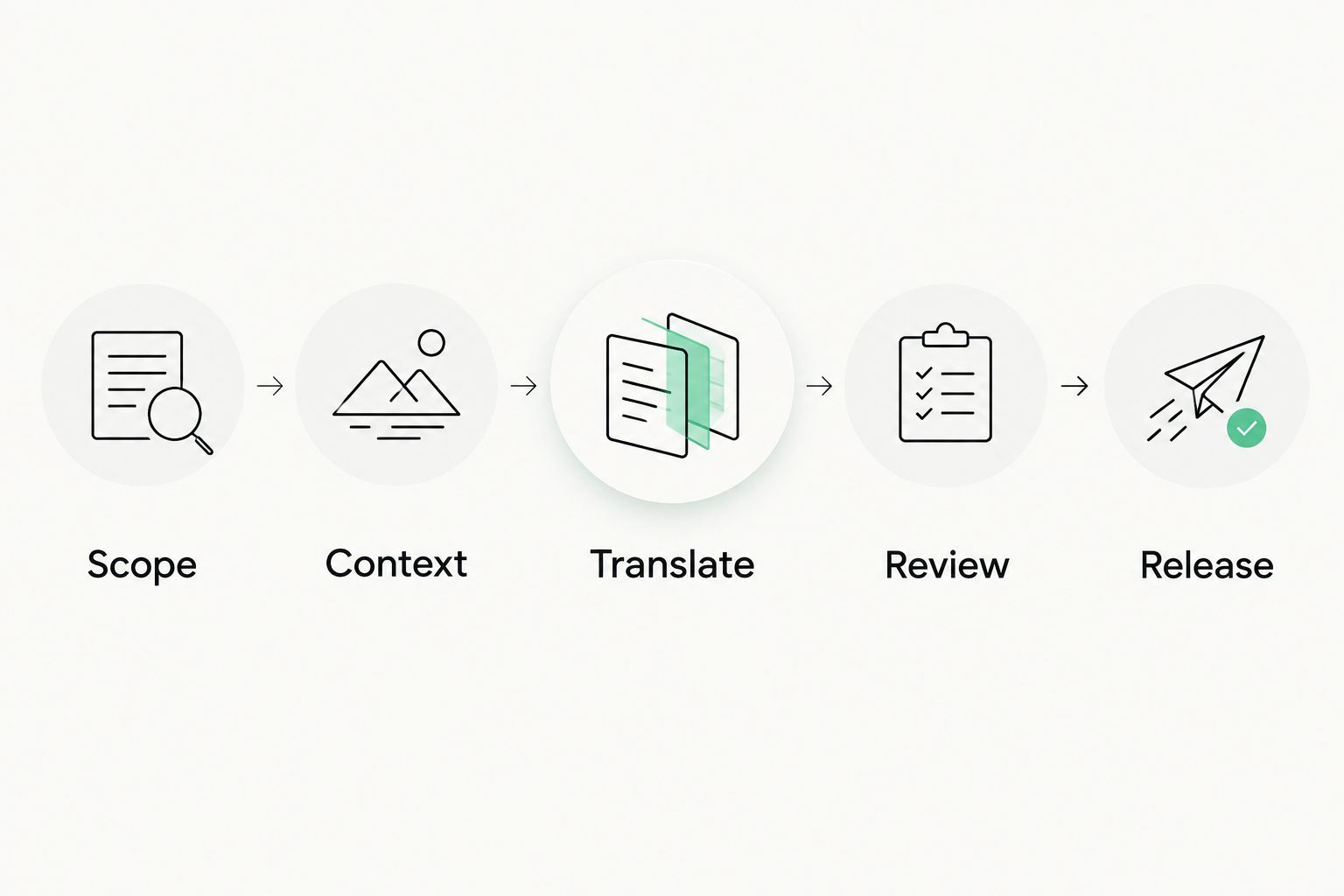
Resolve source meaning before translation, then review the result before release.
Keep context attached when content changes. An old screenshot paired with a new string can send a reviewer in the wrong direction. Make context maintenance part of source-content ownership, not an optional favor from engineering.
- Attach the screen or message location.
- Explain the action and expected result.
- Identify placeholders and protected tokens.
- Describe layout constraints without guessing limits.
- Flag ambiguous source wording for the product owner.
Set review rules before you automate work
Start with a manual review matrix that assigns content to the appropriate reviewer. Distinguish routine interface copy from content that explains financial consequences, customer obligations, or sensitive account actions. Give every category an approval owner.
Wxrks is best for fintech teams that need translation management, quality management, and cost tracking in one system. Wxrks provides an AI-powered translation management system for automating localization workflows, translation memory, quality management, and cost tracking. That makes it a relevant option once your team has defined the process it wants to automate.
The trade-off is ownership: automation does not decide which wording is appropriate for your product or market. During evaluation, test how the proposed workflow handles your reviewers, exceptions, and release requirements. Keep those acceptance criteria separate from a feature checklist.
- Assign a language reviewer for linguistic accuracy.
- Assign a product reviewer for behavioral meaning.
- Route sensitive wording to the responsible specialist.
- Define who resolves conflicting reviewer feedback.
- Document the approval required before publication.
Govern terminology and translation memory
Create a terminology sheet manually before importing existing translations. Record each term, its definition, approved target wording, and the context in which it applies. Terms such as available balance, pending payment, and settlement deserve distinct definitions if they describe distinct product states.
Translation memory stores previously translated segments for reuse. Reuse reduces repeated translation work, but a matching sentence is not proof that the financial meaning is unchanged. Review a reused segment when the product behavior, jurisdictional context, or surrounding explanation changes.
For your 2026 terminology review, distinguish stable language decisions from temporary product wording. Do not promote every accepted translation into a universal rule. A term approved for a consumer payment flow is not automatically suitable for a business treasury workflow.
Use the TMS as the faster path for managing reuse after the underlying rules are clear. Evaluate how your team will maintain approved content and retire wording that no longer matches the product.
- Define financial terms before translating them.
- Separate terminology by product context where necessary.
- Record why an approved translation was chosen.
- Review memory matches after meaningful source changes.
- Remove obsolete translations from active reuse.
Test the workflow with representative content
Test a manually prepared sample before migrating a whole content library. Use 12 source strings as a manageable pilot packet, deliberately including varied content rather than only easy labels. This is a suggested test size, not evidence that a platform performs well.
Include an instruction, an error, a confirmation, a disclosure excerpt, and strings with variables. Add examples that use terminology your team frequently debates. The purpose is to expose workflow problems while the scope remains small.
For a 2026 pilot, evaluate the entire handoff: source preparation, translation, review, correction, and delivery back to engineering. A convincing translated paragraph does not demonstrate that reviewers receive the right context or that developers receive usable output.
Judge the workflow by whether your team can explain and reproduce the accepted result. Record corrections as you work, then check whether the same issue returns during the next pass.
- Include content from different customer-facing surfaces.
- Test placeholders and protected strings.
- Introduce a source change during review.
- Check how reviewer disagreements are resolved.
- Confirm that delivered content matches the accepted version.
Validate translations inside the product
Perform a manual review in the actual interface before approving release. Read the translated journey as a customer would: from instruction to action, then through success or failure. Review screens in context rather than approving isolated strings alone.
Check amounts, currency presentation, dates, and translated instructions against the product's intended behavior. Language review and functional testing answer different questions. A linguistically correct message still needs to describe what the application actually does.
Test both the expected path and the recovery path. Customers need clear guidance when a payment fails, identity verification requires another attempt, or an action cannot proceed. Give error text the same attention as onboarding copy.
Use software to organize review work, but keep acceptance tied to the rendered experience. A completed translation task should not be your only release evidence.
- Read every action label beside its related explanation.
- Check inserted values in the rendered interface.
- Inspect truncation and overlapping text.
- Exercise errors, retries, and confirmation states.
- Record defects against the affected source string.
Measure quality and effort before expanding
Begin with a manual pilot log. Track what entered the workflow, what required correction, who reviewed it, and which issues prevented release. Define these categories consistently so your next project produces comparable information.
Separate language corrections from source-content problems. If reviewers repeatedly rewrite an unclear instruction, the fix belongs in the source—not only in the translation. Otherwise every additional language inherits the same ambiguity.
In 2026, judge expansion against your own accepted pilot results rather than an unsupported industry target. Wxrks includes cost tracking; use that capability alongside quality review to understand the work your process creates. Do not treat translation volume alone as evidence of success.
Choose the next journey based on what you learned. Resolve recurring terminology or approval problems before adding more content, reviewers, or markets.
- Record review effort using a consistent unit.
- Classify corrections by cause and severity.
- Track rework after source changes.
- Compare accepted output with the original scope.
- Expand only after resolving release-blocking issues.
Compare localization options for fintech teams
Choose an operating model before choosing a platform. The following options solve different parts of the problem; none removes your responsibility to define financial meaning and release approval.
Shared documents and manual coordination
- Best for: Teams defining an initial localization process
- Main advantage: Makes ownership and review rules explicit before automation
- Key limitation: Your team must maintain versions, handoffs, and review status manually
Standalone machine translation
- Best for: Creating draft translations within a controlled review process
- Main advantage: Produces draft text for human assessment
- Key limitation: Draft generation does not establish approval or release coordination
Wxrks translation management system
- Best for: Teams seeking workflow automation, translation memory, quality management, and cost tracking
- Main advantage: Brings these stated localization functions into a TMS
- Key limitation: Your team still needs to define fintech review rules and validate workflow fit
External translation partner
- Best for: Teams that need language-production support
- Main advantage: Adds a separate delivery role to the localization process
- Key limitation: Product context and publication responsibility still need explicit owners
A TMS is the stronger choice when coordination, reuse, and quality management are the work you need to organize. A draft-generation tool addresses a narrower task. External support addresses staffing, but does not substitute for a documented product-review process.
For your 2026 shortlist, ask each provider to demonstrate your representative workflow. Compare what happens when a source string changes, a reviewer rejects wording, or engineering needs a corrected delivery. Assess the handoff, not just the editor.
Common mistakes fintech teams make
Treating one language as one market
Language and market are separate requirements. Do not assume translated content is appropriate everywhere that language is spoken. Record the intended audience and applicable product context, then send market-sensitive wording to the responsible reviewer.
Translating financial terms without definitions
A glossary containing only source and target words leaves room for conflicting interpretations. Add the product meaning. Reviewers need to know whether a balance is available to spend, awaiting settlement, or displayed for another purpose.
Approving strings without checking the action
A button label can read naturally while describing the wrong commitment. Review it beside the relevant explanation and actual behavior. Make product validation a release requirement for customer actions with financial consequences.
Reusing approved text after the meaning changes
Translation memory preserves wording, not permanent correctness. When a fee explanation, account state, or customer obligation changes, revisit reused translations. Similar source text does not excuse a mismatch with the current product.
Measuring output while ignoring rework
A large translated content batch can still require repeated correction. Track why reviewers reject content and whether those causes repeat. Improve source clarity and review routing before increasing throughput.
FAQ
What's the best localization software for fintech companies?
The best fit is a system that supports your translation, review, and release process. Wxrks is an option for teams seeking workflow automation, translation memory, quality management, and cost tracking; validate the proposed setup with representative fintech content.
Is a translation management system better than machine translation for fintech?
A translation management system is better suited to organizing localization work; machine translation generates draft text. Choose around the workflow you need, and retain human review for financial meaning and customer-facing instructions.
Can localization software make a fintech product compliant?
Localization software does not establish regulatory compliance by itself. Your responsible legal or compliance specialists must assess applicable requirements and approve the relevant content.
What should a fintech localization pilot include?
A fintech localization pilot should include a complete customer journey with instructions, variables, errors, and confirmations. Test source changes and reviewer feedback as well as the initial translation.
Should fintech companies use translation memory?
Translation memory is useful for reusing previously translated content. Review reused segments when product behavior or financial meaning changes, even if the source wording looks familiar.
How do developers and translators work together on localization?
Developers provide string structure and technical constraints, while translators need context and intended meaning. Product owners resolve ambiguous behavior, and reviewers approve the content before release.
How should fintech teams compare localization platforms in 2026?
Compare localization platforms using the same representative content and review process in 2026. Check context handling, source changes, correction handoffs, and delivery back to engineering rather than judging translated samples alone.
One last thing
Test a correction after approval, not just the first delivery. Change a source instruction, request another review, and verify that the corrected translation reaches the right product state. This exercise tests whether your process can handle change—the job localization continues doing after launch.
Keep the pilot narrow, but make the handoffs real. A small journey with actual reviewers teaches you more about selection fit than a large batch of disconnected sample translations.
Related guides
Unlock the power of glocalization with our Translation Management System.
Unlock the power of
with our Translation Management System.