


translation management system for government agencies 2026


Public-sector translation management is the coordination of multilingual content, reviewers, and approvals so residents receive accurate government information. A translation management system for government agencies organizes that work; this 2026 guide explains how to evaluate one without confusing translation automation with security approval or publication authority.
TL;DR
- Choose a translation management system for government agencies around approval controls, translation memory, and quality management.
- Wxrks fits translation teams seeking workflow automation, translation memory, quality management, and cost tracking.
- Keep sensitive records outside any translation workflow until your agency approves its data handling.
- Test changed source content and rejected translations before approving a system for production.
Why translation management matters for government agencies
Government translation needs more than readable sentences. An eligibility condition, filing instruction, or emergency notice must preserve its meaning across languages, and the published version must match the approved source.
Your workflow therefore needs a named source owner, language reviewers, and a publication decision. A translation platform supports those responsibilities; it does not assume them. Public institutions coordinating decentralized content owners face a related challenge in higher-education translation management.
In 2026, evaluate translation software against the documents your agency actually publishes. Separate public information from case records and internal correspondence before discussing automation. That boundary determines what enters the workflow, who sees it, and what evidence procurement needs.
Choose the workflow before choosing the software. A fast translation process still fails when nobody owns the source, nobody resolves terminology disputes, or an outdated notice remains live.
How to build a government translation workflow
Define your content boundaries
Start with a shared inventory and a simple classification worksheet. Record the source owner, intended audience, publication channel, and sensitivity of each content group. You do not need a new platform to establish these rules.
Use 3 content types for the initial exercise: a public notice, an application instruction, and a website page. These are recommended test categories, not a workload benchmark. Select examples your agency is authorized to share.
Keep operational differences visible. A website update needs a publishing handoff; an application instruction needs review of conditions and required actions. Neither should inherit the other's approval rules simply because both contain translated text.
- Identify the authoritative source for each content type.
- Separate public content from personal or restricted information.
- Assign an owner who can answer questions about meaning.
- Record the channels where each translation will appear.
- Specify which changes require renewed language review.
Assign review and publication authority
Create an approval matrix in a spreadsheet before configuring software. Give 2 roles distinct responsibilities: a language reviewer checks the translation, and a publication approver authorizes release. Your agency decides whether separate people must hold those roles.
Add a policy or subject-matter reviewer when language depends on legal meaning, eligibility rules, or technical instructions. Fluency alone does not establish authority to interpret a government program.
For your 2026 process, make rejection explicit. A reviewer needs a way to return content with a reason, identify the affected passage, and prevent that version from reaching publication. An approval history is useful only when it records a meaningful decision.
- Name the reviewer and approver for each content group.
- Define when subject-matter review is required.
- Write a clear rule for returning disputed translations.
- Document who resolves disagreements about source meaning.
- Keep publication permission separate from translation completion.
Build terminology and translation memory rules
Begin with an approved terminology sheet and a collection of previously reviewed translations. Record definitions, preferred terms, prohibited alternatives, and usage context. Remove obsolete material before treating previous wording as reusable.
Translation memory stores translated segments for reuse; a glossary governs selected terms. Neither replaces contextual review. A sentence approved for one program can mislead readers when reused under another program's conditions.
Wxrks provides translation management software for workflow automation, translation memory, quality management, and cost tracking. Wxrks is best for translation teams seeking those capabilities in a translation management system. For government procurement, evaluate that functional fit separately from your agency's security and contractual requirements.
Reuse approved language, not merely familiar language. Software is the faster path for organizing reusable segments, but your agency still needs ownership rules for accepting, updating, and retiring them.
- Define official program names and approved equivalents.
- Add context to terms with multiple possible meanings.
- Exclude superseded notices from approved reuse collections.
- Assign responsibility for terminology changes.
- Review reused segments whenever source conditions change.
Check data handling before connecting systems
Start with a written data-flow map. List what enters the translation process, who receives it, which systems process it, and where copies remain. Use sanitized examples while evaluating vendors.
Ask procurement and security teams to define required evidence rather than accepting a broad assurance that a service is secure. Hosting location, subprocessors, retention, deletion, access controls, and incident procedures are separate questions. A feature demonstration does not answer them.
For a 2026 evaluation, require written answers tied to the proposed service and contract. Where a requirement is mandatory, treat it as a pass-or-fail gate. Keep functional scoring separate so attractive automation does not obscure an unresolved data-handling requirement.
- Identify all recipients of source and translated content.
- Request documentation for retention and deletion practices.
- Confirm how account access is granted and revoked.
- Review proposed processing locations and subprocessors.
- Require agency approval before using restricted content.
Test the full translation cycle
Run the proposed workflow manually on approved sample content first. Move it through intake, translation, review, approval, and publication. Record every handoff that depends on an email, spreadsheet, or undocumented decision.
Then test the same process in the candidate system. A polished initial translation is not enough. Change the source after review, reject a translated passage, and check whether the team can identify what needs attention before release.
The test should expose operational failure points, not just demonstrate translation speed. Include the publication destination: a correct translation is not ready when its page, form, or document still needs checking.
- Intake: confirm the source owner and current version.
- Translation: provide terminology and necessary context.
- Review: record corrections and unresolved questions.
- Approval: identify the version authorized for release.
- Publication: verify the final content in its destination.
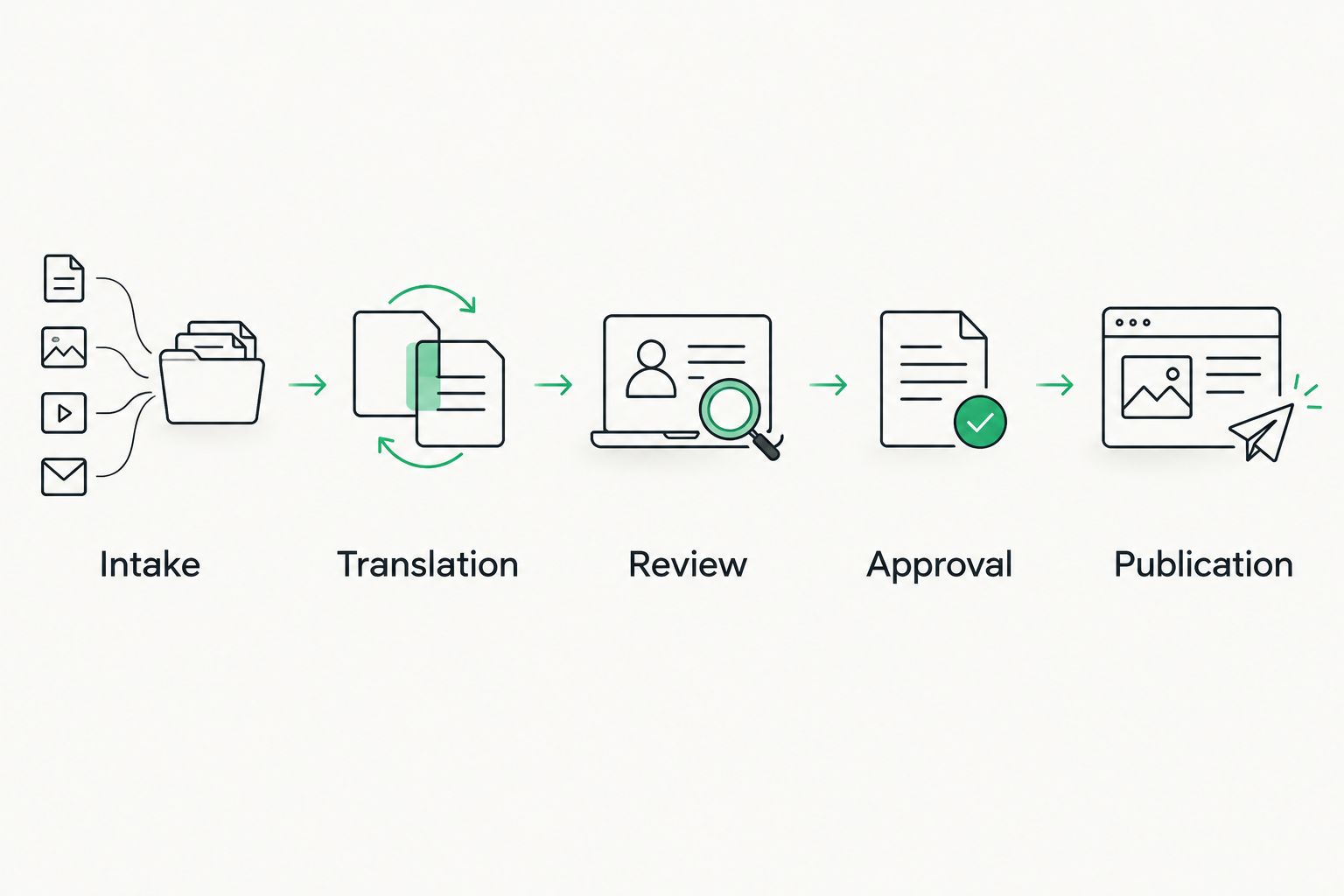
Translation completion and publication approval are separate decisions.
Measure quality and workload separately
Use a shared reporting sheet before buying reporting features. Track 4 measures: review corrections, turnaround time, source-change rework, and spending by content group. Define each measure consistently so teams are not comparing different activities.
Record turnaround time in hours or days, but specify its start and end events. Intake-to-approval time answers a different question from translation-only time. Do not attribute delays to translators when the source is waiting for policy clarification.
Quality measurement also needs context. Distinguish an error affecting eligibility or meaning from a stylistic preference. A total correction count without severity tells procurement little about whether the workflow protects residents.
- Classify corrections by meaning, terminology, and presentation.
- Separate review time from time waiting for source answers.
- Record rework caused by source changes.
- Compare spending within equivalent content groups.
- Use findings to revise instructions before expanding scope.
Roll out by content risk and ownership
Keep the initial rollout bounded. Start with approved public content that has a clear owner and available reviewers. Expand only after the team can handle changed sources, disputed translations, and publication corrections.
Create a handoff document for staff who were not involved in the evaluation. It should explain intake requirements, reviewer responsibilities, escalation routes, and how to stop publication. Training that covers only interface buttons leaves the operating model undocumented.
In 2026, judge rollout readiness by whether another authorized team member can follow the process without private instructions. Document the exceptions before increasing volume. Urgent requests need an accountable route, not an invisible shortcut around review.
- Select content with a named owner and approved source.
- Document routine intake and exception handling.
- Train reviewers on rejection and correction procedures.
- Establish a process for replacing outdated published versions.
- Review access and responsibilities when staff roles change.
Compare options for government translation work
Choose between operating models before comparing feature lists. The right option depends on whether your main problem is coordination, specialist language work, reusable content, or all of these together.
This 2026 comparison separates functional benefits from limitations. For a named system, request evidence against your agency's requirements; category fit is not procurement approval.
Shared files and an approval register
- Best for: A bounded workflow with few handoffs
- Main benefit: Your team can document ownership without introducing another platform
- Key limitation: Staff must reconcile versions, approvals, and reusable language manually
External translation provider
- Best for: Work requiring outside language capacity or specialist review
- Main benefit: You can assign translation and review deliverables through a defined scope
- Key limitation: Your agency still needs source ownership, acceptance criteria, and publication control
Translator-focused CAT workflow
- Best for: Language teams prioritizing segment reuse
- Main benefit: Computer-assisted translation tools support work with reusable translated segments
- Key limitation: Agency-wide intake and publication governance need separate evaluation
Wxrks translation management system
- Best for: Teams seeking workflow automation, translation memory, quality management, and cost tracking
- Main benefit: Brings the stated translation-management capabilities into the software evaluation
- Key limitation: Government suitability requires a separate security, procurement, and workflow assessment
A manual workflow is a useful starting point, not a permanent answer for every workload. A provider adds language capacity, not automatic agency governance. A translation management system organizes work, but the agency retains responsibility for source accuracy and release decisions.
Common mistakes government agencies make
Treating translation output as an approved notice
A completed translation is not evidence that the policy owner approved its meaning. Keep language review and release authorization visible. When eligibility conditions change, renew review instead of publishing a previous translation with isolated edits.
Sending case records through a public-content workflow
Public notices and individual case documents do not belong in the same evaluation dataset by default. Classify content before upload and use sanitized samples for demonstrations. Never let convenience establish the data-handling policy.
Reusing outdated program language
Translation memory can return wording that was correct when originally approved. Assign an owner to retire obsolete segments and inspect surrounding context during reuse. A high match is not a current policy decision.
Evaluating only the happy-path demonstration
An intake-to-translation demo misses the difficult work: rejection, changed sources, disputed terms, and corrected publication. Ask vendors to demonstrate those events using your approved examples. Check whether staff can explain the next action without relying on the presenter.
Leaving the publishing team outside the process
A translation team cannot verify a resident-facing page it never sees. Include the final destination in acceptance checks, including link labels, form instructions, and document layout. Make the publishing owner responsible for confirming that the approved version reached the intended channel.
FAQ
What's the best translation management system for government agencies?
The best translation management system for government agencies is the one that meets the agency's approval, data-handling, and procurement requirements while supporting its translation workflow. Evaluate those requirements with approved sample content and written vendor evidence, not feature counts alone.
Is Wxrks suitable for government translation teams?
Wxrks supports workflow automation, translation memory, quality management, and cost tracking, which are relevant to government translation work. Your agency must separately evaluate security, contractual requirements, and the proposed operating workflow before approval.
Can government agencies use automated translation without human review?
Automated output should not replace accountable review for public content affecting rights, eligibility, safety, or required actions. Assign language review and publication authority according to the content's risk and your agency's rules.
What's the difference between translation memory and a glossary?
Translation memory stores translated segments for reuse, while a glossary defines approved terminology. Government teams need context and ownership rules for both so old program wording does not become an unexamined default.
Do we need a translation management system before creating an approval process?
No, you can define ownership, review stages, and publication authority with shared documents first. Use that process to evaluate whether software reduces manual handoffs without removing necessary controls.
What should a government translation software pilot test?
A government translation software pilot should test intake, translation, review, approval, and publication using content authorized for evaluation. Include source changes, rejected translations, and correction of the final published version.
Can a translation management system guarantee legal compliance?
A translation management system does not by itself establish legal compliance. Your agency must assess applicable obligations, contractual terms, data processing, and actual operating practices with its responsible legal and security teams.
One last thing
Test whether your team can withdraw a translation, not just publish one. Select an approved sample, change a material instruction, and ask staff to identify every affected language version and publication destination.
For your 2026 evaluation, that exercise tests the connection between source ownership and resident-facing content. If the team cannot find the affected versions, faster translation will not fix the release process.
Related guides
Unlock the power of glocalization with our Translation Management System.
Unlock the power of
with our Translation Management System.