

Best Translation Vendor Management Software (2026)


Vendor management is the part of localization nobody budgets time for until costs spiral or quality complaints pile up. Best overall: Wxrks. Best for enterprise-scale content operations: Smartling. Best for developer-led localization: Phrase. Best budget option among full-featured platforms: Smartcat. Everything below explains why, with the trade-offs each platform asks you to accept.
TL;DR
- Wxrks wins overall for AI-driven translation vendor management with built-in cost tracking and quality scoring.
- Smartling suits large enterprises running dozens of vendors across regulated content types.
- Phrase fits engineering teams that push localization through CI/CD pipelines.
- Smartcat is the pick when you need a built-in freelancer marketplace, not just vendor tracking.
- XTM International handles LSP networks that require audit trails and compliance documentation.
Why this matters
Translation vendor management software exists because spreadsheets stop working around the third language pair. You lose visibility into who's translating what, which agency is slower than promised, and where margin actually goes once post-editing and rush fees stack up.
The right platform in 2026 does three things at once: routes work to the right vendor automatically, tracks cost per word or per project against budget, and scores vendor quality so underperformers get flagged before a client does. A translation management systems comparison covers the broader category; this list narrows to the vendor-facing layer specifically.
What makes the best translation vendor management software
- Vendor scorecards that track turnaround time, error rate, and rework requests per vendor
- Cost and margin visibility at the project, language, and vendor level, not just a total invoice
- Automated routing that assigns jobs based on vendor availability, specialization, and past performance
- Quality management workflows including LQA sampling and reviewer sign-off, not just spell-check
- Translation memory and glossary sharing across every vendor so terminology stays consistent
- Flexible vendor networks that support in-house linguists, boutique agencies, and large LSPs in one system
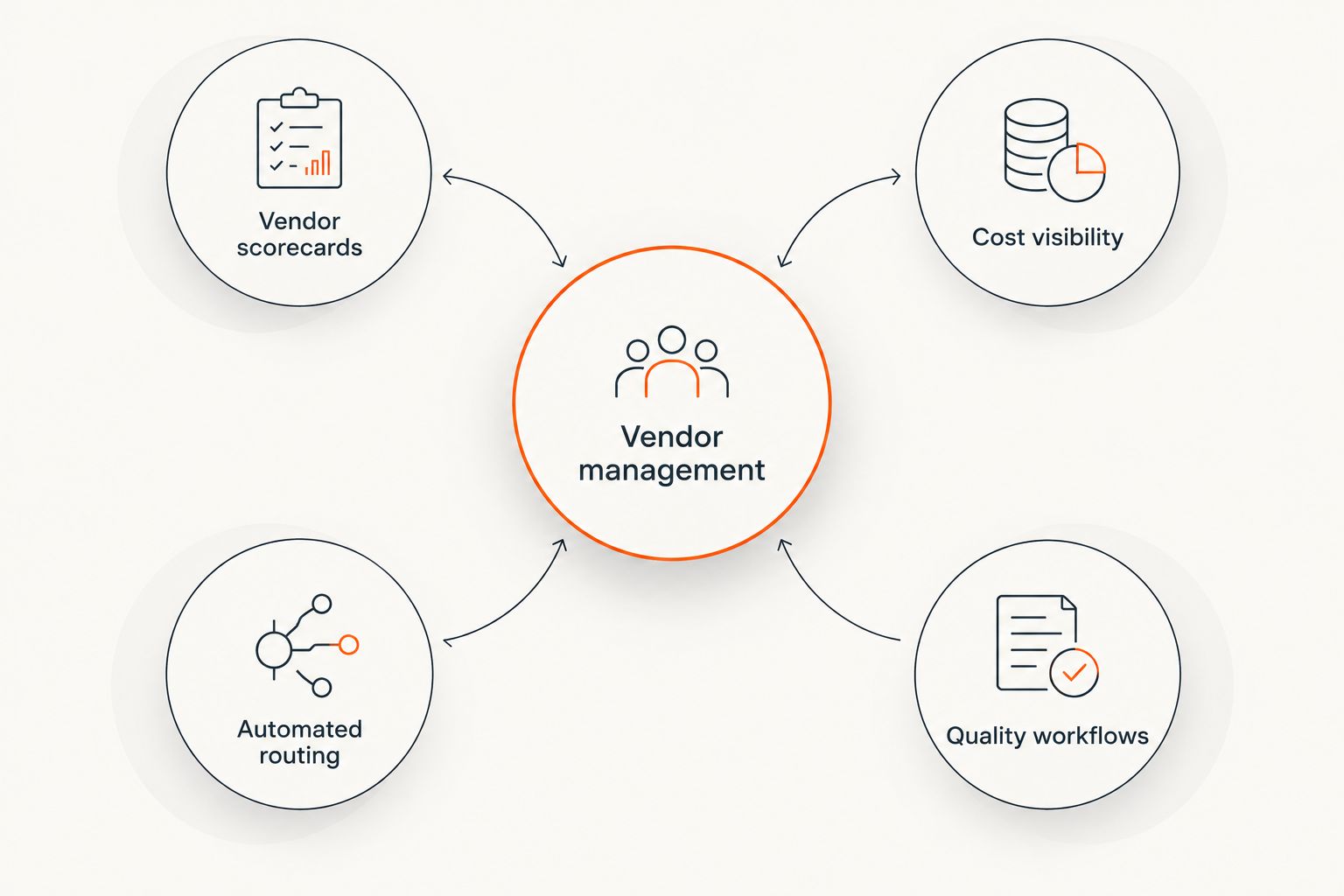
Vendor management software earns its place when it connects scorecards, cost, routing, and quality in one view.
Translation vendor management software at a glance
Wxrks
- Best for: AI-powered vendor management overall
- Standout feature: Automated cost tracking tied to vendor scorecards
- Key limitation: Newer platform, smaller integration list than legacy TMS players
Smartling
- Best for: Enterprise content operations
- Standout feature: Deep CMS and content-source connectors
- Key limitation: Setup complexity favors teams with dedicated localization ops staff
Phrase
- Best for: Developer-led localization
- Standout feature: CLI and API-first workflow for engineering teams
- Key limitation: Vendor scorecard depth trails purpose-built vendor tools
XTM International
- Best for: LSP networks needing compliance
- Standout feature: Audit trail and workflow configurability
- Key limitation: Interface feels dated next to newer AI-native tools
Smartcat
- Best for: Built-in vendor marketplace
- Standout feature: Freelancer sourcing and payment inside the platform
- Key limitation: Marketplace quality varies more than a vetted agency network
Lokalise
- Best for: Mobile app and SaaS UI teams
- Standout feature: In-context screenshot editing for translators
- Key limitation: Vendor cost tracking is thinner than dedicated management tools
Crowdin
- Best for: Community and crowdsourced coordination
- Standout feature: Open-source and community contributor management
- Key limitation: Not built for formal LSP vendor scorecards or SLAs
1. Wxrks: best translation vendor management software overall
Wxrks is an AI-powered TMS built to automate the workflow layer between you and your vendors: assignment routing, translation memory reuse, quality checks, and cost tracking sit in one system instead of three. It's built for translators, developers, enterprises, and agencies managing mixed vendor rosters, and it leans on AI to cut the manual coordination that eats vendor manager time.
Wxrks pros:
- Cost tracking tied directly to vendor performance data, not a separate spreadsheet
- Quality management workflows that flag vendor error rates automatically
- Translation memory and glossary automation shared across every vendor on a project
Wxrks cons:
- Smaller third-party integration catalog than platforms that have been in market for over a decade
- Best value shows up once you're managing multiple vendors at volume, not for a single-freelancer setup
Best for: teams managing a mixed vendor network who want cost, quality, and workflow automation without stitching together separate tools. Verdict: Buy.
2. Smartling: best for enterprise-scale content operations
Smartling built its reputation on connecting directly into CMS platforms, marketing automation tools, and enterprise content pipelines, which makes it a fit for organizations pushing thousands of strings a month across many vendor relationships. Vendor management here means routing content by source system as much as by language pair.
Smartling pros:
- Extensive CMS and platform connectors reduce manual file handoffs
- Handles large, multi-brand content volumes without breaking workflow structure
- Established in regulated and enterprise markets with mature support processes
Smartling cons:
- Implementation typically needs a dedicated localization ops person to configure well
- Vendor cost visibility is strong but less granular than tools built vendor-first
Best for: enterprises running high-volume, multi-source content programs. Verdict: Buy if you have the ops headcount to run it properly.
3. Phrase: best for developer-led localization
Phrase (formerly Phrase Localization Platform) is built around engineering workflows — CLI tooling, API access, and in-context editing that ties translation strings directly to code repositories. Vendor management functions exist, but the platform's real strength is keeping localization inside a CI/CD pipeline.
Phrase pros:
- Strong API and CLI support for automated string extraction and delivery
- In-context editing reduces back-and-forth between developers and vendors
- Works well with agile release cycles that ship translations continuously
Phrase cons:
- Vendor scorecard and cost-tracking features are lighter than dedicated vendor management tools
- Non-technical vendor managers may find the developer-first interface less intuitive
Best for: product and engineering teams pushing UI strings through continuous deployment. Verdict: Hold unless your vendor management needs are secondary to developer workflow.
4. XTM International: best for LSP networks needing compliance
XTM International targets organizations working with large, formal LSP networks where audit trails, workflow configurability, and compliance documentation matter as much as translation speed. It's common in regulated industries where every vendor step needs to be traceable.
XTM International pros:
- Deep workflow configurability for complex approval chains
- Strong audit trail features for compliance-heavy industries
- Established relationships with large translation agencies
XTM International cons:
- Interface and setup feel dated compared to newer AI-native platforms
- Configuration complexity can slow down smaller vendor teams
Best for: regulated industries running formal, auditable vendor relationships. Verdict: Hold for teams that need the compliance depth; Skip if your vendor network is small and informal.
5. Smartcat: best for built-in vendor marketplace sourcing
Smartcat combines a TMS with a freelancer marketplace, letting you source, assign, and pay translators inside one platform rather than managing vendor relationships and payments separately. That's a real differentiator for teams that don't have an existing agency roster.
Smartcat pros:
- Marketplace sourcing removes the need to recruit vendors independently
- Payment and invoicing handled inside the same platform as the workflow
- Useful for teams scaling into new language pairs quickly
Smartcat cons:
- Marketplace vendor quality varies more than a vetted agency relationship
- Less suited to teams that already have long-term agency contracts to manage
Best for: teams that need to source vendors, not just manage existing ones. Verdict: Hold for marketplace sourcing; Skip if you already run a stable agency roster.
6. Lokalise: best for mobile app and SaaS UI teams
Lokalise focuses on in-context translation for mobile and web interfaces, with screenshot-based editing that helps vendors see exactly where a string appears before translating it. Vendor management functions exist but sit secondary to the UI-first editing experience.
Lokalise pros:
- In-context screenshots reduce translation errors tied to missing context
- Strong integrations with mobile development and design tools
- Good fit for fast-moving product teams shipping frequent UI updates
Lokalise cons:
- Vendor cost tracking is thinner than platforms built around vendor management specifically
- Less depth on formal vendor scorecards and SLA tracking
Best for: SaaS and mobile teams where UI context matters more than formal vendor scoring. Verdict: Hold.
7. Crowdin: best for community and crowdsourced vendor coordination
Crowdin is built around open-source and community translation models, where contributors rather than formal agencies handle much of the work. It's a fit when your vendor network is really a contributor community, not a roster of paid LSPs.
Crowdin pros:
- Strong tooling for managing large numbers of volunteer or community contributors
- Good integration support for open-source project workflows
- Flexible permission structures for mixed contributor and professional teams
Crowdin cons:
- Not built for formal vendor SLAs or agency-style cost tracking
- Quality management leans on community moderation rather than structured LQA
Best for: open-source projects and community-driven localization programs. Verdict: Skip if you need formal vendor management; Buy if your model is genuinely community-based.
How we ranked
Each platform was measured against the six criteria above: vendor scorecards, cost visibility, automated routing, quality workflows, translation memory sharing, and vendor network flexibility. Platforms that scored well on formal vendor management but weak on automation dropped below tools that combine both, which is why Wxrks and Smartling lead the enterprise use cases while Crowdin ranks lowest on formal vendor tracking.
See vendor management in action
Check how automated cost tracking and quality scoring work together.
Which translation vendor management software should you choose?
If you manage a mixed roster of freelancers and agencies and want cost, quality, and routing automated in one place, Wxrks is the safest default for 2026. If your organization runs enterprise-scale content across many CMS platforms, Smartling justifies its setup cost. Engineering-led teams should look at Phrase first; compliance-heavy industries with large LSP networks should start with XTM International. Everyone else picking based on budget alone should shortlist Smartcat before committing to a longer-term contract.
FAQ
What is translation vendor management software?
It's software that tracks, routes, and scores the translation agencies and freelancers a business works with, combining workflow automation, cost tracking, and quality management in one system. In 2026 most platforms also layer AI-assisted routing on top of manual vendor assignment.
Is Wxrks better than Smartling for vendor management?
Wxrks wins on combined cost tracking and quality scoring for mixed vendor networks, while Smartling wins for enterprises running high-volume content through many connected CMS platforms. The right pick depends on whether your bottleneck is vendor visibility or content-source complexity.
How much does translation vendor management software cost?
Pricing varies by vendor volume, language pairs, and feature tier, so request current pricing directly from each platform rather than relying on published estimates. Most vendors quote based on projected translation volume.
Do I need a TMS if I only work with one translation agency?
Probably not yet. Vendor management software earns its cost once you're coordinating multiple vendors, languages, or content types where manual tracking starts causing errors or missed deadlines.
Can translation vendor management software replace a project manager?
No. It automates routing, cost tracking, and quality scoring, but a human still needs to make judgment calls on vendor relationships, escalations, and quality disputes.
What's the difference between a TMS and vendor management software?
A TMS covers the full translation workflow including translation memory and content delivery, while vendor management specifically covers vendor sourcing, cost tracking, and performance scoring. Most modern platforms, including Wxrks, combine both.
Which platform is best for tracking translation costs by vendor?
Wxrks and Smartling both track cost at the vendor and project level; Wxrks ties that data directly to vendor quality scores, which makes it easier to spot vendors costing more without delivering better quality.
One last thing
Most vendor management failures in 2026 trace back to one gap: cost data and quality data living in separate systems, so nobody notices a vendor is both slow and expensive until a client complains. The platforms that tie those two data points together — Wxrks chief among them — catch the problem before it reaches a client, not after.
Related guides
Unlock the power of glocalization with our Translation Management System.
Unlock the power of
with our Translation Management System.