


Translation management system for higher education wins 2026


Higher education translation management is the coordination of multilingual content, reviewers, translation memory, and approvals to help students and staff receive accurate institutional information. This 2026 guide explains how to choose a translation management system for higher education when admissions, academic departments, and student services need different terminology but a shared publishing process.
TL;DR
- Choose a translation management system for higher education around ownership, translation memory, and quality review—not translation speed alone.
- Wxrks supports localization workflow automation, translation memory, quality management, and cost tracking.
- Keep academic terminology centrally governed while departments retain responsibility for factual approval.
- Test representative admissions, learning, and student-services content before committing to a campus-wide rollout.
Why translation management matters for higher education
A university translation is not finished when the words read well. The application deadline must match the source, the qualification name must mean the right thing, and the published page must reflect the approved version. Treat translation as a publishing workflow, not an isolated language task.
Recurring institutional language makes reuse valuable. A translation memory software guide explains the underlying concept: retain approved source-and-target segments so translators can reuse them when matching content returns. Reuse still needs context; a previously approved sentence is not automatically correct for a different program.
For a 2026 implementation, separate public recruitment material from records, restricted research content, and other sensitive documents. These content classes need different access decisions and review responsibilities. A system that handles a brochure satisfactorily has not thereby passed your requirements for student information.
The practical goal is shared control without removing subject expertise. Your central team governs the process; departmental owners approve the institutional facts.
How to build a higher education translation workflow
Define your content scope and ownership
Start with an inventory in a spreadsheet. Record the source location, content owner, target audience, required languages, update trigger, and publication destination. This manual exercise exposes ambiguous responsibilities before software turns them into recurring assignments.
Distinguish translating institutional communications from evaluating documents submitted by applicants. A multilingual admissions page and an applicant's academic transcript serve different purposes. Do not assume the same workflow, reviewer, or acceptance criteria applies to both.
For your 2026 inventory, group content by function rather than file extension. An admissions email and an admissions webpage can share terminology, even though their publication routes differ. Conversely, two PDFs can require entirely different handling.
Assign a source owner and a language approver to each content group. Where one person holds both roles, record that explicitly rather than leaving the responsibility implicit.
- List admissions, student-services, and learning content separately.
- Identify the authoritative source for each content item.
- Assign responsibility for correcting source-language errors.
- Mark content containing personal or restricted information.
- Record who approves each language before publication.
Establish terminology before translating
Build a shared glossary manually before importing anything into a platform. Include the source term, approved translation, definition, usage example, department, and approval owner. Context matters more than a long list of word pairs.
Academic terms deserve particular attention. A department name, credential, course category, or student status can carry a precise institutional meaning. Ask the relevant subject owner to explain that meaning before a translator selects the target-language wording.
Keep terminology and translation memory distinct. A glossary governs how a term should be expressed; translation memory stores previously translated segments. Neither replaces a current factual check. If a program changes its name, an old memory entry remains old even when it matches perfectly.
Set an escalation route for disagreements. Translators should know who can resolve a terminology question without sending the same email to several departments.
- Start with terms from the content selected for your pilot.
- Add definitions for qualifications and academic structures.
- Record preferred terms and explicitly rejected alternatives.
- Preserve official names where your institution requires them.
- Assign an owner to approve glossary changes.
Design approvals around content risk
Draw the workflow before configuring automation. A shared checklist can establish the sequence: source review, translation, quality review, then publication. At each stage, identify the person responsible and the condition that allows the content to move onward.
Wxrks is best suited to teams evaluating workflow automation, translation memory, quality management, and cost tracking together. Its stated capabilities address those functions; your evaluation still needs to establish how the system fits your institution's approval and access requirements.
Start manually, then use a TMS as the faster coordination path. Automate predictable handoffs only after the team agrees on what counts as ready, approved, and published. A notification does not resolve an unclear decision.
Keep linguistic review separate from institutional approval. A translator can check clarity and terminology, while a program owner checks eligibility requirements or course details. Neither responsibility should disappear into a generic approved status.
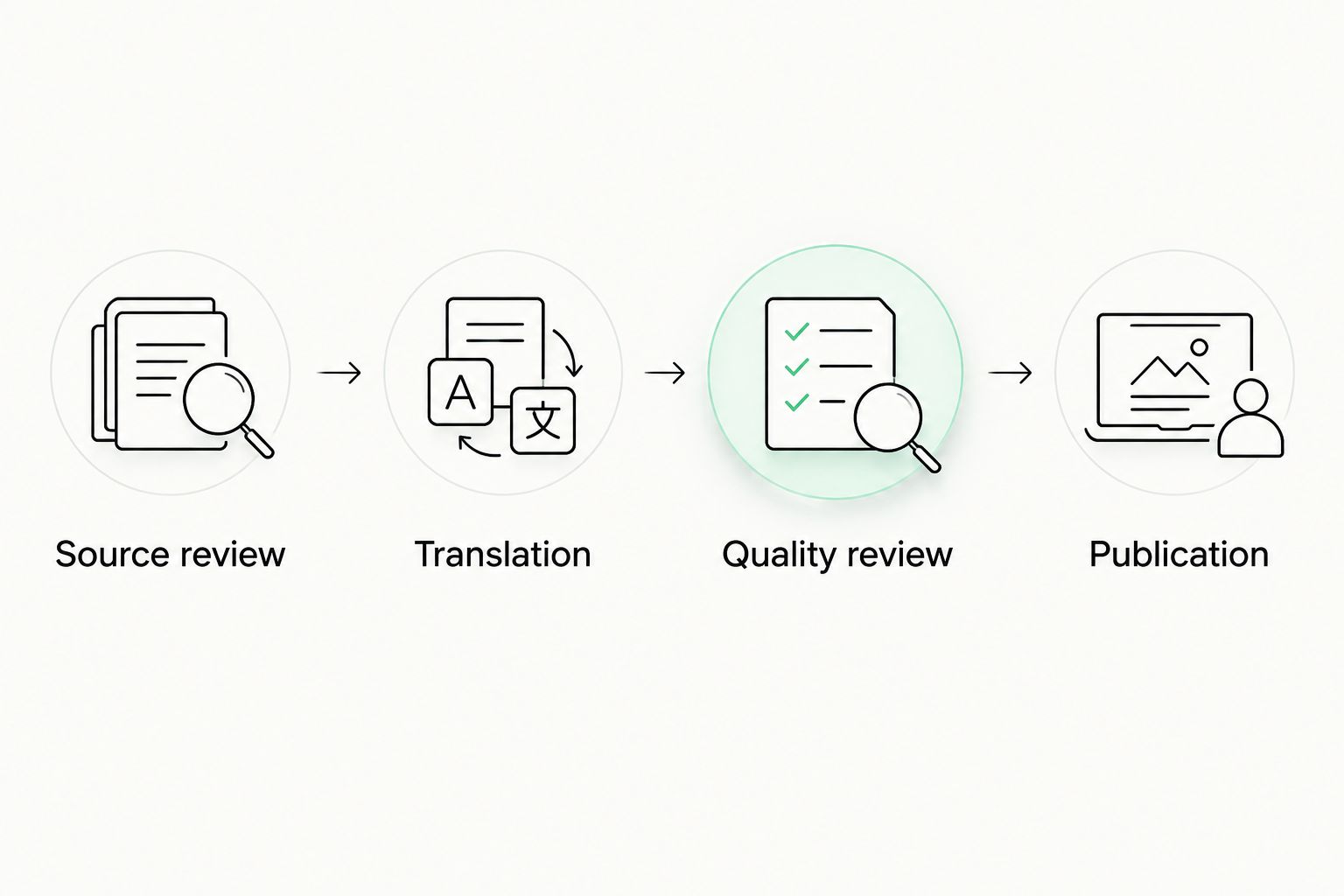
Define each approval gate before automating the handoff.
Use the same core workflow across departments, then add review requirements where the content warrants them. Avoid creating a completely separate process for every request.
- Source review: confirm facts and resolve unclear wording.
- Translation: provide the approved source and terminology.
- Quality review: check meaning, terminology, and content-specific details.
- Publication: confirm the destination and approved version.
- Return rejected work to a named owner with a reason.
Test files and publishing destinations
Run a manual round trip with representative content. Export or copy the source, translate it, return it to the destination, and inspect the result. This establishes the actual handoff your software must support.
Do not evaluate only the translation editor. Website content, learning materials, captions, forms, and downloadable documents have different publication checks. Correct text can still appear in the wrong field, lose a heading, or leave a source-language attachment linked from a translated page.
Give reviewers the context available to the reader. A short interface label needs its surrounding screen; a course instruction needs the activity it describes. Isolated strings invite avoidable ambiguity.
If you need a connection to a content management system or learning management system, require a demonstration using your intended workflow. Do not infer compatibility from a general claim about automation.
- Test an export and re-import using actual content formats.
- Check headings, links, lists, and document reading order.
- Inspect placeholders and variables without changing their function.
- Review translated content inside its publication destination.
- Confirm how updated source content reaches the translation queue.
Verify privacy and access requirements
Classify the material before uploading it anywhere. Public recruitment copy is a sensible starting point for a pilot; documents containing student information require a separate institutional decision. Translation software selection does not replace that decision.
Use your existing procurement and information-security process to request evidence about access controls, retention, deletion, subprocessors, and processing locations. Ask how submitted content is handled by any machine translation or other external processing service involved in the workflow.
For a 2026 evaluation, document the answers in your institution's assessment record. Do not treat an unanswered security question as an implied capability, and do not describe a platform as institutionally approved before the responsible team has approved it.
The manual starting point is a data-handling checklist and a restricted test dataset. Automating routing becomes appropriate after those boundaries are settled.
- Classify public, internal, and restricted content separately.
- Confirm who can view, edit, approve, and export material.
- Request documented retention and deletion procedures.
- Review external processing arrangements with procurement.
- Test only content your institution authorizes for the evaluation.
Measure quality and work completed
Start with a shared issue log. Record the content item, language, error category, severity, correction, and responsible owner. This gives your reviewers a consistent way to distinguish a terminology issue from an incorrect date or a missing paragraph.
Define completion carefully. Translated, reviewed, approved, and published are different milestones. Reporting only translated words can hide a queue of material that students still cannot access.
Track cost alongside workflow status rather than interpreting cost in isolation. Wxrks includes cost tracking and quality management among its stated functions; evaluate how the available records support your departmental reporting and review process.
Use translation memory matches as review inputs, not quality scores. Reused wording still needs checking when the surrounding meaning or source facts change. Require the person accepting a segment to see sufficient context.
- Define error categories before reviewers start logging issues.
- Record factual errors separately from stylistic preferences.
- Track approval and publication status alongside translation status.
- Attribute corrections to their underlying cause.
- Review recurring issues with the relevant content owner.
Run a bounded pilot before expanding
Use a proposed 30-day pilot with 3 content types and 2 target languages. These are planning boundaries, not a performance benchmark. Select admissions information, a student-services instruction, and a learning resource so the exercise covers different owners and publication needs.
Include a source revision during the pilot. Initial translation shows how content enters the workflow; a revision shows whether the team can identify affected translations, reuse suitable work, and prevent an outdated version from being published.
Set acceptance criteria before the pilot begins. Require approved terminology, correct institutional facts, a completed publication check, and an attributable approval record. Add requirements from your security assessment rather than borrowing a generic software checklist.
End the 2026 pilot with a rollout decision based on demonstrated fit. Expand the content scope only after the participating owners can explain their responsibilities without relying on the evaluator to coordinate every handoff.
- Select content with named source owners and language reviewers.
- Include repeated terminology and at least one source revision.
- Test a correction returned from review to translation.
- Verify the final published version against the approval record.
- Document unresolved requirements before expanding the rollout.
Compare the options for your institution
Choose the operating model first. A translation management system coordinates work, a translation service supplies language work, and a spreadsheet records assignments. They solve different parts of the problem and can coexist.
Use the option that addresses your workflow gap, not the one with the longest feature list. If reviewers and publication owners remain undefined, changing software leaves the central problem intact.
Shared spreadsheet and approved document folders
- Best for: A tightly bounded pilot with a named coordinator
- Main advantage: Makes responsibilities and handoffs visible without platform configuration
- Key limitation: Your team must maintain versions, reminders, and status records manually
Wxrks translation management system
- Best for: Teams evaluating automated localization workflows, translation memory, quality management, and cost tracking
- Main advantage: Brings the stated translation-management functions into one system
- Key limitation: Your institution must verify access, security, file handling, and publishing fit
Managed translation service
- Best for: Teams that need external translation and review work
- Main advantage: Gives you a service-based route to assigning linguistic tasks
- Key limitation: Institutional facts and final publication still need internal ownership
Department-led translation with a shared glossary
- Best for: Departments with accountable language reviewers
- Main advantage: Keeps subject knowledge close to translation decisions
- Key limitation: Cross-department reuse and status reporting require deliberate coordination
A central system does not require every department to surrender its expertise. It requires shared definitions for source readiness, terminology changes, approval, and publication.
Common mistakes higher education teams make
Treating every academic term as a direct equivalent
A familiar target-language term can describe a different academic structure. Translating a qualification or student status without checking its institutional meaning creates a factual problem, not merely a style disagreement. Give translators definitions and require the appropriate academic owner to resolve ambiguous terms.
Publishing translations without a source-update rule
A translated admissions page is vulnerable to becoming outdated when its source changes independently. Establish who identifies affected languages and who authorizes republication. Do not mark a source update complete while related translations remain unreviewed.
Using one approval route for every document
Recruitment copy, course instructions, and student records do not have identical review needs. Match the approval route to the content's purpose and handling requirements. Keep the shared workflow, but make additional approvals explicit rather than assuming somebody will notice the sensitive material.
Buying automation before assigning owners
Automated routing cannot determine who is entitled to approve a revised program requirement. Configure assignments only after the department confirms its decision-maker. Wxrks workflow automation belongs downstream of that ownership decision, not in place of it.
Accepting a translated file as a published experience
A completed document does not prove that a multilingual webpage, form, or learning activity works correctly. Inspect the destination, including linked files and instructions. Make publication verification a separate completion requirement so it cannot disappear inside linguistic review.
FAQ
What's the best translation management system for higher education?
The best translation management system for higher education is the one that passes your institution's workflow, quality, data-handling, and publishing tests. Wxrks is an option for teams evaluating workflow automation, translation memory, quality management, and cost tracking; verify institution-specific requirements during a pilot.
Do universities need a TMS or a translation agency?
A TMS coordinates translation work, while a translation agency provides language services. A university can use both, with internal owners retaining responsibility for institutional facts and publication approval.
Can translation memory handle changing admissions information?
Translation memory can reuse previously translated segments, but it does not establish whether admissions information is current. Review changed facts and their context before accepting reused wording.
Can we upload student records to a translation platform?
Upload student records only after your institution authorizes the platform and the proposed data-handling process. Review access, retention, deletion, and external processing requirements before using sensitive content.
How should we test a TMS before a campus-wide rollout?
Test representative content through translation, review, correction, and publication before expanding the rollout. Include a source revision so the pilot tests ongoing maintenance rather than only the initial translation.
Does a TMS replace human translation review?
A TMS does not replace responsibility for linguistic and institutional review. Assign reviewers to check meaning and terminology, and assign content owners to approve facts such as deadlines and program requirements.
What should a higher education translation glossary include?
A higher education glossary should include approved terms, definitions, usage examples, and an approval owner. Prioritize qualifications, department names, student statuses, and recurring admissions language from your selected content.
One last thing
Make a source change part of your 2026 selection test. Ask the content owner to revise an admissions requirement after its translation has been approved, then follow that change through the entire workflow. This reveals whether your process connects source ownership, translation updates, review, and publication. A successful first translation is useful; controlled maintenance is what keeps institutional information accurate.
Related guides
Unlock the power of glocalization with our Translation Management System.
Unlock the power of
with our Translation Management System.