Is AI translation accurate enough for legal documents?


AI translation is useful for drafting and understanding legal documents, but you should not treat unreviewed output as ready for signing, filing, or legal reliance. Accuracy depends on the language pair, legal terminology, source quality, and intended use. A qualified legal translator should check the complete document, while the receiving authority’s requirements determine whether certification or another formal step is necessary.
TL;DR
- Is AI translation accurate enough for legal documents? For drafting, yes; for legal reliance, require qualified review.
- Legal translation accuracy depends on meaning, terminology, completeness, and the receiving authority’s requirements.
- Wxrks supports translation management workflows; software does not replace qualified legal review.
- Keep translation memory separate from approval: a stored translation is not automatically a legally suitable translation.
Why this matters
A legal translation can read naturally while changing an obligation. A missing exception, a changed deadline, or an inconsistent defined term matters more than elegant prose. Your review needs to establish that the translated document preserves the source’s meaning—not just that it sounds professional.
For a 2026 legal translation workflow, separate drafting, verification, and authorization to use the result. The legal translation software guide covers the software category; the decision here is whether a particular translated document is fit for its intended purpose.
Is AI translation accurate enough for legal documents?
AI translation is a drafting method, not evidence that a legal document is accurate. Judge the finished translation against the source, the relevant legal context, and the requirements of the person or organization receiving it.
The following approaches serve different purposes. These are workflow recommendations, not measured accuracy rankings.
Unreviewed machine translation
- Best for: Preliminary reading of documents you are authorized to process
- Main benefit: Produces a draft for orientation
- Main limitation: Meaning-changing errors remain unchecked
- Recommendation: Keep it out of final legal use
Machine translation with qualified legal review
- Best for: Drafting followed by document-level verification
- Main benefit: Combines automated drafting with expert checking
- Main limitation: Requires review of the entire source and target
- Recommendation: Use only after appropriate approval
Qualified human translation with independent revision
- Best for: Documents needing specialist handling and a separate check
- Main benefit: Gives legal terminology and ambiguities direct human attention
- Main limitation: Human work still requires quality controls
- Recommendation: Choose when the document’s risk warrants it
No approach removes the need to understand submission requirements. Human translation is not automatically certified, and certification is not a substitute for checking accuracy.
For your 2026 assessment, ask whether the translator verified every clause and whether the final version meets its intended use. Do not approve a document because an isolated paragraph looks convincing.
What does accurate mean in a legal translation?
An accurate legal translation preserves who must do what, under which conditions, and with which exceptions. It also preserves references, figures, names, and the relationship between clauses. Smooth language is useful, but it cannot compensate for a changed legal meaning.
For example, a hypothetical clause containing a payment obligation and an exception requires both elements to survive translation. If the target text preserves the obligation but drops the exception, it is incomplete even when every remaining sentence is grammatical.
Review the document as a connected text. Definitions at the beginning can control clauses much later, and an attachment can qualify what appears to be an unconditional statement.
Preliminary reading: useful, but not an approved translation
Best for: understanding the broad subject before commissioning or reviewing a translation. An automated draft can help you identify what a document discusses and which passages require specialist attention. Treat unfamiliar terminology and ambiguous passages as questions, not settled answers.
The drawback is that readable output can conceal uncertainty. Without comparing the draft with the source, you cannot tell whether an obligation, exclusion, or qualification disappeared.
Label this version as a draft. Keep it separate from documents circulated for execution, submission, or advice, and check your organization’s confidentiality rules before sending any material to a translation service.
Reviewed translation: the reviewer checks meaning, not just style
Best for: workflows where automated drafting is followed by qualified legal translation review. The reviewer must compare the source and target throughout the document. Editing only awkward sentences leaves fluent errors untouched.
Give the reviewer the complete source, relevant attachments, intended jurisdiction, and intended use. Supply approved terminology where it exists, but allow the reviewer to challenge terminology that does not fit the current context.
The limitation is straightforward: machine-generated text still needs substantive attention. A review described as proofreading should not be treated as legal translation verification unless its scope explicitly includes checking meaning against the source.
Submission-ready translation: accuracy and acceptance are separate
Best for: documents intended for an authority or recipient with stated translation requirements. Start with those requirements before assigning the work. Ask what languages, translator declarations, certification, formatting, or supporting documents the recipient requires.
A translation can be accurate yet fail a recipient’s procedural requirements. Conversely, the presence of a declaration does not eliminate the need to check the translated content.
In 2026, verify the current instructions for the exact receiving body rather than borrowing rules from another court, agency, or transaction. Keep the applicable instructions with the project so the translator and approver work toward the same deliverable.
Why legal translation accuracy varies
Legal translation involves more than replacing words. These factors determine what your reviewer needs to investigate:
- Language pair: Terminology, grammar, and available reference materials differ between languages. Assess the actual source and target pair rather than assuming performance transfers across languages.
- Legal context: A legal term can refer to a concept without a direct equivalent in another system. The reviewer must preserve the concept without suggesting a false equivalence.
- Source quality: Unclear drafting, missing pages, illegible scans, and extraction errors make faithful translation harder. Repair or clarify the source before treating the draft as complete.
- Document-wide terminology: Defined terms must retain their meaning throughout the text. A familiar translation from another agreement can be wrong for the current definition.
- Formatting and structure: Tables, footnotes, annexes, and cross-references carry information. Checking running text alone leaves these elements outside the review.
- Intended use: Preliminary reading, contract execution, and formal submission need different approval decisions. Establish the use before deciding who reviews and what evidence accompanies delivery.
Do not reduce these factors to a generic accuracy percentage. A document-level decision needs identifiable checks and an accountable approver.
How do you check an AI-translated legal document?
Use 3 review gates: source readiness, bilingual verification, and release approval. These gates organize the work; they are not an accuracy benchmark or a legal certification standard.
1. Source readiness
Confirm that the source is complete and readable. Check attachments, signature pages, exhibits, and any incorporated material supplied for translation. Resolve discrepancies between copies before drafting starts.
For scanned documents, compare extracted text against the visible original. A translation cannot preserve a sentence that extraction omitted. Keep the source version identifiable so everyone reviews the same document.
2. Bilingual verification
Have a qualified legal translator compare the 2 language versions in full. The check should cover meaning, terminology, completeness, and document structure—not merely spelling or style.
Prioritize obligations, permissions, prohibitions, exceptions, and conditions. Then verify names, dates, amounts, units, references, and definitions. Treat unresolved ambiguities as issues requiring clarification rather than invitations to rewrite the source.
3. Release approval
Confirm that the reviewed translation is the version being delivered. Check recipient requirements, required declarations, attachments, and the intended use. Record who approved the document and which source version the approval covers.
A later edit needs an appropriate recheck. Approval of an earlier draft does not establish that a changed document is ready to use.
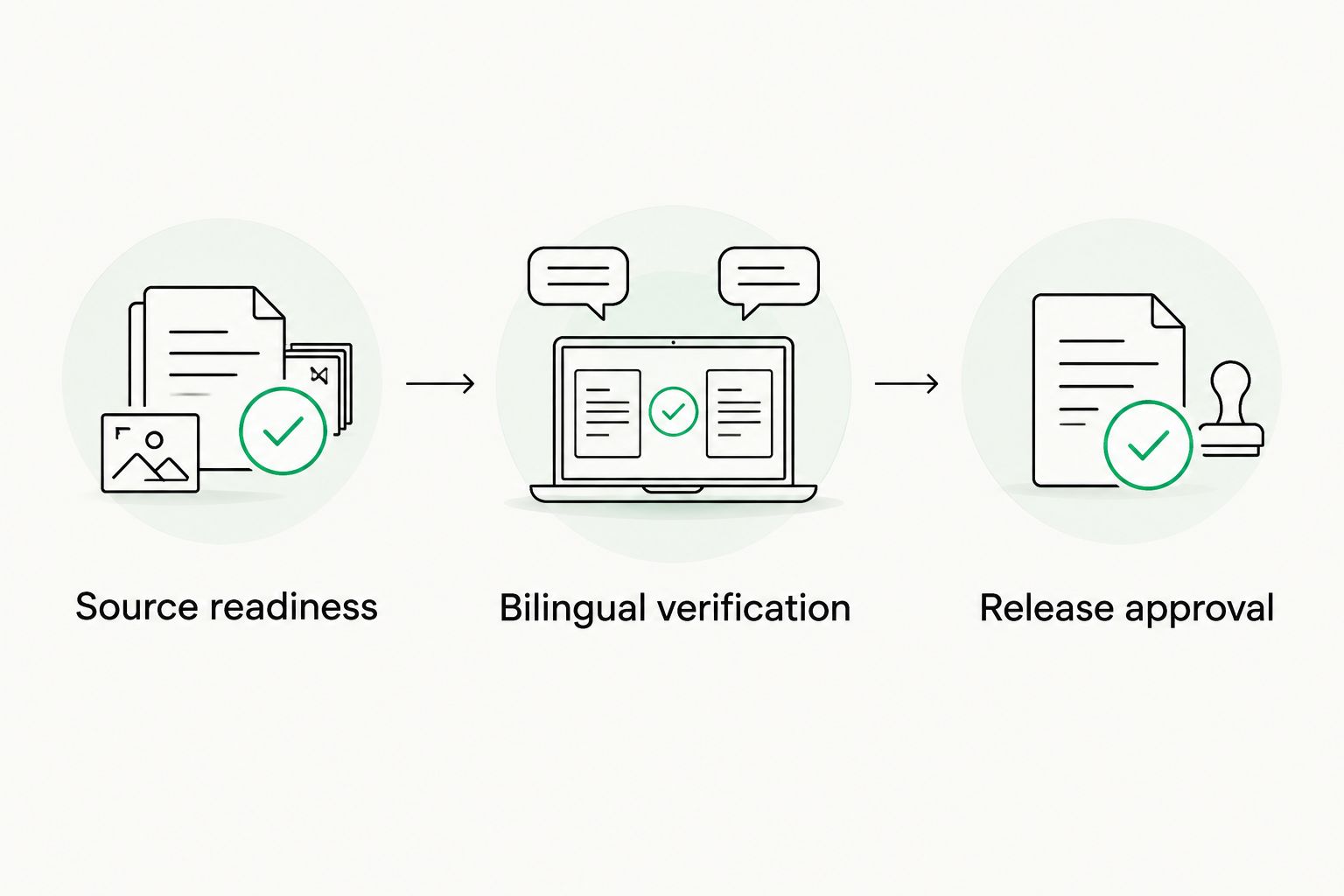
Drafting is separate from verification and approval for the intended use.
What should your bilingual review checklist include?
Use a checklist that follows the document’s legal meaning. It should help the reviewer find issues without replacing their judgment.
- Parties and identifiers: Confirm names, addresses, registration details, and each party’s role.
- Defined terms: Check that each term matches its definition wherever it appears.
- Obligations and exceptions: Preserve duties, permissions, exclusions, and qualifying language.
- Figures and references: Check dates, amounts, units, clause references, and exhibit references against the source.
- Complete content: Account for headings, tables, footnotes, stamps, handwritten additions, and attachments within scope.
- Unresolved questions: Record ambiguities and obtain clarification from the responsible person before release.
The checklist’s purpose is coverage. Finding an error should trigger a search for related errors elsewhere, especially when the same term or clause pattern repeats.
Where translation management software fits
Wxrks is an AI-powered translation management system for translators, developers, enterprises, and translation agencies. Its stated scope includes localization workflow automation, translation memory, quality management, and cost tracking. Those functions support managing translation work; they do not establish that a particular legal document is correct.
Wxrks is best suited to teams managing translation workflows, not to replacing qualified legal review. For your 2026 process, define the review and approval responsibilities before deciding how software should support them.
Translation memory also needs context. A previously accepted segment belongs to a particular document and purpose; reuse does not prove that it fits a new contract. Check the definition, surrounding clauses, and current source before accepting a repeated segment.
Keep drafting assistance and authorization distinct. That distinction gives translators room to use software while leaving the final decision with the people responsible for the document.
Can you use AI translation for contracts?
You can use AI translation to draft a contract translation, but the complete contract needs qualified review before legal reliance. Check defined terms, obligations, exceptions, and attachments together rather than approving clauses in isolation.
The drafting method does not determine which language version controls. Ask the responsible legal adviser to address the governing-language question instead of assuming that the translation has the same status as the original.
Does a legal translation need to be certified?
A legal translation needs certification when the receiving authority or applicable procedure requires it. There is no universal certification rule covering every legal document and every recipient.
Ask for the current requirements before commissioning the work. Do not confuse certification, notarization, and translation review: they address different questions, and the required combination depends on the use.
Is it safe to upload confidential legal documents?
Upload confidential legal documents only through services permitted by your organization’s policies and the applicable obligations. Check the provider’s terms concerning processing, retention, access, and use of submitted material before uploading.
This is a separate decision from translation accuracy. A faithful translation does not make an unauthorized disclosure acceptable, and a restricted workflow does not guarantee faithful translation.
FAQ
Is AI translation accurate enough for legal documents in 2026?
AI translation is useful for drafting legal documents in 2026, but unreviewed output should not be treated as ready for legal reliance. Require qualified bilingual review and confirm the receiving authority’s requirements.
Can I sign a contract translated only by AI?
Do not rely on an unreviewed AI translation to decide what a contract requires. Obtain qualified translation review and ask the responsible legal adviser about the status of each language version.
Does human review mean checking only the grammar?
Human review for legal translation must check meaning against the source, not just grammar. It should cover obligations, exceptions, definitions, figures, references, and completeness.
Is a certified translation always required for legal documents?
A certified translation is required when the receiving authority or applicable procedure requires it. Confirm the exact recipient’s instructions before assigning the translation.
Can translation memory make a legal translation accurate?
Translation memory supports reuse but does not establish legal accuracy. Review reused segments against the current document’s definitions, context, and intended use.
Can Wxrks replace a qualified legal translator?
Wxrks is a translation management system, not a substitute for qualified legal translation review. Its stated functions include workflow automation, translation memory, quality management, and cost tracking.
What should I do if the source document is ambiguous?
Ask the responsible author or legal adviser to clarify the ambiguity before approving the translation. Do not silently resolve it by choosing whichever target-language wording sounds most natural.
One last thing
A fluent error deserves the same attention as an obvious one. A hypothetical sentence with 1 missing negation can reverse the intended meaning while still sounding perfectly natural. Make source-to-target verification the release condition—not confidence in the draft’s tone.
Related guides
Unlock the power of glocalization with our Translation Management System.
Unlock the power of
with our Translation Management System.