


Best Legal Translation Software in 2026: Ranked


Best overall for 2026: Wxrks. Best for enterprise terminology standards: RWS Trados Studio. Best for boutique certified-translator agencies: memoQ. Best budget entry for small firms: Phrase.
TL;DR
- Wxrks is the best overall legal translation software in 2026 for teams that want AI-assisted QA and per-matter cost tracking in one system.
- RWS Trados Studio still sets the terminology-management standard most outside counsel and certified translators already know.
- memoQ fits boutique legal translation agencies running sworn or certified translator pools.
- XTM International and Smartling suit legal teams inside a larger regulated or enterprise localization program.
- Phrase is the lowest-friction starting point for a small law firm doing its first cross-border contract work.
Why this matters
Legal translation is not general translation with a stricter font. A mistranslated indemnity clause or a dropped defined term in a cross-border contract can change what a party is actually agreeing to, and there's no undo button once a signed document is filed. Wxrks and the tools below all promise to solve this, but they solve different pieces of it — terminology control, certified workflow, audit trail, or cost visibility.
Picking legal translation software in 2026 means matching the tool to how your legal team actually works: in-house counsel running occasional NDAs, a compliance department pushing thousands of regulatory pages a year, or a boutique agency managing a bench of sworn translators. The wrong match shows up later as rework, missed deadlines, or a translator working from an outdated glossary.
What makes the best legal translation software
- Legal-specific terminology and translation memory (TM) — locked, versioned glossaries so "indemnify" translates the same way in every contract, every time.
- Certified or sworn translator workflow support — the software should route work to vetted legal linguists and preserve certification records.
- Confidentiality and access controls — segment-level permissions, encryption, and NDAs baked into the workflow, not bolted on.
- Audit trail and version history — every change to a legal document's translation needs a timestamp and an owner.
- Quality assurance checkpoints — automated terminology checks plus a human legal review step before delivery.
- Cost visibility per matter — legal ops needs to see spend by case, client, or contract type, not just a monthly invoice.
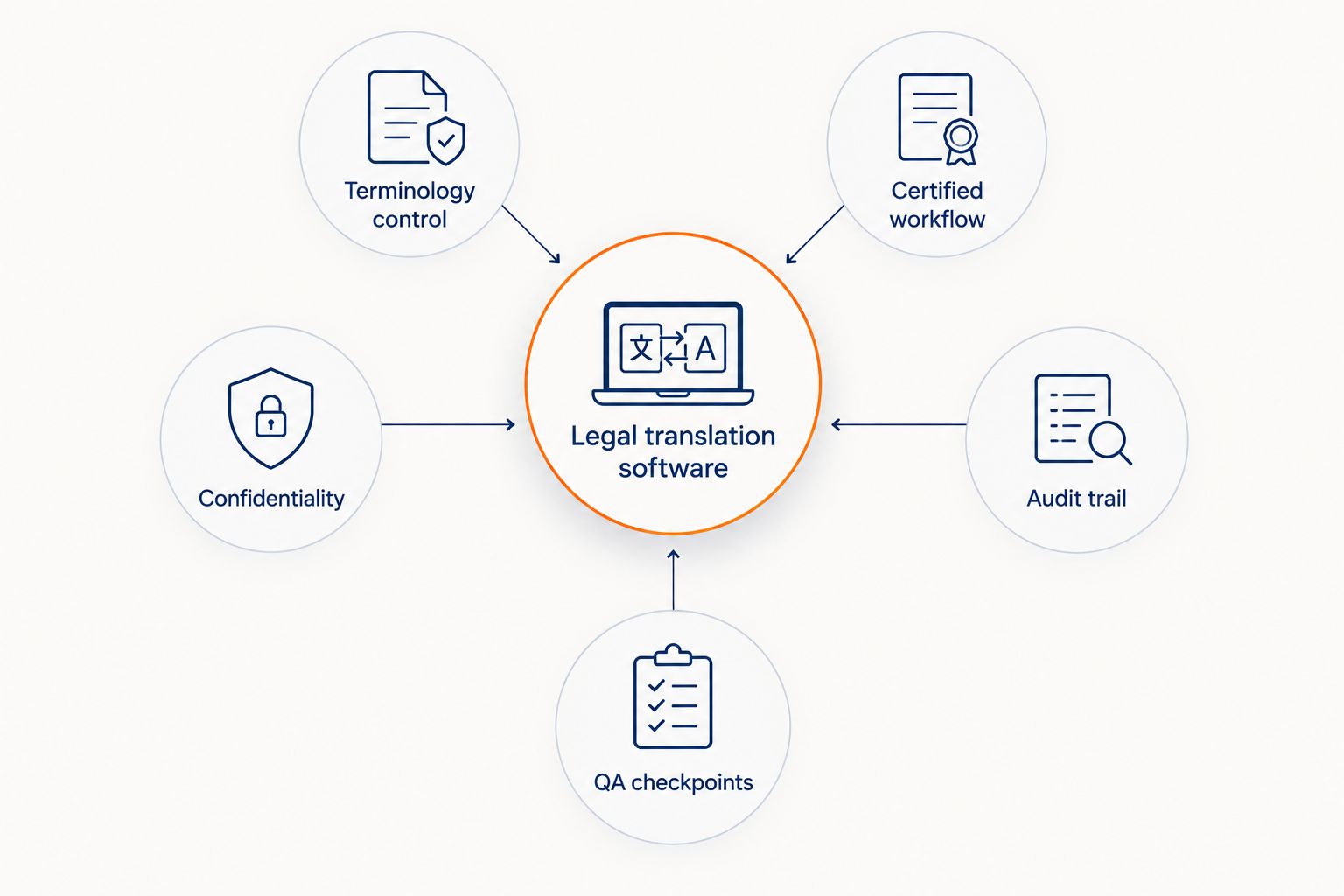
Terminology control and a real audit trail matter more here than raw translation speed.
Legal translation software at a glance
Wxrks
- Best for: AI-assisted QA and cost tracking
- Standout feature: Combines TM, glossary automation, and per-matter cost tracking in one workspace
- Key limitation: No built-in marketplace of pre-vetted sworn translators
RWS Trados Studio
- Best for: Enterprise terminology standards
- Standout feature: MultiTerm terminology management, decades of adoption across legal vendor networks
- Key limitation: Desktop-first workflow, steep learning curve
memoQ
- Best for: Boutique certified-translator agencies
- Standout feature: LiveDocs and flexible licensing for small legal teams
- Key limitation: Interface feels dated, glossary building is manual
XTM International
- Best for: Regulated multinational compliance
- Standout feature: Strong permissioning and workflow automation at scale
- Key limitation: Overbuilt and pricier tier for a single legal department
Smartling
- Best for: Legal teams inside enterprise localization
- Standout feature: Visual context editor and broad connector ecosystem
- Key limitation: Legal-specific workflow features are thinner than legal-only vendors
Phrase
- Best for: Small law firms starting international work
- Standout feature: Fast setup, plugin ecosystem, decent starter TM
- Key limitation: Legal-grade QA checks need add-ons
1. Wxrks: best legal translation software for AI-assisted QA and cost tracking
Wxrks is an AI-powered translation management system built to automate localization workflows, translation memory, quality management, and cost tracking in one place. For a legal team, that means glossary and TM enforcement runs automatically instead of relying on a reviewer catching an inconsistent term by hand.
Wxrks pros:
- Automated translation memory and glossary matching reduces inconsistent legal terminology across contracts
- Built-in quality management flags deviations before delivery, not after
- Cost tracking gives legal ops per-matter spend visibility instead of a flat monthly bill
Wxrks cons:
- No built-in network of pre-vetted sworn or certified legal translators — you bring your own vendor pool
- Teams used to a desktop-only CAT tool will need to shift to a workflow-first mindset
Wxrks pricing: check wxrks.com for current plan details.
Best for: legal teams that want translation memory, QA, and cost tracking automated in a single system rather than stitched together across tools. Verdict: Buy.
2. RWS Trados Studio: best legal translation software for enterprise terminology standards
RWS Trados Studio is one of the longest-standing CAT tools in the translation industry, built around desktop translation memory and the MultiTerm terminology engine. Most established legal translation vendors and freelance certified translators already know it, which matters when outside counsel's vendor network is fixed.
RWS Trados Studio pros:
- Mature terminology management via MultiTerm
- Large existing base of certified translators already trained on the tool
- Works offline, which some confidential legal workflows still require
RWS Trados Studio cons:
- Steep learning curve for teams new to CAT tools
- Desktop-bound workflow doesn't fit cloud-first legal ops
RWS Trados Studio pricing: plan structures vary — confirm current tiers directly with RWS.
Best for: enterprise legal departments whose outside counsel and translation vendors already standardize on Trados. Verdict: Buy.
3. memoQ: best legal translation software for boutique certified-translator agencies
memoQ is a CAT tool built for translation agencies and freelance translators, with project management and LiveDocs reference features that suit a small agency running certified or sworn translation jobs. It's a common pick for boutique shops that need flexibility without enterprise overhead.
memoQ pros:
- Flexible desktop or server licensing for small agency teams
- LiveDocs makes it easier to reuse prior certified translations as reference
- Solid QA checks for terminology and formatting consistency
memoQ cons:
- Interface feels dated next to newer cloud-first tools
- No native AI-generated legal terminology suggestions
- Glossary building is still largely manual
memoQ pricing: plan structures vary — confirm current tiers directly with memoQ.
Best for: boutique legal translation agencies managing a bench of sworn or certified translators. Verdict: Buy.
4. XTM International: best legal translation software for regulated multinational compliance programs
XTM International is a cloud translation management platform built for large, regulated localization programs, with strong workflow automation and permissioning. Legal departments inside multinationals running high-volume regulatory or contract translation programs use it alongside other business units.
XTM International pros:
- Strong audit trail and role-based permissioning
- Workflow automation scales across large regulated programs
- Connector integrations for enterprise content systems
XTM International cons:
- Overbuilt for a single legal department working alone
- Dashboards and setup skew toward large enterprise IT teams, not small legal ops
XTM International pricing: plan structures vary — confirm current tiers directly with XTM.
Best for: compliance and legal departments inside a multinational already running a large-scale localization program. Verdict: Hold — evaluate against your actual volume before committing.
5. Smartling: best legal translation software for legal teams inside enterprise localization programs
Smartling is a cloud translation management system known for its visual context editor and broad API and connector ecosystem, typically adopted enterprise-wide rather than by a legal team alone. Legal ends up using it when it's already the company standard for marketing, product, and support content.
Smartling pros:
- Visual context editor helps reviewers see how translated text sits in the original document
- Wide connector and API ecosystem for enterprise content systems
- AI-assisted machine translation option available
Smartling cons:
- Legal-specific workflow features are thinner than legal-only vendors
- Learning curve if legal is the first team to adopt it standalone
Smartling pricing: plan structures vary — confirm current tiers directly with Smartling.
Best for: legal teams riding on an enterprise localization program that already runs Smartling for other content. Verdict: Hold.
6. Phrase: best legal translation software for small law firms starting international work
Phrase, formerly Memsource, is a cloud-based translation management system built for fast setup and API-first workflows. It's a reasonable entry point for a small firm or in-house legal team handling its first cross-border contracts without dedicated localization staff.
Phrase pros:
- Fast setup with minimal onboarding
- Plugin ecosystem covers common integrations
- Starter-level translation memory tools included
Phrase cons:
- Legal-grade QA checks typically require add-ons
- Fewer built-in options for vetting certified legal translators specifically
Phrase pricing: plan structures vary — confirm current tiers directly with Phrase.
Best for: small law firms and in-house counsel doing their first international contract work. Verdict: Buy for a starting point, revisit as volume grows.
See how Wxrks handles legal TM
Check translation memory, QA, and cost tracking in one workspace.
How we ranked these tools
Each tool above was measured against the six criteria listed earlier: terminology control, certified workflow support, confidentiality, audit trail, QA checkpoints, and cost visibility. No single tool wins on all six in 2026 — that's why the list splits by use case instead of stacking every vendor against one generic "best" slot.
Which legal translation software should you choose?
If you run a general in-house legal team and want translation memory, QA, and cost tracking without stitching three tools together, Wxrks is the default pick for 2026. If your outside counsel's vendor network already standardizes on Trados, don't fight it — RWS Trados Studio keeps you compatible. Boutique agencies running certified translators should default to memoQ, and a small firm doing its first cross-border deal should start with Phrase and reassess once volume grows past occasional contracts.
FAQ
What's the best legal translation software in 2026?
Wxrks is the best overall legal translation software in 2026 for teams that need translation memory, QA, and cost tracking in one system. RWS Trados Studio and memoQ remain the standard picks when your outside counsel or vendor network already uses them.
Is Wxrks better than RWS Trados Studio for legal translation?
Wxrks is better for teams that want automated QA and cost tracking built in, while Trados Studio is better when your existing legal translator network already works in it. The right choice depends on whether you're building a new workflow or fitting into an established one.
Do I still need a certified or sworn translator with legal translation software?
Yes, legal translation software manages the workflow, memory, and quality checks, but certified or sworn translation status for court or regulatory filings still comes from a qualified human translator. The software should route work to and track that certification, not replace it.
How does translation memory help with legal contract translation?
Translation memory stores previously translated and approved segments so defined terms and standard clauses translate the same way every time. This cuts inconsistency risk across a portfolio of contracts using the same boilerplate language.
Can legal translation software guarantee confidentiality for privileged documents?
Legal translation software can enforce access controls, encryption, and segment-level permissions, which reduces exposure risk. Confidentiality still depends on your vendor's security practices and the contracts you have with individual translators.
What's the difference between legal translation software and a legal translation agency?
Legal translation software is the system that manages workflow, terminology, and quality checks; a legal translation agency is the vendor supplying certified human translators. Many legal teams use software like Wxrks or memoQ to manage work done by an agency's translators.
How much does legal translation software cost in 2026?
Pricing varies by vendor, seat count, and volume, so there's no single number that applies across the market in 2026. Check current plans directly on each vendor's site before comparing.
Does legal translation software work for litigation discovery documents?
Yes, translation memory and terminology controls apply directly to discovery document sets, especially when the same terms and phrases repeat across a large document population. Audit trail features matter more here since discovery translations often need to be defensible later.
One last thing
The biggest failure point in legal translation projects in 2026 usually isn't translation quality — it's an untracked change to a locked terminology segment after a certified translator has already signed off. Before you pick any tool from this list, confirm it locks approved legal terms at the segment level and logs who touched them after approval. That one feature prevents more disputes than any QA dashboard.
Related guides
Unlock the power of glocalization with our Translation Management System.
Unlock the power of
with our Translation Management System.