Translation quality assurance for manufacturing: complete 2026 guide


Manufacturing translation quality assurance is the process of checking translated technical content against its source, engineering context, and release requirements to protect meaning and safe use. This guide to translation quality assurance for manufacturing companies covers terminology, technical review, document checks, and approval controls for manuals, work instructions, labels, and equipment interfaces.
TL;DR
- Translation quality assurance for manufacturing companies requires technical review, terminology control, and checks on the final published document.
- Wxrks supports translation workflows, translation memory, quality management, and cost tracking; engineering approval remains a separate responsibility.
- Block release when a translation changes a safety instruction, operating limit, component identity, or required action.
- Use approved terminology and translation memory, but recheck reused content against the current product revision.
Why translation quality assurance matters for manufacturing
A manufacturing translation must describe the right action for the right equipment revision. Fluent wording is not enough. A translated instruction that reverses an action or names the wrong component fails even when its grammar is correct.
Your review therefore needs to connect language with product knowledge. Use the principles in how to measure translation quality accurately to separate error types rather than hiding them inside a single score.
For your 2026 quality plan, distinguish between linguistic acceptance and technical authorization. A translator checks meaning and language; an engineering reviewer confirms that the instruction matches the equipment. Neither responsibility disappears when software enters the workflow.
Treat translation approval as a controlled release decision, not a proofreading task. The practical question is whether the intended reader can perform the correct action using the published material.
Build a manufacturing translation QA workflow
Use the following sequence for a new translation or a controlled revision. You can start with a spreadsheet, shared terminology sheet, and documented approvals; introduce a translation management system when maintaining those records becomes repetitive.
Classify content
Start by listing what you translate and what happens if the reader misunderstands it. Separate operating instructions, maintenance procedures, product descriptions, equipment labels, and interface text instead of assigning the same review treatment to every file.
For an initial pilot, choose 1 manual and 2 target locales. These are suggested pilot boundaries, not an industry benchmark. Select a manual containing representative warnings, tables, illustrations, and repeated instructions so the pilot tests your actual review needs.
Assign 3 review roles: a language reviewer, a technical reviewer, and a release owner. One person can hold multiple responsibilities, but the acceptance record should still distinguish them. This makes unresolved ownership visible before a deadline forces a decision.
- Record the product model, source revision, target locale, and intended reader.
- Identify instructions whose mistranslation changes safety or equipment operation.
- Name the reviewer responsible for each content category.
- Define which findings block release and who resolves disputes.
Freeze the source
Approve the source before translating it. A shared folder and a release checklist are enough to establish a baseline, provided every participant works from the same identified version.
Look for ambiguous component names, unclear pronouns, missing conditions, and instructions that depend on undocumented knowledge. Resolve those issues with the source owner. Translators should not have to infer whether a valve stays open or closes before maintenance begins.
For a 2026 revision, compare the new source with the last approved version and identify the changed passages. Keep the surrounding context available: a small edit can alter a warning or invalidate an earlier instruction elsewhere in the document.
- Assign a source revision and preserve the approved file.
- Resolve unclear instructions before translation starts.
- Provide drawings, screenshots, and component references where relevant.
- Record source changes made after translation begins.
Control terminology
Build a shared terminology sheet before buying additional software. Include the source term, approved target term, definition, product context, and approving specialist. Add prohibited alternatives when a familiar word could identify the wrong part or action.
A glossary answers which term to use; translation memory stores previously translated passages. Keep those resources distinct. An approved component name does not make every sentence containing it correct, and a previously accepted sentence does not automatically fit another machine.
Wxrks is a translation management system that supports workflow automation, translation memory, quality management, and cost tracking. Wxrks is best for translation teams seeking workflow automation alongside translation memory and quality management. For manufacturing, evaluate those capabilities against your terminology and approval requirements; software does not establish technical correctness by itself.
- Define terms using the component's function, not just a dictionary equivalent.
- Separate terminology that differs by product family or target market.
- Identify who approves terminology changes.
- Remove obsolete translations from active reference material.
Check translated meaning
Give the language reviewer the approved source, terminology, and technical context. Begin with a bilingual review that checks whether the target text preserves the action, condition, sequence, and consequence of the original.
Then ask a qualified technical reviewer to resolve product-specific questions. Language fluency alone does not establish whether a maintenance instruction describes the correct operation. Conversely, technical knowledge alone does not establish whether the target wording communicates clearly to its intended reader.
Automated checks help identify patterned issues such as inconsistent terms or changed numbers when configured for those checks. They do not replace a judgment about the intended action. A translation can preserve every numeral and still attach a limit to the wrong component.
- Compare warnings and instructions directly with their source passages.
- Check negation, prerequisites, sequence, and conditional language.
- Verify component references against the supplied engineering context.
- Record disputed meanings and obtain a documented resolution.
Inspect final output
Review the file your customer or operator will actually use. Approval of translated text does not cover errors introduced during layout, export, or insertion into an interface.
For a 2026 manual release, inspect the rendered document alongside the approved translation. Check whether table rows still align, callouts point to the intended components, and warnings remain attached to the instructions they govern. A correct sentence placed beside the wrong diagram is still a release defect.
For equipment interfaces, review strings in their operating context rather than only in a spreadsheet. A short label can be grammatically acceptable but unclear when displayed beside another control. Ask reviewers to assess the action the label communicates.
- Check text clipping, missing characters, and unreadable line breaks.
- Match illustrations, captions, callouts, and cross-references.
- Verify numbers, units, and decimal notation against approved requirements.
- Inspect labels and interface text in representative layouts.
Resolve release blockers
Keep an issue register that connects every finding to a document location, source revision, target locale, owner, and resolution. A spreadsheet works if the team maintains it consistently. Workflow software is the faster path when assignments and repeated handoffs become difficult to track manually.
Use severity to describe consequences, not reviewer preference. A stylistic improvement should not receive the same treatment as an instruction that changes a required action. Define your categories before review so translators and engineers apply the same release rules.
An unresolved safety-related mistranslation should block release. Do not average it away with clean pages elsewhere in the manual. Close the finding, recheck the correction in context, and retain the acceptance decision.
- Describe the error and its practical consequence.
- Assign an owner and a clear acceptance condition.
- Recheck corrected passages and affected references.
- Record approval against the exact final revision.
Maintain approved content
After publication, preserve the approved source, translation, terminology, and release record together. Start manually with a controlled archive if necessary. The essential requirement is traceability between what engineering approved and what each market received.
Translation memory makes repeated content reusable, but reuse needs boundaries. A passage approved for one product configuration can be wrong for another. Before accepting a match, confirm the component, operating conditions, document revision, and surrounding instructions.
Make your 2026 review cycle change-driven. When engineering changes an instruction, identify the affected languages and related content rather than assuming the next complete manual revision will catch everything. Feed accepted corrections back into reference resources so the same defect does not return.
- Archive the final files with their approval records.
- Update reference translations only after corrections are accepted.
- Track product and source changes that require target-language review.
- Revisit repeated errors in reviewer guidance and terminology.
The workflow connects source control to maintenance after release. Skipping an intermediate check leaves the next reviewer to discover problems without the context needed to resolve them.
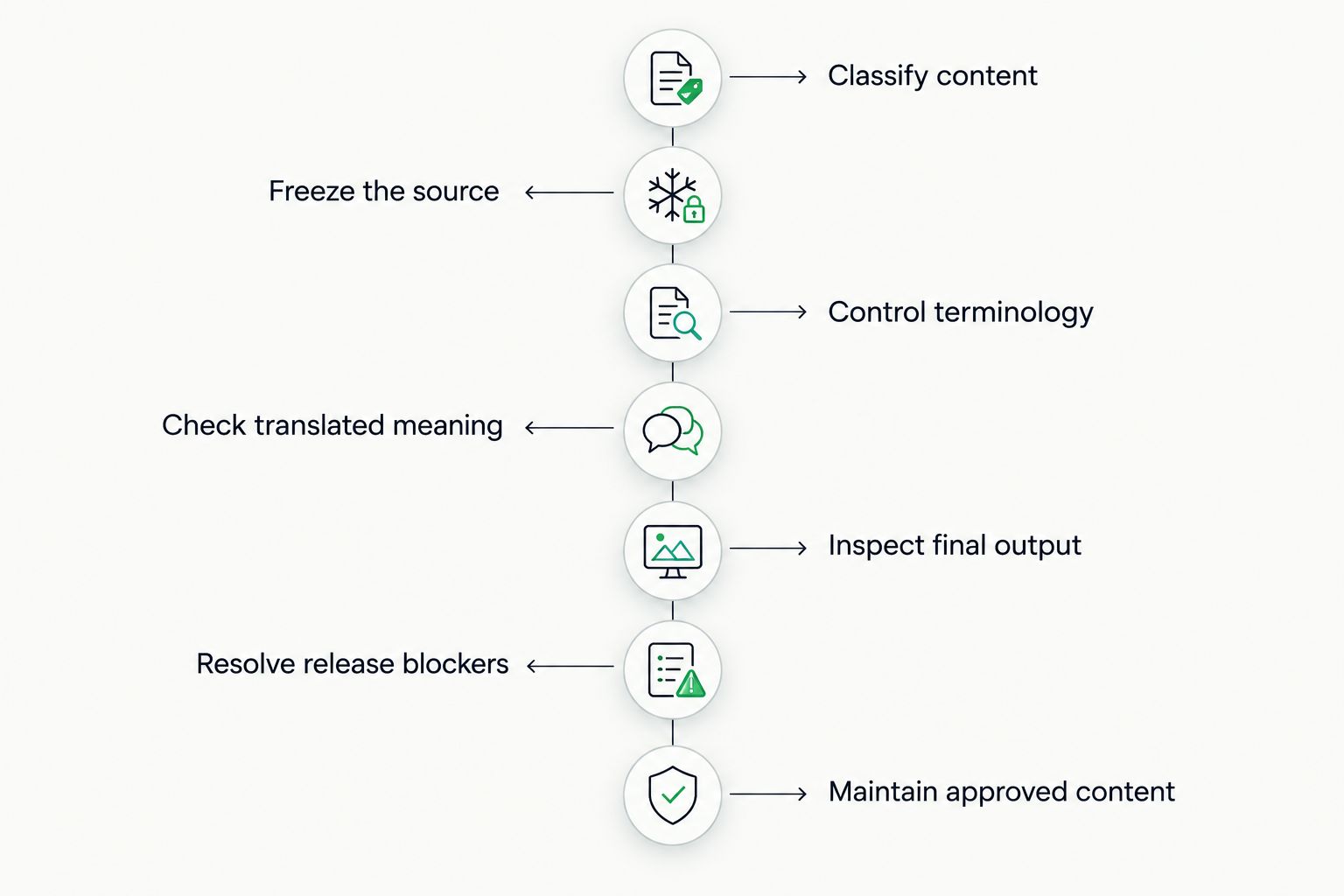
Final-output inspection and release approval belong after translation review, not inside an assumed completion status.
Compare manufacturing translation QA options
Choose the workflow around your review responsibilities, not a feature count. Every option below still needs access to approved source material and someone authorized to resolve technical questions.
Manual checklist and shared files
- Best for: A bounded pilot with clearly assigned reviewers
- Main advantage: Starts with documents and review tools you already use
- Key limitation: Version control, issue tracking, and follow-up remain manual
Translator tools with bilingual review
- Best for: Translation specialists checking passages against source text
- Main advantage: Keeps linguistic review close to the translation
- Key limitation: Final document inspection and engineering approval still need coordination
Wxrks translation management system
- Best for: Teams seeking workflow automation, translation memory, quality management, and cost tracking
- Main advantage: Brings these translation-management capabilities into a TMS
- Key limitation: Technical acceptance still requires your reviewers; validate manufacturing-specific requirements before selection
External technical translation service
- Best for: Teams seeking translation and review capacity outside the business
- Main advantage: Provides a route to assign language work externally
- Key limitation: You must assess subject expertise and retain ownership of product context and acceptance
These options are not mutually exclusive. You can combine an external translation provider with an internal technical reviewer and a TMS. The important boundary is accountability: outsourcing translation does not transfer your knowledge of the product or determine your release criteria.
For a 2026 evaluation, run the same pilot material through each proposed workflow. Compare the resolved findings, remaining manual handoffs, final-file checks, and clarity of the approval record. Do not treat a clean automated report as evidence that the operator instructions are correct.
Common mistakes manufacturing teams make
Approving language without checking the machine
A reviewer can accept fluent text without knowing whether it describes the correct product configuration. Supply the relevant engineering references and identify who answers technical questions. Keep unresolved questions visible rather than letting a delivery deadline become an implicit approval.
Treating every memory match as approved for reuse
Translation memory records previous wording, not universal applicability. Check reused instructions against the current component, revision, and operating context. When an accepted correction changes a repeated instruction, find the other affected occurrences instead of fixing only the reported passage.
Converting units without engineering authorization
Localization is not permission to change a technical specification. Preserve the approved value and follow the manufacturer's documented rules for presenting alternate units. Have engineering resolve any proposed conversion, rounding, or change in notation that affects interpretation.
Reviewing only editable text
Text review misses layout defects and misplaced content in the delivered file. Inspect the exported manual, production label artwork, or localized interface as applicable. Keep that inspection separate from checking the translation in a bilingual editor.
Using one quality score as the release decision
A combined score conceals the difference between a minor wording issue and an incorrect safety instruction. Review error severity and unresolved findings alongside any summary measure. Set release conditions around the consequence of an error, not just the volume of accepted text.
FAQ
What is translation quality assurance for manufacturing companies?
Translation quality assurance for manufacturing companies checks translated technical content against approved source material, product context, terminology, and release requirements. It includes linguistic review, technical verification, final-output inspection, and documented acceptance.
Can automated checks replace a technical translation reviewer?
Automated checks do not replace a technical translation reviewer. They help flag configured error patterns, but a qualified reviewer must resolve whether an instruction describes the correct action for the equipment.
Who should approve a translated manufacturing manual?
Assign language acceptance to a qualified language reviewer, technical acceptance to an authorized product specialist, and final release to a named owner. Record those responsibilities even when one person holds more than one role.
Is translation memory enough to ensure consistent manufacturing terminology?
Translation memory alone does not establish consistent terminology. Maintain approved terms with definitions and product context, then review reused passages against the current source revision.
Where does Wxrks fit into manufacturing translation QA?
Wxrks supports translation workflow automation, translation memory, quality management, and cost tracking. Use those capabilities alongside your engineering review and release controls, and validate any manufacturing-specific requirements during evaluation.
Should every translated document receive the same level of review?
Set review depth according to the consequences of misunderstanding the content. Safety instructions and operating procedures need explicit technical acceptance; other content still needs defined linguistic and publication checks.
What should block the release of a translated manual?
Block release when an unresolved translation error changes a safety instruction, operating limit, component identity, or required action. Confirm the correction in the final output before recording acceptance.
One last thing
A source correction is also a translation QA result. If a translator discovers that an instruction is ambiguous, fix the approved source and assess every affected language. Repairing only the translation leaves the underlying problem available for reuse.
Start with the pilot manual, trace a single instruction from source approval to published output, and ask who can prove that each version is current. That exercise exposes missing ownership more clearly than adding another checklist item.
Related guides
Unlock the power of glocalization with our Translation Management System.
Unlock the power of
with our Translation Management System.