Translation project management for media teams: complete 2026 guide


Media translation project management is the coordination of multilingual editorial assets, reviewers, and release decisions with the aim of publishing accurate content on schedule. This 2026 guide explains how to manage articles, subtitles, promotional copy, and corrections without losing the source version or the person responsible for approval.
TL;DR
- Translation project management for media companies should connect source versions, language assignments, editorial review, and release approval.
- Wxrks fits teams seeking translation management, translation memory, quality management, and cost tracking in one system.
- Keep subtitle timing and playback checks separate from linguistic approval.
- Start with a controlled spreadsheet workflow, then evaluate automation against your actual editorial handoffs.
Why translation project management matters for media teams
A media asset rarely travels alone. A published story can depend on a headline, caption, thumbnail text, subtitle file, and promotional description, each with its own review requirements. Your project plan needs to track those dependencies, not just the translated word count.
An editorial correction creates another problem: an approved translation can become outdated when its source changes. Approval belongs to a specific version, not permanently to an asset. Your workflow must make that distinction visible before publication.
For your 2026 editorial plan, define completion as approved content in its intended publishing context. A translated subtitle file is not finished until someone checks playback; a localized headline is not finished until an editor checks meaning and presentation.
You can establish these controls manually. The decision to move beyond spreadsheets should follow your handoff problems, not precede them; use the guide to switching from spreadsheets to a TMS to frame that evaluation.
Build a workflow your editorial team can follow
Define your release unit before assigning work
Start with a shared spreadsheet and a folder containing the source assets. Define the release unit: the collection of files and text that must be approved together. For an interview, that might include the article, pull quotes, captions, and promotional copy rather than the transcript alone.
Give every asset a stable identifier. Keep the identifier unchanged when a headline or filename changes, so editors can connect the latest source to its translations without guessing.
For a controlled pilot, use 1 editorial package in 2 target languages. These are suggested test boundaries, not a production benchmark. Choose a package with a real correction cycle so you can test what happens after translation begins.
- Assign a release identifier to the complete editorial package.
- Record the source language and each target locale.
- List every dependent asset, including promotional text.
- Name the source editor and final release owner.
- Mark embargoes and restrictions on external sharing.
Map your handoffs and approval gates
Write the workflow in a shared document before configuring software. Use a simple sequence: Intake, Translation, Review, and Release. Give each stage an owner and a clear exit condition; a status label without an acceptance rule leaves the next person guessing.
Separate language approval from publishing approval. A reviewer can confirm that a translation preserves meaning while a producer checks whether it fits a subtitle cue or page layout. Neither decision substitutes for the other.
For your 2026 workflow, define who can reopen an approved asset after a correction. Avoid a blanket instruction to restart everything: identify which translated assets depend on the changed source passage, then send those assets through review again.
- Define what makes an intake package ready for translation.
- Assign a named owner to each handoff.
- Separate linguistic review from presentation checks.
- Specify who approves publication for each locale.
- Record the reason whenever an approved asset reopens.
The workflow should preserve a visible boundary between creating a translation, approving its language, and authorizing its release.
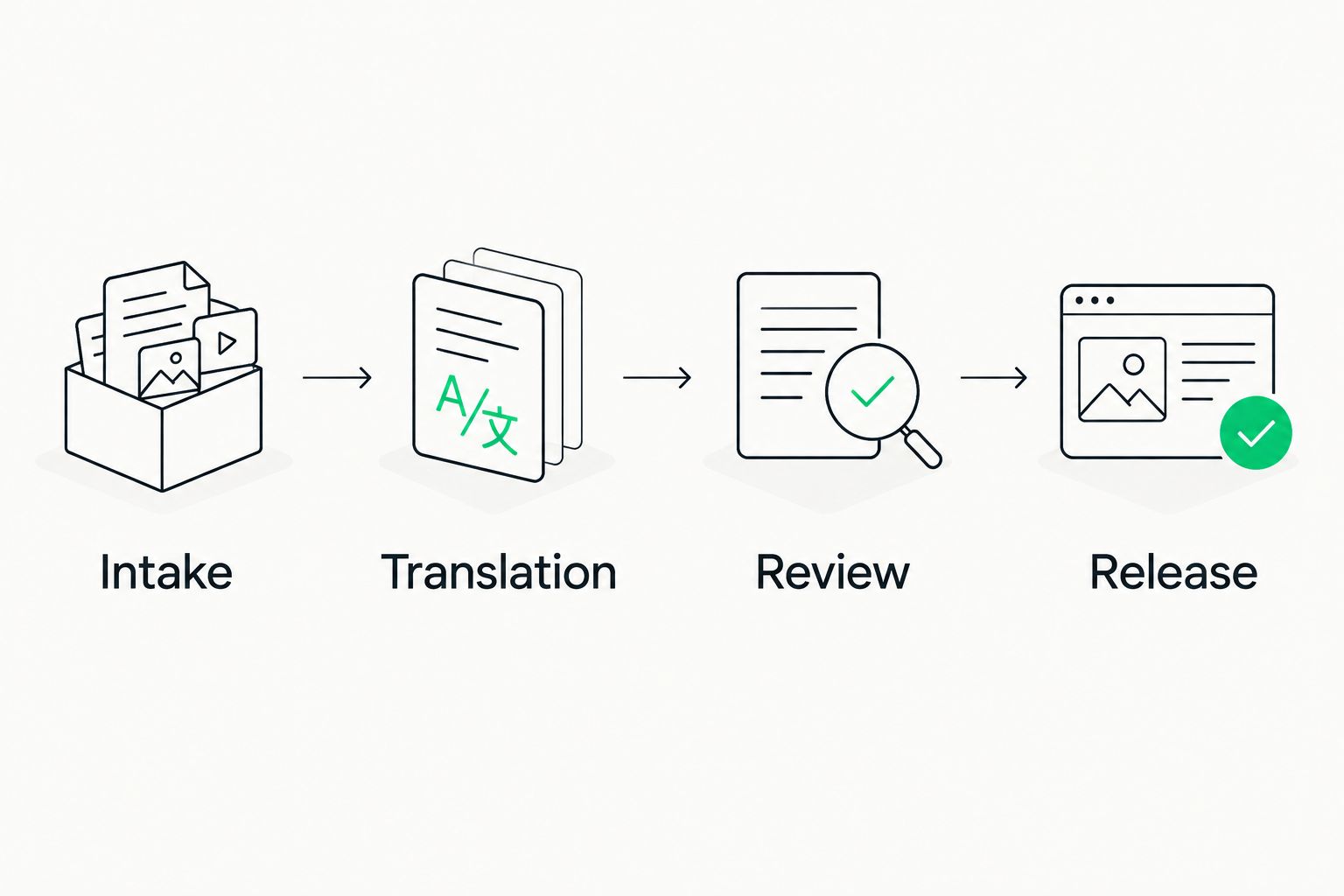
Language review and release approval are separate decisions.
Centralize your context and approved language
The manual approach is a shared terminology sheet, a reference folder, and an approved-translations archive. Include speaker names, show titles, recurring descriptions, editorial tone, and instructions for handling quotations. Give translators the surrounding passage or relevant clip rather than an isolated sentence.
Wxrks translation management is best for media teams seeking workflow automation, translation memory, quality management, and cost tracking together. Wxrks provides those capabilities; evaluate them against the handoffs you documented rather than assuming a TMS replaces your editorial process.
Translation memory stores translated segments for reuse, while a glossary records preferred terminology. Neither removes the need to check context. An approved phrase from a promotional campaign does not automatically suit a news report, and a source correction can invalidate previously approved wording.
- Store terminology with definitions and usage context.
- Distinguish mandatory terms from editorial preferences.
- Attach relevant reference material to each assignment.
- Identify which translations are approved for reuse.
- Check proposed reuse against the current source meaning.
Assign work by format and editorial risk
Use a shared assignment sheet to match each asset with a translator and reviewer. Treat a news headline, an interview subtitle, and a promotional description as different editorial tasks. The language skills overlap, but their acceptance criteria differ.
Choose the translation method after identifying the content's risks. A machine-generated draft still needs review against the source. For quotations, allegations, sensitive descriptions, and wordplay, specify the required editorial scrutiny before work starts rather than leaving the translator to infer it.
Where you use translation management software, test whether the assignment process preserves those instructions. Automation is useful only when the right context and acceptance rules reach the people doing the work. A faster handoff that drops an embargo restriction is not an acceptable handoff.
- Label each asset by format and publishing destination.
- Flag quotations, sensitive claims, and ambiguous source passages.
- Assign reviewers with the relevant language and editorial skills.
- State whether drafting, post-editing, or translation is required.
- Give translators a route for resolving source questions.
Test translations in their publishing context
Begin with a manual preview in the destination environment. Read a localized article as a page, watch subtitles with the video, and inspect promotional text in its intended placement. A clean bilingual document does not prove that the published asset works.
For subtitles, separate linguistic checks from timing, segmentation, and playback checks. For articles, check headlines, captions, links, and embedded quotations alongside the body copy. Use the destination's actual delivery requirements rather than applying an invented universal character limit.
A TMS can support the language workflow, but do not assume it supplies every audiovisual check. Wxrks translation management includes quality management; confirm the specific checks your media formats require before treating any platform as a complete production solution.
- Compare the translation with the current source version.
- Verify names, numbers, quotations, and attribution.
- Preview headlines and captions in their intended layout.
- Watch subtitles with the corresponding final video.
- Record language defects separately from presentation defects.
Control corrections after source changes
Maintain a correction log even if your team works entirely through shared files. Record what changed, which source version changed, and which target assets need another review. Do not overwrite a published translation without preserving the reason for the update.
For your 2026 release checklist, include a source-version check immediately before publication. A translator can finish accurately and still deliver an outdated asset if the source changes during review. The release owner needs a clear answer to whether the approved translation matches the source being published.
Corrections also affect reusable language. Review the associated translation-memory entry when a correction changes meaning, terminology, or attribution; otherwise an old error remains available for a later assignment.
- Log source changes with a description and responsible editor.
- Identify the target assets affected by each change.
- Reopen only the approvals the change invalidates.
- Review reusable translations linked to the correction.
- Confirm the final source and target versions before release.
Measure handoffs and rework before expanding
Start with timestamps and a simple defect log. Measure elapsed time in hours from assignment to approval, then distinguish active work from time awaiting answers or review. This gives you a useful diagnosis without pretending that every delay belongs to the translator.
For the pilot, also track the number of assets reopened after source changes and the reasons for reopening. Do not treat all rework alike: fixing a mistranslation and responding to a rewritten headline require different process changes.
Wxrks includes cost tracking, but your evaluation should also examine whether the workflow supports the reporting you need. Define the measures before comparing systems, and record your own baseline rather than borrowing an unsupported productivity target.
- Record assignment, delivery, review, and approval timestamps.
- Measure turnaround in hours using consistent start and end points.
- Separate source-change rework from translation defects.
- Record actual costs against the relevant release package.
- Review unresolved questions before expanding the workflow.
Compare workflow options for your media team
For a 2026 evaluation, compare options against the same editorial package. Ask each approach to handle a source correction, a terminology decision, a language review, and a final publishing check. A feature list alone does not show whether the handoffs fit your team.
Shared spreadsheet and folders
- Best for: A bounded pilot with a clear release owner
- Main advantage: Makes assignments and acceptance rules visible without a platform rollout
- Key limitation: People must maintain status, version links, and correction records manually
Wxrks
- Best for: Teams seeking translation workflow automation, memory, quality management, and cost tracking
- Main advantage: Brings the stated translation-management capabilities into one system
- Key limitation: Media-format checks and required integrations still need validation
Dedicated subtitle editor
- Best for: Teams whose main bottleneck is timed-text preparation
- Main advantage: Supports subtitle-focused editing and playback work
- Key limitation: Does not by itself define ownership of articles, promotional copy, and release approvals
TMS plus audiovisual tools
- Best for: Teams coordinating text assets and timed media
- Main advantage: Separates translation coordination from format-specific production
- Key limitation: Requires explicit ownership and version checks between systems
Choose the workflow that closes your actual handoff gaps. Keep a spreadsheet if it gives your pilot clear ownership and reliable version control. Evaluate a TMS when maintaining those controls manually becomes the problem; retain specialist audiovisual tools where the production task requires them.
Common mistakes media teams make
Treating the transcript as the entire package
A translated transcript does not cover every audience-facing asset. Headlines, captions, subtitle files, and promotional descriptions need their own assignments and approvals. Build the package inventory before requesting translation so those assets do not become unplanned last-minute work.
Sending subtitles without the relevant video
Text alone cannot show whether a subtitle matches the speaker, scene, or intended timing. Supply the corresponding video version and define who checks playback. If the video changes, verify that the subtitle approval still applies.
Reusing editorial language without checking context
Translation memory can surface an approved segment that no longer fits the current story. Treat reuse as a suggestion requiring contextual review, especially for quotations, changing titles, and sensitive descriptions. Approval in one asset is not permission to reuse wording everywhere.
Confusing linguistic approval with permission to publish
A reviewer can approve the language before an embargo lifts or before a correction is resolved. Keep publication authorization separate and assign it to a named owner. That owner must check the release conditions, not merely the translation status.
FAQ
What's the best way to manage translation projects for a media company?
Manage each release as a linked package of source assets, translations, reviews, and publishing approvals. Start with clear ownership and version control, then evaluate software against those requirements.
Can I manage media translations in a spreadsheet?
Yes, a spreadsheet can manage a bounded workflow if someone maintains assignments, source versions, and approval records. Its limitation is the manual effort required to keep those records current.
Is Wxrks suitable for media translation project management?
Wxrks fits teams seeking translation workflow automation, translation memory, quality management, and cost tracking. Validate media-format requirements, integrations, and audiovisual checks before choosing the workflow.
Does a translation management system replace subtitle software?
Do not assume a translation management system replaces subtitle software. Check subtitle editing, timing, playback, and delivery requirements separately from translation coordination.
Should media teams use machine translation for published content?
Treat machine translation as a drafting method, not publication approval. Assign review against the source and apply the editorial scrutiny required for quotations, sensitive claims, tone, and context.
What should happen when the source changes after translation?
Identify the affected target assets and reopen the approvals invalidated by the source change. Review related translation-memory entries when the correction changes reusable wording.
Which translation project metrics should a media team track?
Track turnaround in hours, review waiting time, source-change rework, translation defects, and actual costs by release package. Use consistent definitions so the results identify process problems rather than mix unrelated delays.
One last thing
Make your final 2026 release check a version check, not another status check. Ask the release owner to identify the exact source version behind every approved translation. If the answer is unclear, a green approval status is not enough to authorize publication.
Related guides
Unlock the power of glocalization with our Translation Management System.
Unlock the power of
with our Translation Management System.