Is switching from spreadsheets to a TMS worth it in 2026?


Switching from spreadsheets to a translation management system is worth it when recurring updates, translation reuse, and review handoffs create more work than the spreadsheet itself solves. The trade-off is implementation effort: you still need clean source content, agreed terminology, and someone responsible for the workflow.
TL;DR
- Switching from spreadsheets to a translation management system pays off when coordination and repeated translation become recurring work.
- Spreadsheets remain practical for occasional translation projects with simple handoffs and limited reuse.
- Wxrks supports translation memory, quality management, workflow automation, and cost tracking; test those capabilities against your actual bottlenecks.
- Compare complete workflows, including migration and review, rather than judging a TMS by its translation editor alone.
Why this matters
A spreadsheet can hold source text, translations, and status columns. The problem starts when people must repeatedly reconcile changed text, confirm approvals, and locate translations that already exist elsewhere.
For your 2026 evaluation, measure that coordination work alongside translation work. A faster translation editor does not fix an unclear approval process. Use a guide to calculating TMS return on investment to structure the business case around work removed, implementation effort, and continuing administration.
Is switching from spreadsheets to a TMS worth it in 2026?
Switch when the workflow needs shared translation assets and controlled handoffs, not simply because the spreadsheet has become large. Keep spreadsheets when the work is occasional, ownership is clear, and maintaining the file takes little effort.
The distinction is operational. A spreadsheet lets you design your own tracking structure; a TMS brings translation-specific processes that you must configure and maintain. Neither option removes the need for informed review.
Best for
- Spreadsheets: Occasional projects with straightforward handoffs
- Translation management system: Recurring localization with shared assets and review stages
Main strength
- Spreadsheets: Flexible structure that your team controls
- Translation management system: Translation-specific workflow and reuse capabilities
Translation reuse
- Spreadsheets: Requires a process for finding and applying previous work
- Translation management system: Translation memory supports reuse of stored translations
Review coordination
- Spreadsheets: Depends on conventions for status, comments, and ownership
- Translation management system: Evaluate assignment, review, and approval capabilities
Source updates
- Spreadsheets: Requires rules for identifying and reconciling changes
- Translation management system: Evaluate how changed content enters the workflow
Main limitation
- Spreadsheets: Tracking discipline rests heavily on participants
- Translation management system: Setup, training, and ongoing administration remain necessary
Decision test
- Spreadsheets: Can everyone identify the current text and approval state?
- Translation management system: Does the configured workflow remove documented manual work?
Do not treat every TMS as interchangeable. Check the capabilities that matter to your files, reviewers, and publishing process before replacing a working spreadsheet.
Keep spreadsheets: best for occasional, contained projects
Spreadsheets are a reasonable choice when you can keep the source, translation, and review decisions together without constant reconciliation. They also let you adjust columns and instructions without designing a larger operating process.
The limitation is that the spreadsheet does not decide how your team handles changed source text or conflicting edits. You need explicit rules. Otherwise, a completed status can refer to a translation of an outdated source.
Before you switch, improve the existing process enough to identify the real constraint:
- Give each translatable item a stable identifier.
- Separate source text, translated text, context, and review status.
- Name the person who approves each deliverable.
- Define what happens when approved source text changes.
- Keep a clear record of which file is authoritative.
Keep the spreadsheet if those rules resolve the problem without creating another layer of administration. A TMS should solve a recurring workflow need, not compensate for decisions nobody has made.
Switch to a TMS: best for recurring localization
A TMS becomes relevant when your team needs to reuse approved translations, coordinate repeat reviews, or manage content that changes after translation begins. Those are translation-management problems rather than spreadsheet-formatting problems.
Translation memory stores source segments and their translations for later reuse. That gives your team a structured alternative to searching old files. Reuse still requires judgment: similar wording does not guarantee the same meaning or context.
Quality management also needs a defined scope. A check for missing content or inconsistent terminology is different from a reviewer deciding whether the translation communicates the intended message. Evaluate both rather than accepting a generic claim about quality.
For a 2026 migration, prioritize the bottleneck you can demonstrate. If reviewers spend time identifying the current version, test version handling and approvals. If translators repeatedly search past projects, test translation-memory retrieval and the relevance of its suggestions.
Switch when the TMS improves the complete handoff from source to approved output. Do not switch solely because an isolated feature looks faster in a demonstration.
Why the value of switching varies
The value of a TMS depends on the work you bring into it. Use these factors to decide what belongs in your evaluation:
- Update frequency. Repeated source changes require a reliable way to identify affected translations and request fresh review.
- Content repetition. Translation memory is most relevant when previous translations have useful overlap with current work; unrelated content offers less reuse.
- Review complexity. Separate linguistic, subject-matter, and publishing decisions require clear responsibility and handoff rules.
- Context requirements. Short interface strings and ambiguous phrases need information beyond the source sentence. Test how reviewers receive that information.
- Source quality. Duplicate identifiers, mixed languages, and uncertain approval states complicate migration. Software does not resolve those ambiguities by itself.
- Workflow fit. Your file formats, publishing process, and security requirements determine which capabilities you must verify before adoption.
A long feature list is not the decision. The decision is whether the supported workflow matches your actual work without introducing avoidable reconciliation elsewhere.
How do you test a TMS before replacing spreadsheets?
Use a contained pilot rather than importing your entire archive. The following 5 steps turn the decision into a workflow test with observable outcomes.
1. Select a representative project
Choose 1 project that includes the work causing trouble: repeated terminology, review comments, or a source update. Do not choose only the cleanest material. A demonstration built around unusually simple content tells you little about your normal workload.
Record what successful delivery means before the pilot begins. Include the required output format, the approving reviewer, and the conditions that send a translation back for revision.
2. Clean the source
Resolve duplicate identifiers and distinguish approved translations from unfinished drafts. Keep useful context with the content, including explanations of ambiguous terms and references reviewers need.
Do not import every historical row just because it exists. An uncertain translation does not become trustworthy when stored in translation memory. Keep disputed material separate until someone resolves it.
3. Configure the workflow
Define who translates, who reviews, and who approves the final output. Decide what happens when the source changes during review. Then configure only the stages needed to support those decisions.
Keep the first workflow understandable. If participants cannot explain the difference between its statuses, adding more statuses will not improve accountability.
4. Run an update
Test 2 delivery cycles: an initial translation and a subsequent source update. This is a recommended pilot design, not an implementation-time estimate. The second cycle exposes whether the process handles change rather than merely accepting an initial import.
Check what happens to unchanged translations, revised text, reviewer comments, and approval states. Confirm that the exported result contains the intended content and preserves required formatting or technical elements.
5. Compare the results
Record coordination time in minutes per project and rework in corrections per project. Also note where people had to leave the system to resolve uncertainty. Use the same definitions when examining your spreadsheet process.
Separate setup work from repeat work. Initial configuration belongs in the adoption decision, but it should not be confused with the effort required for every subsequent delivery.
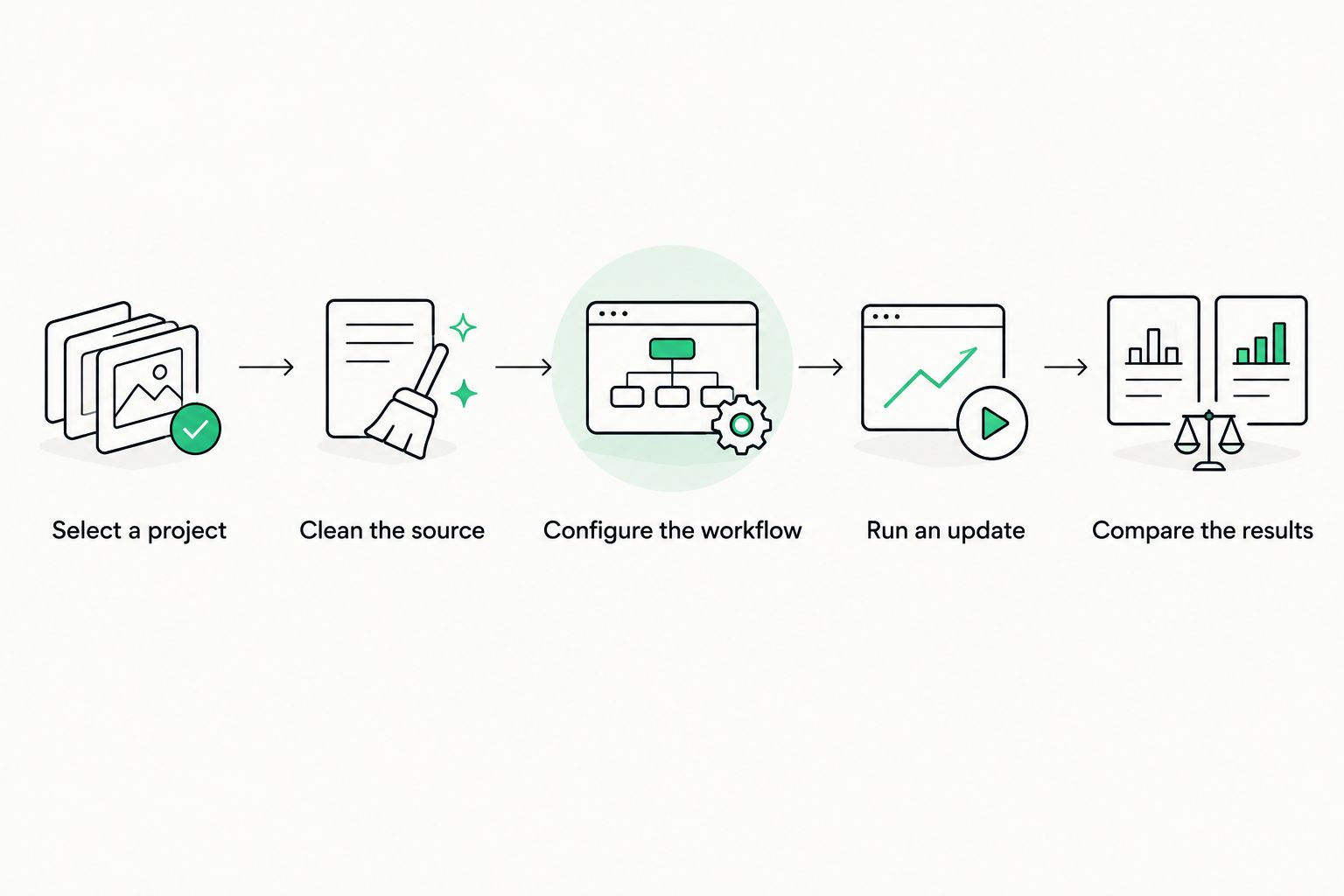
Test a source update before deciding that the migration is complete.
What should your 2026 migration decision include?
Approve a migration only when you can name the manual work it replaces and the responsibilities it introduces. Include source preparation, reviewer training, administration, and export validation in the decision—not just translation activity.
Keep a short decision record. State the original bottleneck, what happened during the pilot, and which requirements remain unresolved. If a critical requirement fails, resolve it before expanding the migration.
Treat your old spreadsheet as a controlled reference during the transition, not as a competing live workflow. Decide where new changes belong and who can approve them. Maintaining two authoritative records recreates the reconciliation problem you were trying to remove.
Where Wxrks fits
Wxrks is best for translators, developers, enterprises, and translation agencies seeking a TMS for workflow automation, translation memory, quality management, and cost tracking. Those are the capabilities to test against the bottlenecks identified in your pilot.
Wxrks supports those translation-management functions. The adoption trade-off remains the same: you must prepare the source material, establish review responsibilities, and verify that the workflow fits your requirements. Evaluate the result, not the promise of automation.
Will a TMS eliminate human translation review?
No. A TMS organizes translation work; it does not remove the need to judge meaning, context, or suitability for the intended audience.
Assign review according to the content's consequences and purpose. Automated checks and translation-memory suggestions support that work, but neither establishes that a sentence is appropriate in every context.
Can you migrate spreadsheet translations into translation memory?
You can prepare spreadsheet translations for translation-memory import when the destination system supports a suitable import route. Verify the supported format and language mapping before restructuring your archive.
Preserve source-target alignment and distinguish approved text from drafts. Test a sample import and retrieval before transferring the remaining material.
How long should you test the new workflow?
Test through 2 delivery cycles: an initial translation and a source update. That recommended scope checks both first-time delivery and change handling; it is not a universal duration in days.
Extend the pilot if it has not covered a critical review, file, or publishing requirement. A completed import is not proof of a completed workflow.
FAQ
Is switching from spreadsheets to a translation management system worth it for a small team?
Switching is worth it when recurring coordination, translation reuse, or review problems justify the adoption effort. Team size alone does not establish the need; test the workflow that causes repeated work.
What's the clearest sign that spreadsheets are no longer enough?
Repeated uncertainty about the current source text or approval state is a clear reason to evaluate a TMS. First establish ownership rules, then test whether the system makes those rules easier to follow.
Do I need to move all my old translations into a TMS?
No, you do not need to migrate every historical translation. Start with useful, approved material and keep disputed or obsolete content out of trusted translation assets until it is reviewed.
Is a TMS better than a spreadsheet for every translation project?
No, a TMS is not automatically better for every project. A contained, occasional translation with clear ownership can remain practical in a spreadsheet; recurring updates and shared assets create a stronger case for switching.
Can translation memory replace a glossary?
No, translation memory and a glossary serve different purposes. Translation memory stores translated segments, while a glossary records terminology decisions; evaluate both against your consistency requirements.
What should I measure during a TMS pilot in 2026?
Measure coordination time, review rework, and the handling of source changes during your 2026 pilot. Compare the same activities in your spreadsheet workflow and separate initial setup from repeat delivery work.
Will automation fix an unclear approval process?
No, automation will not define who has authority to approve a translation. Assign that responsibility and specify how revisions return for review before configuring automated handoffs.
One last thing
The most revealing pilot task is changing content that someone has already approved. Initial imports test whether content gets in; subsequent changes test whether the workflow keeps people aligned.
Before committing in 2026, revise an approved source item and follow it through translation, review, and export. If your team still has to ask which version is final, address that gap before migrating more content.
Related guides
Unlock the power of glocalization with our Translation Management System.
Unlock the power of
with our Translation Management System.