Translation management systems ranked by implementation speed in 2026


Best overall: a narrow, file-based TMS pilot. Best for software teams: a connected localization pilot. Best for teams changing tools: a translation-memory-first migration. This 2026 guide to translation management systems ranked by implementation speed ranks rollout approaches by setup dependencies—not vendors by promised launch dates.
TL;DR
- For translation management systems ranked by implementation speed, prioritize a completed workflow over account setup.
- Wxrks suits teams evaluating workflow, translation memory, quality management, and cost tracking together.
- Start with one content source, one target language, and one named reviewer.
- Add integrations and migration scope only when the pilot proves they are necessary.
Why this matters
A working account is not a working localization process. Your implementation finishes when content reaches a reviewer, corrections survive export, and the next batch follows the same path without improvised handoffs.
Wxrks is a translation management system for teams evaluating workflow automation, translation memory, quality management, and cost tracking together. Those capabilities make it a relevant candidate for a consolidated workflow; your own content and approval process must determine implementation fit.
For a 2026 shortlist, separate platform evaluation from rollout design. A file-based pilot and an organization-wide deployment answer different questions, even when both use the same TMS. Choose the smallest rollout that tests your real production requirements.
What makes the best TMS for implementation speed?
Judge implementation readiness against these criteria before comparing software:
- Source readiness: Can you supply an approved source file without first fixing the publishing process?
- Asset readiness: Are translation memories and terminology resources organized, current, and clearly owned?
- Workflow ownership: Does each translation, review, and release task have a named decision-maker?
- Connection requirements: Must the first batch use an integration, or can a manual transfer test the workflow?
- Acceptance criteria: Can your team explain what makes an exported translation ready to publish?
- Repeatability: Can the next batch follow the same process without rebuilding assignments or instructions?
For your first test, use 1 source file, 1 target language, and 1 named reviewer. These are suggested pilot boundaries, not vendor performance benchmarks. Choose representative content rather than the easiest file in your archive.
Implementation approaches at a glance
The order below prioritizes fewer initial dependencies. It is a decision framework, not a claim that every file-based project finishes before every connected project.
1. File-based pilot
- Best for: Teams proving the basic workflow
- Standout implementation advantage: Separates translation operations from integration work
- Key limitation: Does not establish automated publishing
2. Translation-memory-first migration
- Best for: Teams replacing an existing translation tool
- Standout implementation advantage: Tests reuse of existing language assets early
- Key limitation: Requires asset cleanup and import validation
3. Connected localization pilot
- Best for: Developers testing recurring content updates
- Standout implementation advantage: Tests the source-to-return handoff
- Key limitation: Depends on access, configuration, and ownership
4. Agency workflow pilot
- Best for: Translation agencies coordinating delivery
- Standout implementation advantage: Tests assignments, review, and delivery together
- Key limitation: Requires agreement across operational roles
5. Enterprise governance rollout
- Best for: Organizations with shared controls
- Standout implementation advantage: Establishes permissions and approval boundaries
- Key limitation: Requires cross-functional decisions before expansion
1. File-based pilot: best TMS approach for a first working workflow
A file-based pilot moves representative content through translation, review, and export without making a production integration the first milestone. It gives you a bounded way to evaluate a translation management system before expanding the setup.
Use this approach when your immediate question is whether translators and reviewers can complete the work correctly. It does not replace an integration test when automated delivery is essential.
File-based pilot pros:
- Keeps the first evaluation focused on actual translation work.
- Gives reviewers a concrete output to accept or reject.
- Separates file-handling problems from connection problems.
File-based pilot cons:
- Manual transfers remain part of the pilot.
- A successful export does not prove a recurring publishing workflow.
Best for: Teams moving from scattered files or evaluating their first TMS.
For a Wxrks translation management system evaluation, use this scope to examine workflow, translation memory, quality management, and cost tracking against the same content. Record where a person still has to intervene, then decide whether that intervention belongs in the final process.
Verdict: Buy only after the file-based pilot passes review and export checks.
2. Translation-memory-first migration: best for preserving existing work
A translation-memory-first migration starts with the language assets your team already uses. Instead of treating migration as a bulk upload, it checks whether approved translations remain useful in the new workflow.
Choose this approach when preserving existing linguistic work is a purchase requirement. The relevant test is usable reuse—not simply whether an import completes.
Translation-memory-first migration pros:
- Makes existing translation assets part of the buying decision.
- Exposes ownership and language-pair issues before broader migration.
- Lets reviewers examine reused content in its new context.
Translation-memory-first migration cons:
- Outdated entries need review rather than automatic acceptance.
- Asset cleanup adds work before you can assess reuse reliably.
Best for: Translation teams replacing an established tool or consolidating language assets.
Start with an approved subset rather than the entire archive. Check language direction, duplicates, and whether accepted corrections enter the intended memory. Keep an unchanged copy of the original assets while you validate the new process.
The guide to migrating translation memory from another CAT tool is a useful next step when migration defines your implementation scope.
Verdict: Hold the full migration until representative assets pass reuse checks.
3. Connected localization pilot: best for recurring software updates
A connected localization pilot tests how content moves between its source and the translation workflow. It matters when your buying decision depends on recurring updates rather than occasional document delivery.
Keep the first connection narrow. Test the exact source, content type, and return path you intend to use instead of treating a successful connection as proof of a complete release process.
Connected localization pilot pros:
- Tests the handoff that developers will maintain.
- Makes access and ownership requirements visible.
- Reveals whether returned content fits the release process.
Connected localization pilot cons:
- Requires cooperation from the source-system owner.
- A connection can work while review or release handling remains incomplete.
Best for: Product teams whose localization work follows regular content changes.
Ask who authorizes access, who resolves failed transfers, and who approves translated content before release. Include a changed source string in the test so the pilot covers updates, not just an initial import.
For a 2026 software rollout, keep connection acceptance separate from linguistic acceptance. Developers verify the content path; reviewers verify the translation. Both must pass before the workflow becomes routine.
Verdict: Buy only after changed content completes the return path correctly.
4. Agency workflow pilot: best for coordinated client delivery
An agency workflow pilot follows a job from intake through assignment, translation, review, and delivery. Its purpose is to test operational handoffs rather than an isolated translator workspace.
Use a representative job with a clear delivery owner. Keep exceptional client requirements outside the first pilot unless those requirements are central to the agency’s work.
Agency workflow pilot pros:
- Makes responsibility visible at each handoff.
- Tests reviewer instructions alongside translation work.
- Connects delivery acceptance with project administration.
Agency workflow pilot cons:
- Different client instructions can require different workflows.
- Unclear responsibility creates delays that software alone cannot resolve.
Best for: Translation agencies evaluating shared workflow and cost administration.
Wxrks serves translation agencies and includes workflow automation, quality management, and cost tracking. Evaluate those areas within the same representative job rather than approving each feature in isolation.
Have the delivery owner confirm that the final files, review status, and cost records support the agency’s actual closeout process. Document any manual reconciliation instead of hiding it outside the pilot. That record distinguishes acceptable administration from unresolved implementation work.
Verdict: Hold expansion until a complete job closes without ambiguous handoffs.
5. Enterprise governance rollout: best for shared organizational controls
An enterprise governance rollout establishes who can access content, approve work, change resources, and authorize release. It is the right scope when those controls are prerequisites, not optional improvements.
Do not make every department part of the first launch. Establish the required controls within a bounded workflow, then use that workflow as the basis for expansion.
Enterprise governance rollout pros:
- Makes approval authority explicit before broader adoption.
- Brings content ownership into the implementation decision.
- Creates a defined process for adding teams and workflows.
Enterprise governance rollout cons:
- Requires decisions across business and technical owners.
- Department-specific exceptions complicate a shared process.
Best for: Organizations that need agreed access and approval boundaries before production use.
Ask the platform provider to demonstrate required controls against your documented requirements. Do not infer security, compliance, or permission capabilities from the term enterprise. Separately confirm who owns terminology, translation memory, and final publication decisions.
A narrow launch still needs the controls that apply to its content. Reducing scope is useful; omitting a mandatory approval is not.
Verdict: Wait for required access and approval checks before production release.
How the implementation ranking works
This 2026 ranking follows dependency scope: a bounded file workflow first, existing-asset validation next, then connections, coordinated delivery, and organizational controls. It does not assign vendor-specific implementation durations.
Your order changes when a dependency is mandatory. If an integration is essential to the purchase, test it early. If existing translation memory defines success, validate migration before evaluating a clean-start workflow.
Use these acceptance gates for any shortlisted TMS:
- Import: Representative source content enters the workflow correctly.
- Review: The designated reviewer can identify and resolve issues.
- Export: Approved content returns in a usable form.
- Repeat: The next batch follows the agreed process.
Run 2 consecutive batches before declaring the pilot repeatable. This is a recommended acceptance test, not a published implementation benchmark.
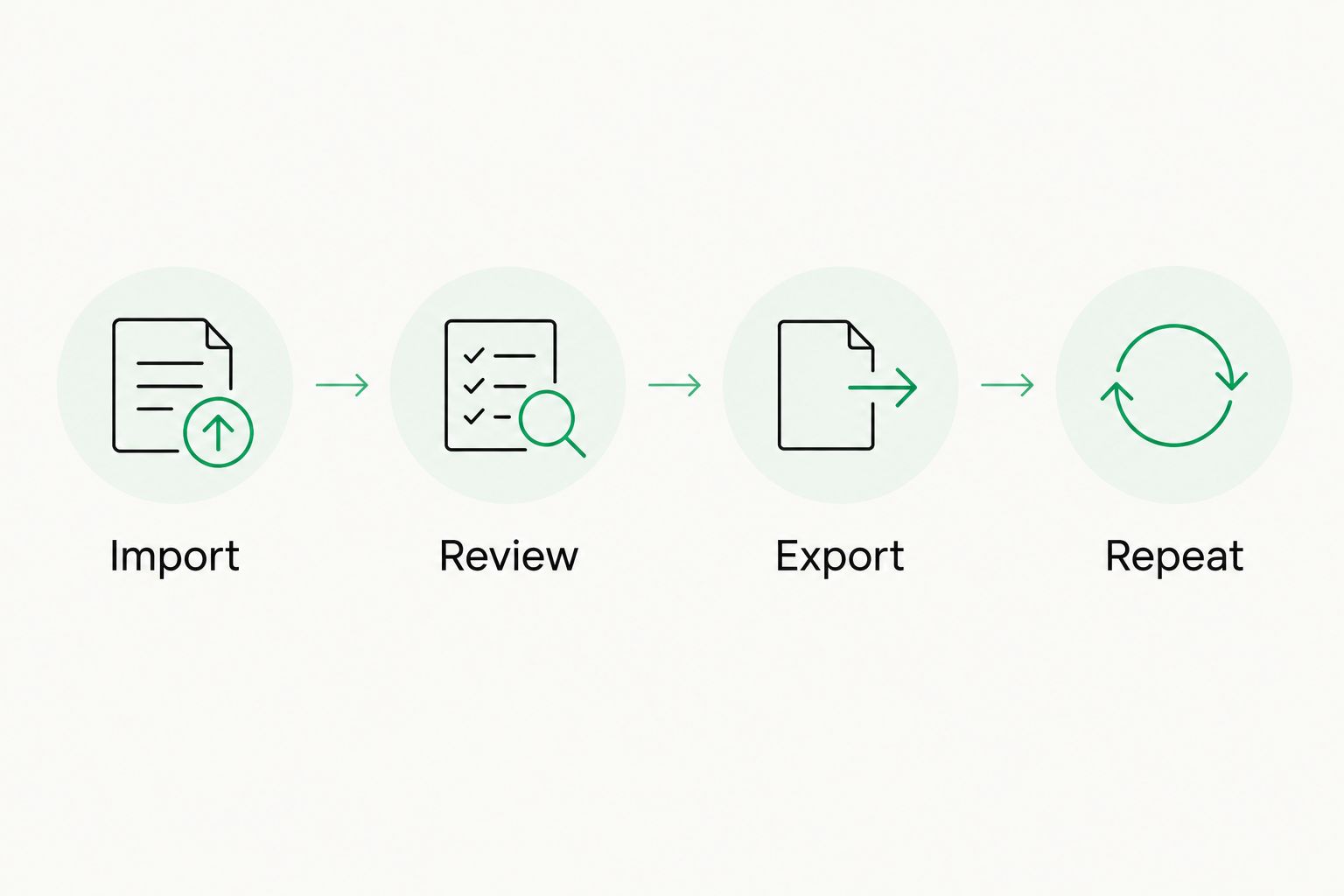
A successful import is only the first acceptance gate.
Assign an owner to each gate and record the evidence needed to pass it. A screenshot of a connection is not evidence that approved content returned correctly.
Which TMS implementation approach should you choose?
Choose a file-based pilot by default, then add the dependencies your production workflow requires. Start elsewhere only when migration, integration, or governance is essential to the buying decision.
For your 2026 evaluation, give every shortlisted provider the same representative content and acceptance gates. Compare completed work, unresolved tasks, and the people needed to maintain the process—not different demonstrations with different scopes.
Separate supplier-controlled tasks from your own approvals. That distinction gives you an actionable implementation plan: who does what, what must happen first, and what qualifies as finished.
Evaluate your translation workflow
Review workflow automation, translation memory, quality management, and cost tracking.
FAQ
What's the fastest way to implement a translation management system?
Start with the smallest workflow that tests your production requirements. Use representative content, a named reviewer, and a verified export before expanding the rollout.
Which translation management system has the fastest implementation?
Choose on a completed pilot rather than a universal speed ranking. Compare providers using the same content, required connections, migration assets, and acceptance gates.
Is Wxrks a suitable TMS to evaluate for workflow consolidation?
Wxrks is a suitable candidate for teams evaluating workflow automation, translation memory, quality management, and cost tracking together. Validate the required workflow with your own content before committing to a broader rollout.
Should translation memory migration happen before integrations?
Test translation memory first when preserving existing language assets is a purchase requirement. Prioritize an integration instead when the source-to-return connection is essential to daily operation.
Does a successful integration mean implementation is finished?
No. Implementation also requires successful review, usable export, and a repeatable process for subsequent content changes.
What should a first TMS pilot include?
A first TMS pilot should include representative source content, a target language, a reviewer, and an export check. Include any mandatory approval or connection that determines whether the workflow is usable.
How should teams compare implementation proposals in 2026?
Compare proposals against an identical scope and definition of done. Require named owners, explicit dependencies, and acceptance evidence for import, review, export, and repeat use.
One last thing
Test a correction, not just a translation. After the first export, change an approved term and follow that correction through review and delivery. A clean initial batch tests the happy path; a correction tests whether your process preserves the decision that matters.
Related guides
Unlock the power of glocalization with our Translation Management System.
Unlock the power of
with our Translation Management System.