Localization software for hospitality companies: complete 2026 guide


Hospitality localization software is a system for managing multilingual guest content with the aim of keeping booking information, property details, and guest communications accurate across languages. Hospitality teams need more than translated sentences: the wording must match the property, the booking conditions, and the experience you actually deliver.
TL;DR
- Localization software for hospitality companies should manage translation memory, review ownership, and changes to guest-facing content.
- Wxrks suits teams seeking translation workflow automation, quality management, translation memory, and cost tracking.
- Test booking conditions and property-specific terminology before expanding your localization workflow.
- Keep language approval separate from confirmation that the translated promise matches the property.
Why localization matters for hospitality companies
A translated room description makes a promise. If the description confuses a connecting room with an adjoining room, polished language does not fix the underlying mistake. Your localization process needs someone who understands the language and someone who can confirm the property facts.
The same principle applies to cancellation conditions, accessibility descriptions, dining information, and arrival instructions. Treat each as operational content, not just marketing copy. Identify the source owner before assigning a translator.
For your 2026 plan, start by mapping where translated content changes hands. The decision to move from spreadsheets to a TMS should follow an ownership problem you can name, rather than a feature list.
Choose a translation management system when you need to control the workflow, not merely generate another language version. A simpler process remains an option when your content is limited and someone can reliably maintain it.
How to build your hospitality localization workflow
1. Inventory the content guests act on
Start with a spreadsheet. List the source location, content owner, target language, publication destination, and consequence of an incorrect translation. This gives you a usable inventory before you configure any software.
Separate content that persuades from content that sets expectations. A destination headline needs editorial judgment; a cancellation condition needs exact alignment with the approved policy. Do not assign both the same review instructions.
For a first pilot, choose 1 property, 2 target locales, and 20 content items. These are suggested test boundaries, not industry benchmarks. Include difficult material rather than selecting only attractive room descriptions.
- Booking conditions: Record the policy owner and source version.
- Room descriptions: Distinguish room categories, layouts, and included amenities.
- Arrival instructions: Include access details and property-specific exceptions.
- Guest messages: Separate reusable wording from reservation details.
- Dining content: Flag ingredients and dietary statements for specialist review.
2. Define terminology before translating
Create a shared glossary manually, starting with terms that change what guests expect. Record the approved meaning, preferred translation, locale, and examples of incorrect usage. A bilingual term without context is not enough.
Keep property names and branded room categories separate from generic descriptions. Decide which names stay unchanged and which descriptions require translation. Then give translators a way to ask questions before an ambiguous term becomes approved content.
For your 2026 glossary, prioritize terms tied to entitlements and restrictions. A consistent translation of an unclear source phrase simply repeats the ambiguity across languages. Resolve the source first.
- Define room-category differences in plain language.
- Document whether an amenity is included, optional, or conditional.
- Specify approved wording for cancellation and arrival conditions.
- Attach examples that distinguish similar property terms.
- Assign an owner to approve terminology changes.
3. Choose software around the handoffs
Map the process manually before evaluating a platform: who requests the work, who translates it, who approves it, and who publishes it? Use that map as your evaluation script. Ask vendors to demonstrate the handoffs with your pilot content.
Wxrks is best for hospitality teams seeking localization software that combines workflow automation, translation memory, quality management, and cost tracking. Those capabilities address translation operations; they do not establish compatibility with your booking engine or property systems.
Wxrks provides translation management software, not a substitute for property expertise. Verify required file handling, access controls, and publishing connections directly. Do not infer a connector or approval feature from a general automation claim.
- Demonstrate a source correction after translation has started.
- Test how approved translations enter translation memory.
- Inspect the quality-management process with an intentional error.
- Establish how translation costs are recorded and reviewed.
- Verify every required connection using your actual content path.
4. Separate language review from property review
You can manage review with a shared checklist and named approvers before automating assignments. Define these stages explicitly: Source approval, Translation, Language review, Property review, and Publication. Each stage answers a different question.
Language review asks whether the translation communicates the approved meaning naturally. Property review asks whether that meaning is true for the location. Publication confirms that the approved wording reached the intended destination without layout or version errors.
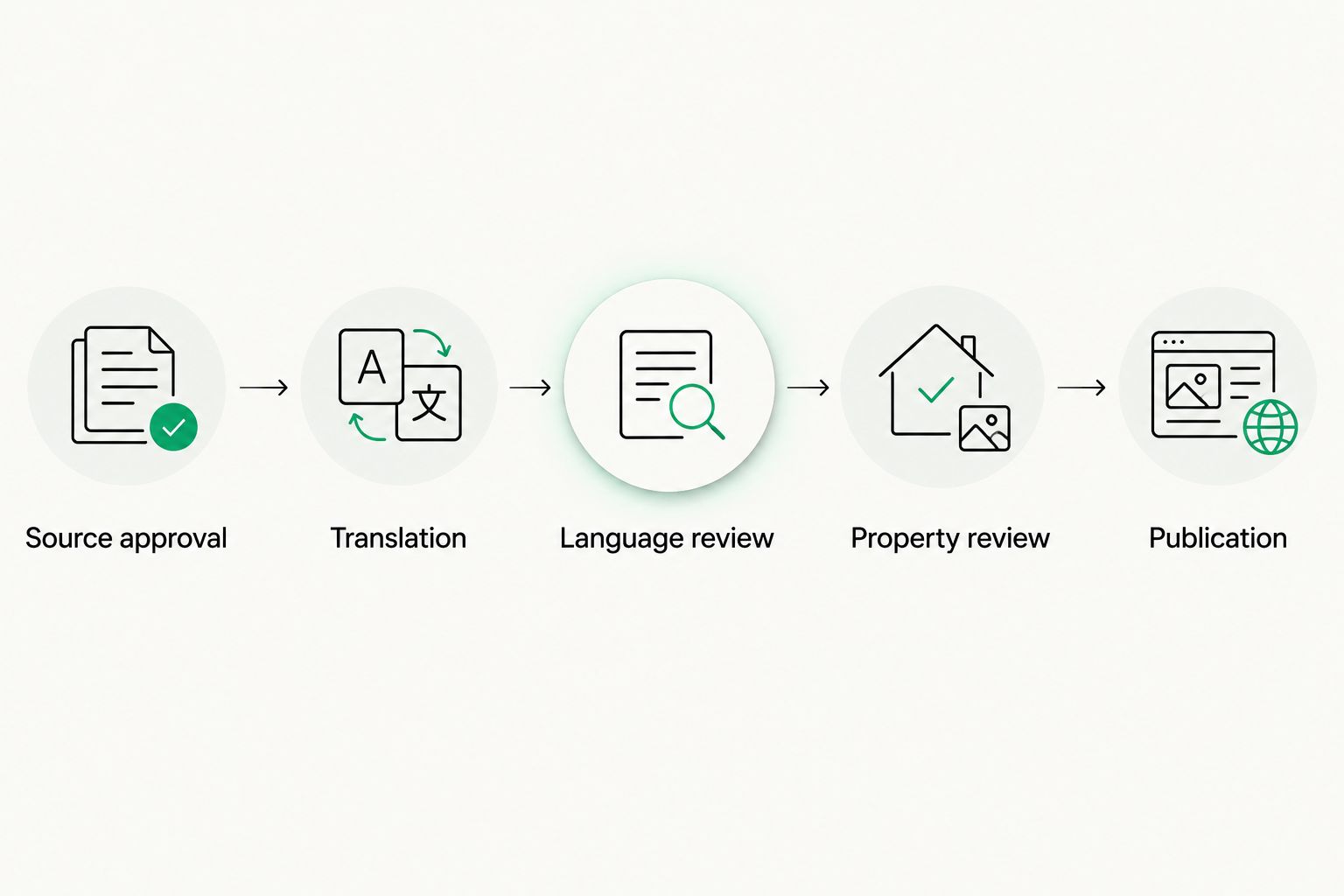
Language accuracy and property accuracy require separate checks.
Keep the checklist attached to the content rather than buried in an email conversation. Your 2026 release process should identify the approved source version and the person responsible for each decision. Automation should move approved work, not erase accountability.
- Confirm the source before translation begins.
- Give language reviewers the glossary and relevant context.
- Ask property reviewers to verify claims and conditions.
- Check translated content in its publishing layout.
- Record unresolved questions instead of treating silence as approval.
5. Reuse approved wording without copying outdated promises
Start a reusable phrase library in a shared document if you do not yet have translation memory. Include the source, approved translation, locale, property scope, and approval context. Exclude uncertain translations until someone resolves them.
Translation memory makes approved wording available for reuse. It does not establish whether an old statement still applies to a different property or a changed policy. Treat a suggested match as material to verify, not permission to publish.
For example, an approved arrival instruction is unsuitable for another property if the access arrangement differs. Preserve the language work while checking the operational details. That distinction belongs in your reviewer instructions, not just in training conversations.
- Reuse language only against the current source meaning.
- Mark phrases that apply to a particular property.
- Remove superseded policy wording from active reference material.
- Check names, times, units, and placeholders separately.
- Keep a record of why an approved translation changed.
6. Test the complete update cycle
Run the pilot manually before scaling automation. Send the selected content through translation, review, publication, and correction. A workflow that handles initial publication but loses track of later changes is not ready for broader use.
Use a 5-business-day pilot window as a planning boundary, not a promised implementation time. Include a deliberate source correction during the test so you can observe what happens to the existing translation. Record the work required at every handoff.
For the 2026 rollout decision, compare results against your own starting process. Measure elapsed time, review effort, unresolved errors, and recorded translation spend. Faster drafting alone is not evidence that the full workflow improved.
- Track time from approved source to approved translation.
- Record review minutes separately from translation effort.
- Categorize errors by meaning, terminology, property facts, and layout.
- Test an update to content that is already published.
- Assign ownership for every issue before expanding the pilot.
Compare your operating options
Choose the operating model before choosing the interface. A spreadsheet, a translation engine, a service provider, and a TMS solve different parts of the problem. None removes your responsibility for the accuracy of property information.
Use this comparison to decide what to test, not to rank unlike services as interchangeable products. Your 2026 evaluation should include both the work each option handles and the work your team retains.
Shared spreadsheet and manual review
- Best for: Small, bounded content sets with a named owner
- Main advantage: Makes the workflow visible without configuring a platform
- Key limitation: Your team must maintain versions, assignments, and publication records manually
Standalone machine translation
- Best for: Producing drafts for a defined human-review process
- Main advantage: Generates translated draft text
- Key limitation: Draft generation does not manage property verification or publication approval
Hospitality translation services
- Best for: Teams assigning language work to external specialists
- Main advantage: Lets you commission translation and review work
- Key limitation: Scope, revision handling, and delivery responsibilities require explicit agreement
Wxrks localization software
- Best for: Teams managing repeatable translation operations
- Main advantage: Combines workflow automation, translation memory, quality management, and cost tracking
- Key limitation: Required hospitality-system connections and publishing behavior need verification
Match external support to a defined responsibility
If your team lacks language-review capacity, assigning more software administrators will not fill that gap. Define whether an external partner owns translation, linguistic review, terminology decisions, or some combination. Keep property verification with someone authorized to confirm the facts.
When commissioning hospitality translation services, specify whether the assignment covers booking conditions, property terminology, and revised source content, rather than treating every word as the same task. The scope should also state who resolves questions and who approves the final wording.
A service provider and a TMS are not mutually exclusive. One supplies agreed language work; the other manages translation operations. If you combine them, define where approved files, terminology, and revision records live so your team can maintain the content later.
Common mistakes hospitality teams make
Applying a chain-wide description to every property
Shared wording is convenient until a property has a different facility, access arrangement, or room layout. Translation memory can preserve a sentence without preserving its applicability. Require property confirmation for any statement that describes what a guest will receive.
Keep reusable language separate from location-specific facts. When a property changes its offering, identify the affected translations rather than replacing only the original-language page.
Translating rate conditions without the full context
A short label does not explain the conditions behind it. Give translators the approved policy and the surrounding booking text, not just an isolated phrase. Ask the policy owner to resolve ambiguous source language before review begins.
Check that headings, summaries, and detailed conditions agree. A correct paragraph cannot repair a contradictory booking label elsewhere in the guest journey.
Treating dietary wording as promotional copy
Do not let an editor infer ingredient or dietary information from a dish name. Obtain approved source facts from the responsible food-service team, then assign appropriate language review. Escalate uncertainty instead of publishing a confident guess.
Apply the same discipline when the menu changes. Previously approved wording is not approval for a new recipe or ingredient substitution.
Approving translations outside their actual layout
Reviewing a document does not reveal every issue in a booking form or message template. Check the rendered content, including truncated labels, placeholders, and text direction where relevant. Preserve the approval record for the version that actually goes live.
Test the guest action attached to the wording. A clear translated button still needs to lead to the intended next step.
FAQ
What's the best localization software for hospitality companies?
The best fit is software that supports your actual translation workflow and passes a property-specific pilot. Wxrks supports workflow automation, translation memory, quality management, and cost tracking; verify required publishing connections separately.
Do hotels need a TMS or just translation software?
Use a TMS when you need to manage assignments, review, reusable translations, and ongoing updates. Draft translation alone does not establish who approved a property claim or whether the published version is current.
Can machine translation handle hotel booking conditions?
Machine translation can produce a draft, but booking conditions require review against the approved source. Keep responsibility for policy meaning with the authorized policy owner.
Does localization software replace hospitality translators?
Localization software manages translation work; it does not replace the need for language judgment and property verification. Assign those responsibilities explicitly, whether reviewers are internal or external.
How should hospitality teams test translation software?
Test a bounded set of property content through translation, review, publication, and a later correction. Include booking conditions and property-specific terminology, not just marketing headlines.
Does a TMS automatically connect to a booking engine?
A TMS does not automatically establish compatibility with your booking engine. Verify the required connector, file exchange, or manual publishing process using representative content before rollout.
What should hospitality teams measure after implementation?
Measure time to approval, review effort, unresolved errors, and translation spend against your previous process. Track source corrections through publication so faster drafting does not hide extra downstream work.
One last thing
Make a cancellation-policy correction the final test before rollout. Change the approved source, identify the affected translations, obtain fresh approval, and confirm the published wording. This tests the maintenance process you will depend on after launch, not just the initial translation.
If nobody can identify who owns that correction, fix ownership before adding more languages. More translated content creates more material to maintain; it does not resolve an undefined handoff.
Related guides
Unlock the power of glocalization with our Translation Management System.
Unlock the power of
with our Translation Management System.