Is vendor management software necessary for translation agencies?


Vendor management software is necessary when your translation agency can no longer reliably track assignments, supplier qualifications, quality feedback, and approved work through its existing process. A separate platform is not automatically necessary: first check whether your translation management system already covers the workflow you need, because another application also adds setup, maintenance, and reconciliation work.
TL;DR
- Is vendor management software necessary for translation agencies? Yes, when existing processes lose control of assignments, quality, or approvals.
- Choose a dedicated vendor platform for supplier administration; evaluate a TMS when translation production also needs attention.
- Wxrks suits agencies seeking translation management software for workflow automation, translation memory, quality management, and cost tracking.
- Test actual agency handoffs before committing; a feature list does not prove the workflow fits.
Why this matters
An agency needs more than a list of translators. You need to know who is qualified for an assignment, who accepted it, what instructions apply, and whether the delivered work passed review.
Those questions connect supplier administration to translation production. Your 2026 software decision should start with the handoff that fails, not with the category name on a vendor’s website.
Before comparing systems, separate your administrative requirements from your production requirements. This guide to translation vendor management software provides a starting point for that evaluation; the decision framework below helps you establish whether you need another system at all.
Is vendor management software necessary for translation agencies?
Yes, when your current process cannot maintain a dependable connection between the translator, the assignment, the review, and the approval. No, when your existing tools already maintain that connection and your team can demonstrate it without reconstructing email threads.
Compare these approaches against your actual workflow, not against an assumed agency size.
Shared register and documented procedures
- Best for: Agencies with a manageable supplier roster and straightforward handoffs
- Main advantage: Keeps the process simple and visible
- Main limitation: Updates and cross-checks remain manual
Dedicated vendor management software
- Best for: Agencies whose main problem is supplier administration
- Main advantage: Centers the evaluation on qualifications, onboarding, and supplier records
- Main limitation: Translation production can remain in another system
Translation management system
- Best for: Agencies addressing production workflow alongside translation assets and quality
- Main advantage: Connects the evaluation to how translation work moves through delivery
- Main limitation: Vendor administration depth needs separate verification
These are buying categories, not interchangeable feature sets. A dedicated vendor platform is not automatically a translation editor, and a TMS is not automatically a complete supplier administration system.
For a 2026 shortlist, require a demonstration of your workflow in each candidate. Treat undocumented capabilities as unresolved requirements, not assumed benefits.
A shared register: best for a process you can still control
A shared register is a reasonable choice when an assigned owner keeps supplier information current and project managers consistently record decisions. Simplicity is an advantage when everyone follows the same process.
Keep qualifications separate from availability. A translator’s language pair or subject expertise does not establish whether that person can accept the current assignment.
Your register should distinguish:
- Supplier identity and contact details.
- Language direction and relevant subject expertise.
- Qualification status and supporting evidence.
- Assignment acceptance and delivery status.
- Review findings and corrective actions.
- Approval status for completed work.
The limitation is manual upkeep. If project managers maintain conflicting copies, the register no longer provides a dependable operational record.
Keep the shared register only if your team can explain who updates each field and when. Software is not the first fix for an undefined responsibility.
Dedicated vendor software: best for supplier administration gaps
Evaluate a dedicated vendor platform when your main problem sits around the translation work: onboarding suppliers, documenting qualifications, maintaining records, and communicating assignment terms.
Write these as requirements to verify, not features to assume. Ask the provider to demonstrate how a supplier record changes after qualification, how an assignment is accepted, and how administrative exceptions are handled.
The benefit is a focused scope. You can address supplier administration without treating every translation production task as part of the same purchase.
The trade-off is the boundary between systems. If production and supplier records live separately, determine which system owns assignment status and how approved changes reach the other system.
Choose dedicated vendor software only when its administrative value justifies the additional handoffs. Replacing a spreadsheet with a disconnected database does not resolve inconsistent records.
A translation management system: best for connected production work
Evaluate a TMS when supplier coordination problems also involve translation memory, reviewer feedback, quality management, or tracking work through production. Start with the work itself: source content, assignment, translation, review, approval, and delivery.
Wxrks is best for agencies seeking a TMS for workflow automation, translation memory, quality management, and cost tracking. Those stated capabilities make it relevant when your agency’s needs extend beyond maintaining supplier records.
The limitation is scope verification. Wxrks’ stated translation management capabilities do not establish every vendor administration feature your agency might require; check those requirements directly rather than treating the TMS label as proof.
When evaluating Wxrks, use an agency workflow to examine the stated capabilities. Keep any additional supplier administration requirements explicit, with a clear answer for how each would be handled.
Do not purchase overlapping systems until you understand what the existing platform already does. In a 2026 evaluation, consolidation is useful only when the resulting workflow meets the requirements.
Why the need for vendor management software varies
The deciding factor is operational complexity, not a universal supplier-count threshold. Evaluate these drivers against your own records:
- Assignment overlap: Simultaneous projects require a dependable view of acceptance, deadlines, and responsibility.
- Qualification differences: Language direction, subject expertise, and review responsibilities affect supplier selection.
- Review handoffs: Feedback needs to reach the right person and remain connected to the relevant assignment.
- Approval requirements: Your team needs a shared understanding of what counts as accepted work.
- Cost tracking: Changes to scope and completed work need a record that supports reconciliation.
- Record ownership: Split systems require explicit rules for where information is maintained and corrected.
A weakness in any of these areas creates a requirement to investigate. It does not, by itself, prove that a particular software category is the answer.
How do you test whether software will solve the problem?
Use 4 steps to evaluate a representative assignment. This is a proposed buying test, not a performance benchmark: the objective is to expose unclear handoffs before signing a contract.
1. Map ownership
Choose a completed project with enough detail to show how your agency works. Identify who selected the supplier, who confirmed acceptance, who reviewed the work, and who approved completion.
Write down where each decision was recorded. If your team cannot agree on the authoritative record, resolve that ownership question before discussing automation.
2. Assign work
Recreate the assignment using content suitable for a software evaluation. Show how the supplier receives the brief, confirms acceptance, and accesses the instructions needed for the job.
Ask what happens when the supplier declines. The demonstration should reveal the reassignment process, not stop at a successful invitation.
3. Review quality
Follow the work through review and correction. Verify how feedback identifies the relevant content and how the translator knows which issues still need attention.
Distinguish automated checks from reviewer judgment. A completed check is not the same thing as editorial approval, so your process should make that distinction visible.
4. Reconcile records
Close the assignment and trace the accepted work back to its supplier, scope, and approval. Identify any information someone still has to copy between systems.
For your 2026 buying decision, record each manual handoff as an explicit implementation task. Do not assume that a connection exists because both applications use similar field names.
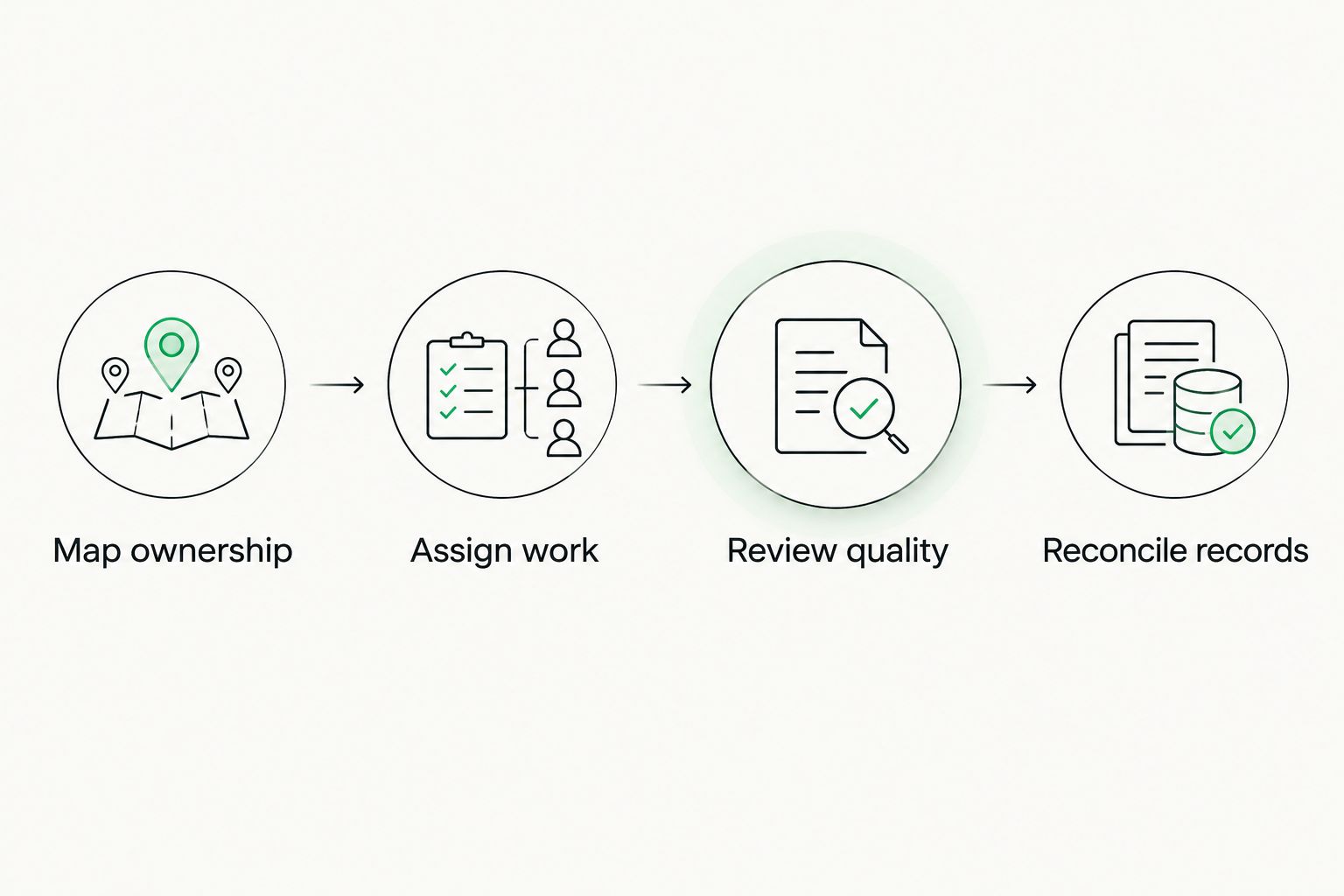
Test the complete assignment, including the handoffs after translation is finished.
A successful demonstration explains both the normal path and the exceptions. Your team should leave knowing where decisions live, who owns them, and what still requires manual attention.
What should you measure before deciding?
Establish your own baseline instead of borrowing an unsupported savings claim. Use 3 checkpoints that reflect the problems you are trying to fix:
- Coordination time, in minutes per assignment: Record the time spent checking acceptance, finding instructions, and chasing status.
- Rework, in review cycles per assignment: Separate avoidable instruction or handoff problems from substantive language revisions.
- Reconciliation effort, in minutes per completed project: Record the work needed to connect approved delivery with the supplier record.
Apply the same definitions before and during a pilot. Changing what you count makes the comparison unreliable.
These measures do not capture every benefit or limitation. Include a written record of unresolved exceptions, especially when an apparently faster process leaves approval ownership unclear.
Adopt software because it improves a documented workflow, not because the demonstration looks faster.
Can a small translation agency keep using spreadsheets?
Yes, a small translation agency can keep using spreadsheets when ownership, updates, and approvals remain dependable. Agency size alone does not establish the need for a separate platform.
Test whether another project manager can understand an assignment from the shared record without asking its original owner to reconstruct events. If not, improve the process and evaluate whether software is needed to maintain it.
Does a TMS replace dedicated vendor management software?
A TMS replaces dedicated vendor management software only when its verified capabilities cover the agency’s supplier administration requirements. Translation memory and quality management do not, on their own, establish onboarding or administrative coverage.
Compare requirements individually. Retain a separate system only where it performs a necessary role and the connection between systems has a clear owner.
Should an agency automate supplier selection completely?
No, an agency should not treat automated assignment as a substitute for qualification and accountability. Define the selection criteria and exception process before automating the handoff.
Keep a responsible person for decisions that fall outside those criteria. Automation should execute an agreed process, not hide an undefined one.
FAQ
Is vendor management software necessary for translation agencies in 2026?
Vendor management software is necessary when an agency’s existing process cannot reliably track supplier qualifications, assignments, quality feedback, and approvals. A separate platform is unnecessary if existing tools already meet those requirements.
What’s the best starting point for choosing translation vendor software?
Start with a completed assignment and identify where ownership or information became unclear. Use that workflow to test candidates rather than selecting from feature lists alone.
Is a spreadsheet enough to manage freelance translators?
A spreadsheet is enough when a shared process keeps supplier records, assignment status, and approvals dependable. It stops being enough when conflicting records or unrecorded decisions prevent reliable handoffs.
Does translation memory manage translation vendors?
Translation memory does not replace vendor management. Reusing translated content and managing supplier qualifications, assignments, and approvals are different responsibilities.
What is Wxrks relevant for in an agency software evaluation?
Wxrks is relevant for agencies evaluating a translation management system for workflow automation, translation memory, quality management, and cost tracking. Verify additional supplier administration requirements directly rather than assuming they are included.
How do I compare a dedicated vendor platform with a TMS?
Compare a dedicated vendor platform and a TMS against the same assignment workflow and administrative requirements. Record which system owns each decision and where manual transfers remain.
Can software replace translation quality reviewers?
Software should not be treated as proof that human review is unnecessary. Define which checks are automated, which decisions require a reviewer, and who approves the completed translation.
One last thing
Test a declined assignment before you test another successful delivery. A rejection forces your process to reveal who reassigns the work, where acceptance is recorded, and whether the deadline changes.
Make that exception part of your 2026 acceptance criteria. If nobody owns the next action, the workflow is unfinished—even when every screen looks complete.
Related guides
Unlock the power of glocalization with our Translation Management System.
Unlock the power of
with our Translation Management System.