Is machine translation good enough for marketing copy?


Machine translation is good enough to draft straightforward marketing copy, but it is not a substitute for target-language editorial approval. Publish only after a qualified reviewer checks meaning, brand voice, and the action you want readers to take. Headlines, humor, positioning, and sensitive claims need creative or specialist review—not just corrections to grammar.
TL;DR
- Is machine translation good enough for marketing copy? Yes for drafts; require editorial approval before publication.
- Use post-editing for factual copy and transcreation when persuasion depends on wordplay or cultural context.
- Wxrks supports translation management; marketing teams still need reviewers who own meaning, voice, and claims.
- Judge localized marketing by accuracy, audience fit, and the published experience—not fluency alone.
Why this matters
A translation can read smoothly while changing your promise. It can also preserve every fact yet make your campaign sound stiff, generic, or aimed at the wrong audience.
For your 2026 localization plan, separate generating text from approving text. Machine translation addresses the first task; your review process must address the second. The practical question is not whether the draft sounds plausible, but whether you can publish it responsibly.
Start with the distinction between correction and creative rewriting. This guide to machine translation post-editing explains the review decision behind that choice.
Is machine translation good enough for marketing copy?
Yes for a starting draft; no as an automatic publication standard. Choose the workflow according to what the copy must accomplish, not simply its length or file type.
A factual description and a campaign headline demand different judgments. The description needs faithful information and readable language. The headline also needs positioning, rhythm, and a reason for the audience to care.
Machine translation alone
- Best for: Internal comprehension and draft exploration
- Main benefit: Produces a starting version without manual translation
- Main limitation: Fluent wording does not establish accuracy or persuasive fit
- Publication requirement: Keep outside the publication workflow until reviewed
Machine translation with post-editing
- Best for: Factual marketing copy with a clear source
- Main benefit: Gives an editor text to correct against the original
- Main limitation: An editor can preserve an ineffective source structure
- Publication requirement: Approve meaning, voice, claims, and layout
Transcreation
- Best for: Taglines, campaign concepts, humor, and positioning
- Main benefit: Lets a writer recreate the intended effect
- Main limitation: Requires creative judgment and agreement on acceptable changes
- Publication requirement: Approve against a campaign brief, not literal similarity
These are workflow choices, not a quality ranking. Transcreation is unnecessary when a clear factual sentence already does the job. Post-editing is insufficient when the central idea needs rebuilding for the audience.
Machine translation alone: keep it at the draft stage
Machine translation alone is best for understanding source material or exploring a first version. It gives you text to inspect, but that text has not passed an editorial decision.
The limitation matters most when polished language hides a changed meaning. A translated sentence can alter who qualifies for an offer, make a conditional benefit sound guaranteed, or attach a modifier to the wrong feature. Readability does not resolve those questions.
Do not treat a clean-looking draft as approved marketing. Assign someone who understands both languages to compare the message, then have a target-language reviewer assess whether the copy works for its audience.
For a small assignment, the same qualified person can perform both tasks. Keep the responsibilities explicit even when the team is small.
Post-editing: use it for factual marketing copy
Post-editing is best for copy whose message should remain close to the source: product explanations, feature descriptions, and informational campaign sections. The editor corrects translation errors and makes the language fit its intended use.
The advantage is a defined starting point. The limitation is anchoring: editing a draft can turn into polishing its wording instead of questioning whether its structure works.
Give the editor permission to restructure sentences, remove awkward repetition, and flag unclear source copy. Require escalation when the translation cannot preserve a claim without interpretation.
In your 2026 editorial brief, distinguish required corrections from optional stylistic preferences. A wrong product statement blocks publication; choosing between equally natural phrasings is an editorial decision. Treating both as the same kind of problem makes approval harder to manage.
Transcreation: use it when the idea needs rebuilding
Transcreation is best for language whose effect depends on more than its literal meaning. That includes wordplay, memorable slogans, culturally specific references, and campaign concepts built around a particular expression.
The writer needs the campaign objective, audience, intended emotion, and nonnegotiable claims. A source sentence alone does not supply that brief.
The benefit is freedom to create an effective local message. The drawback is that stakeholders must judge a version that can differ substantially from the original. Literal back-translation helps explain meaning, but it cannot demonstrate rhythm, naturalness, or persuasive effect.
Approve transcreated copy against the brief. Ask the reviewer to explain what changed, why it changed, and which original commitments remain intact.
Why machine translation quality varies for marketing
Use these factors to decide how much review an assignment needs. They describe the content and its context, not a universal score for an engine.
- Source clarity: Ambiguous pronouns, undefined terms, and compressed sentences leave interpretation unresolved before translation begins.
- Creative dependence: Humor, metaphor, rhyme, and wordplay require judgments beyond preserving dictionary meaning.
- Available context: Audience, channel, screenshots, and campaign objectives help reviewers interpret short or isolated text.
- Terminology requirements: Product terms and approved claims need consistent treatment, including decisions about what remains untranslated.
- Publication stakes: A factual error in an advertised promise requires a different response from a stylistic weakness in an internal draft.
- Language and locale: Review the actual target locale, including conventions, register, and audience expectations, rather than approving a language in the abstract.
Do not transfer approval from one campaign to another without checking these conditions. A workflow that suits a factual announcement does not automatically suit a new brand platform.
A publication workflow in 5 steps
Use these 5 steps as your 2026 publication checklist. They separate preparation, drafting, and approval so that producing a translation never silently becomes permission to publish.
1. Brief
Specify the audience, locale, channel, desired action, and essential message. Include surrounding copy or a screenshot when the text belongs inside a larger experience.
Identify claims that cannot change and phrases that can. For a headline, explain the idea it must communicate instead of asking the translator to preserve the wording at any cost.
2. Route
Choose post-editing or transcreation before drafting starts. Route clear factual passages toward post-editing and concept-led passages toward creative adaptation.
A page can contain both. Keep that distinction visible so a factual section does not get unnecessarily rewritten and a campaign headline does not receive only grammatical corrections.
3. Draft
Generate or write the target-language version using the approved brief. Keep source text and reference material available to the person preparing it.
Do not resolve an unclear source claim by guessing. Send the question to the content owner and carry the answer into the working brief.
4. Review
Apply 3 checks: meaning, voice, and publication context. Compare the translation with the source, read it as local marketing, and inspect it where customers will encounter it.
Name the issue when requesting a change. A comment such as “the benefit became a guarantee” gives the editor a specific problem to fix; “make it better” does not.
5. Approve
Assign 2 approval roles: language owner and claim owner. The language owner confirms the target copy; the claim owner confirms that the business can stand behind its statements.
One person can hold both roles when qualified and authorized. Record the approved version, and reopen review if subsequent edits change its meaning.
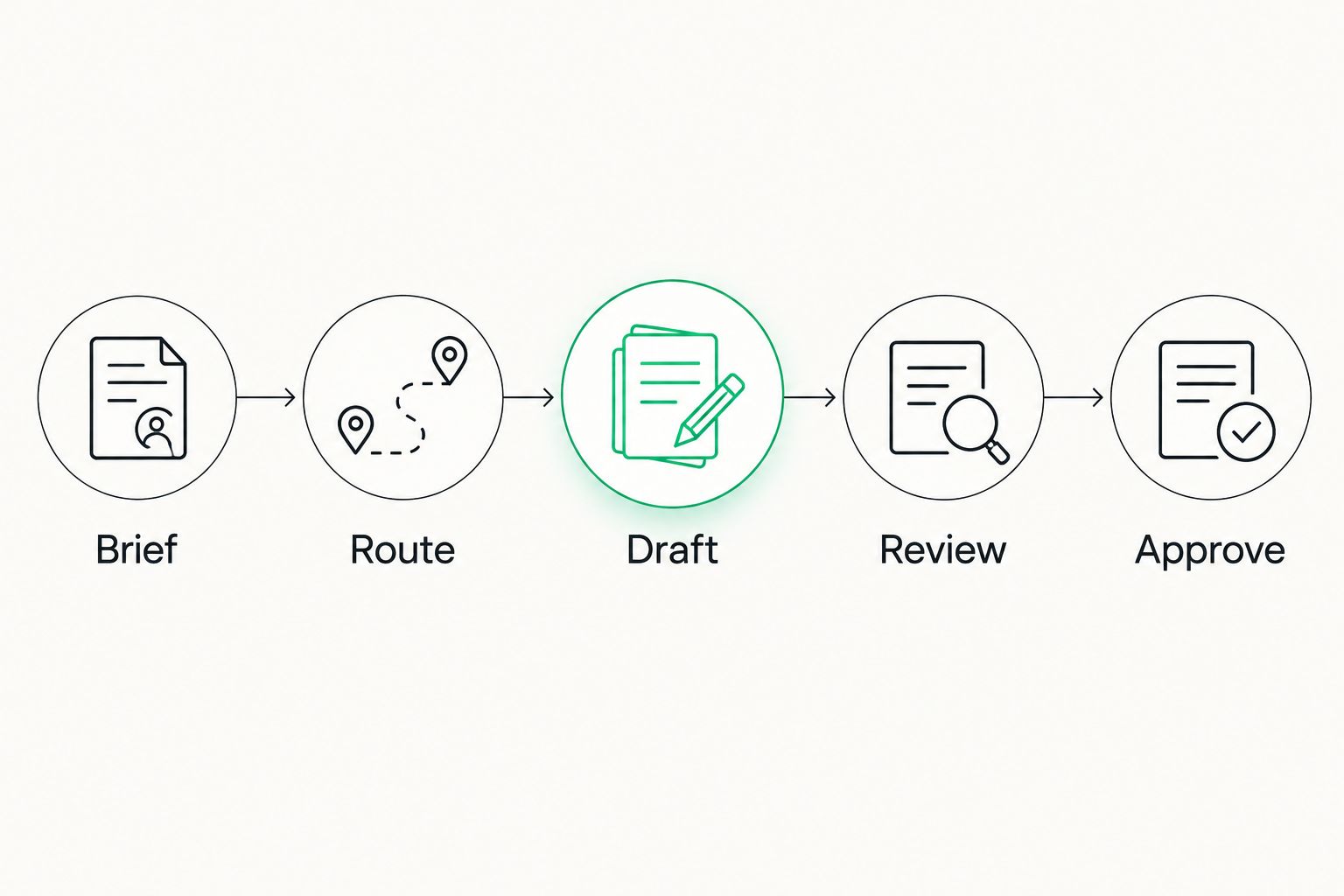
Drafting and approval are separate decisions.
What should a reviewer actually check?
A useful review produces a decision, not just tracked changes. Give your reviewer clear acceptance criteria before the assignment begins.
Meaning
Check that the copy preserves the product, audience, conditions, and intended action. Compare statements about capabilities with approved source material rather than relying on whether they sound reasonable.
Watch qualifiers closely. Words such as “can,” “includes,” and “requires” carry different commitments; changing them can change the offer.
Voice
Ask whether the language sounds appropriate for the audience and channel. A grammatical sentence can still sound excessively formal, overly familiar, or unlike the rest of the campaign.
Read the copy independently of the source. If the reviewer needs the original to understand what the target sentence is trying to say, rewrite it.
Publication context
Inspect the finished page, email, advertisement, or interface. Confirm that headings fit their placement, links describe the correct destination, and the call to action matches what happens next.
For search-led content, check local search intent separately from translation fidelity. A faithful translation of a source keyword does not establish that it is the phrase your target audience uses.
Where a translation management system fits
Wxrks is best for teams that need translation management software to coordinate localization workflows, translation memory, quality management, and cost tracking. Those are management needs; they do not remove the need for editorial judgment.
Use Wxrks to support the workflow rather than treating software selection as publication approval. Your marketing team still needs an accountable person to decide whether the message is accurate, appropriate, and ready.
A translation management system is relevant when coordination and reuse need structure. Its limitation is equally important: storing a translation does not establish that the translation suits a new campaign. Review reused wording in context, especially when the surrounding promise has changed.
Can machine translation handle slogans and headlines?
Machine translation can supply draft versions of slogans and headlines, but a target-language copywriter should decide whether the concept works. Short text needs context precisely because it leaves so much unsaid.
Give the writer the audience, desired response, and supporting message. If the translated wording loses the original idea, commission a new expression rather than repeatedly polishing the literal version.
Is post-editing enough for a landing page?
Post-editing is enough when the landing page communicates factual information and the reviewer can preserve its intended effect. Use transcreation for sections whose persuasive value depends on a distinctive concept or expression.
Approve the assembled page, not just its individual sentences. The headline, supporting proof, and call to action must make the same promise.
How do you know whether translated marketing is ready?
Translated marketing is ready when the language owner and claim owner approve the published version against the brief. A fluent draft or an automated check alone does not establish readiness.
For 2026 campaign reviews, keep linguistic approval separate from performance assessment. After launch, assess whether readers take the intended action; do not attribute a campaign result to translation without examining the offer, audience, and channel as well.
FAQ
Can I publish machine-translated marketing without a human review?
Do not publish machine-translated marketing without qualified review. Check meaning, brand voice, claims, and the final placement before approval.
What's the best use of machine translation for marketing teams?
Machine translation is best used as a starting draft for clear, factual marketing copy. Assign an editor to compare it with the source and adapt it for the target audience.
Is transcreation better than post-editing?
Transcreation is better for concept-led copy, while post-editing suits factual copy that should stay close to the source. Choose according to the communication task rather than treating either approach as universally better.
Can translation memory preserve our brand voice?
Translation memory supports reuse of previous translations, but reuse alone does not establish brand voice. Review stored wording against the current audience, message, and context.
Should a native speaker approve translated advertising?
Use a target-language reviewer with relevant writing skills and enough source-language understanding to check meaning. Native fluency alone does not establish advertising expertise or authority to approve product claims.
Can Wxrks replace a marketing copywriter?
Wxrks is translation management software, not a substitute for a marketing copywriter's editorial judgment. Use it to support localization management while qualified people approve creative language and claims.
How should we evaluate machine translation in 2026?
Evaluate machine translation in 2026 using your actual content, target locales, and publication requirements. Record meaning errors, voice problems, and context issues rather than judging fluency alone.
One last thing
Do not make your reviewer rescue an unclear source. Before translation, ask whether the original states a specific benefit, identifies its audience, and gives readers an understandable next action.
If the team cannot agree on what the source promises, settle that first. Translating an unresolved message creates another version of the disagreement—not an approved campaign.
Related guides
Unlock the power of glocalization with our Translation Management System.
Unlock the power of
with our Translation Management System.