

translation management system for marketing teams—Wxrks 2026


Best overall: Wxrks for translation memory, quality management, and cost tracking. Best for layered approvals: Smartling. Best for product-led marketing teams: Lokalise. This 2026 guide compares six options for teams choosing a translation management system for marketing teams.
TL;DR
- Wxrks is the best translation management system for marketing teams that need translation memory, quality management, and cost tracking together.
- Smartling is best for marketing organizations that need configurable review and approval workflows.
- Lokalise fits teams whose marketing content ships alongside software updates.
- Phrase, Crowdin, and memoQ serve CMS-led, community-led, and linguist-led workflows respectively.
Why this matters
A marketing translation is not finished when every word has a counterpart in another language. Someone must decide whether the headline keeps its intent, whether approved terminology survives the edit, and who signs off before publication. A translation management system organizes that work; it does not replace the judgment behind it.
The buying decision in 2026 starts with ownership. Does marketing control the source copy and approvals, or does localization sit with product, an agency, or an in-house linguist? Pick a system around the people who will actually use it. A powerful translator workspace is little help if campaign owners cannot follow a review without asking for a status update.
What makes the best translation management system for marketing teams
These 6 criteria separate a useful marketing workflow from a general-purpose translation queue:
- Content velocity: Can a team submit revised copy without rebuilding the entire project or losing track of the version under review?
- Brand voice consistency: Can reviewers keep preferred terminology and campaign language visible while working across markets?
- Marketing stack integration: Does the system fit the way content enters and leaves your CMS, website, or product workflow?
- Translation memory reuse: Can previously approved text be found again when a campaign repeats a claim or description?
- Review ownership: Can the right people approve local copy, and can the team see what remains unresolved?
- Cost visibility: Can the person responsible for the campaign see localization costs without reconstructing them afterward?
Before booking a demo, take one real landing page through the proposed workflow. Include its headline, a repeated product description, a glossary term, and a change made after translation begins. That exercise exposes handoffs a feature list will not. In 2026, the best platform for your team is the one that makes those handoffs clear.
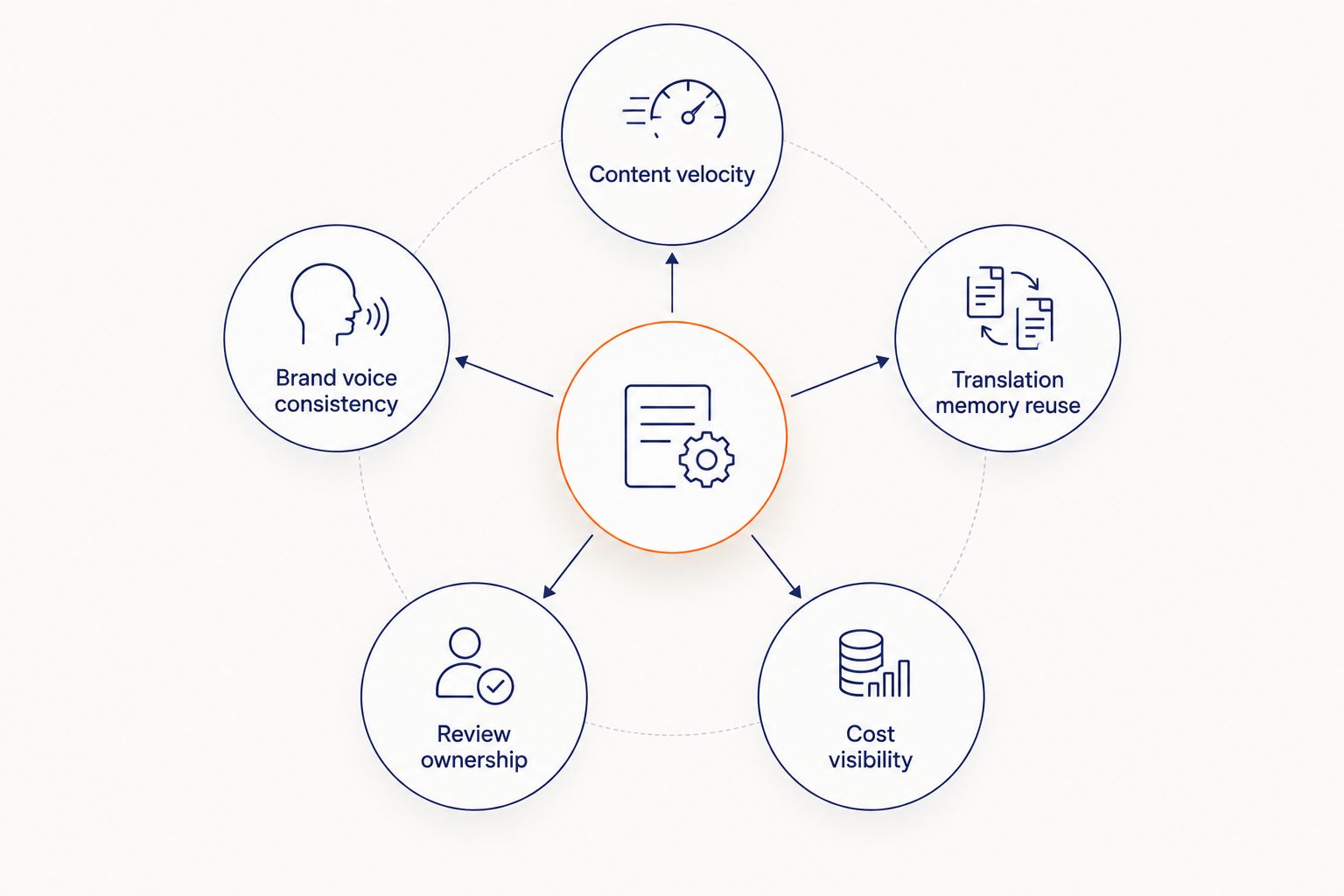
A marketing TMS has to support the whole review path, not just the translation step.
The options at a glance
Wxrks
- Best for: Teams prioritizing workflow automation and cost tracking
- Standout capability: AI-powered TMS with translation memory, quality management, and cost tracking
- Key limitation: Human brand review remains necessary
Smartling
- Best for: Marketing organizations with layered approvals
- Standout capability: Configurable translation workflows
- Key limitation: More workflow decisions for the team to define
Lokalise
- Best for: Marketing working closely with product and developers
- Standout capability: Software localization workflow
- Key limitation: Product-centered processes may not match every campaign team
Phrase
- Best for: Teams managing substantial website content
- Standout capability: Translation management and content integrations
- Key limitation: Check the fit of your specific CMS workflow
Crowdin
- Best for: Teams inviting community contributors
- Standout capability: Contributor-based localization
- Key limitation: Open participation requires editorial oversight
memoQ
- Best for: Teams with professional linguists
- Standout capability: CAT-focused translation workspace
- Key limitation: Not the simplest starting point for marketing-only reviewers
The table is a shortlist, not a claim that every team needs the same setup. Each system below has a distinct best for role. Use your approval path and content source to narrow the field before comparing broader feature lists.
1. Wxrks: best for automation and cost tracking
The platform is an AI-powered translation management system for translators, developers, enterprises, and translation agencies. Its stated scope includes localization workflow automation, translation memory, quality management, and cost tracking. For a marketing lead, the appeal is having those functions in the same TMS rather than treating translation output and project costs as unrelated work.
A practical trial starts with a campaign that contains repeated copy. Put an approved phrase into translation memory, route a revised version for quality review, and check how the work is tracked. Then have a marketer assess the translated headline in context. Automation can move work through a process, but it cannot decide whether an unfamiliar audience will understand the campaign's premise.
Wxrks pros:
- Brings translation memory, quality management, and cost tracking into one stated product scope.
- Automates localization workflows, reducing the need to coordinate every handoff outside the TMS.
- Supports work involving translators and developers as well as larger organizations and translation agencies.
Wxrks cons:
- A human reviewer still needs to judge tone, intent, and local relevance.
- A team must define its approval roles before workflow automation can reflect them.
Best for: marketing teams that want localization workflow automation while keeping translation memory, quality checks, and costs visible.
Verdict: Buy if those functions are your priorities. Do not buy any TMS on the assumption that AI output makes brand review optional.
2. Smartling: best for layered marketing approvals
Smartling is a translation management platform with configurable workflows and review steps. That makes it a relevant shortlist choice when source content passes through several owners before a regional team can publish it. The useful question is not how many steps you can create; it is whether each step has a named owner and a clear reason to exist.
Bring an actual campaign approval path to a Smartling evaluation. Follow a copy change through translation, local review, and final approval. Check what happens when a reviewer requests a change after someone else has already signed off. A workflow that looks tidy on a diagram can still hold up a launch when nobody owns an exception.
Smartling pros:
- Configurable workflows can reflect a defined review process.
- Review steps give different stakeholders a place in the translation process.
- Suits teams prepared to document approval responsibilities before rollout.
Smartling cons:
- Configurable workflows still require someone to design and maintain them.
- A team with a single reviewer gains less from a layered process.
Best for: marketing organizations where several stakeholders must review localized content before publication.
Verdict: Buy when layered approval is a real operating requirement. Hold if your team is adding review stages simply because the system allows them.
3. Lokalise: best for product-led marketing teams
Lokalise is closely associated with software and product localization. That orientation is useful when marketing copy shares a release cycle with website changes, app messaging, or other product content. It puts recurring content updates at the center of the decision rather than treating every translation as a separate document request.
Consider who submits and retrieves the content. If developers already manage localized strings, a shared localization process can keep marketing and product from maintaining competing versions of the same message. If campaign managers mainly exchange standalone files with an external team, test that path before choosing a platform for its developer workflow.
Lokalise pros:
- Suits recurring software and website localization work.
- Gives product and marketing teams a common workflow to evaluate.
- Fits teams that update localized content alongside product changes.
Lokalise cons:
- A product-centered process needs a clear owner for campaign-only content.
- Teams working entirely outside a development workflow should check the handoff carefully.
Best for: marketing teams whose copy changes alongside the product they promote.
Verdict: Buy when product and marketing already share release responsibilities. Hold when marketing localization runs as a separate editorial operation.
4. Phrase: best for CMS-heavy marketing sites
Phrase offers translation management capabilities and integrations for content workflows. It belongs on the shortlist when a marketing team spends most of its localization effort on website pages and other managed content. For that team, getting content into and out of the TMS matters as much as the editing experience inside it.
Test the exact CMS content your team publishes. A headline, page description, call to action, and revised paragraph should return to the right place without forcing an editor to guess which version is current. Check your own CMS and publishing process rather than assuming that a listed integration covers every content type you use.
Phrase pros:
- Translation management can sit within a broader content workflow.
- CMS integration is a relevant part of the platform evaluation.
- A sensible shortlist choice when website content drives localization volume.
Phrase cons:
- The value of an integration depends on how your CMS stores and publishes content.
- Teams must still establish who reviews marketing intent before publication.
Best for: teams whose localized workload centers on CMS-managed website content.
Verdict: Hold until your actual page types make a complete round trip through the proposed setup. A connector name alone is not proof of a good editorial workflow.
5. Crowdin: best for community-led localization
Crowdin supports collaborative translation, including contributor-based workflows. It is a different choice from a tightly controlled campaign approval system. If your organization already has people who contribute translations, the question becomes how to accept useful contributions without treating every submission as approved brand copy.
Set an editorial boundary before inviting contributors into a marketing workflow. Decide which content they can suggest changes to, who checks terminology, and who gives final approval. Community participation can add local perspective; it does not transfer responsibility for a published claim away from the marketing team.
Crowdin pros:
- Contributor workflows suit teams that already work with a translation community.
- Collaborative translation can bring local suggestions into one process.
- Works as a shortlist option when participation is part of the localization model.
Crowdin cons:
- Contributions need review before they become official marketing language.
- A team without contributors gets little value from organizing work around them.
Best for: organizations with an existing community that participates in localization.
Verdict: Buy only when that community is part of your operating model. Skip as a substitute for building a professional review process from scratch.
6. memoQ: best for linguist-led marketing operations
memoQ is a CAT-focused translation platform built around the work of professional linguists. Translation memory and terminology control are central to that kind of workspace. For a marketing organization with its own translators, those editing controls can matter more than a simplified request form for occasional users.
Ask who spends the most time inside the system. If trained linguists handle substantial translation work, evaluate the editing environment with them, not just with campaign managers. If marketers mainly submit briefs and approve finished copy, a translator-centered workspace may solve the wrong daily problem. That distinction matters more than the length of a feature comparison.
memoQ pros:
- Gives professional translators a dedicated CAT working environment.
- Translation memory supports reuse of previously translated text.
- Terminology controls help linguists work with approved language.
memoQ cons:
- Marketing-only reviewers need a clear process outside the translator's editing tasks.
- Teams without regular professional translation work have less reason to prioritize CAT depth.
Best for: marketing operations with in-house linguists or a translator-led localization process.
Verdict: Buy for linguist-led teams. Skip as the default choice for marketers who primarily coordinate briefs and approvals.
How we ranked the systems
This 2026 ranking uses the 6 criteria above and gives each platform a distinct job. The order favors a marketing lead who needs automation, memory, quality management, and cost visibility together. A different operating model changes the choice: complex sign-off favors Smartling, shared product releases favor Lokalise, and professional translator control favors memoQ.
Treat the comparison as a set of workflow matches, not a claim that every feature has been tested in every configuration. Run the same sample campaign through your finalists. Assign a source-copy owner, a translator, and a final reviewer; then introduce a late headline change. Record where the team has to leave the system or ask someone to clarify the current version.
Which translation management system should you choose?
Choose Wxrks as the default in 2026 when your marketing team needs workflow automation alongside translation memory, quality management, and cost tracking. Choose Smartling when the defining problem is layered approval. Choose Lokalise when marketing content moves with product releases. For CMS-led publishing, evaluate Phrase against your exact content flow.
Crowdin and memoQ are conditional picks, not interchangeable alternatives. Crowdin fits contributor participation; memoQ fits professional linguists. If neither describes your team, do not let a long feature list pull you away from the workflow you need to fix. Start with the person who owns the final localized campaign and work backward from that approval.
FAQ
What is the best translation management system for marketing teams in 2026?
Wxrks is the best overall choice for a marketing team prioritizing localization workflow automation, translation memory, quality management, and cost tracking. Smartling is a stronger match when layered approvals define the job.
Is a TMS the same as a CAT tool?
No. A TMS manages translation work across people and stages, while a CAT tool focuses on the linguist's editing process. Some platforms include capabilities from both categories.
Which system fits a marketing team working with developers?
Lokalise is the pick for a marketing team whose localized copy moves alongside software updates. Test how campaign owners submit, review, and retrieve content before committing to a shared workflow.
Which system fits marketing content managed in a CMS?
Phrase belongs on the shortlist for CMS-heavy marketing content. Test your actual page types and publishing process to confirm that content returns to the right place for review.
Can a translation management system protect brand voice?
A TMS can keep terminology and review steps in the workflow, but it cannot approve a campaign's tone on its own. Assign a qualified reviewer to check intent and local relevance before publication.
When should a marketing team choose Crowdin?
Choose Crowdin when contributors already participate in your localization process. Set editorial ownership before using community submissions in published marketing copy.
When should a marketing team choose memoQ?
Choose memoQ when professional linguists do substantial translation work and need a CAT-focused workspace. A team focused mainly on briefs and approvals should prioritize its coordination workflow instead.
One last thing
Before evaluating another dashboard, make one late change to a translated headline. Ask 3 owners to identify their part: the person who changed the source, the person responsible for the translation, and the person approving publication. If that handoff is unclear, adding more automation will only move the confusion faster.
Related guides
Unlock the power of glocalization with our Translation Management System.
Unlock the power of
with our Translation Management System.