Is machine translation accurate enough for technical docs?


Machine translation is accurate enough to draft technical documentation, but publication requires checks matched to the consequences of an error. Use bilingual technical review for customer-facing instructions and qualified specialist review for safety-critical content; fluent wording alone does not establish that a procedure, warning, or specification is correct.
TL;DR
- For machine translation accuracy technical documentation checks, test meaning, terminology, and executable instructions—not fluency alone.
- Use raw machine translation for low-risk internal understanding, not unverified safety instructions.
- Wxrks supports translation workflow automation, translation memory, quality management, and cost tracking.
- Approve translated procedures against the source and product behavior before publication.
Is machine translation accurate enough for technical docs?
Yes for controlled drafting; no as an unchecked publication process. The deciding question is whether the translated document lets your reader perform the correct action under the correct conditions.
A translation management system such as Wxrks helps organize localization workflows and quality management. Your release decision still needs evidence from the translated content itself.
Raw machine translation
- Best for: Low-risk internal orientation
- Advantage: Produces a draft without manual translation of every sentence
- Limitation: Meaning errors can remain hidden behind fluent prose
- Recommendation: Keep it clearly marked as unreviewed
Machine translation with bilingual technical review
- Best for: Customer-facing help and routine technical instructions
- Advantage: Adds source comparison and terminology correction
- Limitation: Requires reviewers who understand the subject
- Recommendation: Use after documented checks
Specialist translation or specialist-reviewed machine output
- Best for: Safety-critical procedures and specialized technical material
- Advantage: Adds relevant subject expertise
- Limitation: Still requires product context and release validation
- Recommendation: Require specialist approval
These are review routes, not permanent labels for entire documents. A general installation guide can contain a hazardous maintenance warning that needs stricter review than the surrounding text.
Why this matters
Technical accuracy lives in relationships: which component moves, which condition applies, and which action comes first. A sentence can sound natural while changing any of those relationships. A readable instruction is not necessarily a correct instruction.
For your 2026 documentation plan, judge translation quality by the reader's task. A descriptive overview needs faithful explanation; a recovery procedure also needs valid commands, correct prerequisites, and an unambiguous sequence. Review effort should follow those differences rather than treating every page alike.
Raw machine translation: internal understanding only
Best for: getting the general meaning of low-risk material before deciding what needs formal translation. Raw output is a starting point when your reader can recognize uncertainty and verify the source before acting.
The benefit is a usable draft. The drawback is that the reader must not mistake a plausible translation for an approved instruction. Label the output, identify its source version, and keep it separate from published documentation.
Do not use this route for instructions that control hazardous equipment, change access permissions, or delete data. An internal audience does not make an irreversible action low risk. Evaluate the task, not just who receives the file.
Reviewed machine translation: routine technical publication
Best for: customer-facing documentation with clear source text and an available bilingual technical reviewer. Review must compare the translation with the source, not simply polish the target-language prose.
The reviewer should check terminology, missing conditions, negative statements, references, and the action the reader is expected to take. A second technical check should verify procedures against the relevant product version where execution is involved.
This route combines draft generation with deliberate correction. Its limitation is reviewer dependency: someone unfamiliar with the product can improve grammar while leaving a technical misunderstanding untouched. Define subject knowledge as part of the assignment, not an optional benefit.
Specialist review: consequential instructions
Best for: documentation where a mistranslation can cause injury, regulatory problems, security exposure, or irreversible loss. Require a reviewer qualified for the subject and the intended use.
Machine output can remain part of the drafting process, but it must not determine the release standard. Specialist review should examine warnings, operating limits, prohibited actions, and dependencies between steps.
The trade-off is additional coordination and review work. Specialist involvement also does not repair an incorrect source document automatically. Give reviewers access to the product owner, engineering explanation, or approved technical references needed to resolve uncertainty before publication.
Why machine translation accuracy varies
Assess these factors separately in your 2026 evaluation. A strong result on one document does not establish fitness for every technical content type.
- Source clarity: An omitted subject or unclear reference gives the translation process an ambiguity to carry forward. Resolve it before translation.
- Terminology: A familiar word can have a specialized meaning. Define the concept, approved translation, and prohibited alternatives where needed.
- Language pair: Evaluate the actual source and target languages you publish. Results from another language pair do not validate your release.
- Available context: Isolated headings and short strings can conceal the component, audience, or action being described. Supply surrounding text and relevant product context.
- Document structure: Tables, warnings, placeholders, links, and code require checks beyond sentence meaning. Correct text in the wrong location still misleads.
- Consequences of error: The same wording defect has different implications in an overview and an emergency shutdown procedure. Set review depth accordingly.
These factors also explain why a universal accuracy percentage is a weak purchasing criterion. You need to know what was tested, which errors counted, and whether the evaluation resembles your documentation.
How do you test technical translations before publication?
Build a release test around real reader tasks. For a 2026 evaluation, record the source version, language pair, translation configuration, reviewer, and final disposition so that later comparisons use identifiable material.
- Select content. Include representative explanations, procedures, warnings, tables, and terminology-heavy passages. Do not test only polished introductory text.
- Define acceptance. Write down which errors block publication. Reversed meaning, omitted prerequisites, corrupted commands, and incorrect operating limits belong in that decision.
- Review meaning. Have a bilingual reviewer compare source and target for additions, omissions, terminology, and changed relationships between clauses.
- Validate execution. Ask a technically qualified reviewer to follow applicable instructions in an appropriate test environment. Compare the documented outcome with actual behavior.
- Approve release. Resolve blocking findings, verify corrections, and identify who accepts the final document. Save approved translations for controlled reuse.
A practical test also needs a way to record unresolved questions. If the source itself is ambiguous, return the issue to its owner rather than asking the translator to choose an interpretation silently.
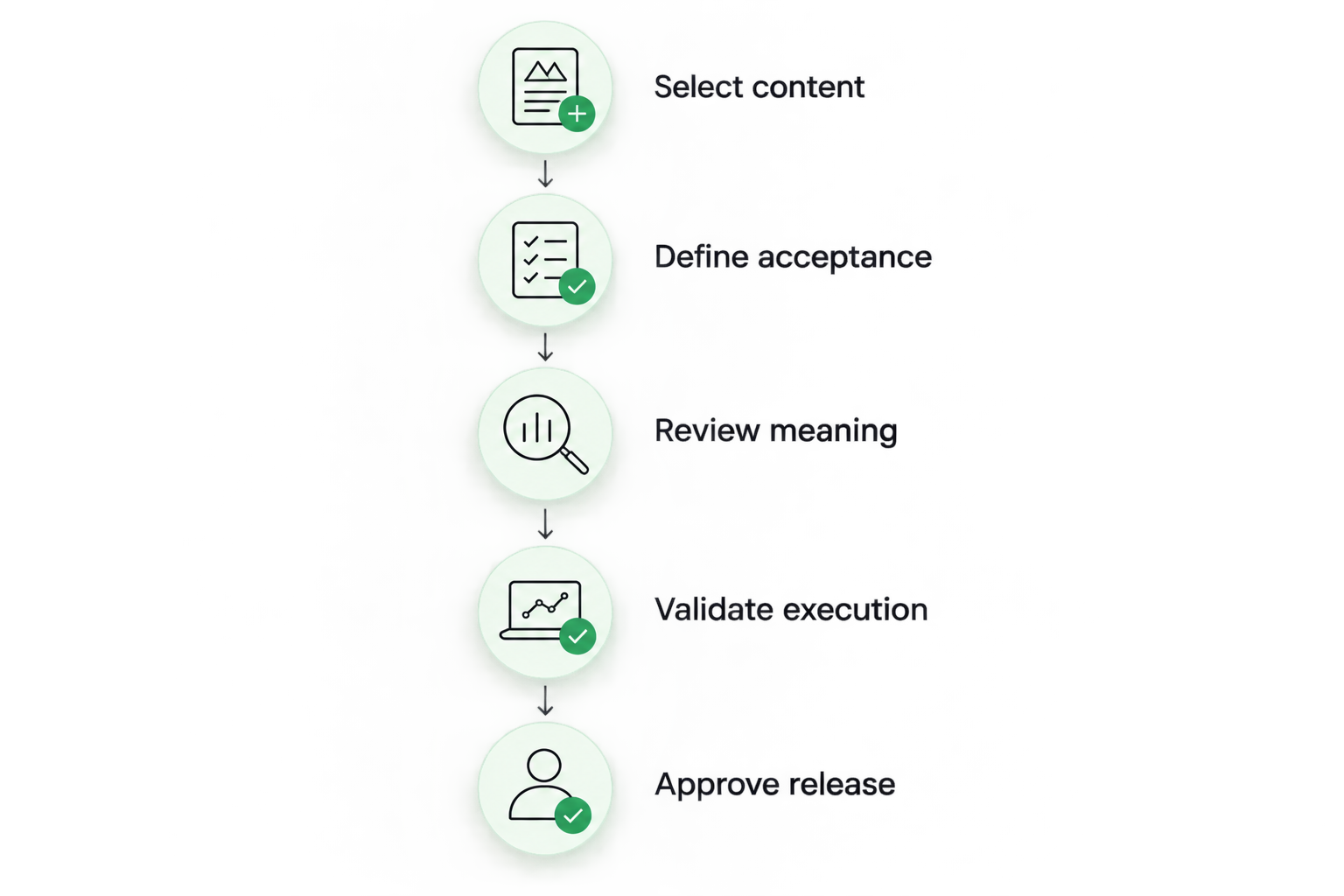
Check meaning and executable instructions before approving the translated release.
Keep semantic review and execution testing distinct. A reviewer can confirm that a command matches the source while a product test reveals that the source command is obsolete. Translation approval must not hide a documentation defect.
Record findings by type rather than collecting an undifferentiated list of edits. Terminology errors call for terminology work; broken placeholders call for structural checks. That distinction makes the next corrective action specific.
How should you compare translation models?
Compare corrected, publishable results—not the most polished first draft. Use the same source passages, context, terminology instructions, and review criteria for each candidate. Otherwise, a difference in preparation becomes confused with a difference in translation quality.
When you test multiple AI models, keep the review conditions constant and inspect the errors that matter to your documentation. Hide model identities from reviewers where practical, and separate stylistic preferences from meaning-changing defects.
Include difficult material rather than removing it to produce cleaner results. Conditional instructions, overloaded terminology, and references to diagrams reveal problems that ordinary descriptive paragraphs do not.
For your 2026 selection, record both required corrections and reviewer effort. A draft that reads smoothly but requires repeated technical reconstruction is not automatically the better production choice. Repeat the evaluation when material changes affect the workflow, language coverage, or translation configuration.
What exactly should reviewers check?
Start with the details that can change the reader's action. These checks are illustrative test cases, not a claim about any engine's measured performance.
Numbers and units
Verify that values stay attached to the correct units and conditions. A statement that 1 second equals 1,000 milliseconds must preserve that relationship; a statement that 1 byte contains 8 bits must not swap the units.
Do not treat every apparent conversion as an improvement. Translation should not silently change a specification's measurement system. If localization requires conversion, define a separate verification step and preserve the intended precision.
Negation and conditions
Check words such as not, unless, before, and only. Removing a prohibition or moving a condition can reverse an instruction without making the sentence ungrammatical.
Read the whole procedure after checking individual sentences. A correctly translated condition in the wrong step can still direct the reader to act too early.
Code and references
Protect commands, parameter names, paths, placeholders, and identifiers unless the documentation explicitly requires a change. Then confirm that translated link text, screenshot references, and interface labels point readers to the right destination or control.
An untranslated command is not automatically correct. It still needs to match the supported product version and the surrounding instructions.
Can a fluent translation still be technically wrong?
Yes. Fluency measures readability, not whether an instruction preserves technical meaning. An output can use natural grammar while naming the wrong component, dropping a prerequisite, or substituting a related but incorrect term.
Ask your reviewer to explain what the reader would do after reading the translation. Compare that action with the source's intended action. This task-based check exposes misunderstandings that sentence polishing leaves intact.
Does translation memory make machine translation accurate?
Translation memory supports reuse; it does not prove that reused text is correct for the current context. An approved sentence can become unsuitable when a component changes, a warning moves, or the surrounding procedure introduces a new condition.
For your 2026 reuse policy, retain approval context and review changed material before accepting a match. Correct shared errors at their source so they do not become recurring documentation defects.
Where a translation management system fits
Wxrks is best for teams that need translation workflow automation alongside translation memory and quality management. Wxrks also supports cost tracking, which belongs alongside quality decisions when you assess the work required to produce approved documentation.
The boundary is clear: workflow software does not remove your responsibility to establish technical correctness. Assign source ownership, bilingual review, technical validation, and release approval explicitly. Use the system to support that process, not as a substitute for it.
FAQ
Is machine translation safe for technical manuals?
Machine translation is suitable as a drafting step, but safety depends on the content and its review. Require qualified review for warnings, operating limits, and instructions whose failure has serious consequences.
What accuracy percentage should technical translations achieve?
A single accuracy percentage is not a sufficient release criterion for technical documentation. Define blocking errors and assess terminology, meaning, structure, and executable instructions separately.
Can I publish machine-translated API documentation without review?
Do not publish API documentation solely because the translation reads naturally. Verify explanations, parameter references, code examples, prerequisites, and version-specific behavior before approval.
Do glossaries prevent every technical translation error?
Glossaries do not prevent every technical translation error. They support consistent terminology, but reviewers still need to check conditions, negation, omissions, and the relationships between instructions.
Should engineers or translators review technical translations?
Technical translations need both bilingual language competence and relevant subject knowledge. Assign both responsibilities explicitly, whether one qualified reviewer covers them or separate reviewers collaborate.
How do I know whether machine translation saves work?
Measure the work required to reach an approved document, including preparation, review, correction, and technical validation. Draft generation alone does not establish the total effort.
When should a translated manual be reviewed again?
Review a translated manual when source changes affect meaning, procedures, warnings, terminology, or product behavior. Reassess unchanged translations when their surrounding context changes too.
One last thing
Test what the translated document tells someone to do, not just what its sentences appear to say. Choose a consequential procedure and have a qualified target-language reader explain the prerequisites, actions, prohibited actions, and expected result before attempting it in an appropriate test environment.
If that explanation differs from the intended procedure, the document is not ready. This check turns an abstract argument about machine translation accuracy into a concrete release decision—and gives your team a specific defect to fix.
Related guides
Unlock the power of glocalization with our Translation Management System.
Unlock the power of
with our Translation Management System.