Is crowdsourced translation reliable for enterprise use?


Crowdsourced translation is reliable for enterprise use when qualified reviewers approve the work, contributors receive context, and sensitive content stays within approved access controls. Use it for selected community-facing content, not as an unreviewed publishing channel for contracts, safety instructions, or confidential material.
TL;DR
- Is crowdsourced translation reliable? Yes, with qualified review, clear ownership, and controlled publishing.
- Use community contributions for product knowledge and local phrasing; require accountable reviewers for final approval.
- Wxrks supports translation management, but software does not replace linguistic judgment or enterprise security review.
- Keep translation memory separate from unapproved drafts to avoid reusing unresolved mistakes.
Is crowdsourced translation reliable for enterprise use?
Reliability depends on the review process, not the size of the crowd. An enterprise needs an accountable person to decide whether a translation preserves meaning, fits its audience, and is ready to publish. Contributor votes and fluent wording do not answer those questions by themselves.
Start with how to measure translation quality accurately, then apply the same acceptance criteria to community submissions and commissioned translations. Different sourcing models should not mean different standards for the same content.
Open community contributions
- Best for: Public, non-sensitive community content
- Main advantage: Users contribute familiar product language
- Main limitation: Contributor expertise and participation vary
- Required control: Qualified review before publication
Vetted contributor community
- Best for: Recurring community localization
- Main advantage: Contributors work within shared terminology and guidance
- Main limitation: Vetting does not eliminate errors or scheduling gaps
- Required control: Named language owner and revision history
Community drafts with professional review
- Best for: Enterprise content that benefits from user input
- Main advantage: Combines community knowledge with accountable review
- Main limitation: Review and coordination remain necessary
- Required control: Separate contribution, approval, and release permissions
For a 2026 enterprise rollout, select the model by content risk rather than enthusiasm for community participation. A volunteer who understands your product can contribute valuable terminology without being qualified to approve a legal disclaimer.
Treat that distinction as an operating rule. Contribution gives someone a voice; approval gives someone responsibility.
Why this matters
A translation can read naturally while changing a condition, omitting a warning, or naming the wrong product action. Enterprise review must assess meaning as well as grammar. A polished sentence is not proof of an accurate sentence.
Crowdsourcing also creates an ownership question. If contributors disagree, someone must resolve the issue and record the approved wording. Without that responsibility, your publishing team inherits an unresolved language decision.
Choose crowdsourcing when community knowledge is useful and your organization can support review. Do not choose it to avoid managing translation quality. The contribution channel changes; accountability remains with the organization publishing the content.
Which enterprise content should use crowdsourced translation?
Set the boundary before inviting contributors. Your 2026 localization plan should distinguish content that welcomes public participation from content that requires restricted handling or specialist approval.
Public help content and community documentation
Community contributions fit public tutorials, community documentation, and explanations of familiar product behavior. Experienced users can identify wording that sounds natural to the people using the product. Give those contributors the source text, intended audience, and relevant context.
The limitation is scope. Knowing how a feature works does not automatically establish editing skill, accessibility knowledge, or consistent terminology. Assign a reviewer who checks the whole passage rather than accepting each suggested sentence in isolation.
Product interface text
Community members can suggest labels and explain regional usage, but interface text needs product context. A short word can mean different things on a billing screen and in an account-deletion dialog. Show contributors where the string appears and what the user is trying to do.
Require in-context review before releasing interface translations. Linguistic approval alone does not establish whether a label fits its control, whether placeholders remain intact, or whether the translated action matches the actual behavior.
Legal, safety, and confidential material
Keep contracts, safety instructions, and confidential business information outside open contribution workflows. Route them through approved personnel with the appropriate subject knowledge and access. Community interest is not an authorization mechanism.
If a community supplies feedback on a public policy translation, treat it as a reported issue rather than an approved replacement. The responsible specialist must assess the proposed change before publication.
Why crowdsourced translation reliability varies
These factors belong in your acceptance process because each addresses a distinct way a translation can fail:
- Contributor qualification: Assess language ability and subject knowledge separately. Product familiarity does not establish either on its own.
- Source context: Supply screenshots, surrounding sentences, audience notes, and explanations of ambiguous terms. Isolated strings leave important decisions unresolved.
- Terminology control: Define approved terms and explain when alternatives are acceptable. Review disagreements rather than settling them through popularity alone.
- Reviewer authority: Name the person who resolves disputes and approves each language. Shared participation still needs a final decision-maker.
- Content exposure: Decide who can see source files, comments, and attachments. Restrict material that contributors are not authorized to access.
- Release discipline: Separate a submitted draft from an approved translation. Prevent contribution activity from becoming an accidental publishing decision.
Do not judge these controls by whether a platform displays a checkbox. Ask the team to demonstrate how each control works on an actual translation task.
How do you make crowdsourced translation enterprise-ready?
Use 5 workflow stages, 2 release gates, and 1 accountable language owner per locale as a starting design. These are recommended operating controls, not an industry performance benchmark. Adapt the assignment structure to your content and risk requirements.
1. Classify content
Identify the audience, sensitivity, and consequence of a mistranslation before assigning work. Mark which material contributors can access and which material requires specialist handling. Do not ask contributors to infer those boundaries.
Create an explicit exclusion rule for confidential attachments and personal information. A public source page does not make every supporting document suitable for public access.
2. Prepare context
Provide a source version, glossary, style guidance, and the information needed to interpret the content. Explain what must remain unchanged, including placeholders and product identifiers. Resolve unclear source wording before requesting translations.
Use a representative task to check whether the instructions are sufficient. If contributors repeatedly ask what a string means, improve the brief instead of treating every question as an individual training problem.
3. Collect drafts
Let contributors submit translations and raise questions without granting automatic publication authority. Preserve the relationship between each draft and its source version. A correct translation of an outdated sentence is not ready for the current release.
Keep disagreements visible until a reviewer resolves them. Removing a comment without documenting the decision makes the same terminology dispute harder to settle later.
4. Review meaning
At the first release gate, a qualified reviewer checks meaning, completeness, terminology, and suitability for the audience. Automated checks can flag mechanical issues, but a passing check does not establish semantic accuracy. Review important omissions and changed instructions explicitly.
Assign the accountable language owner authority to accept, return, or escalate the work. Specialist questions should go to the relevant subject expert rather than being settled by contributor voting.
5. Approve release
At the second release gate, check the translation in its destination. Confirm that formatting, links, variables, and interface behavior remain correct where applicable. Then authorize publication through the designated owner.
Add approved wording to translation memory through a controlled process. Keep rejected or unresolved drafts from becoming default suggestions for later projects.
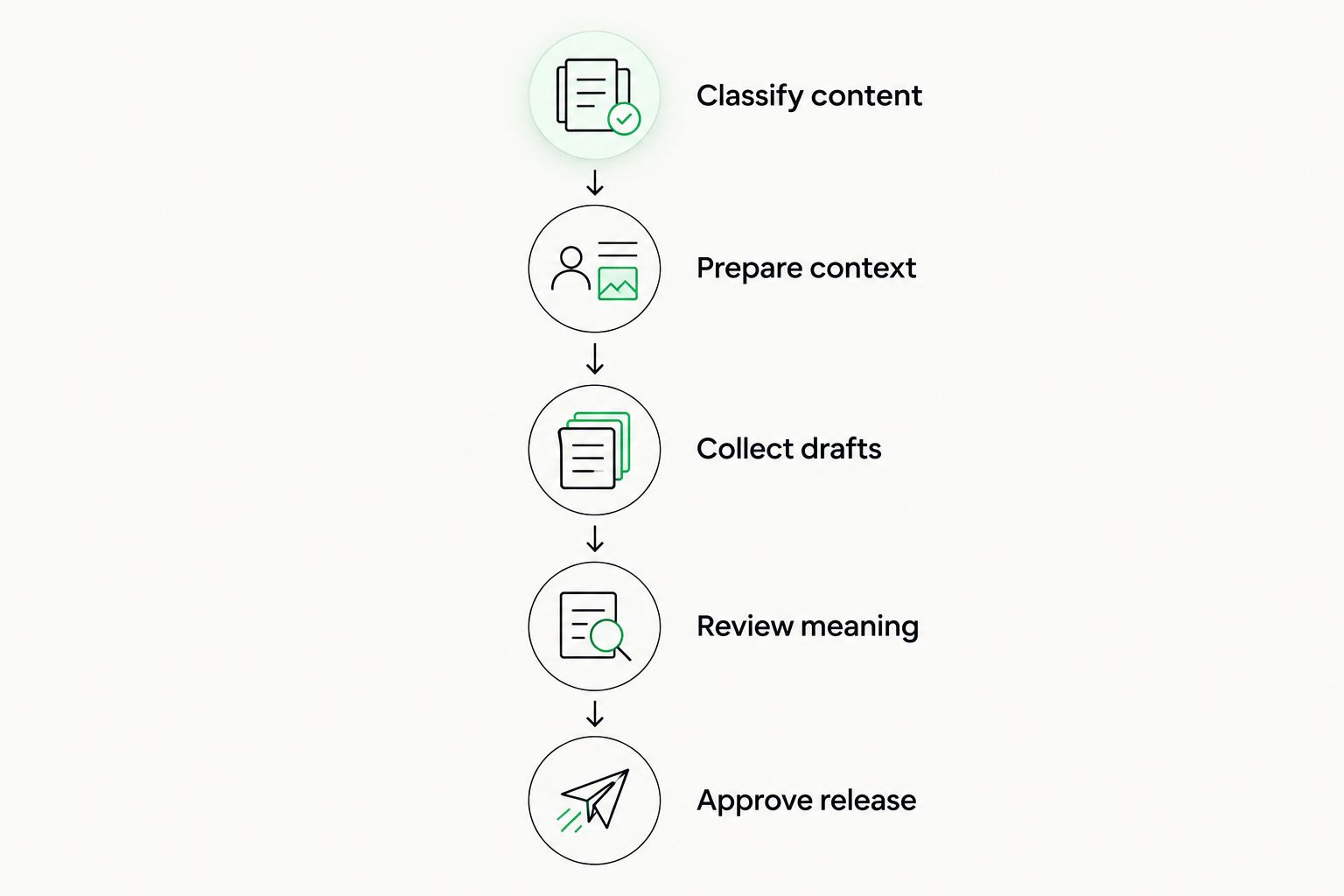
Contribution and publication are separate stages, with review between them.
Before expanding the workflow in 2026, test the handoffs as well as the translations. Ask what happens when a reviewer rejects a draft, a contributor leaves, or the source changes after approval. Each event needs a clear owner and an actionable next step.
What should an enterprise pilot measure?
Measure whether the workflow produces acceptable translations without hiding unfinished review work. Count submitted text separately from approved text. Otherwise, contribution volume can look like delivery progress while publication remains blocked.
Track these measures against your own acceptance criteria:
- Meaning errors: Record omissions, additions, and changes that alter the source message. Distinguish serious issues from stylistic preferences.
- Review effort: Record the work required to bring drafts to approval. Include terminology research and discussion, not just edits.
- Approval progress: Identify which translations remain unreviewed and who owns the next action. Submission is not completion.
- Terminology decisions: Record recurring disagreements and update guidance after resolution. Repeated corrections indicate a process problem worth fixing.
- Release defects: Record issues discovered after publication and how the team corrected them. Feed the approved correction back into reusable resources.
For your 2026 pilot, write the acceptance criteria before reviewing results. Include both quality and operational requirements, such as documented ownership and a workable correction process. Do not declare success solely because contributors produced a large amount of text.
Where does a translation management system fit?
Wxrks is a translation management system for enterprises that need to automate localization workflows, manage translation memory, and track quality and costs. Those are relevant functions when community contributions become part of a managed localization process.
The distinction matters: Wxrks translation management software supports the work, but selecting software does not establish whether contributors are qualified or content is safe to share. Your organization still owns language approval, access decisions, and release policy.
Evaluate Wxrks against a representative workflow rather than a feature list alone. Ask for a demonstration of your required contribution, review, and release process; verify the permissions and security requirements your organization needs before committing sensitive content.
Software is not a substitute for an accountable reviewer. Include setup, administration, and reviewer time when deciding whether a managed community workflow fits your team.
Can community voting replace professional translation review?
Community voting cannot replace accountable review for enterprise publication. Votes establish contributor preference, not whether the translation preserves a contractual condition, technical instruction, or safety warning. Use voting to surface alternatives, then assign the final decision to a qualified reviewer.
Is crowdsourced translation the same as machine translation?
Crowdsourced translation describes who contributes; machine translation describes how a draft is generated. A contributor can write a translation or submit machine-generated text, so your contribution policy should explain which methods are permitted and what review they require.
Should you use crowdsourcing for every target language?
Use crowdsourcing only where you can support qualified review and ongoing ownership. Participation in one language does not establish readiness in another. Assess each locale separately before adding it to your 2026 release plan.
FAQ
Is crowdsourced translation reliable enough for a business website?
Crowdsourced translation is suitable for selected business website content when qualified reviewers approve it before publication. Route legal terms, sensitive material, and specialist claims through the appropriate approval process.
What's the best way to check community translation quality?
Review meaning, completeness, terminology, and audience suitability against the current source. Use automated checks for mechanical issues, then inspect the translation in its published context.
Can volunteers translate confidential company documents?
Do not share confidential company documents through an open volunteer workflow. Use approved contributors, appropriate agreements, and verified access controls for restricted material.
Is a vetted translation community better than an open crowd?
A vetted community is better suited to work that requires assessed contributors and defined responsibilities. Vetting still does not replace review or establish that every contributor understands every subject.
How many reviewers does crowdsourced translation need?
Assign 1 accountable language owner per locale as a starting operating rule, then add reviewers or specialists according to content risk. Ownership and subject expertise matter more than a universal reviewer count.
Can Wxrks help manage crowdsourced translation?
Wxrks provides translation management software for localization workflows, translation memory, quality management, and cost tracking. Verify your required community contribution process, permissions, and security controls during evaluation.
Should community translations go straight into translation memory?
Only approved translations should enter the translation memory used as an authoritative source. Keep unresolved drafts separate so later work does not inherit unreviewed wording.
One last thing
The decision to publish deserves more attention than the decision to invite contributors. A community can provide useful language knowledge while the enterprise retains approval responsibility. Those roles do not conflict.
Before inviting contributions, write down who can approve a translation, who can publish it, and who corrects it after release. If those responsibilities are unclear, fix the workflow first. A larger contributor pool will not resolve an ownership gap.
Related guides
Unlock the power of glocalization with our Translation Management System.
Unlock the power of
with our Translation Management System.