Is an in-house localization team worth it versus a TMS?


An in-house localization team is worth it when you need sustained language judgment, product context, and clear accountability; a TMS is worth it when you need to organize and automate translation work. They solve different problems, so your 2026 decision should separate the people responsible for quality from the software supporting their workflow—and include implementation, review, and maintenance in the comparison.
TL;DR
- Is an in-house localization team worth it versus a TMS? Separate language ownership from workflow automation before choosing.
- An internal team owns context and approval; a translation management system organizes work and translation memory.
- Wxrks suits teams seeking translation workflow automation, quality management, and cost tracking—not a replacement for accountable reviewers.
- Choose staffing around judgment gaps and software around coordination gaps.
Is an in-house localization team worth it versus a TMS?
Hire for decisions. Buy software for repeatable work. An internal team can decide whether a translation fits your product and audience. A translation management system can organize assignments, store reusable translations, and support quality checks, depending on its capabilities and configuration.
The useful comparison is not employees against software. It is the operating model you need to deliver approved content. When evaluating the business case, use a translation management system ROI calculation that includes staff time and implementation—not just the software subscription.
In-house team with manual coordination
- Best for: Work requiring close internal collaboration
- Main advantage: Direct access to product context and decision-makers
- Main limitation: People still handle handoffs, tracking, and asset maintenance
TMS-led workflow with external language specialists
- Best for: Repeatable work with defined briefs and approval rules
- Main advantage: Structured coordination without staffing every language internally
- Main limitation: External contributors still need context and accountable review
In-house ownership plus a TMS
- Best for: Ongoing localization with recurring review and coordination needs
- Main advantage: Combines internal judgment with organized workflows
- Main limitation: Requires both staffing commitments and software administration
A TMS-led model does not mean a people-free model. Someone must supply context, resolve disagreements, and decide when content is ready to publish.
Why this matters
A staffing decision changes who understands your content. A software decision changes how that content moves. Confusing the two leaves the underlying problem untouched.
For your 2026 plan, identify the bottleneck before choosing a solution. If reviewers disagree about meaning, another workflow tool does not settle the disagreement. If approved translations sit in disconnected files, another translator does not automatically fix distribution.
Separate quality problems from coordination problems. Then decide which requires internal ownership, specialist support, or a repeatable workflow.
In-house localization team: best for context and accountability
An internal localization team is the stronger fit when language decisions require frequent access to your product, brand, and business owners. The value comes from continuity: people can retain the reasoning behind earlier decisions instead of receiving each assignment as an isolated task.
Internal ownership is especially useful when source content changes through discussion. A localization lead can challenge ambiguous wording, explain a terminology decision, and bring unresolved questions back to the person who owns the source.
Where an internal team earns its place
- Source clarification: Internal staff can work directly with authors to resolve unclear meaning.
- Terminology ownership: A named owner can approve preferred terms and document exceptions.
- Review accountability: You know who can accept a translation or request changes.
- Product context: Recurring collaboration gives language specialists access to decisions behind the text.
The limitation is coverage. Hiring an internal team does not, by itself, provide expertise in every language or content type. You still need a plan for work outside that team's capabilities.
Manual coordination also remains work. Without a suitable system, internal specialists can spend time chasing files, reconciling edits, and maintaining status reports rather than resolving language issues.
Recommendation: choose in-house ownership when your recurring bottleneck is judgment or accountability. Define the decisions the role owns before adding headcount.
TMS-led localization: best for repeatable coordination
A TMS-led workflow suits work that can follow documented briefs, assignments, review rules, and delivery requirements. Its purpose is to make the process repeatable—not to decide what your business means.
Translation memory stores translated segments for reuse. Workflow management organizes tasks and handoffs. Quality checks help identify defined issues, but a passed check does not establish that wording is appropriate for the audience.
Where a TMS earns its place
- Task coordination: Work follows an assigned process rather than an informal chain of messages.
- Translation reuse: Approved segments can inform later work through translation memory.
- Quality management: Defined checks support review rather than relying only on memory.
- Cost visibility: Tracking supports a clearer view of localization activity and spending.
Those functions require setup and ownership. Someone must decide which translations belong in memory, who can approve changes, and what happens when a task fails a check.
A TMS also does not remove the need for language expertise. Translators and reviewers still need enough context to understand the source and judge the output.
Recommendation: choose a TMS-led model when coordination is the bottleneck and language decision-makers are already identified. Confirm the required capabilities instead of assuming every platform provides the same workflow.
In-house ownership plus a TMS: best for recurring localization
Combining internal ownership with software makes sense when you have both recurring language decisions and repeatable production work. The internal owner sets expectations; the system supports execution.
The internal role does not have to translate everything. It can own terminology, briefs, review policy, and publication approval while external specialists handle languages or subject areas outside the team's expertise.
Wxrks is best for teams that need translation workflow automation with quality management and cost tracking. The Wxrks translation management system also supports translation memory; your organization still needs to assign responsibility for meaning, review, and approval.
That distinction is the limitation to keep in view: software capabilities do not constitute language coverage or an internal approval policy. Evaluate the system against your actual handoffs and review requirements.
Recommendation: combine internal ownership with a TMS when both decision-making and coordination need a permanent home. Do not add either component without specifying what it owns.
Why the right localization model varies
Your 2026 operating model should follow the work, not a preference for hiring or automation. Use these factors to define the requirement:
- Context dependence: Content that needs frequent clarification requires accessible decision-makers, whether translators are internal or external.
- Update frequency: Repeated source changes create a need to identify affected translations and route them through review.
- Content reuse: Repeated wording makes translation memory relevant, but reused text still needs an appropriate context.
- Language coverage: Your staffing model must account for the languages and specialist knowledge your internal team does not cover.
- Approval requirements: Each content type needs a clear owner and a defined publication decision.
- Coordination burden: File transfers, status requests, and edit reconciliation are workflow problems to examine separately from translation quality.
None of these factors establishes an automatic hiring threshold. Use your own workload records to determine whether the problem is persistent and whether the proposed solution addresses it.
How should you compare the workload before deciding?
Use a representative piece of content and trace it from source creation to publication. Include a later source edit, because the initial translation does not show how the process handles change.
Map the work
Write down every handoff: who prepares the source, answers questions, translates, reviews, approves, and publishes. Record where work waits and why.
Keep waiting separate from active work. A delayed approval calls for a different fix than a difficult translation.
Assign ownership
Give each decision an owner. Specify who approves terminology, resolves conflicting feedback, and accepts the final language version.
Avoid assigning responsibility to a department without identifying a role. A workflow needs an actual decision-maker.
Check reuse
Inspect how approved translations are stored and retrieved. Check whether later corrections reach the reusable assets or remain buried in a document.
Do not treat every existing translation as approved material. Establish which content is trusted before making it reusable.
Test changes
Change the source and follow the affected translation through the proposed process. Confirm how contributors discover the change and how reviewers distinguish current content from superseded wording.
This exposes responsibilities that an initial translation assignment can hide.
Review results
Compare the completed workflow against the problem you intended to solve. Look at unresolved questions, repeated manual work, review outcomes, and ownership gaps.
Use your own baseline for the 2026 decision. A useful evaluation produces evidence about your process, not a generic promise about automation.
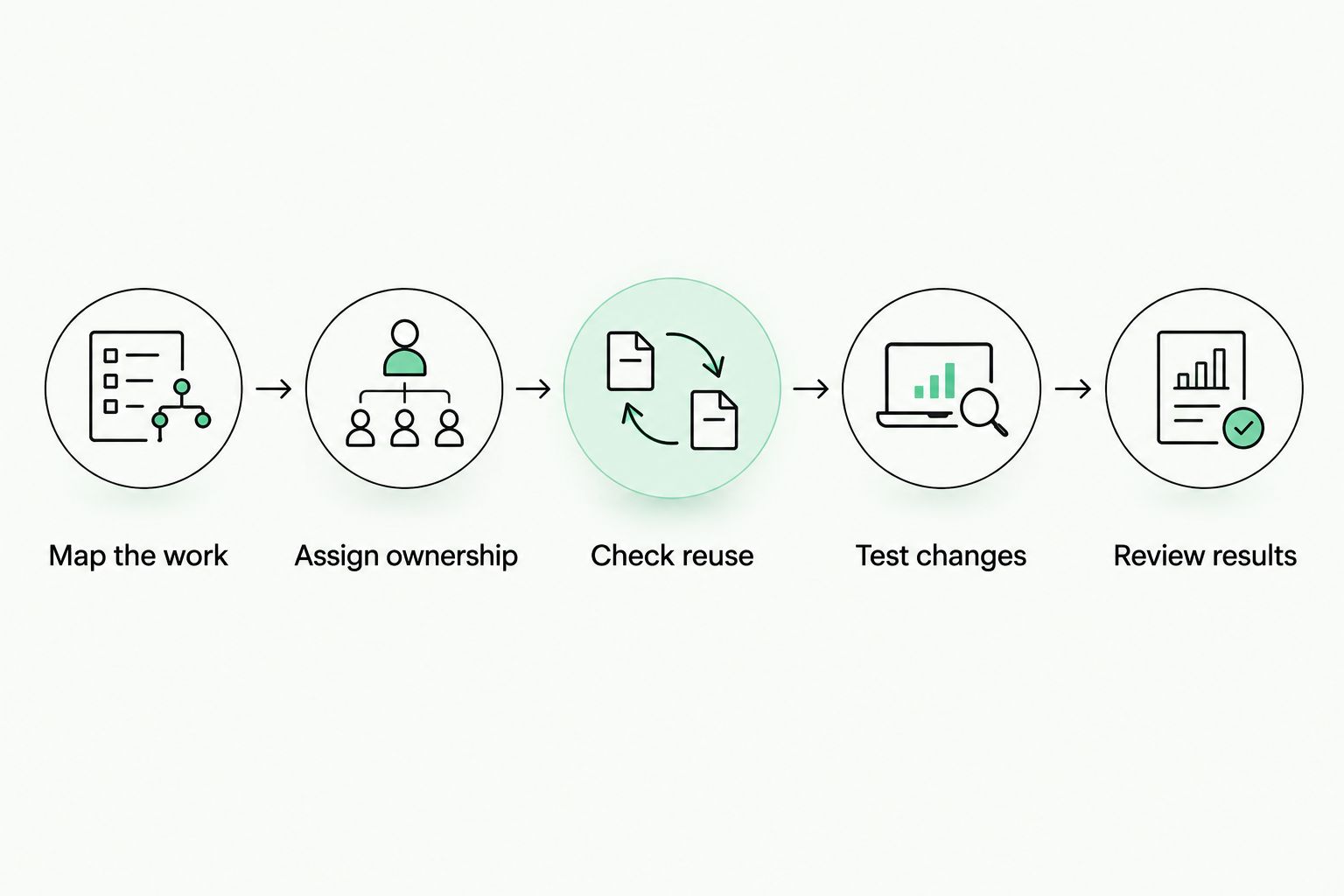
Test source changes as well as the initial translation handoff.
How should you compare the total commitment?
Build the comparison around the same content, languages, and acceptance criteria. Otherwise, one model can appear simpler because it excludes work that another model includes.
For staffing, account for recruitment, onboarding, management, language coverage, and continuity during absences. For software, account for evaluation, configuration, training, administration, and maintenance of reusable assets.
Both models still need translation and review work. Avoid treating that work as eliminated merely because it moves to a different person or system.
Language decisions
- Staffing-focused model: Assigned internal specialists or external reviewers
- TMS-supported model: Assigned specialists or reviewers; software supports the process
Handoffs
- Staffing-focused model: Coordinated through the team's chosen tools
- TMS-supported model: Configured and maintained in the workflow
Reusable translations
- Staffing-focused model: Someone maintains approved assets
- TMS-supported model: Someone governs translation memory and corrections
Continuity
- Staffing-focused model: Coverage for unavailable contributors
- TMS-supported model: Contributor coverage plus system administration
Acceptance
- Staffing-focused model: A named person approves publication
- TMS-supported model: A named person approves publication
Compare complete operating models, not an employee against a software license. Document excluded responsibilities before approving either option.
Can a TMS replace an internal localization manager?
A TMS can support assignments, tracking, and repeatable handoffs, but it does not assume organizational accountability. Someone still decides priorities, resolves disputes, and approves the process.
Whether that requires a dedicated internal manager depends on your workload and responsibilities. Assign ownership first; decide the staffing arrangement second.
Should you hire translators before implementing a TMS?
Hire translators first when missing language expertise is preventing you from producing or approving content. Evaluate software first when qualified contributors already exist but coordination is obstructing their work.
If both problems exist, define the workflow and required expertise together. Neither purchase fixes the other gap automatically.
Is a TMS useful if you already have an internal team?
A TMS is useful when an internal team needs structured coordination, translation reuse, or quality management. It is not automatically useful simply because the team exists.
For a 2026 evaluation, ask internal specialists to identify the repetitive tasks they want removed. Test those tasks against the proposed system before changing the working process.
FAQ
Is an in-house localization team worth it versus a TMS?
An in-house localization team is worth it when you need recurring language judgment and accountability; a TMS addresses workflow organization and automation. Choose based on the bottleneck, or combine them when both needs exist.
Can I use a TMS without hiring internal translators?
Yes, a TMS can support a workflow involving external translators and reviewers. You still need someone responsible for briefs, terminology decisions, and final approval.
Does translation memory remove the need for review?
No, translation memory provides reusable translations rather than a guarantee of suitability. Review reused wording against its current context and source meaning.
What should an internal localization lead own?
An internal localization lead should have explicitly assigned responsibility for language decisions and the approval process. Define ownership of terminology, source questions, review disputes, and publication acceptance.
Is Wxrks a replacement for a localization team?
Wxrks is a translation management system, not a replacement for accountable language specialists. It supports workflow automation, translation memory, quality management, and cost tracking.
How do I compare staffing and software fairly?
Compare staffing and software against the same workload and acceptance criteria. Include implementation, management, review, maintenance, and responsibilities left outside each proposal.
What should I test in a localization workflow evaluation?
Test the complete route from source preparation to publication, including a later source change. Check ownership, context, reusable translations, review decisions, and unresolved handoffs.
One last thing
Test a correction, not just a first translation. Ask who approves it, where the approved wording is stored, and what happens when the same text appears again.
That exercise connects staffing and software to the same outcome: a decision someone owns and a process that preserves it. Make that your acceptance test before committing to either model.
Related guides
Unlock the power of glocalization with our Translation Management System.
Unlock the power of
with our Translation Management System.