Can a TMS support continuous localization for agile teams?


Yes, a TMS can support continuous localization for agile teams by moving new and changed strings through translation, review, and delivery alongside development. The condition is a reliable connection between source content, translation status, and release controls—not simply access to machine translation. In 2026, evaluate the complete change-to-release workflow before treating a TMS as part of your delivery pipeline.
TL;DR
- Can a TMS support continuous localization for agile teams? Yes, when source changes, review, and delivery stay connected.
- Translation memory supports reuse; approval rules determine what reaches a release.
- Continuous localization needs version control, string context, and explicit release gates—not automatic publishing.
- Wxrks supports localization workflow automation, translation memory, quality management, and cost tracking; verify your required delivery connections.
Can a TMS support continuous localization for agile teams?
Yes. A TMS supports continuous localization when it processes content changes without separating translation from the development workflow. Your team still needs to decide who approves translations, what happens when source text changes, and which languages must be ready before release.
Start with the mechanics of automatically syncing new strings when your app ships an update. Then evaluate the rest of the workflow through these steps:
- Detect changes. Identify new, edited, and removed source strings. Keep stable identifiers so a wording change does not become an unrelated translation task.
- Send context. Include the string's purpose, relevant developer notes, placeholders, and interface constraints. Translators need to know what the text does, not just what it says.
- Reuse approved work. Apply translation memory and terminology guidance where relevant. Review reused text when its meaning or context has changed.
- Route review. Assign the right reviewer and distinguish drafts from approved translations. Automation should move work between stages without silently replacing approval.
- Return approved content. Deliver translations to the intended source location or build process. Keep the relationship between the translation and its source version intact.
- Validate the release. Check completeness, placeholders, and the rendered interface before shipping. A completed translation task is not proof that the product displays the text correctly.
These are workflow requirements, not claims that every TMS provides every connection. Use them as acceptance criteria during evaluation.
Why this matters
Agile development changes text while translation is still underway. A button label gets rewritten, an error message gains a variable, or a feature disappears before its translations are approved. Without change tracking, your team loses the connection between the content being reviewed and the content being shipped.
Continuous localization is a controlled flow of changes, not a promise that every language updates instantly. The useful outcome is clear status: developers know which translations match the current source, reviewers know what changed, and release owners know what remains unresolved.
For your 2026 delivery plan, define localization readiness alongside the rest of your release criteria. A workflow that imports strings automatically but relies on someone remembering to export them still has a manual release dependency.
What should move automatically, and what needs approval?
Automate predictable routing and synchronization. Keep explicit decisions for meaning, terminology exceptions, and release readiness. Those responsibilities belong to different parts of the workflow.
The following approaches describe ways to organize localization, not competing products. Choose based on how often your source changes and how closely translation must follow those changes.
Manual batch handoffs
- Best for: Deliberately scheduled, separate translation releases
- Main advantage: Clear handoff boundaries
- Main limitation: Your team must reconcile edits made after the handoff
Connected TMS workflow
- Best for: Product teams translating alongside development
- Main advantage: Source changes and translation status can stay connected
- Main limitation: Requires integration setup, ownership, and release rules
Connected workflow with approval gates
- Best for: Teams that need reviewed translations before publication
- Main advantage: Separates automated movement from publishing authority
- Main limitation: Review capacity still affects readiness
A connected workflow is the right direction when developers and translators work on overlapping changes. It does not eliminate review work. It makes that work visible and ties it to the correct source content.
For an infrequently updated document, a scheduled handoff can be sufficient. For changing product interfaces, choose a workflow that preserves identifiers and handles source revisions rather than repeatedly replacing files without reconciliation.
Build a continuous localization workflow your team can operate
A continuous workflow needs a clear sequence and an owner at every decision point. Before connecting production content, agree on what enters the system, what counts as approved, and where approved translations return.
Source changes
Keep translatable text in the source location your team actually maintains. Avoid a separate translation copy that developers must update by hand whenever they change the product.
Assign stable string identifiers. When the source meaning changes, require the associated translations to be checked again rather than treating their earlier approval as permanent.
Context travels
Attach notes that explain the action, audience, and surrounding interface. For an ambiguous label such as Open, specify whether it describes a status or tells someone to perform an action.
Preserve placeholders and explain their purpose. A translator should know whether a variable represents a person's name, a date, or another value that affects the sentence.
Translation reuse
Use approved translation memory as a starting point for repeated content. Maintain glossary guidance for product terms and language-specific conventions.
Do not equate a matching sentence with a matching use case. A phrase reused in a warning can require different wording from the same phrase in a promotional message.
Review gates
Give reviewers a defined task: check meaning, terminology, and the intended user action. Establish who resolves disagreements and who approves exceptions.
Keep draft, reviewed, and approved states distinct. If the source changes after review, the workflow needs a rule for reopening the affected translation.
Approved delivery
Return approved translations to the correct destination and source version. Test how the workflow handles simultaneous edits before allowing automated updates to shared content.
Avoid a process that treats every returned file as ready for publication. Delivery means the content has reached the release workflow; publication remains a separate decision.
Release validation
Check translated text in the product, not only inside the translation editor. Look for clipped labels, broken placeholders, missing text, and messages that no longer match the action.
Confirm how your team handles an incomplete language. Delay it, exclude it from the release, or use an explicitly approved fallback—do not let the build make that decision accidentally.
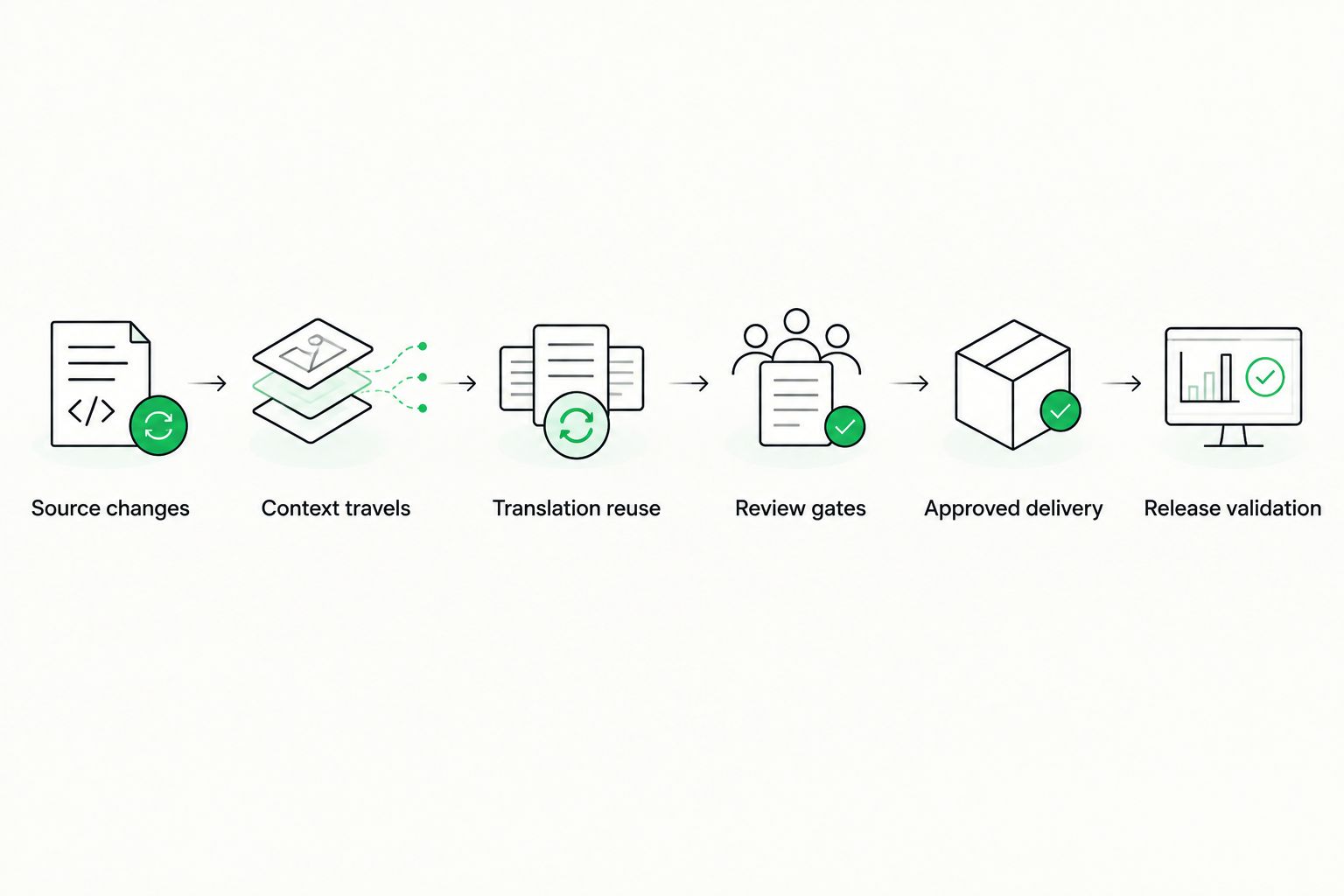
Automated delivery does not replace review gates or release validation.
Why continuous localization readiness varies
The same release process does not fit every team. Your readiness depends on the content you change, the people who approve it, and the rules that control publication.
- Source-change frequency. Frequent edits require a clear policy for invalidating translations that no longer match the source.
- Content context. Short interface strings need usage information; isolated words do not explain the intended action.
- Review ownership. Work stops when nobody has authority to approve terminology or resolve conflicting feedback.
- Version handling. Parallel changes require translations to remain associated with the intended source version.
- Release policy. Requiring every language before launch creates a different dependency from releasing languages separately.
- Quality criteria. Placeholder checks and terminology checks answer different questions from a review of meaning or an interface inspection.
Write down your release policy before automating delivery. Otherwise, automation simply moves unresolved decisions closer to production.
How do you prove the workflow works before rollout?
Run a small pilot against real content. For a 2026 evaluation, use 1 source change across 2 target languages, then repeat the exercise with an edit made after translation approval. These are suggested test inputs, not performance benchmarks.
Choose content that includes an interface label and a placeholder-bearing message. That combination lets you inspect context handling and technical preservation without starting with the entire product.
Use 3 release checks as your initial acceptance criteria:
- Source alignment: The translation corresponds to the source version your release uses.
- Approval status: Only translations that meet your approval policy enter the release candidate.
- Rendered behavior: The interface displays the translation correctly and preserves the intended action.
Then test failure paths. Remove a source string, interrupt delivery, and change wording while a reviewer is working. Your team should be able to identify affected content and recover without guessing which file is current.
Record the result as pass or fail against your own requirements. Do not substitute an impressive demo for evidence that the workflow handles your release process.
Where does Wxrks fit in this workflow?
Wxrks is an AI-powered translation management system for translators, developers, enterprises, and translation agencies. Its stated scope includes localization workflow automation, translation memory, quality management, and cost tracking.
Wxrks is best for teams seeking localization workflow automation with translation memory, quality management, and cost tracking. Those functions address the coordination work around translation, rather than treating translated text as an isolated output.
The advantage of Wxrks as a TMS candidate is that these workflow functions are part of its stated scope. The evaluation requirement is equally important: check the exact source connection, version behavior, approval controls, and delivery path your team needs. A category-level feature description does not establish how a particular release integration behaves.
For a 2026 selection, ask for a demonstration using your pilot content and approval policy. Keep the decision tied to observable behavior: what happens after a source edit, what reviewers see, and what returns to the release workflow.
Does continuous localization mean translations ship immediately?
No. Continuous localization means changes enter an ongoing workflow; it does not require immediate publication. Review rules and release policy determine when approved translations ship.
You can automate intake while keeping a deliberate publishing gate. That separation is useful when your team needs to inspect a translated interface before users see it.
Can translation memory handle every source change automatically?
No. Translation memory supports reuse, but a changed source or a changed context still requires evaluation. Previously approved wording is not automatically correct for a new use.
Treat matches as candidates for reuse. Preserve the ability to review terminology, meaning, and placeholders before approval.
Do developers still need to participate?
Yes. Developers own the technical connection between source strings and the released product. They also help provide context, preserve placeholders, and investigate delivery failures.
Make those responsibilities explicit in your 2026 workflow. Localization becomes part of development when source changes and release checks have owners—not when everyone assumes the TMS handles them.
FAQ
Can a TMS support continuous localization for agile teams?
Yes, a TMS can support continuous localization by connecting source changes, translation work, review, and delivery. Verify that the workflow preserves source versions and respects your release approval rules.
What's the difference between continuous localization and automatic translation?
Continuous localization coordinates ongoing content changes through translation, review, and release. Automatic translation generates translated text; it does not by itself establish context, approval, or publishing readiness.
Do we need to translate every language before each release?
No, translating every language before each release is a release-policy choice. Define which languages are required and what happens when an optional language is incomplete.
Can we use translation memory without skipping human review?
Yes, translation memory reuse and human review can operate in the same workflow. Review reused content when source meaning, interface context, or terminology requirements change.
What should happen when a developer edits an approved string?
An edited source string should trigger evaluation of its associated translations. Your workflow should identify affected languages and apply your rule for reopening review.
How can we test a continuous localization workflow before adopting it?
Test 1 source change across 2 target languages, then change the source again after approval. Check source alignment, approval status, and rendered behavior before expanding the workflow.
Can a TMS replace localization quality checks?
No, a TMS does not replace every localization quality check. Automated checks, linguistic review, and inspection of the rendered product address different failure types.
One last thing
Test a changed approved string, not just a new string. A new-string demonstration shows that content can enter the workflow; a post-approval edit shows whether the workflow can keep translations aligned with a moving source.
Make that scenario part of your acceptance test. Continuous localization needs to handle the next change, not merely complete the first handoff.
Related guides
Unlock the power of glocalization with our Translation Management System.
Unlock the power of
with our Translation Management System.