Is a translation management system GDPR compliant in 2026?


A translation management system can support GDPR-compliant processing in 2026, but using one does not make your localization workflow compliant automatically. Your lawful basis, processor contracts, access controls, retention rules, and international transfers must cover the personal data handled throughout translation, including translation memory and external AI services.
TL;DR
- Is a translation management system GDPR compliant? Only when its contracts, configuration, and actual processing meet GDPR requirements.
- Wxrks supports translation workflow automation; assess GDPR requirements separately before uploading personal data.
- Translation memory, translator access, and external AI services belong inside your privacy assessment.
- EU hosting alone does not establish GDPR compliance or resolve every international-transfer question.
Why this matters
Translation creates additional places where personal data can live: source documents, translated files, reviewer comments, reusable segments, and exports. Removing a name from the final document does not remove it from every intermediate record.
Wxrks provides translation management software for workflow automation, translation memory, quality management, and cost tracking. Those functions describe what the software does, not whether a particular deployment meets your legal obligations.
Approve the processing workflow, not just the vendor. For your 2026 review, trace personal data from upload through deletion, including every person and external service that receives it. This is practical procurement guidance, not a substitute for legal advice on your processing.
Is a translation management system GDPR compliant in 2026?
A TMS supports GDPR compliance when the organization using it establishes lawful processing and the provider meets the obligations applicable to its role. No hosting location, security feature, or contract establishes compliance by itself.
The GDPR provides the legal basis for this assessment. For a 2026 procurement review, the relevant provisions include Article 5 on processing principles, Article 28 on processors, Article 32 on security, and Chapter V on international transfers.
Processing roles
- Evidence to request: Documented controller and processor responsibilities
- What it establishes: Who decides purposes and who follows instructions
Processor contract
- Evidence to request: Agreement covering Article 28 requirements
- What it establishes: Binding obligations for outsourced processing
Security
- Evidence to request: Documented technical and organizational measures
- What it establishes: How protection addresses the processing risks
Subprocessors
- Evidence to request: Current list and authorization procedure
- What it establishes: Which downstream providers process personal data
Retention
- Evidence to request: Rules for files, memories, logs, and backups
- What it establishes: How long different copies remain
International transfers
- Evidence to request: Locations, recipients, and applicable safeguards
- What it establishes: Whether restricted transfers have a lawful mechanism
A signed processor agreement is necessary where Article 28 applies, but it is not the whole assessment. You still need an appropriate lawful basis, transparent information for individuals, and a workflow that follows the documented rules.
Map personal data
Start with the content, not the software settings. Identify names, contact details, account references, employee information, and any special-category data in the material you translate.
Determine whether GDPR applies to the processing. Article 3 addresses territorial scope; a US business is not automatically outside GDPR simply because its headquarters are outside Europe.
Assign processing roles
Your organization usually acts as controller when it decides why customer or employee documents need translation. A TMS provider acts as processor when it processes that personal data on your behalf under your instructions.
Roles depend on actual activities. A translation agency can be a processor for client documents while acting as controller for its own staffing records. Do not use a single label to describe unrelated processing.
Review processor terms
Check that the processor agreement addresses documented instructions, confidentiality, security, assistance with individual rights, subprocessors, and the return or deletion of data. Article 28 also addresses information and audit obligations needed to demonstrate compliance.
Examine terms covering external translation engines separately. Establish whether submitted content is retained, used for model training, or processed for another purpose, and assess those activities rather than assuming the TMS contract covers everything.
Test access controls
Request evidence of how access is restricted and removed. Then test the proposed workflow with synthetic documents rather than real customer records.
Check what translators, reviewers, administrators, and support personnel can see. A project restriction is insufficient if the same personal data remains searchable through a shared translation memory.
Verify deletion
Test deletion across the source file, translated output, comments, translation memory, exports, and connected services. Ask how backups are handled, including restoration procedures and scheduled expiry.
Deletion does not always mean immediate removal from every backup. The provider must explain the retention and protection arrangements so you can assess whether they meet your obligations.
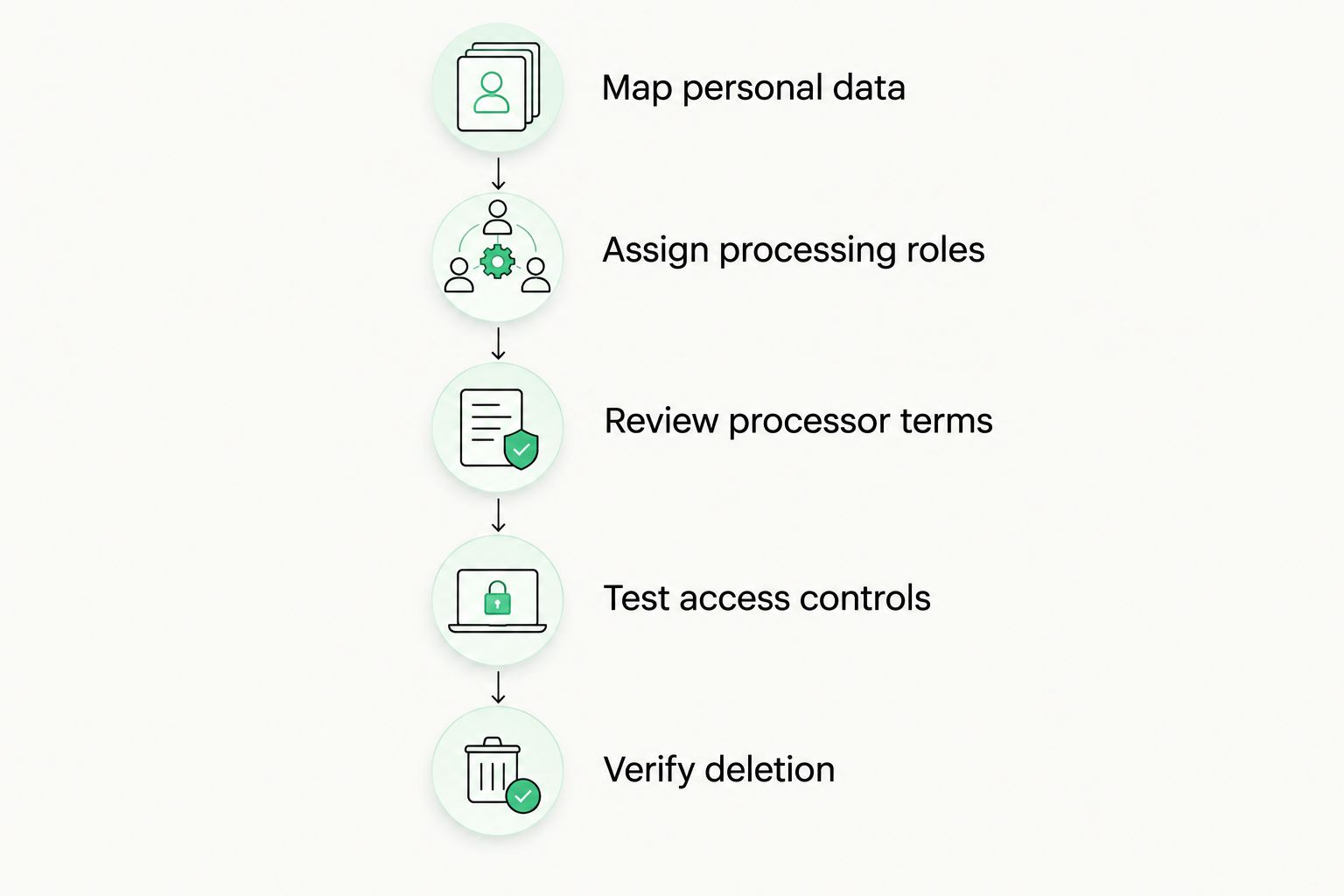
Review the entire processing path before approving personal data for translation.
Cloud TMS: assess the provider and every downstream recipient
A cloud TMS places infrastructure operations with the provider, while your organization retains responsibility for its own processing decisions. The benefit is centralized service administration; the limitation is dependence on the provider's contractual commitments and operational evidence.
Best for teams that want provider-managed infrastructure and can approve the processing chain. Ask where content is stored, where support personnel access it, and which services receive it for translation or analysis. Do not treat a storage-region setting as a complete answer.
Self-hosted TMS: assess your own operating responsibilities
A self-hosted TMS gives your organization direct responsibility for operating the environment. That can provide more control over deployment, but it also places patching, access administration, monitoring, and backup management with your team.
Best for teams equipped to operate and secure their own environment. Self-hosting does not remove privacy obligations or prevent transfers through connected services.
Cloud TMS
- Best for: Teams seeking provider-managed infrastructure
- Benefit: Provider operates the hosting environment
- Limitation: Requires assessment of provider practices and downstream processing
Self-hosted TMS
- Best for: Teams with internal operating capability
- Benefit: Direct control over the deployment environment
- Limitation: Organization must maintain and secure the environment
Neither deployment model is automatically more compliant. Choose the arrangement whose responsibilities your organization can meet and verify.
Why GDPR requirements vary between translation workflows
Your 2026 assessment should follow the content and processing risks, rather than apply the same approval to every project. These factors change the questions you need to answer:
- Data sensitivity: Health information and other special-category data require an Article 9 condition in addition to an Article 6 lawful basis.
- Processing purpose: Translating a document for its original business purpose differs from reusing its contents for unrelated model training.
- Access scope: External translators, reviewers, administrators, and support personnel create different access requirements.
- Memory reuse: Shared translation memory can expose a segment outside the project where it originated.
- Recipient locations: Storage, external processing, and access from other countries affect the transfer assessment.
- Retention needs: Source files, reusable segments, logs, and backups need justified retention arrangements rather than one indefinite default.
A data protection impact assessment is required where processing is likely to result in a high risk to individuals' rights and freedoms. Article 35 sets that threshold; using AI does not automatically establish or remove the requirement.
Does EU hosting make a TMS GDPR compliant?
EU hosting does not make a TMS GDPR compliant. Storage location addresses only part of the processing arrangement, and GDPR obligations still apply to contracts, security, transparency, rights, and retention.
Remote access by a separate recipient outside the EEA can also raise international-transfer requirements. Identify the recipient and transfer arrangement before choosing the applicable mechanism; standard contractual clauses are not a substitute for assessing the transfer and any necessary supplementary measures.
Can translation memory contain personal data?
Translation memory can contain personal data. A stored source-and-target segment can preserve a customer's name, an employee's circumstances, or an account reference after the original translation project ends.
Keep sensitive projects out of broadly shared memories unless you have established appropriate controls and a lawful purpose. The guide to translation memory software for freelancers explains the reuse model; apply privacy controls to that reuse, not just to document storage.
Can AI translation be used with personal data in 2026?
AI translation can be used with personal data when the processing meets applicable GDPR requirements. Check instructions, recipients, retention, training use, and transfer arrangements before enabling an external engine.
Removing direct identifiers reduces exposure but does not necessarily anonymize the content. GDPR still applies to pseudonymized data where an individual remains identifiable using additional information.
What response deadlines should your workflow support?
A TMS workflow must support your organization's applicable response obligations, not merely provide a support inbox. Under Article 12, controllers generally respond to rights requests without undue delay and within 1 month of receipt.
That period can be extended by 2 further months where necessary because of the request's complexity and number. The controller must inform the individual of the extension and reasons within the initial month; an extension is not a routine default.
Under Article 33, a controller must notify the competent supervisory authority of a personal data breach without undue delay and, where feasible, within 72 hours of awareness, unless the breach is unlikely to risk individuals' rights and freedoms. A processor must notify the controller without undue delay after becoming aware of a personal data breach; the processor does not receive the controller's 72-hour deadline as a default allowance.
Ask how the provider helps locate affected records and investigate incidents. Your internal escalation route must work alongside the provider's process.
How should you assess Wxrks for a translation workflow?
Wxrks is best suited to teams seeking translation workflow automation, translation memory, and quality management. That product fit is separate from approval to process personal data.
Evaluate Wxrks translation management software against the same evidence checklist as any other TMS. Record the intended content, approved recipients, required controls, retention rules, and outstanding contractual questions before authorizing production use.
FAQ
Is a translation management system GDPR compliant by default?
No, a translation management system is not GDPR compliant by default. Compliance depends on the processing purpose, lawful basis, contracts, security measures, recipients, and actual configuration.
Do I need consent before translating a customer's document?
Consent is not the only possible lawful basis for translating personal data. Identify the appropriate Article 6 basis and, for special-category data, an applicable Article 9 condition before processing.
Is a data processing agreement enough to approve a TMS?
No, a data processing agreement does not establish compliance on its own. Verify that the processing, security measures, subprocessors, transfers, and retention arrangements match the agreement and your obligations.
Does GDPR apply if my translation team is in the United States?
A US translation team can fall within GDPR's scope. Assess the processing under Article 3 and separately review any applicable international-transfer requirements.
Can I keep translated documents forever for future reuse?
You cannot retain personal data indefinitely merely because future reuse might be useful. Establish a justified retention period or criteria, and apply them to documents and translation memory.
Does encryption remove the need for a GDPR assessment?
No, encryption does not replace a GDPR assessment. It is a security measure, while lawful basis, transparency, processor obligations, individual rights, and transfer requirements remain relevant.
How should I check Wxrks before uploading personal data?
Assess Wxrks against your documented processing requirements before uploading personal data. Review processor terms, downstream recipients, access controls, retention, deletion, and transfer arrangements for the intended workflow.
One last thing
Translation memory can outlive the document that created it. For your 2026 approval test, place a synthetic personal-data marker in a sample document, translate it, and follow it through files, comments, memory, and exports.
Then test removal. A workflow that cannot explain where that marker remains is not ready for personal data, regardless of how reassuring its security summary sounds.
Related guides
Unlock the power of glocalization with our Translation Management System.
Unlock the power of
with our Translation Management System.