How to connect Jira to wxrks for localization ticket sync


Instead of copying localization requests and progress updates between Jira and Wxrks, connect ticket intake to translation work and return only the milestones your delivery team needs. To connect Jira to Wxrks, first confirm a supported connection method, then map ticket identifiers, language requirements, source revisions, and approved completion states before enabling automation.
TL;DR
- To connect Jira to Wxrks, confirm the connection method before configuring ticket sync.
- Keep Jira responsible for delivery tracking and the translation management system responsible for localization work.
- Start with request intake and completion updates; expand only after duplicate and revision tests pass.
- Translation memory and quality management belong in the localization workflow, not duplicated ticket fields.
Why this matters
A localization ticket is not the translated deliverable. Jira records what a release needs; a translation management system coordinates the language work. Confusing those responsibilities creates tickets that look complete while translations still need review.
Wxrks is best for teams that need translation workflows, translation memory, quality management, and cost tracking in a translation management system. Keep those activities in Wxrks rather than rebuilding them as ticket comments.
For your 2026 setup, choose the narrowest sync that answers a delivery question:
Request intake
- Best for: Teams handing approved requests to localization
- Benefit: Reduces repeated request entry
- Limitation: Does not return progress automatically
Intake plus milestones
- Best for: Teams coordinating multilingual releases
- Benefit: Keeps delivery tracking aligned with translation progress
- Limitation: Requires explicit status mapping
Content and milestone sync
- Best for: Teams handling frequent source changes
- Benefit: Connects revisions with translation work
- Limitation: Requires stronger revision and conflict controls
Start with intake plus milestones. Add content synchronization only when the source location and revision rules are settled.
Before you start
- Access: Have permission to configure the relevant Jira project and access the destination translation workspace. Confirm the supported authentication method and required permissions with the administrators responsible for each system.
- Connection contract: Establish whether the implementation uses a supported connector or a custom integration. For a custom integration, obtain documented interfaces, authentication requirements, event behavior, and a secure place to store credentials before building anything.
- The gotcha: A Jira ticket moving to a completed state does not prove every requested language passed review. Define the completion rule and source-revision ownership before allowing either system to update the other.
Treat this as an implementation blueprint, not a promise that a particular connector or menu exists. Do not substitute a guessed endpoint or an undocumented setting for a supported connection method.
Choose a test project without production-sensitive content. Use 1 test ticket and 2 target locales to expose partial-completion behavior before a real release depends on the connection.
Request intake configuration
The intake configuration decides which tickets become translation requests. Keep the scope small enough that a routine engineering update cannot accidentally launch localization work.
- Choose the intake event. Use an agreed request-ready transition or another deliberate event supported by your connection method. Avoid treating every ticket edit as a new request.
- Define the eligibility conditions. Restrict processing to the intended project and request category. If your team uses Jira's Labels field to identify localization work, require the agreed label before sending anything.
- Specify the source location. Put the request context in Description, but identify the authoritative source separately: a controlled file, repository revision, or other approved source reference.
- Require the request essentials. Capture source language, target locales, source reference, delivery owner, review owner, and acceptance criteria. These are proposed data requirements, not assumed built-in destination fields.
- Route incomplete requests back to intake. Explain which information is missing instead of creating translation work with defaults that nobody approved.
Expected result: An eligible ticket produces a complete request payload; an unrelated or incomplete ticket produces no translation request.
For your 2026 pilot, make the first test deliberately incomplete. A connection that rejects a request without target locales is safer than one that quietly guesses them. Then fill in the missing information and confirm that the same ticket becomes eligible without creating parallel requests.
Identifier and field mapping
The identifier mapping connects the business request to its translation work. Titles help people recognize a task; stable identifiers help software distinguish it from another task with the same title.
- Preserve the Jira identity. Store the originating project and ticket identifier in the integration's correlation record. Do not rely on Summary as a unique lookup value.
- Record the destination identity. After successful creation or association through the supported interface, retain the returned work identifier alongside the Jira reference.
- Map fields by meaning. Keep request context, language requirements, source references, and deadlines distinct. Do not pack everything into an unstructured description if the supported interface exposes appropriate fields.
- Preserve locale precision. Use the same agreed locale identifiers throughout the workflow. Do not silently collapse regional variants into a broader language name.
- Make repeated delivery safe. Before creating work, check whether that ticket and source revision already have an associated request. Repeated events should update or acknowledge the existing association rather than create another job.
Expected result: You can trace a ticket to the correct translation request and trace that request back without searching by title.
Keep a mapping document with the source field, destination meaning, transformation rule, and owner. The document is part of the connection: when a project changes its intake fields, the integration owner needs to know which mappings require an update.
Completion and exception mapping
A useful status sync translates meaning, not just names. Translation finished, reviewer approved, and deliverable accepted are different milestones even when your Jira workflow has fewer states.
- Assign authority. Let Jira own release planning and the translation workflow own language-work progress. Choose which side owns each shared field; avoid unrestricted writes in both directions.
- Define milestone meanings. Document what request accepted, work underway, review required, and deliverable accepted mean in your process. These are mapping concepts, not claimed product status labels.
- Define the all-locale rule. Decide whether a parent ticket waits for every requested locale or whether separate child work tracks each locale. Make partial completion visible.
- Keep exceptions open. Missing context, failed quality checks, and source changes need an explicit owner. Do not turn an exception into a completed ticket merely because translation output exists.
- Apply supported updates only. Confirm that the integration identity can perform the intended Jira change and that required fields and workflow conditions are satisfied.
Expected result: Delivery stakeholders see meaningful progress, and a partially reviewed multilingual request cannot appear fully accepted.
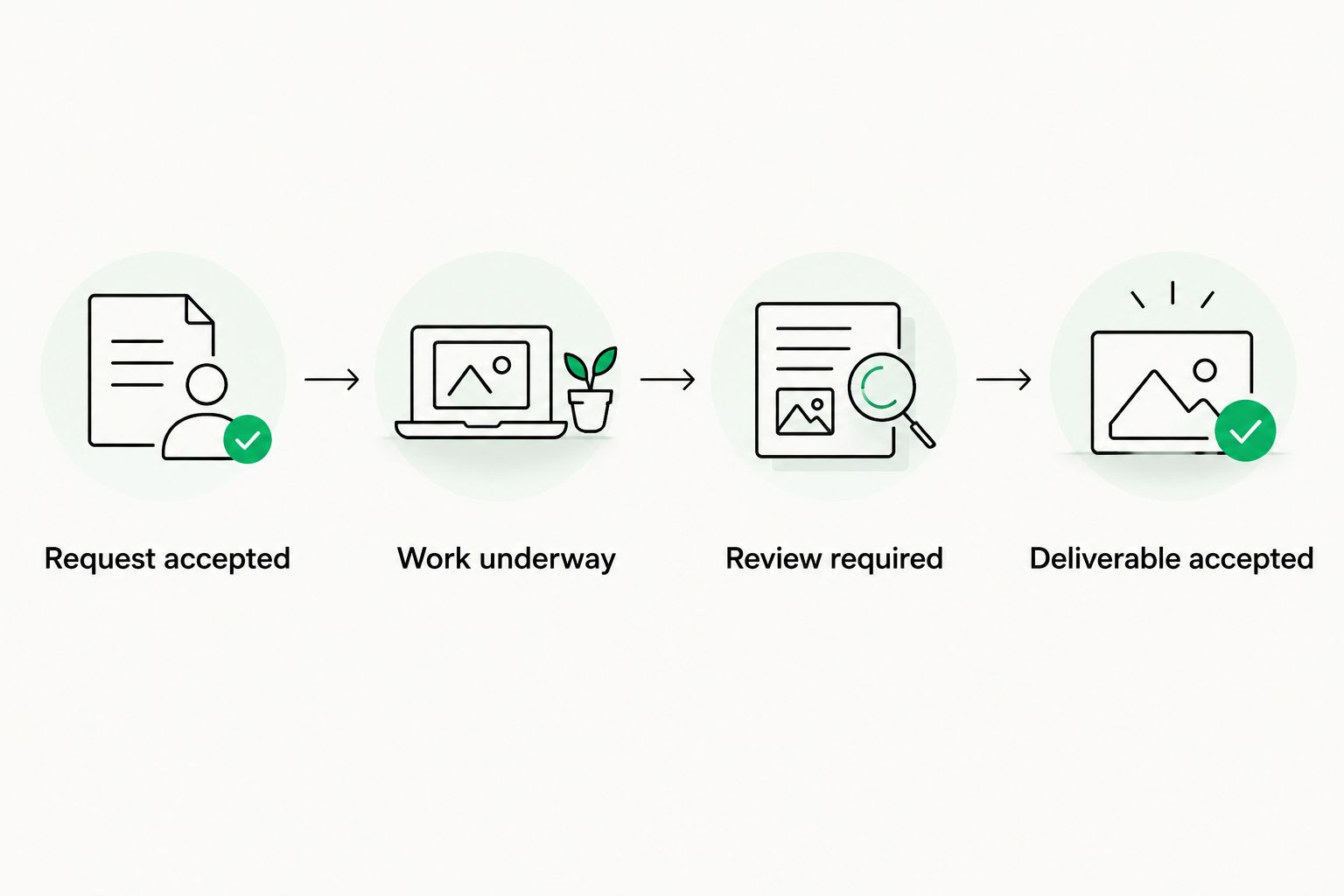
Map acceptance separately from translation completion so delivery tracking reflects review.
Keep the 2026 status map short. Every additional synchronized milestone creates another transition to explain, test, and maintain. If a milestone does not change anyone's next action, leave it in the translation workflow rather than copying it into Jira.
Pilot tests and activation
Test the connection as a delivery process, not just an authentication handshake. A successful request proves connectivity; it does not prove safe synchronization.
- Submit the test request. Confirm that the selected source revision, language requirements, and originating ticket identity arrive together.
- Replay the intake event. Send the same eligible event again through your test mechanism. Confirm that the association remains unchanged and no duplicate request appears.
- Complete one locale. Leave the other locale awaiting review. Confirm that the parent ticket remains short of full acceptance under your chosen completion rule.
- Exercise 3 event cases. Test a new request, a repeated event, and an older update arriving after a newer update. Record the expected outcome before executing each case.
- Check failure visibility. Make a test request invalid, confirm that an owner can find the failure, and verify that retrying does not duplicate successful work.
- Activate a limited scope. Enable one agreed project or request category, assign an operational owner, and retain a clear way to pause outgoing updates.
Expected result: The pilot demonstrates correct creation, repeat handling, partial completion, and recoverable failure before broader activation.
Record the approved configuration as your 2026 baseline. Include permissions, field mappings, milestone meanings, test outcomes, and the person responsible for changes. Store credentials separately in the approved secret store, not in the configuration document or ticket comments.
Variant: update localization when source content changes
Use revision-aware updates when an approved source changes after localization begins. Do not reopen every translation request whenever a ticket description changes. Administrative edits and source edits are different events.
- Identify the authoritative source revision associated with the existing request.
- Compare the incoming revision with the recorded revision before applying an update.
- Identify the affected content and locales, then route the change through the supported update method.
- Require review of changed material before returning the request to an accepted milestone.
- Keep the revision history attached to the correlation record so an older event cannot replace newer work.
For product teams, software localization workflows need to coordinate source changes, linguistic review, and release acceptance; ticket synchronization should preserve those boundaries rather than flatten them into a single completed flag.
The benefit is continuity: the request retains its identity as the source changes. The trade-off is stricter revision management. Use this variant only after the intake and milestone workflow passes its pilot tests.
Troubleshooting
A repeated event creates duplicate translation work
Check whether creation uses a stored correlation record or a title search. Replace title matching with the originating ticket identity and source revision, and protect the create operation against simultaneous processing. Retest by replaying the same event before enabling further intake.
The Jira ticket closes before every locale passes review
Inspect the completion rule. A single locale-completed event must not satisfy an all-locale acceptance requirement. Aggregate the required locale outcomes and keep review acceptance separate from translation output generation.
Updates fail despite successful authentication
Check the integration identity's project access, required fields, and permission to perform the intended transition. Authentication establishes identity; it does not grant every project action. Inspect the returned error and repair the specific permission or validation failure instead of repeatedly resending the request.
Status updates bounce between systems
Inspect whether each incoming update generates an equivalent outgoing update. Assign a single owner for each shared field, suppress unchanged values, and record event origin. Pause the return path while fixing the loop so repeated writes do not bury meaningful activity.
An older source revision replaces newer work
Compare the incoming revision against the stored accepted revision before processing. Route out-of-order events to a visible exception rather than applying them automatically. Then investigate the event ordering and retry behavior of the chosen connection method.
Customize your workflow
Once ticket sync behaves correctly, expand the context before expanding the automation. Add approved terminology references, audience details, screenshots where appropriate, and clear review ownership to the request template.
Wxrks supports translation memory and quality management; ticket synchronization should coordinate handoffs without moving those responsibilities into Jira. Use translation quality measurement to define acceptance criteria that distinguish a completed translation task from an accepted deliverable.
For your next 2026 iteration, review exceptions before adding more triggers. Repeated missing-context failures call for a better intake template. Repeated source-revision conflicts call for clearer ownership. Neither problem is solved by copying more ticket fields.
Expand one boundary at a time: another project, another content source, or another milestone. Keep each change independently testable and reversible.
FAQ
How do I connect Jira to Wxrks for localization ticket sync?
Confirm a supported connection method, then configure request eligibility, stable identifiers, field mappings, and completion rules. Test duplicate events, partial locale completion, and source revisions before enabling production updates.
Can I assume there is a native Jira connector?
No. Confirm connector support and its exact capabilities before planning the setup; otherwise, establish whether documented interfaces support the proposed custom integration.
Should Jira or the translation system own localization status?
The translation workflow should own language-work progress, while Jira owns delivery tracking. Map selected milestones between them instead of allowing both systems to overwrite every status.
How do I stop duplicate localization requests?
Use a stable ticket identity and source revision to associate events with existing work. Make repeated event processing safe and protect against simultaneous creation attempts.
Should a ticket close when the first language is translated?
No, not when the ticket requires acceptance across all requested locales. Track partial completion and require the agreed review outcome before marking the parent request accepted.
What happens when the source text changes during translation?
Treat the change as a new source revision associated with the existing request. Identify affected content, preserve revision history, and require review before restoring acceptance.
What should I test before enabling localization ticket sync?
Test request eligibility, field mapping, duplicate delivery, partial completion, stale updates, and failure recovery. A successful authentication test alone does not establish a reliable workflow.
One last thing
Test a request that must not complete. Leave a locale unreviewed, submit an older source revision, or remove required context. A connection that creates work is only half proven; the more revealing test is whether it refuses the wrong next step.
Keep that negative test in your regression checks whenever permissions, request fields, or workflow transitions change.
Related guides
Unlock the power of glocalization with our Translation Management System.
Unlock the power of
with our Translation Management System.