How much does professional translation cost per word in 2026?


Professional translation has no universal per-word rate in 2026: the payable rate depends on the language pair, subject matter, review requirements, and delivery scope. A per-word quote alone does not establish whether revision, formatting, project management, or other work is included. Compare complete deliverables, not isolated word rates, before choosing a translator or agency.
TL;DR
- How much does professional translation cost per word? Compare written quotes for the same language pair, scope, and review requirements.
- A translation memory match is reusable material to assess, not an automatic guarantee of finished quality.
- Compare human translation and machine translation post-editing against the same acceptance criteria.
- Wxrks is a translation management system for teams managing localization workflows, quality, and cost tracking.
How much does professional translation cost per word in 2026?
There is no single professional translation rate that applies across languages and projects. Your usable figure is the rate attached to a defined assignment: source language, target locale, content, word-count method, review standard, and delivery requirements.
For a valid comparison, ask each provider to quote against the same source files and instructions. Separate the translation work from additional services so that a lower word rate does not conceal a narrower deliverable.
Word-count basis
- What to establish: Source words or target words; counting method
- Why it changes the comparison: Different counting rules produce different billable quantities
Language pair
- What to establish: Source language and exact target locale
- Why it changes the comparison: A quote for one locale does not define another assignment
Translation scope
- What to establish: Human translation or machine translation post-editing
- Why it changes the comparison: The starting material and work required differ
Review scope
- What to establish: Translator checks, independent revision, final approval
- Why it changes the comparison: These are distinct responsibilities
Reuse treatment
- What to establish: Repetitions and translation memory match categories
- Why it changes the comparison: Not all source words necessarily receive the same treatment
Delivery scope
- What to establish: Translated text, formatted files, or implementation checks
- Why it changes the comparison: The final handoff determines which tasks belong in the quote
If a provider proposes machine translation post-editing, use the guide to machine translation post-editing to frame the workflow discussion. Establish what the editor must deliver before comparing that quote with human translation.
Why this matters
A per-word rate is a unit of measurement, not a quality standard. It tells you little about who checks terminology, who resolves ambiguous source text, or who approves the final file.
That distinction matters when you buy translation in 2026. You need a defined outcome, not merely a translated word count. A quote that includes independent revision and a quote that includes only translation do not describe the same service.
Ask what you receive, who checks it, and what constitutes acceptance. Put those answers in the scope before negotiating the rate. Otherwise, the disagreement arrives after delivery, when revisions and ownership are harder to resolve.
Human translation: best for work requiring original language judgment
Human translation starts with a translator interpreting the source and writing the target text. It is a useful workflow to evaluate when terminology, intent, tone, and audience require deliberate decisions rather than acceptance of an existing draft.
The advantage is direct responsibility for those decisions. The limitation is that hiring a translator does not, by itself, establish independent review, subject expertise, or in-context testing. Specify each requirement rather than treating the word professional as a complete service description.
For your quote, identify the target reader and explain how the text will be used. A support instruction, a product tagline, and an internal reference document require different editorial decisions, even when they contain similar vocabulary.
Best for: content whose meaning and presentation need a translator's judgment from the start. Confirm qualifications, review responsibilities, and acceptance criteria before appointing the provider.
Machine translation post-editing: best for reviewing an existing draft
Machine translation post-editing means a human editor reviews and corrects machine-generated translation. It is a different workflow from translating the source without that draft; it is not a promise that every project takes less work.
Its advantage is a draft that the editor can assess and revise. Its limitation is that incorrect meaning, inconsistent terminology, and awkward phrasing still require attention. A readable sentence can remain inaccurate, so fluency alone is not an acceptance test.
For a 2026 procurement brief, define the required final quality rather than asking only for post-editing. State whether the text must be publication-ready, follow a glossary, preserve formatting, and receive a separate review.
Best for: content with machine-generated output that a qualified editor can assess against clear requirements. Reject a comparison that assumes post-editing and human translation include identical checks without confirming the scope.
Human translation
- Best for: Work needing original language judgment
- Main advantage: Translator makes meaning and wording decisions from the source
- Main limitation: Independent revision is not established by the label
- What to confirm: Expertise, review scope, and final deliverable
Machine translation post-editing
- Best for: Reviewing a machine-generated draft
- Main advantage: Editor has existing target text to assess
- Main limitation: Draft quality does not establish final accuracy
- What to confirm: Output standard, editor responsibilities, and checks
Translation memory reuse
- Best for: Reviewing previously translated material
- Main advantage: Approved wording provides a reference
- Main limitation: A match can be unsuitable in a new context
- What to confirm: Match rules, context checks, and approval status
Translation memory reuse: best for recurring approved content
Translation memory stores source segments alongside their translations for later reuse. It can help a translator find previous wording, but a matching segment still needs the right context.
The advantage is access to earlier language decisions. The limitation is that previous wording can be outdated or wrong for the new use. An unchanged sentence in a different interface, product, or document can require a different interpretation.
Ask the provider to distinguish new text, repetitions, and translation memory matches in the analysis. Then establish how each category will be reviewed and billed. Do not assume that a match label means no work remains.
Best for: recurring content backed by relevant, approved translations. Define who maintains the memory and whether corrected wording will replace obsolete entries after approval.
Why professional translation quotes vary
For a fair 2026 comparison, hold the assignment constant and examine the following drivers. Each one belongs in the brief rather than in an informal conversation after the quote arrives.
- Language pair and locale. Specify both languages and the target audience. A language name alone does not settle regional terminology or conventions.
- Subject matter. Identify technical concepts, specialized terminology, and reference material. The provider needs to understand the assignment before committing to its scope.
- Review requirements. Distinguish the translator's own checks from independent revision and your internal approval. Assign responsibility for resolving disagreements.
- Source condition and file work. Provide the actual files, not just a word count. Text extraction, layout repair, and translated-file checks are separate tasks to define.
- Reuse and repetition. Supply relevant translation memories and glossaries. Agree on match categories and the review expected for reused material.
- Deadline and handoff. State the delivery date, file format, and approval process. Ask the provider to identify any work outside the quoted scope.
These factors explain what to compare; they do not establish a universal rate. The right quote describes the work clearly enough that both sides can tell when it is complete.
How do you calculate the total from a per-word quote?
Calculate the translation subtotal by multiplying each agreed billable word category by its quoted rate, then adding the categories together. Add separately agreed services to understand the full assignment, and keep taxes distinct where applicable.
Do not multiply a headline rate by a word count until you know the counting basis. Source and target word counts are different measures, and extracted text needs checking against the actual files.
Use a comparable quote request
- Source files. Send the same final source package to each provider. Identify text embedded in images or other material outside the main document.
- Target locale. Name the intended market and audience. Include terminology references and instructions for names, measurements, and product language.
- Word analysis. Request the counting basis and a breakdown of new words, repetitions, and memory matches where relevant.
- Review scope. Specify who translates, who revises, who approves, and what checks must happen before delivery.
- Delivery scope. Define file formats, formatting responsibilities, deadline, and the procedure for resolving corrections.
The sequence prevents a common comparison error: evaluating competing rates before establishing whether the providers are quoting the same job. Keep the written brief with the quote so changes remain traceable.
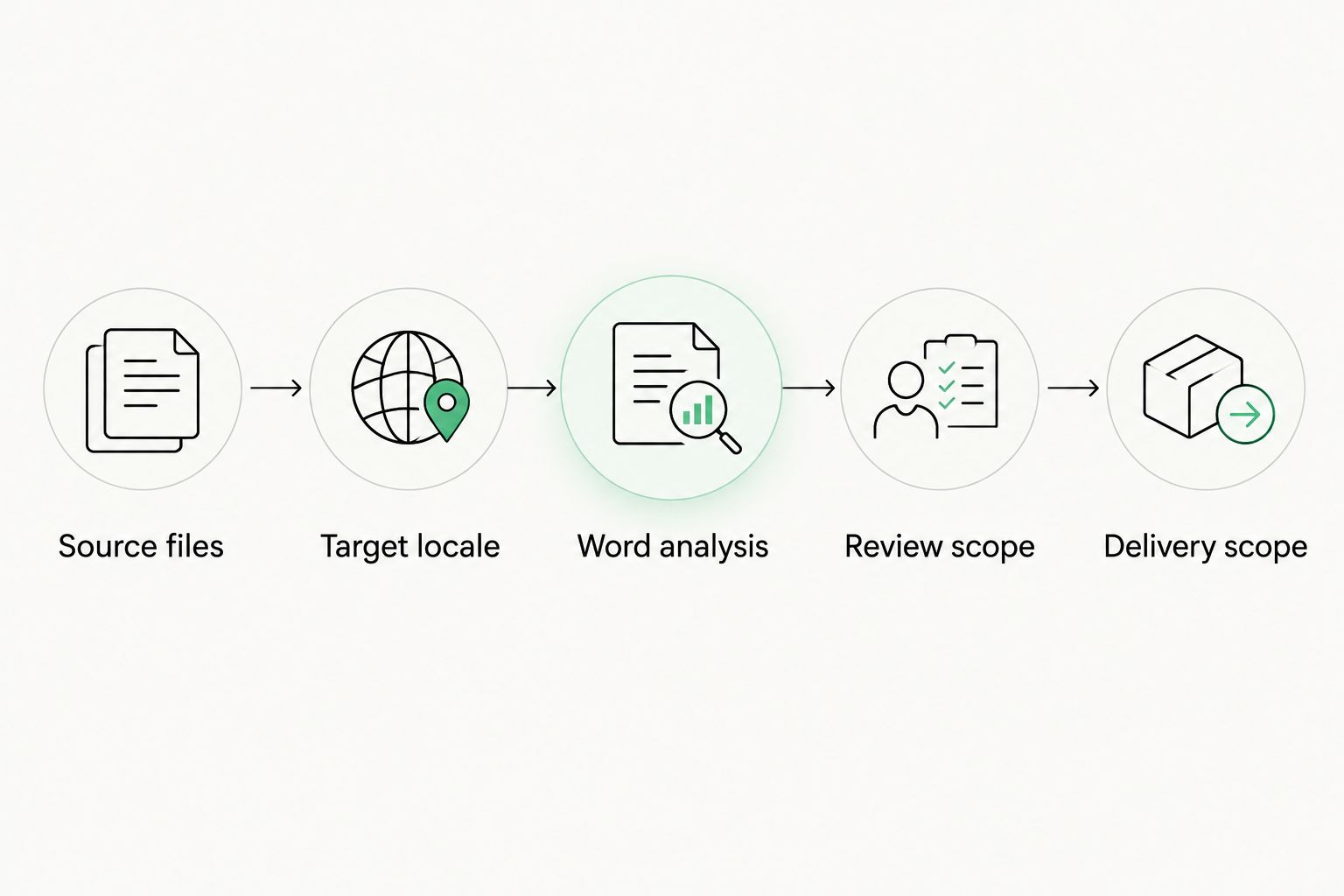
Define the assignment before comparing the quoted word rates.
Once the provider returns the quote, check every exclusion against your intended handoff. If you need a formatted document but the quote covers text only, resolve that difference before approval.
Is a lower per-word quote better value?
A lower per-word quote is better value only when it meets the same requirements with an acceptable final result. Compare scope first, then assess the proposed workflow and the provider's ability to execute it.
Ask for a relevant work sample or an agreed evaluation task when you need evidence of suitability. Give the evaluator the source, target audience, glossary, and acceptance criteria; personal preference alone is not a useful quality measure.
For your 2026 evaluation, separate errors from editorial preferences. Missing meaning, incorrect terminology, and broken placeholders need explicit checks. Stylistic choices need a shared brief so reviewers do not repeatedly reverse acceptable decisions.
Keep feedback actionable. Mark the issue, explain the required correction, and identify the reference supporting it. This gives you a defensible basis for accepting work rather than choosing whichever draft sounds most familiar.
Does translation software replace professional translation fees?
Translation software and professional translation describe different parts of the workflow. Software manages work and language resources; a service scope defines the translation, editing, and review people must deliver.
Wxrks is a translation management system for teams that need localization workflow automation and cost tracking. Wxrks supports translation memory and quality management alongside those functions.
That makes the software relevant when you need to organize recurring translation work. It does not make the platform a substitute for an agreed language-service scope, and its stated capabilities do not establish a provider's per-word rate. Evaluate Wxrks translation management software against your operational needs, then evaluate translation services against the required output.
When assessing a platform, ask how your team will record approved work, maintain language resources, and connect spending to assignments. Keep those questions separate from whether an individual translation is accurate and ready to publish.
What should you confirm before accepting a translation quote?
Before approving a translation quote in 2026, confirm that the written scope answers the questions below. An unresolved assumption is a reason to clarify the quote, not a reason to guess.
- What exactly is counted, and which files does the analysis cover?
- Which target locale and terminology references govern the work?
- Who performs translation, revision, and final approval?
- What happens when the source changes after approval?
- Which corrections fall within the agreed assignment?
- What files and language resources will you receive at handoff?
Also nominate a decision-maker on your side. If subject experts disagree about terminology, the provider needs a clear route to an approved answer. Record that answer so later assignments do not reopen the same dispute.
Approve the scope and the quote together. A word rate becomes useful only when the billable quantity, deliverable, and review responsibilities are explicit.
FAQ
How much does professional translation cost per word in 2026?
Professional translation has no universal per-word rate in 2026. Request a quote for your language pair, source files, review requirements, and delivery scope, then compare providers on the same basis.
Do translators charge for source words or translated words?
The provider's quote should specify whether billing uses source words or target words. Confirm the counting method before comparing rates or approving the assignment.
Is machine translation post-editing the same as human translation?
Machine translation post-editing starts from a machine-generated draft, while human translation does not require that starting point. Compare the required final quality and included checks rather than assuming the workflows are interchangeable.
Are repeated words automatically excluded from translation charges?
Repeated words are not automatically excluded; their treatment depends on the agreed quote. Ask how repetitions and translation memory matches are counted, reviewed, and billed.
Does a per-word translation quote include proofreading?
A per-word translation quote includes only the services stated in its scope. Ask whether the provider includes translator checks, independent revision, formatting checks, and final corrections.
Can Wxrks track translation costs?
Wxrks includes cost tracking as part of its translation management software. Use a defined service scope alongside cost records so you can connect spending to the work commissioned.
What should I send to get a comparable translation quote?
Send each provider the same source files, target locale, reference material, deadline, and delivery requirements. Require the same review scope and word-count basis so the quotes describe comparable work.
One last thing
Ask who owns the approved wording after delivery. Your final translated document and your reusable language resources serve different purposes: one is the deliverable, while the other informs later work.
Confirm the handoff of any agreed glossary updates and translation memory changes. Resolving terminology once is useful; recording the approved decision makes it available for the next assignment.
Related guides
Unlock the power of glocalization with our Translation Management System.
Unlock the power of
with our Translation Management System.