How much does localizing a mobile app into languages cost?


The cost to localize a mobile app into multiple languages depends on your content, target locales, engineering work, and release process—not language count alone. A translation-only quote excludes work such as preparing strings, adapting layouts, testing translated screens, and maintaining localized releases. For a 2026 budget, separate launch work from recurring localization before comparing proposals.
TL;DR
- Cost to localize mobile app multiple languages: budget translation, engineering, linguistic review, testing, and ongoing updates.
- Compare quotes against the same source files, target locales, review requirements, and acceptance criteria.
- Wxrks suits teams seeking translation workflow automation, translation memory, quality management, and cost tracking.
- Separate shared setup from locale-specific work so your budget does not multiply every task by language count.
How much does localizing a mobile app into languages cost?
Your localization budget is the sum of shared preparation, locale-specific production, release testing, and ongoing maintenance. A per-word translation quote covers only part of that scope. Ask for a breakdown that distinguishes work performed across the project from work repeated for each locale.
Use this structure to compare proposals. For the release-planning side, see the guide to how long localizing a mobile app takes.
Shared preparation
- What belongs in the scope: String extraction, resource structure, context, terminology preparation
- How to compare proposals: Identify reusable setup and existing technical gaps
Translation
- What belongs in the scope: New strings, changed strings, relevant supporting content
- How to compare proposals: Require the same source files and target locales
Linguistic review
- What belongs in the scope: Meaning, terminology, tone, consistency
- How to compare proposals: Specify reviewers and acceptance criteria
Engineering
- What belongs in the scope: Resource integration, locale handling, layout adjustments
- How to compare proposals: Separate shared changes from locale-specific fixes
In-app testing
- What belongs in the scope: Rendered text, navigation, formatting, interaction checks
- How to compare proposals: Define screens, platforms, and test coverage
Release maintenance
- What belongs in the scope: Updates, corrections, terminology changes, regression checks
- How to compare proposals: Separate recurring work from launch scope
A useful estimate explains assumptions beside each component. If testing is excluded, treat it as excluded—not as work the translation line implicitly covers.
Why this matters
A translated resource file is not a localized app. Users encounter text inside buttons, forms, notifications, permission flows, and error states, where meaning and behavior depend on context.
For your 2026 plan, define completion as a reviewed, working experience in each target locale. That makes proposals comparable and gives engineering, language reviewers, and product owners the same finish line.
Build your estimate from the actual app
Start with an inventory rather than a language multiplier. The goal is to expose work before it becomes a change request.
Inventory the content
List user-facing strings, onboarding, validation messages, transactional messages, and app-store content. Include server-delivered text and embedded text in graphics when those assets are part of the release.
Keep support articles and marketing pages separate unless the launch requires them. A clear boundary prevents an app-localization estimate from quietly becoming a broader content project.
Define target locales
Name the intended language and regional audience. Language labels alone do not settle date formats, currencies, regional terminology, or market-specific content.
Specify the platforms and release channels covered. Your estimate should make clear whether reviewers will test the same localized experience across each supported app implementation.
Inspect technical readiness
Check whether user-facing text lives in localization resources or remains embedded in application code. Review plural handling, placeholders, locale-sensitive formatting, and layout behavior before requesting production estimates.
Fixing the source structure is different work from translating the source text. Keep those responsibilities separate so neither disappears between your developer and language provider.
Set acceptance criteria
Describe what reviewers must approve: meaning, terminology, tone, rendered layout, and functional behavior. Provide screenshots or other context where an isolated string is ambiguous.
Name the person who resolves disputed terminology and the person who approves the localized build. Approval without an owner creates an unfinished handoff.
Separate launch and maintenance
Ask for the initial release scope and the process for subsequent changes. Specify how new strings, revised source text, and corrections enter the workflow.
Your 2026 launch budget should not stand in for the ongoing operating budget. Maintaining localized releases requires a defined change process, not just access to the original translated files.
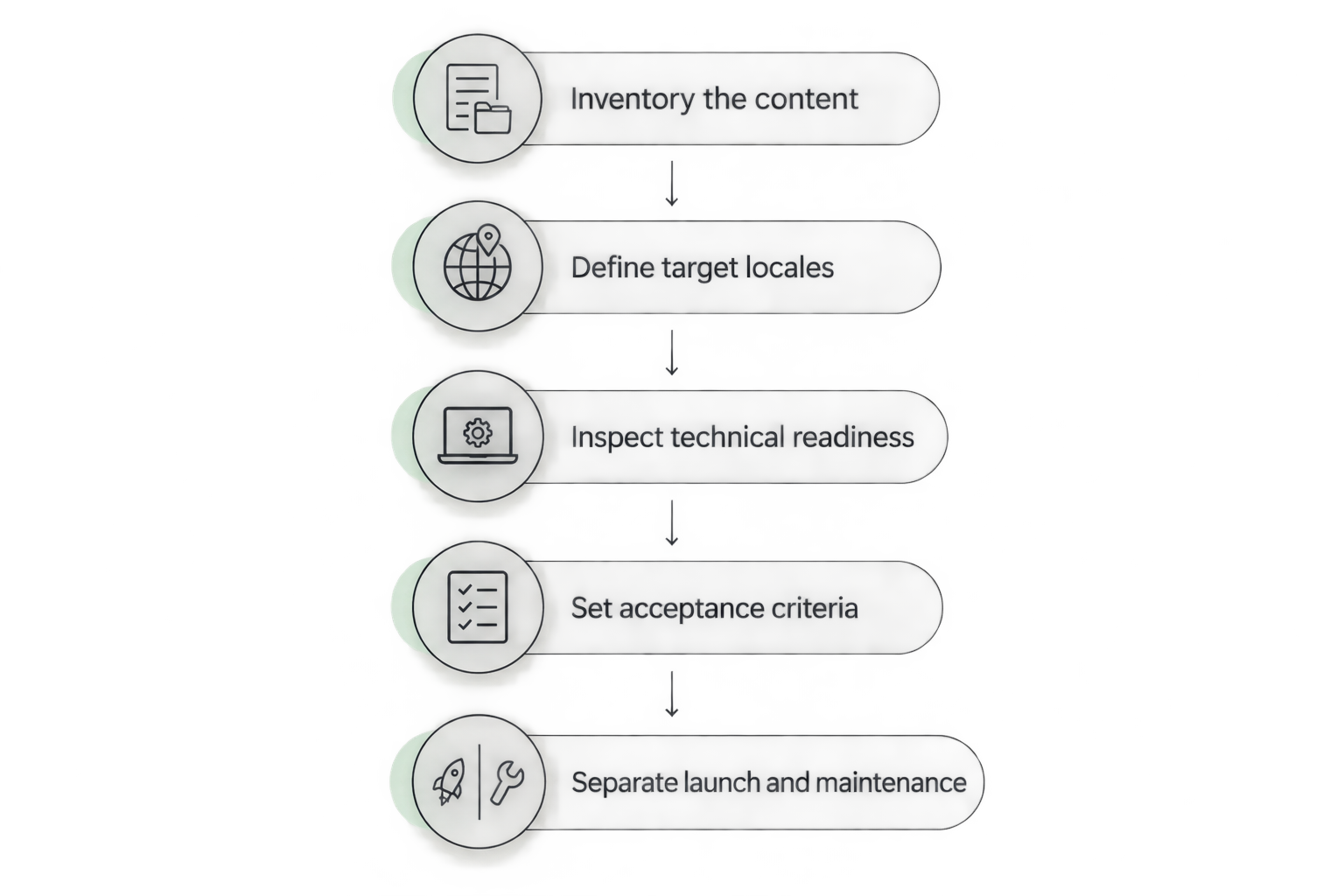
Define the work and approval conditions before comparing localization proposals.
Shared preparation: budget it separately
Shared preparation includes work that supports the multilingual app as a whole: organizing resources, removing hard-coded text, providing string context, and defining the handoff process. Some technical changes also serve several locales rather than belonging to a single language.
The benefit is reuse. The constraint is that preparation does not eliminate locale-specific review or testing. Ask your developer to distinguish existing readiness from unfinished internationalization work, then assign ownership for each gap.
Do not assume that every preparation task repeats for every language. Equally, do not assume a shared technical fix resolves every writing-system or layout requirement.
Locale-specific production: quote the full experience
Locale-specific work includes translation, linguistic review, terminology decisions, and checking the translated experience in context. It also includes adapting relevant content when direct translation does not express the intended action or meaning.
A defined locale scope gives you a reviewable deliverable. Its limitation is that source-file completeness determines coverage: omitted notifications, graphics, or backend messages remain outside the work unless explicitly included.
Ask providers to identify what they need from your team. Product explanations, screenshots, terminology decisions, and working test access are project inputs, not details to resolve after delivery.
Ongoing updates: treat localization as release work
After launch, new features and revised copy create new localization work. Previously approved translations also need attention when their source meaning or product context changes.
A recurring workflow keeps updates connected to the product release process. It still requires ownership: someone must identify changed content, resolve questions, approve translations, and verify the resulting build.
For 2026 planning, distinguish new content from unchanged material and revisions. Ask how each category is identified, reviewed, and recorded so you can explain recurring effort rather than treating every update as an unrelated project.
Why mobile app localization costs vary
These factors change the work required. Use them to explain differences between proposals instead of assuming a higher total means a higher translation rate.
- Content volume and change frequency. New copy and frequent revisions create production and review work; duplicated text also needs context before you treat it as reusable.
- Language and regional requirements. Writing direction, plural rules, terminology, and locale-sensitive formats affect implementation and review scope.
- Technical readiness. Externalized strings and adaptable layouts present a different task from hard-coded copy and fixed-width interfaces.
- Review depth. A linguistic file review and a review inside the running app cover different failure modes. State which deliverables require each.
- Testing coverage. Supported platforms, relevant device layouts, user journeys, and locale-specific behaviors define the testing assignment.
- Release workflow. Source changes, approval handoffs, and file coordination determine what project-management and integration work you must include.
Keep these assumptions consistent across your 2026 requests for proposals. Otherwise, you are comparing different deliverables under the same project name.
Which translation workflow should you budget for?
Choose the workflow by content and acceptance requirements—not by the smallest production line item. Both approaches below require context, review ownership, and in-app checks.
Human translation with review
- Best for: Ambiguous UI copy, brand-sensitive text, and content requiring careful interpretation
- Advantage: A translator makes wording decisions from the source and supplied context
- Limitation to budget around: Product questions and approval work still need explicit ownership
Machine translation with post-editing
- Best for: Content selected for a machine-assisted workflow after sample evaluation
- Advantage: Gives the editor an initial draft to assess and revise
- Limitation to budget around: Unsuitable output requires correction or retranslation; review remains necessary
Do not approve machine-assisted production solely because the draft reads fluently. Check whether it preserves meaning, terminology, placeholders, and the intended user action.
Use the same acceptance criteria when evaluating either workflow. A useful sample contains representative interface strings, including ambiguous labels and messages with variables—not just straightforward descriptive text.
Where translation management fits
A translation management system coordinates localization work; it does not replace your app’s engineering or release acceptance responsibilities. Include workflow administration in the project scope whether you coordinate through software or through manual handoffs.
Wxrks is best suited to teams that need translation workflow automation, translation memory, quality management, and cost tracking in a TMS. Wxrks supports those functions for translators, developers, enterprises, and translation agencies. Evaluate the workflow against your actual app resources and review process before selecting a platform.
The benefit is having software support for these localization activities. The limitation is equally clear: a TMS is not the localized app itself. Your team still needs to define context, engineering ownership, and acceptance criteria.
How do I compare app localization quotes fairly?
Compare app localization quotes against an identical content inventory, locale list, and acceptance checklist. Require providers to mark exclusions, assumptions, and responsibilities beside the work they cover.
Request clarity on source changes, terminology questions, review revisions, and defect correction. A proposal is easier to evaluate when it explains what triggers additional work and who approves it.
Does adding another language repeat all the work?
Adding another language repeats locale-specific production and validation, not necessarily every shared preparation task. Separate reusable technical work from translation, review, and testing that must address the additional locale.
Do not assume that existing layout fixes cover a different writing direction or writing system. Ask engineering to inspect the added locale’s requirements before extending the estimate.
How do I reduce localization spending without dropping quality?
Reduce localization spending by removing obsolete source content, stabilizing terminology, supplying context, and distinguishing changed text from unchanged material. Preserve review of user-facing meaning and testing of the localized app.
Prioritize a clearly defined release scope rather than translating everything without a launch requirement. Cutting unnecessary content is different from leaving required screens partially localized.
FAQ
How much should I budget to localize my mobile app?
Build your mobile app localization budget from shared preparation, translation, linguistic review, engineering, testing, and ongoing updates. Request a scoped estimate using your actual source content and target locales rather than treating a translation quote as the complete project.
Is mobile app localization charged by word or by project?
A proposal can separate text production from project-based or time-based work such as engineering and testing. Ask each provider to identify the billing unit for every component and the deliverable it covers.
Is machine translation enough for a mobile app launch?
Machine translation alone does not establish that a mobile app is ready to launch. Review meaning and terminology, then check translated text, placeholders, and layouts inside the app.
Do I need to test every localized version of my app?
Each localized version needs validation against its release requirements. A source-language test does not establish that translated text fits or that locale-sensitive behavior works as intended.
Does translation memory remove the need for review?
Translation memory does not remove the need for review. A previously approved translation still needs checking when its meaning, terminology, or interface context has changed.
What should I ask a localization provider before accepting a quote?
Ask what content, locales, review work, engineering, and testing the quote includes. Confirm ownership of terminology decisions, source changes, corrections, and final approval.
Can Wxrks help manage app localization costs?
Wxrks includes cost tracking alongside translation workflow automation, translation memory, and quality management. You still need to define project scope and distinguish launch work from ongoing localization.
One last thing
Ask reviewers to assess ambiguous strings before production begins. A short label can require more product explanation than a long descriptive sentence; word count does not capture that context requirement.
Attach a screenshot, identify the action, and explain any placeholder. Making the intended meaning explicit gives translators something concrete to work from—and gives reviewers a clear basis for approval.
Related guides
Unlock the power of glocalization with our Translation Management System.
Unlock the power of
with our Translation Management System.