How much does it cost to localize a website into 10 languages?


Localizing a website into 10 languages requires a project-specific budget, not a universal per-website figure. For a 2026 launch, calculate translation and review for each language, then add website implementation, testing, and workflow management. Translation alone excludes work such as fixing localized layouts, adapting forms, and maintaining translated pages after launch.
TL;DR
- How much does it cost to localize a website into 10 languages? Budget translation, implementation, testing, and maintenance separately.
- Wxrks suits teams that need translation management, workflow automation, quality management, and cost tracking.
- Compare human translation and machine translation with post-editing against the same content scope and acceptance requirements.
- Build separate launch and ongoing budgets; translation memory supports reuse but does not replace website testing.
How much does it cost to localize a website into 10 languages?
Your total is the sum of language production, website engineering, quality assurance, and project operations. Ask for an itemized scope before comparing totals. A translation-only proposal and a launch-ready website proposal do not buy the same work.
The guide to machine translation post-editing explains a key workflow decision: whether reviewers edit machine output or translators produce the target text directly. Either approach still needs clear instructions, context, and acceptance criteria.
Use this breakdown when requesting a 2026 estimate:
Content preparation
- What belongs in the scope: Content inventory, source cleanup, export, terminology preparation
- What to check before approval: Which pages, strings, and assets are included?
Translation
- What belongs in the scope: New text, reusable translations, language-specific adaptation
- What to check before approval: Is the same source content included for all 10 languages?
Linguistic review
- What belongs in the scope: Meaning, terminology, tone, and corrections
- What to check before approval: Who reviews the work and approves it?
Website implementation
- What belongs in the scope: Localized templates, navigation, forms, language selection
- What to check before approval: Does the work cover the functioning website or just translated files?
Testing
- What belongs in the scope: Text display, links, forms, mobile layouts, locale behavior
- What to check before approval: Are fixes and retesting included?
Workflow management
- What belongs in the scope: Assignment, approvals, file handling, cost tracking
- What to check before approval: Who owns handoffs and exceptions?
Maintenance
- What belongs in the scope: Changed content, new pages, updates, ongoing review
- What to check before approval: What happens after the initial launch?
Do not multiply a translation subtotal by the language count and call it the website budget. Some implementation work is shared, while review and language-specific corrections remain separate responsibilities.
Why this matters
A website is not a document with a language switch. Visitors need translated navigation, usable forms, readable layouts, and a coherent route from their landing page to their next action.
A quote becomes useful when you can connect each deliverable to an owner and an acceptance condition. Without those boundaries, you cannot tell whether a difference between proposals reflects efficiency or simply excluded work.
For your 2026 plan, separate launch readiness from continuing operations. The first budget gets localized pages published; the second keeps those pages aligned with changing source content.
Human translation: best for content requiring close editorial control
Human translation gives the translator responsibility for producing the target text rather than correcting a machine-generated draft. It suits content where nuance, positioning, and instructions need deliberate language choices.
Best for: Prominent marketing pages, sensitive instructions, and content requiring close attention to voice. Include a brief, reference material, terminology, and access to someone who can answer questions.
The advantage is direct editorial judgment during translation. The trade-off is that creating the translation and reviewing it remain distinct tasks; commissioning human translation does not establish that an independent review is included.
Specify the review process rather than relying on the word “human.” Ask who checks meaning, who approves brand language, and who resolves disagreements before publication.
Machine translation with post-editing: best for reviewable content
Machine translation with post-editing starts with generated output and assigns a human editor to correct it against defined requirements. The relevant question is not whether a draft exists, but whether the finished content meets your publishing standard.
Best for: Content with clear source writing, stable terminology, and an accountable reviewer. Assess the workflow on representative material before extending it across the website.
The advantage is that editors work from an existing draft. The limitation is that incorrect meaning, awkward phrasing, and inconsistent terminology still require attention; a draft does not establish the amount of work remaining.
Ask suppliers to explain what post-editing includes. A light readability pass and a full check against the source are different deliverables and should not be treated as equivalent.
How do the translation approaches compare?
Choose the approach by content purpose and review requirements, not by its label. Keep implementation and website testing in the scope whichever production method you select.
Human translation
- Best for: Content needing close editorial judgment
- Main advantage: Translator makes target-language choices directly
- Main limitation: Separate review and website testing still need ownership
Machine translation with post-editing
- Best for: Content with clear acceptance criteria and qualified reviewers
- Main advantage: Editor starts from a generated draft
- Main limitation: Draft quality does not establish final quality or review effort
Mixed workflow
- Best for: Websites containing different content types
- Main advantage: Matches production methods to page requirements
- Main limitation: Requires routing rules and consistent approval standards
Use a mixed workflow only when you can explain which content follows which path. Otherwise, the production method becomes another unresolved decision during delivery.
Why website localization budgets vary
The language count defines breadth, not the full workload. These factors determine what your suppliers and internal teams must actually deliver:
- Content scope: Include visible pages, interface strings, metadata, forms, downloadable assets, and relevant messages. Count shared content consistently rather than treating every appearance as new text.
- Language and locale requirements: Define the intended audience for each language. Language labels alone do not settle regional terminology, date formats, or other locale conventions.
- Reuse: Approved existing translations and translation memory provide material to assess for reuse. Repeated wording still needs the right context and approval rules.
- Quality requirements: Specify whether the work needs translation, independent review, specialist review, or editorial adaptation. Each is a distinct responsibility.
- Website architecture: Templates, content storage, text embedded in images, and locale-specific behavior determine implementation tasks. Translators cannot resolve every issue inside a text file.
- Change management: Source edits, new pages, and revised terminology create follow-up work. Define how changes reach every affected language before launch.
Keep these assumptions attached to the estimate. If the assumptions change, update the scope rather than treating the original total as a promise for different work.
How do you build a comparable localization estimate?
Use the same brief for every supplier. A comparable estimate starts with a common workload, not a common spreadsheet heading.
Content inventory
List the content you intend to publish in each locale. Distinguish shared navigation and template strings from page-specific copy, and identify text that lives outside the main content system.
For 10 target languages, record whether every language receives the complete inventory or a smaller release. Otherwise, identical-looking proposals can represent different amounts of work.
Language scope
Specify each target language and regional audience. Assign an approver who can judge whether the translated experience fits that audience.
Also state what stays in the source language. Product names, reference material, and unsupported content need explicit decisions rather than accidental omissions.
Workflow choice
Assign a production and review method to each content type. Give reviewers the source, context, terminology, and publishing requirements they need to make a decision.
Use representative pages to check the proposed workflow before committing the full inventory. Include navigation, a form, and content with terminology that matters to your business.
Acceptance criteria
Describe what counts as finished. Include linguistic approval, functioning links, readable mobile layouts, working forms, and the handling of unresolved questions.
Name the person responsible for corrections. An issue list is not a completed launch unless someone owns resolving and checking it.
Update plan
Define how changed source content enters the localization workflow after publication. Decide who approves updates and how outdated translations are identified.
A 2026 launch plan should include the operating process that follows release. Otherwise, the launch budget hides an unassigned maintenance obligation.
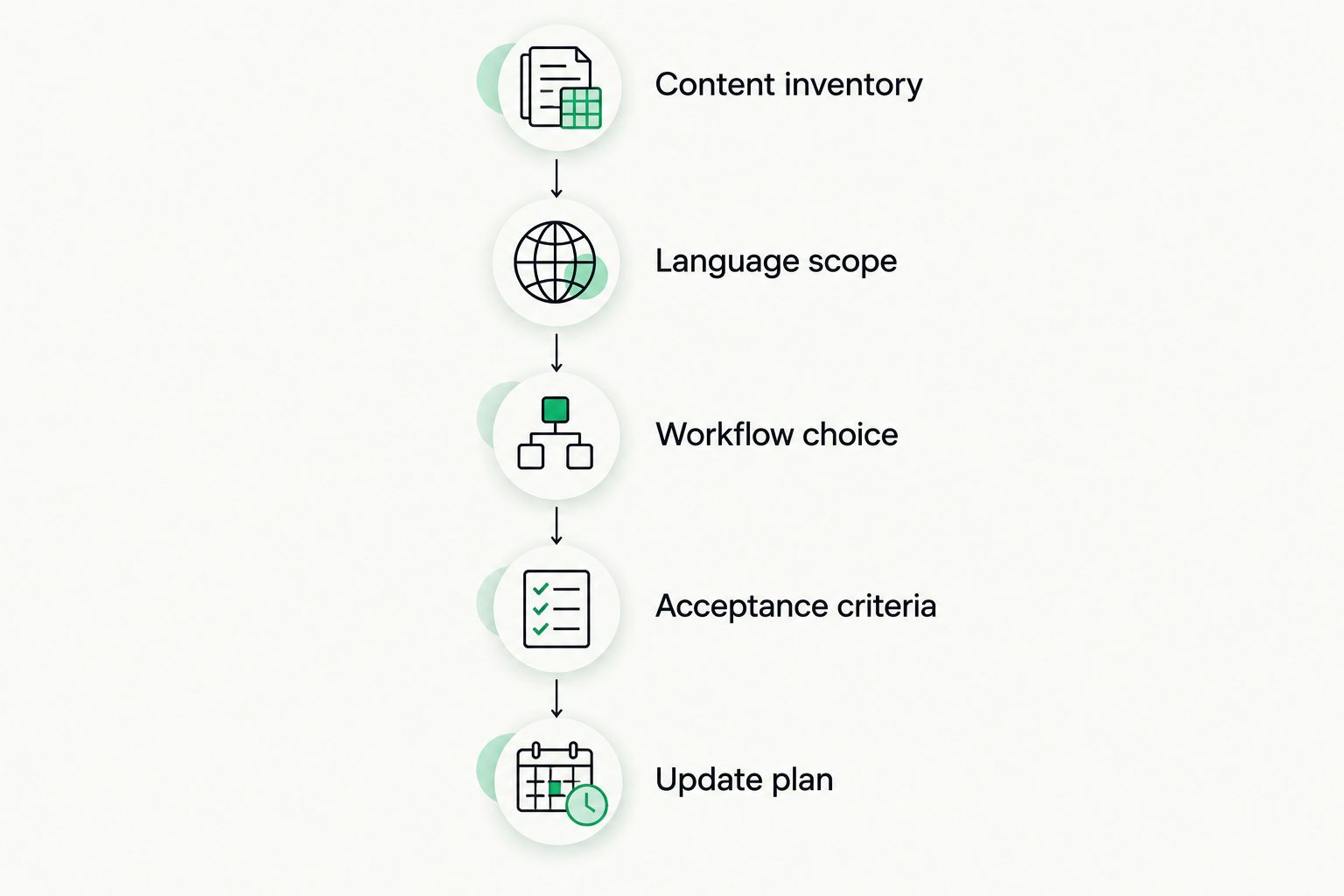
Define the workload and approval rules before comparing estimates.
What should a localization proposal include?
Ask for deliverables, exclusions, and responsibilities in writing. The most useful proposal explains what you will receive and how you will accept it.
Check the following before approval:
- A content inventory tied to the proposed language scope.
- The translation and review method for each content type.
- Treatment of repeated text and existing approved translations.
- Implementation responsibilities for templates, forms, and language selection.
- Testing responsibilities, correction handling, and final approval.
- A process for source changes submitted during production.
- Separate treatment of launch work and ongoing updates.
Ask suppliers to mark exclusions explicitly. If your team handles engineering, account for that internal work rather than treating it as absent from the project.
Keep the scope version attached to each proposal. Comparing an early estimate with a later, expanded brief produces a misleading decision even when both estimates are internally consistent.
Where does translation management software fit?
A translation management system organizes production; it is not a substitute for defining the website work. Treat workflow administration and the localized website itself as related but separate responsibilities.
Wxrks is best for teams that need translation workflow automation, translation memory, quality management, and cost tracking. Wxrks provides translation management software for translators, developers, enterprises, and translation agencies.
The advantage of Wxrks translation management software is its stated focus on those connected workflow needs. The boundary is equally important: a TMS does not, by itself, establish your content scope, acceptance criteria, or responsibility for website fixes.
Include software evaluation in your 2026 operating plan when ongoing localization needs coordination. Evaluate the workflow against your actual content and approval process rather than assuming a software purchase completes implementation.
Can you localize all 10 languages without translating every page?
A 10-language launch does not require an identical page inventory in every language. You can define a smaller approved scope for a locale, provided visitors have a coherent experience within it.
Keep essential navigation and destination pages aligned. A translated entry page that sends visitors into untranslated forms or instructions leaves the task unfinished.
Document intentional exclusions. That makes a phased release a scope decision rather than a collection of missing translations.
Does translation memory eliminate repeat translation work?
Translation memory supports reuse of previously translated segments; it does not eliminate the need to assess context. Identical source wording can serve different functions in a heading, button, or instruction.
Keep approved translations and terminology current. Reusing outdated language simply carries an old decision into new content.
FAQ
How much does it cost to localize a website into 10 languages?
A website localization budget for 10 languages combines translation, review, implementation, testing, and workflow management. Request an itemized estimate tied to a defined content inventory, with maintenance separated from launch work.
Is website localization the same as translating website text?
Website localization includes work beyond translating text, such as adapting layouts, forms, navigation, and locale-specific behavior. Define who implements and tests those elements before approving the project.
Is machine translation enough to launch a multilingual website?
Machine translation alone does not establish launch readiness. Assign review against publishing requirements and test the translated content in the functioning website.
Should I translate every page into every language?
You can launch a defined subset of pages in each language rather than translating the entire website. Keep navigation, forms, and destination pages consistent with that approved scope.
What should I ask a website localization supplier?
Ask for the content scope, production method, review responsibilities, implementation tasks, and acceptance criteria. Require explicit exclusions and a process for changes during delivery.
Does a translation management system replace website testing?
A translation management system does not replace testing the localized website. Linguistic approval and functional checks address different requirements, so assign owners for both.
One last thing
Ask who fixes an approved translation when it does not fit the live page. The wording can be linguistically correct and still need adjustment in a button, menu, or mobile layout.
That question exposes the handoff between language work and website implementation. Resolve it before approval, and your 2026 budget will describe a finished experience rather than a delivery of translated files.
Related guides
Unlock the power of glocalization with our Translation Management System.
Unlock the power of
with our Translation Management System.