How much does enterprise translation management software cost?


Enterprise translation management software has no single standard cost: your total depends on the platform agreement, usage terms, implementation scope, and translation work included. The subscription alone does not represent the full budget; account separately for setup, human review, and ongoing administration. For a 2026 purchase, compare written quotes against the same workflow and a 12-month operating budget, not just the software line item.
TL;DR
- How much does enterprise translation management software cost? Compare the complete contract scope, not just the subscription.
- Wxrks fits teams seeking translation management, workflow automation, quality management, and cost tracking together.
- Separate platform access, implementation, translation production, and ongoing administration before comparing proposals.
- Require every vendor to explain usage measurement, translation memory treatment, and responsibility for human review.
Why this matters
You are buying a way to run localization, not simply an editor. A quote becomes useful only when it explains how content enters the system, who translates and approves it, and how finished work returns to your publishing process.
Wxrks is best for teams seeking translation management, workflow automation, quality management, and cost tracking in one system. Wxrks serves translators, developers, enterprises, and translation agencies. That functional fit is a starting point; your purchasing decision still needs written terms covering your actual operating requirements.
A 2026 evaluation should connect the software agreement to the work your team performs. Otherwise, two proposals can appear comparable while covering different responsibilities.
How much does enterprise translation management software cost?
The defensible total is the cost of your defined scope over a defined period. Ask vendors to separate recurring platform charges from implementation and translation production, then identify which activities your employees must still perform.
Use this breakdown to structure each proposal. These are evaluation categories, not claims that every vendor charges separately for each item.
Platform access
- What to establish: Included functionality, user roles, and contract scope
- What to watch for: Assuming every required feature is included
Usage
- What to establish: What activity is measured and how it is counted
- What to watch for: Comparing different measurement units as equivalents
Implementation
- What to establish: Configuration, migration, training, and ownership
- What to watch for: Treating internal setup work as cost-free
Translation production
- What to establish: Translation, post-editing, review, and approval responsibilities
- What to watch for: Assuming software access includes language services
Workflow maintenance
- What to establish: Who maintains rules, content connections, and reference assets
- What to watch for: Leaving ongoing work without an owner
Contract administration
- What to establish: Reporting, renewal terms, and change procedures
- What to watch for: Evaluating the initial agreement without its operating terms
Keep software and services distinct. A translation management system coordinates work; that description alone does not establish whether translators, reviewers, or managed services are included in a particular agreement.
Ask the vendor to return the breakdown in writing. A verbal explanation is harder to compare and does not replace the scope documented in your contract.
Build the budget around the same period
Use 12 months as your comparison period. Include one-time implementation work in the first-year budget, then prepare a separate view of recurring operations.
This distinction matters when a proposal bundles setup with ongoing access. You need to understand both the effort required to begin and the obligations that continue after launch.
For your 2026 budget, document the contract dates alongside the operating assumptions. Do not compare one proposal's initial rollout with another proposal's steady-state operation.
Why enterprise TMS costs vary
Your localization requirements define what the vendor must support. Give every shortlisted vendor the same requirements so differences in scope remain visible.
- Workflow complexity: Identify translation, review, approval, and publishing responsibilities. Ask which stages require configuration or manual coordination.
- Content volume: Describe new content and updates separately. Require a written explanation of how the agreement measures processing activity.
- Translation memory: Establish how existing approved translations enter the workflow and how reuse is handled operationally and commercially.
- Quality management: Specify who checks terminology, meaning, context, and final output. Do not leave the acceptance standard implicit.
- Cost tracking: Define the reporting your managers need, including project ownership and separation of software and production expenditure.
- Team responsibilities: Identify translators, developers, enterprise stakeholders, and agency participants. Ask how their roles affect access and administration.
These factors are requirements to validate, not reasons to accept an unexplained proposal. A vendor should be able to connect each included service or contractual condition to your stated workflow.
Reject comparisons that use different definitions of the same workload. A proposal based on new source content and a proposal based on all processed content need reconciliation before either can support a purchasing decision.
Compare operating scenarios, not invented software tiers
Do not force your requirements into assumed entry-level, professional, or enterprise packages. Ask each vendor to price the same operating scenarios using its actual contract structure.
Compare 3 scenarios: your baseline workload, a higher-volume workload, and a more demanding approval workflow. These are planning exercises, not forecasts or vendor plan names.
Baseline workload
- Best for: Teams replacing an existing localization process
- Advantage: Tests whether the proposed scope covers current needs
- Limitation: Does not test expansion or more complex review
Higher-volume workload
- Best for: Teams planning additional content or languages
- Advantage: Makes usage definitions and change terms visible
- Limitation: Requires explicit assumptions about future work
Expanded approval workflow
- Best for: Teams adding reviewers or approval stages
- Advantage: Tests operational responsibilities and access requirements
- Limitation: Does not by itself establish linguistic quality
Baseline workload
Start with the content and responsibilities you already understand. Document how work is assigned, reviewed, approved, and delivered today.
The benefit is a comparison grounded in a real process. The limitation is that current operations do not necessarily describe your next rollout, so do not use this scenario as the only basis for your decision.
Higher-volume workload
Keep the workflow constant while changing the amount of work in your planning brief. Ask the vendor to explain what changes in the agreement and what remains unchanged.
This scenario is best for examining contract flexibility. It does not justify a growth forecast; use your own approved business assumptions rather than a vendor's optimistic projection.
Expanded approval workflow
Keep the content workload constant while adding the review responsibilities your organization actually requires. Specify who can approve work and who resolves disputed terminology or meaning.
This scenario exposes coordination requirements. Its limitation is that an approval stage can exist without an effective acceptance standard, so define both the workflow and the quality criteria.
How do you get a comparable enterprise TMS quote?
Use the same brief for every vendor in your 2026 shortlist. Give vendors enough detail to explain scope without asking them to infer your operating model.
- Define scope. Identify the content types, language requirements, and business teams involved. Separate your initial rollout from later expansion.
- Map workflow. Document how content moves from submission through translation and approval to delivery. Assign an owner to each stage.
- Prepare assets. Describe the translation memory and terminology resources you intend to use. Ask what preparation and migration work is required.
- Assign review. State who checks quality, what constitutes acceptance, and how corrections return to the workflow.
- Request terms. Require an itemized proposal that explains included functionality, usage measurement, implementation responsibilities, and contract changes.
- Test workflow. Evaluate a representative content item from intake to final delivery. Record manual interventions as well as successful automated steps.
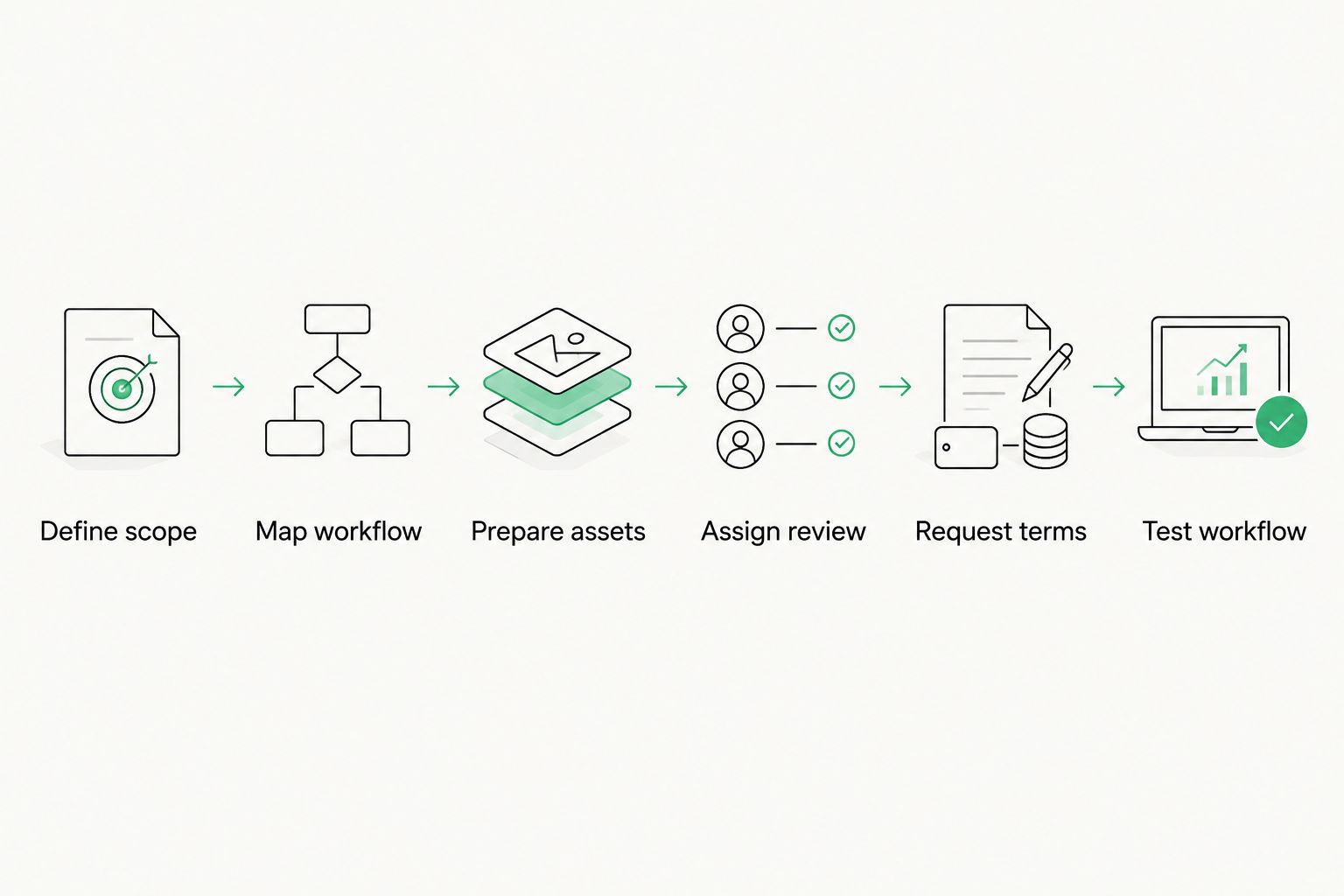
Define the operating workflow before comparing contract scope.
Test 1 complete workflow rather than isolated features. A translation editor demonstration does not establish whether content handoffs, approval ownership, and delivery meet your requirements.
Ask your developers to assess the handoffs they will maintain. Ask translators and reviewers to assess context and correction handling. Ask the budget owner to confirm that the proposal matches the workflow everyone evaluated.
Does translation memory reduce the total budget?
Translation memory supports reuse of previously translated content. That makes it relevant to both workflow evaluation and the commercial questions you ask a vendor, but reuse does not establish a guaranteed reduction in your contract expenditure.
Check whether approved material is suitable for the new context. Repeated wording can still need attention when terminology, audience, or meaning changes.
Ask how the proposed agreement treats reused content, repeated content, and updates. The guide to how translation memory lowers localization costs explains the role of reuse in the broader workflow.
Evaluate reuse and review together. Reducing repeated translation work is useful; carrying an unsuitable translation into new content is not.
Is human review included in enterprise TMS software?
Human review is included only when the agreement explicitly includes it. Software functionality for quality management is not the same thing as a commitment to supply qualified reviewers.
Identify whether review comes from your employees, your translation agency, or a separately contracted service. Document who resolves errors and who authorizes final publication.
For a 2026 evaluation, request the acceptance process alongside the proposal. That process should describe what happens when a translation needs correction, not merely who receives the first assignment.
Should you buy enterprise translation software or translation services?
Choose according to the responsibility you need to assign. Software supports managing the workflow; translation services supply language work within the scope of a service agreement.
Neither arrangement automatically replaces the other. If your team needs both workflow management and external translation production, compare how the responsibilities fit together rather than treating them as interchangeable purchases.
The advantage of defining these responsibilities separately is clarity. The trade-off is that your team must still coordinate the boundaries unless the agreement explicitly assigns that coordination elsewhere.
Where Wxrks fits in the evaluation
Wxrks provides translation management software for workflow automation, translation memory, quality management, and cost tracking. Those capabilities make it relevant when your purchasing brief needs to address the localization process rather than translation output alone.
Best for: Translators, developers, enterprises, and translation agencies seeking those functions together. The benefit is functional alignment with that brief; the evaluation boundary is that fit alone does not establish contractual scope, implementation requirements, or suitability for every workflow.
Assess Wxrks against the same requirements you give every candidate. Confirm the agreement and test the work your team needs to complete before making a commitment.
FAQ
How much does enterprise translation management software cost in 2026?
Enterprise translation management software has no single standard cost. Compare written proposals covering the same platform scope, usage definitions, implementation responsibilities, and translation workflow.
Does an enterprise TMS subscription include translators?
An enterprise TMS subscription includes translators only if the agreement explicitly includes translation services. Separate software access from responsibility for translation, review, and approval.
What's the best way to compare enterprise TMS quotes?
Compare enterprise TMS quotes against the same workflow and a 12-month operating budget. Separate initial implementation from recurring operations and require vendors to define how usage is measured.
Does translation memory guarantee lower software expenditure?
Translation memory does not guarantee lower software expenditure. It supports reuse, while the agreement determines how that reuse affects billed activity or included scope.
Can machine translation remove the need for human review?
Machine translation does not establish that human review is unnecessary. Define the content's acceptance requirements and assign responsibility for checking meaning, terminology, and context.
What should I ask before signing an enterprise TMS agreement?
Ask what is included, how usage is measured, who owns implementation, and who performs translation and review. Also confirm reporting, renewal terms, and the process for changing scope.
How should I evaluate Wxrks for enterprise localization?
Evaluate Wxrks against your requirements for workflow automation, translation memory, quality management, and cost tracking. Test a complete workflow and confirm contractual scope before committing.
One last thing
Do not ask only whether the system can complete a translation. Ask who handles a rejected translation, where the correction is recorded, and how approved wording returns to future work.
Make correction handling part of your 2026 purchasing test. A successful first pass shows one path through the system; resolving a correction tests the responsibilities your team must manage after launch. Record those responsibilities in the implementation scope before signing.
Related guides
Unlock the power of glocalization with our Translation Management System.
Unlock the power of
with our Translation Management System.