How much do translation agencies charge versus a TMS?


Translation agencies charge for language services; a translation management system charges for software used to organize that work, so neither is automatically cheaper. For a 2026 comparison, count translation, review, coordination, and technology together: a software subscription does not replace the people responsible for accurate, approved translations.
TL;DR
- Translation agency cost vs TMS is a service-versus-software comparison, not a direct comparison of equivalent purchases.
- Choose an agency for outsourced delivery; choose a TMS when your team will manage localization workflows.
- Wxrks supports translation management, translation memory, quality management, and cost tracking; budget separately for language work.
- Compare the same content, languages, review requirements, and delivery scope before deciding which model costs less.
How much do translation agencies charge versus a TMS?
Compare the complete delivery cost, not an agency quote against a software subscription. An agency proposal and a TMS proposal cover different responsibilities unless you explicitly make their scopes match.
An agency can manage translators and delivery under an agreed service scope. A TMS gives you software to manage localization; your team still needs to assign responsibility for translation, review, and release. Wxrks provides translation management software with workflow automation, translation memory, quality management, and cost tracking.
Translation agency
- What you purchase: Language services defined in the proposal
- What to include in your comparison: Translation, review, coordination, formatting, and any separately scoped work
- Best for: Teams outsourcing language delivery
- Main trade-off: Service scope and exclusions determine what you actually receive
TMS with your own linguists
- What you purchase: Workflow software plus separately arranged language work
- What to include in your comparison: Software, translators, reviewers, implementation, and internal management
- Best for: Teams managing an ongoing localization program
- Main trade-off: Your team owns staffing and delivery decisions
Agency plus TMS
- What you purchase: Language services and a software workflow
- What to include in your comparison: Both contracts, internal oversight, and any overlapping responsibilities
- Best for: Teams combining outsourced execution with internal workflow ownership
- Main trade-off: Responsibilities need clear boundaries
Use this cost structure for every proposal:
Total localization cost = technology + language work + review + coordination + setup + rework.
Keep each category separate. If an agency includes project management, do not add the same management work again; if a software proposal excludes implementation, do not treat implementation as already covered.
Why this matters
A lower headline charge does not establish a lower delivery cost. You need to know what happens between submitting source content and publishing an approved translation.
For your 2026 budget, distinguish work that disappears from work that moves to your team. An agency handling reviewer reminders performs a coordination task; replacing that agency with software does not eliminate the task unless the new workflow actually handles it.
The reverse also matters. If your team already manages translators, approvals, and terminology, an agency proposal that bundles those responsibilities needs to be compared against the work you intend to transfer—not against your software bill alone.
Translation agency: best for outsourced delivery
Choose an agency when you want an external provider responsible for the language work defined in your agreement. Specify whether that responsibility includes translation, independent review, terminology preparation, formatting, and delivery checks.
The advantage is a defined service relationship. You can assign delivery responsibilities to a provider rather than coordinating every linguist yourself.
The limitation is contractual scope. Do not assume that a translation quote includes subject-matter approval, publishing, unlimited revisions, or maintenance after the source changes. Ask the agency to identify exclusions alongside deliverables.
Your internal work also remains relevant. Someone still needs to supply context, answer questions, resolve terminology disputes, and approve material where your organization holds the necessary expertise.
Before accepting a proposal, request a written explanation of:
- What constitutes a completed, accepted delivery.
- Who translates and who reviews.
- How source changes affect the agreed work.
- How translation memory matches affect billing.
- Who receives translation memories and terminology files afterward.
Verdict: choose an agency for delegated delivery, not because its quote appears to include every possible localization task.
TMS: best for managing your own localization program
Choose a TMS when your team intends to manage translators, review stages, and reusable language assets. Software supports the process; it does not assume organizational responsibility for the final result.
The advantage is workflow ownership. You can define how work enters translation, who reviews it, and when it is ready for release, subject to the capabilities of the platform you select.
The limitation is operational responsibility. Budget for the people who configure the workflow, maintain terminology, answer linguist questions, and resolve failed handoffs. Count their work even when no external invoice records it.
Wxrks is best for teams seeking translation management software rather than outsourced translation delivery. Its stated scope covers workflow automation, translation memory, quality management, and cost tracking; those functions are not a substitute for assigning qualified translators and reviewers.
For a 2026 software evaluation, ask vendors to explain usage measurement, implementation scope, support responsibilities, and data export. Treat each answer as a contract question rather than assuming every TMS handles it the same way.
Verdict: choose a TMS when you have an owner for the localization process and a plan for the language work.
Agency plus TMS: best for shared execution
An agency and a TMS are not mutually exclusive. You can outsource translation while retaining responsibility for the workflow and language assets in a software platform, provided the parties agree on how they will work together.
The advantage is a clear division between service delivery and process ownership. The complication is overlap: your team and agency need to agree who creates projects, assigns reviewers, maintains terminology, and records completion.
Do not pay for an assumed duplication without investigating it. Agency project management and internal platform administration can be distinct tasks, but the contract should explain that distinction.
Ask whether the agency will work in your selected environment, what access it needs, and how it will return approved work. Confirm the arrangement before committing to either contract.
Verdict: choose the combined model when you need outsourced language execution and can define who owns each workflow stage.
Why translation agency cost vs TMS varies
The difference depends on the work being purchased and the responsibilities being transferred. Use these factors to explain differences between proposals rather than treating every difference as a better or worse deal.
- Content scope. New content, changed passages, repeated strings, and formatting work create different workloads. Give every provider the same source material.
- Language scope. Specify source and target languages, including regional variants. A proposal for one locale does not establish the effort required for another.
- Review requirements. Translation, linguistic review, subject-matter approval, and in-context checks are separate responsibilities. State which ones the delivery must include.
- Reusable assets. Existing translation memories and glossaries affect the work available for reuse. Ask how matches are evaluated and how reuse is reflected in the proposal.
- Workflow ownership. File preparation, assignments, questions, approvals, and publishing still need owners. Include the internal work left outside a service agreement.
- Technology scope. Setup, usage, support, and data transfer need explicit treatment. Check which responsibilities sit with the software vendor, agency, and your team.
None of these factors proves that software or an agency is cheaper. Together, they explain why equivalent delivery scopes matter more than headline charges.
How do you compare an agency quote with a TMS proposal?
Use the same delivery brief and acceptance criteria. For your 2026 evaluation, compare completed, approved work—not access to software against a finished translation.
Define scope
Choose representative content from your actual workflow. Include the source files, target locales, context, terminology, expected deliverables, and approval requirements.
Avoid comparing a straightforward document with an interface release that requires contextual checks. The content used in the comparison should reflect the work you expect to repeat.
Assign owners
List every task from source preparation to publication. Assign an owner under the agency model, the TMS model, and the combined model.
A blank responsibility is not a saving. Resolve it before evaluating the proposal, particularly where legal, technical, or brand approval depends on your internal experts.
Separate costs
Keep setup work apart from recurring operations. Record language services, review, software, and internal coordination as distinct categories, using the actual proposals and your own labor records.
Do not assign a financial value to time saved without measuring the work it replaces. A shorter workflow is useful, but its budget effect depends on what your team actually stops doing.
Check acceptance
Require the same definition of completion across models. An untranslated file handed back for correction and an approved file ready for release are not equivalent deliverables.
Specify who fixes rejected work, who approves the correction, and how that activity is recorded. This prevents an apparently finished project from hiding an unfinished review process.
Review results
Run the agreed workflow with representative material before making a broader commitment. Record accepted output, coordination time, correction work, and unresolved issues.
Judge the result against your requirements. A model that shifts more work internally needs to show that work clearly, even when the external invoice is smaller.
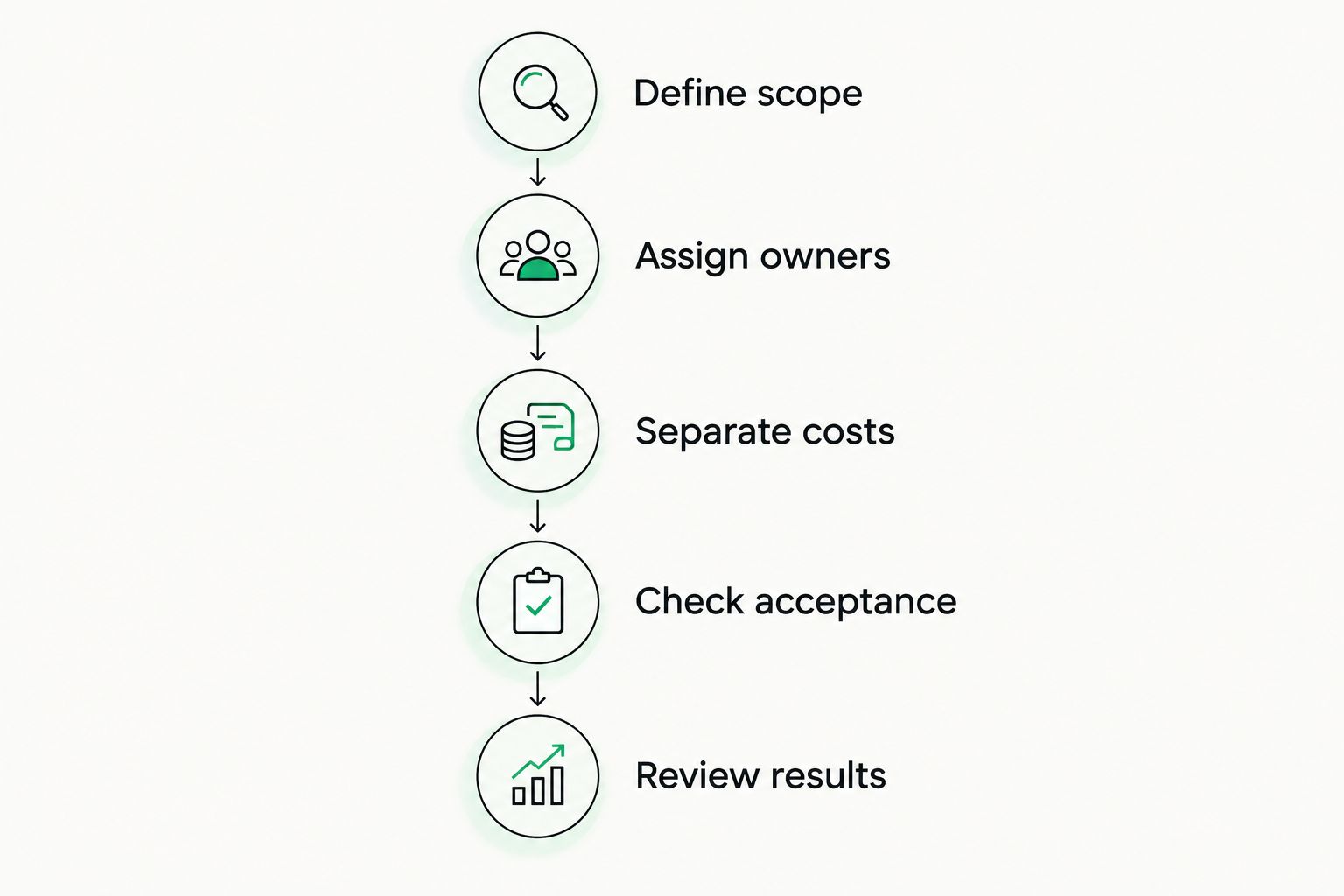
Compare the same deliverable and assign every task before evaluating the total.
The comparison is complete only when both models end at the same accepted outcome. Otherwise, you are measuring different purchases.
Is a TMS cheaper than a translation agency?
A TMS is cheaper only when its complete operating cost is lower for the same accepted output. Include translators, reviewers, coordination, and setup alongside software.
Do not credit automation with savings before identifying the manual work it replaces. Use actual workflow records to distinguish reduced effort from work transferred to another person.
Do you still need translators when you buy a TMS?
Buying a TMS does not remove the need to assign responsibility for translation quality. Your workflow still needs a defined approach to producing, reviewing, and approving target-language content.
Whether you use human translation, machine translation with post-editing, or another agreed process, compare the effort required to reach acceptance—not merely to produce a draft.
Can translation memory reduce agency spending too?
Translation memory supports reuse in agency-managed work as well as internally managed work. The commercial effect depends on the agreement, including how matches are classified and what review they require.
Ask who owns the memory, who maintains it, and how approved updates reach future projects. Reuse is less useful when the stored translation no longer fits the context.
FAQ
What's the fairest way to compare translation agency cost vs TMS?
Compare the total cost of delivering the same approved translations. Include technology, language work, review, coordination, setup, and rework under each model.
Is translation software a replacement for a translation agency?
Translation software is not a direct replacement for an agency's service responsibilities. A TMS supports the workflow; someone still needs to perform and manage the language work.
Does an agency quote include proofreading and formatting?
The written scope determines whether proofreading and formatting are included. Ask the agency to identify each deliverable and exclusion before accepting the proposal.
Can I keep my translation agency and use a TMS?
You can combine an agency with a TMS when both parties agree on workflow access and responsibilities. Define who assigns work, reviews translations, maintains language assets, and approves delivery.
What should I budget for besides the TMS subscription?
Budget for language work, review, internal coordination, and implementation tasks required by your workflow. Ask the vendor to explain any separately contracted usage, support, or data-transfer work.
Is Wxrks a translation agency or translation management software?
Wxrks is translation management software. Its stated functions include localization workflow automation, translation memory, quality management, and cost tracking.
Should I compare translation providers only by their per-word charge?
A per-word charge alone does not establish total delivery cost. Compare the included review, coordination, formatting, revisions, and treatment of reusable translations.
One last thing
Before signing a 2026 agreement, ask every provider the same question: What work will my team still own after this purchase?
Put the answer beside the proposal. The decision becomes clearer when you can see the remaining tasks—not just the external charge. Choose the model that assigns those tasks deliberately and delivers the approval standard your content requires.
Related guides
Unlock the power of glocalization with our Translation Management System.
Unlock the power of
with our Translation Management System.