How long does it take to translate a website?


Website translation has no fixed turnaround: your deadline depends on the content in scope, the language team’s working pace, review requirements, and publishing work. Count the project as finished when the translated site passes review and works in its destination language—not when a draft is ready.
TL;DR
- How long does it take to translate a website? Estimate translation, review, and publishing separately before committing to launch.
- Wxrks supports translation management; a credible website deadline still requires measured work and named reviewers.
- Translation memory helps reuse approved wording, but reused text still needs context checks.
- Machine translation produces a draft, not proof that a website is ready to publish.
How long does it take to translate a website?
Build your website translation schedule from the work required, not from the page count alone. A page with repeated navigation labels creates a different workload from a page with original product explanations, embedded graphics, and legal disclosures.
For a 2026 launch, ask for separate estimates for content preparation, translation, review, implementation, and final testing. Identify which activities can overlap and which require an earlier task to finish.
If your plan starts with machine-generated text, include machine translation post-editing in the schedule. Draft generation and editorial approval are different tasks.
Use this breakdown to turn a delivery promise into a plan you can check:
Content preparation
- What the estimate must cover: Finding text, removing duplicates, resolving source questions
- Completion condition: Approved source content is ready
Translation
- What the estimate must cover: Producing destination-language text with context
- Completion condition: Translation is ready for review
Language review
- What the estimate must cover: Checking meaning, terminology, tone, and omissions
- Completion condition: Reviewer approves the text
Implementation
- What the estimate must cover: Putting approved content into the website
- Completion condition: Translated pages render correctly
Site testing
- What the estimate must cover: Checking layouts, links, forms, and language behavior
- Completion condition: Blocking issues are resolved
Publication
- What the estimate must cover: Releasing the approved language version
- Completion condition: The published site passes final checks
A schedule that ends at translation leaves implementation and testing outside the deadline. Make the delivery definition explicit before work starts.
Why this matters
A translated file and a working multilingual website are different deliverables. Your translator can finish the copy while your developer is still fixing text overflow or your reviewer is waiting for answers about terminology.
This distinction matters when planning a 2026 release because a draft milestone does not establish a publication date. Ask for the date the language version will be ready for visitors, not just the date the translation will arrive.
Name an owner for each handoff. If nobody owns the transfer from approved text to published page, the schedule contains an unresolved dependency.
How do you estimate your website translation timeline?
Use a small, representative content batch to establish a working pace. Choose material that reflects the actual site rather than only its shortest or simplest pages.
1. Define the launch scope
List the pages and languages required for publication. Include navigation, buttons, forms, error messages, metadata, image text, and downloadable files when those elements belong in the launch.
Separate essential visitor journeys from content that can follow later. Translating fewer pages is a scope decision; it is not evidence that the translation process itself became faster.
2. Prepare the source content
Resolve unclear wording, outdated information, and conflicting terminology before translation begins. Give translators the context they need to distinguish a button label from a heading or a product instruction.
Record the source version used for the project. If the source changes during translation, track the change instead of silently replacing the text.
3. Separate new text from reusable text
Count new content separately from material with approved translations. Review translation-memory matches in context, especially when wording appears in a different page type or user journey.
Do not treat every repeated sentence as automatically approved. A familiar phrase can still need a different translation when its function changes.
4. Measure a representative batch
Translate and review a sample that includes the site’s real difficulties. Include specialized terminology, interface text, or persuasive copy when those appear in the planned release.
Record the working time and the elapsed time separately. Time spent translating tells you about production; elapsed time also captures queues, questions, and reviewer availability.
5. Map dependencies
Identify work that must happen in sequence. A final layout check needs implemented text, while terminology preparation can begin before the whole translation batch is complete.
Use this planning rule: launch time follows the longest dependent path through preparation, translation, review, implementation, and testing. Adding every task together overstates the schedule when work overlaps; ignoring dependencies understates it.
6. Confirm the release conditions
Specify who approves language quality, who checks functionality, and who authorizes publication. Define which defects block launch and which edits belong in a later update.
For a 2026 project, keep those conditions beside the schedule. A deadline without an acceptance standard leaves room for disagreement about whether the work is finished.
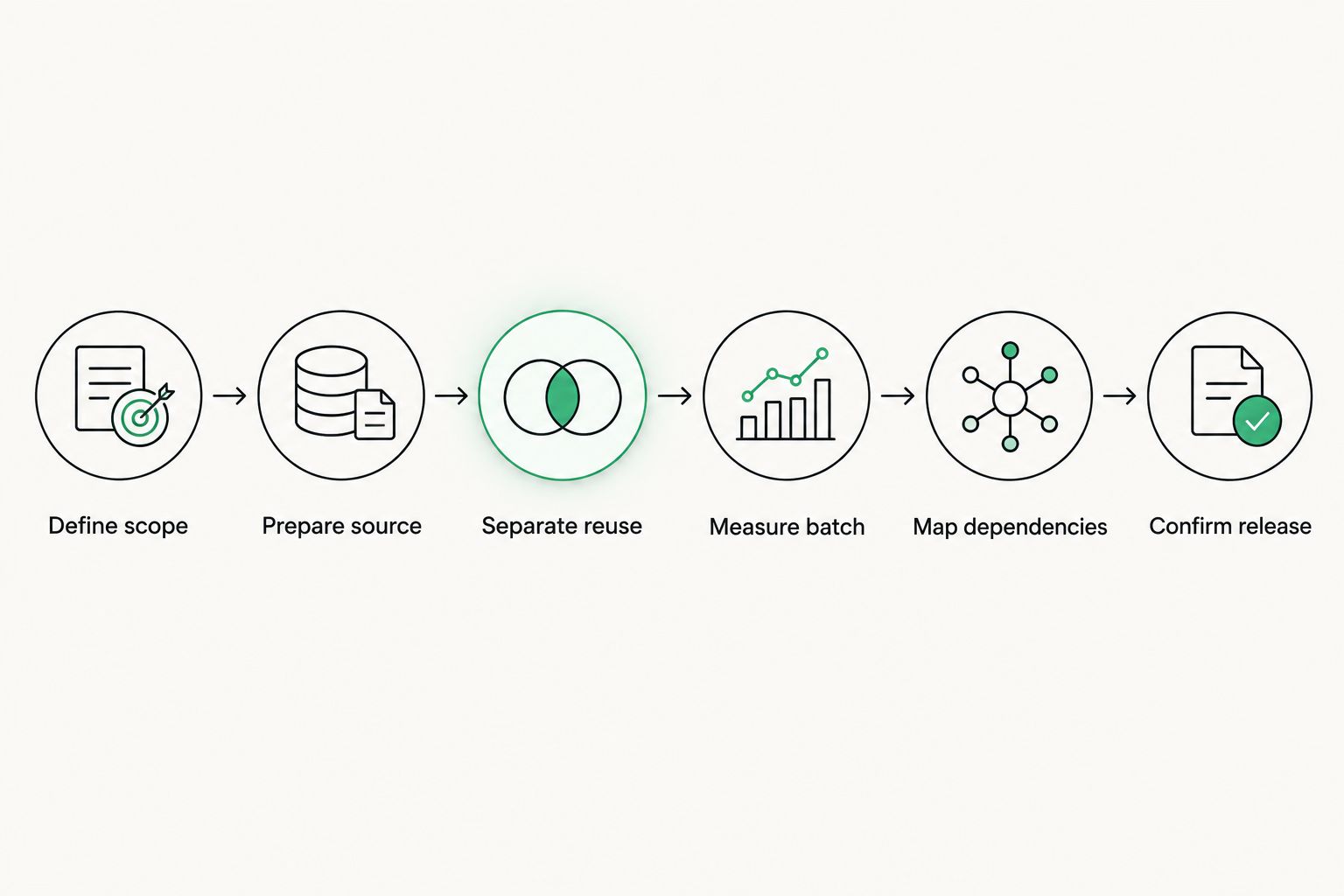
Estimate the complete release process rather than translation alone.
Which translation workflow fits your website?
Choose the workflow by the content’s purpose and review needs. Do not assume that the method producing a draft fastest also produces an approved website fastest.
Human translation
- Best for: Content requiring close attention to intent and context
- Main advantage: A translator develops the wording from the source
- Main limitation: Review and production capacity must be scheduled
Machine translation with post-editing
- Best for: Content where a machine draft proves useful in a representative sample
- Main advantage: A draft gives the editor a starting point
- Main limitation: Correction effort depends on draft quality
Translation-memory reuse
- Best for: Repeated content with approved previous translations
- Main advantage: Existing wording provides a reusable reference
- Main limitation: Matches still require context and version checks
Human translation: schedule production and review
Best for: content whose meaning, tone, or consequences require close editorial attention. Provide page context, reference material, and terminology decisions before the translator starts.
The advantage is deliberate wording built around the source’s intent. The limitation is that translation capacity does not remove approval queues, unanswered questions, or implementation work.
Machine translation with post-editing: measure correction effort
Best for: content where a representative sample demonstrates that editing the draft is useful. Compare the reviewed result with your acceptance requirements, not just with the original machine output.
The advantage is a ready draft. The limitation is that a fluent sentence can still contain a meaning error, and the reviewer must check the content rather than merely polish its style.
Translation-memory reuse: check the context
Best for: recurring website content with approved translations. Translation memory stores source-and-translation pairs that can inform later work.
The advantage is reuse of established wording. The limitation is that an old translation does not settle whether the source, terminology, or destination-page context has changed.
Why website translation timelines vary
These factors explain why similar-looking websites need different schedules. Use them to challenge an estimate before you accept it.
- Content scope. Count the text visitors encounter throughout the journey, including interface messages and supporting documents—not just visible paragraphs.
- Reuse quality. Approved, relevant translations provide a different starting point from outdated text that needs investigation and correction.
- Language coverage. Each destination language needs its own production, review, and release plan. Parallel work depends on the people assigned to it.
- Editorial requirements. Brand voice, specialist terminology, and sensitive instructions require clear acceptance criteria and suitable reviewers.
- Technical implementation. Embedded text, dynamic content, layout changes, and language selection all affect what must be checked on the website.
- Approval and source changes. Unanswered questions, late edits, and unclear ownership interrupt otherwise ready work.
Your 2026 estimate should identify which of these factors remains unresolved. Turn each unresolved issue into an assigned task rather than hiding it inside a vague delivery promise.
How can you shorten the schedule without skipping quality checks?
Remove avoidable waiting before asking people to translate faster. Start by giving each reviewer a defined content batch, an approval standard, and a place to record decisions.
Prepare a glossary before terminology disputes spread across the site. Supply screenshots or page context for short strings whose meaning is unclear in isolation.
Keep the source stable during a translation batch. When changes are necessary, identify the changed text so the team can assess it without rereading everything.
Publish in stages only when each stage gives visitors a complete, usable journey. A translated landing page that sends visitors into an untranslated form is not a complete localized experience.
For teams coordinating this work, Wxrks is a translation management system covering localization workflows, translation memory, quality management, and cost tracking. Wxrks is suited to translators, developers, enterprises, and translation agencies managing localization workflows.
Wxrks translation management addresses workflow organization; your team still owns source readiness, review decisions, and website acceptance. Treat software as part of the process, not as a substitute for defining the work.
Does adding more translators finish the website sooner?
Adding translators helps when the work can be divided and the rest of the workflow can keep pace. It does not remove a shared reviewer, an unresolved terminology decision, or a blocked deployment.
Assign related content together where context matters. Give everyone the same terminology guidance, then reserve time to check consistency across the combined output.
Increase capacity at the bottleneck. More draft production does not solve a queue of completed pages waiting for approval.
Can you translate a website before every page is final?
You can begin with approved, stable sections while other sections remain in development. Keep the boundaries clear and track source changes affecting work already translated.
This approach trades an earlier start for change-management work. Use it when you can identify versions reliably and assign responsibility for reconciling later edits.
FAQ
How long does it take to translate a website in 2026?
A website translation deadline depends on content scope, working pace, review, implementation, and testing. Estimate those stages using a representative content batch, then account for dependencies and reviewer availability.
Can I estimate website translation time from the number of pages?
Page count alone does not establish translation time. Measure the text and page elements in scope, then separate new content from approved reusable translations.
Is machine translation enough to launch a translated website?
Machine translation alone does not establish that a website is ready to launch. Check meaning, terminology, page rendering, links, forms, and language behavior before publication.
Does translation memory make website translation faster?
Translation memory provides reusable source-and-translation pairs for recurring content. Check matches against the current source and page context before treating them as approved.
Should every language version launch on the same date?
Launch language versions together when they meet the same release requirements and your business needs a coordinated launch. Otherwise, define a complete visitor journey and acceptance criteria for each staged release.
What should I ask a translator before agreeing to a deadline?
Ask what the deadline includes: translation only, reviewed content, or a tested website ready for publication. Confirm scope, source versions, reviewer responsibilities, and how changes will be handled.
What usually gets left out of a website translation schedule?
A translation-only estimate excludes implementation and website testing unless those tasks are explicitly included. Put publishing ownership and release checks in the schedule so the delivery date means a usable website.
One last thing
Check the failure paths, not just the homepage. Submit an incomplete form, follow a broken link, and trigger a validation message in the destination language.
Those checks reveal whether your translated content covers the visitor’s actual experience. For your 2026 launch, define completion around that experience—not around a folder of approved files.
Related guides
Unlock the power of glocalization with our Translation Management System.
Unlock the power of
with our Translation Management System.