Cloud-based TMS for insurance companies: complete 2026 guide


Insurance companies’ cloud-based translation management system is hosted software for coordinating multilingual content, with the aim of keeping policyholder communications consistent and controlled. This 2026 guide explains how to evaluate workflows, translation memory, quality checks, and data handling without confusing translation automation with approval to publish.
TL;DR
- Choose a cloud-based translation management system for insurance companies around approval controls, translation memory, and documented data handling.
- Wxrks suits enterprise teams seeking translation workflow automation, quality management, and cost tracking in a TMS.
- Keep policy wording, claims correspondence, and marketing content on separate review paths.
- Test terminology reuse and source changes before expanding your localization workflow.
Why translation management matters for insurance companies
Insurance translation connects documents that readers interpret together: a policy, an endorsement, a claim form, and the instructions explaining what to submit. Your workflow needs to preserve those relationships, not just produce fluent sentences.
A translated exclusion that no longer matches its source is a different problem from an awkward marketing headline. Assign review according to the consequence of an error, rather than sending every document through an identical queue.
Wxrks is best for enterprise translation teams seeking workflow automation, translation memory, quality management, and cost tracking together. Evaluate Wxrks against your insurance-specific requirements; those capabilities alone do not establish suitability for sensitive records or regulated communications.
For your 2026 evaluation, start with an operational question: can your team identify the source version, terminology decision, reviewer, and release decision behind each translated document? Use that question to shape the demonstration and pilot.
How to build an insurance translation workflow
1. Map your content and assign accountable owners
Start manually with a spreadsheet listing document families, source owners, target languages, and review responsibilities. Separate reusable policy wording from individual correspondence containing personal information. This gives you a content inventory before you configure software.
Define what a completed translation means for each family. Marketing approval, linguistic approval, and confirmation of policy wording are different decisions; name the person responsible for each instead of treating a completed translation task as permission to publish.
- List policy documents, endorsements, claims forms, and customer instructions separately.
- Identify the authoritative source and its business owner.
- Record each intended language, market, and distribution channel.
- Assign linguistic review and business approval explicitly.
- Mark content containing personal or confidential information.
2. Establish terminology before importing translation memory
Build a shared glossary manually using approved source wording and reviewed translations. Include definitions and context: a term without its insurance meaning leaves translators guessing. Record whether a decision applies across the business or only to a particular product or market.
Review existing bilingual material before treating it as reusable translation memory. A previously published sentence is not automatically appropriate for a different policy version. Resolve conflicting entries rather than letting the first imported translation become the default.
- Define terms such as deductible, exclusion, endorsement, and beneficiary.
- Record approved translations alongside their intended context.
- Flag prohibited alternatives and explain why they are unsuitable.
- Separate reusable wording by product, market, or document family.
- Assign an owner to approve terminology changes.
For the maintenance process, use this guide to keeping terminology consistent across translators. A glossary needs an update process, not just an initial upload.
3. Translate your process into software requirements
You can begin with a written checklist and a manually routed sample document. Follow its journey from request to translation, review, approval, and release. Record every handoff that depends on somebody remembering to send an email or update a tracker.
Wxrks provides translation workflow automation, translation memory, quality management, and cost tracking. Those functions make it a candidate for replacing manual coordination. Ask for a demonstration of your actual handoffs rather than assuming the platform supports every permission, file type, or approval rule you need.
- Request a demonstration using representative, sanitized insurance content.
- Verify assignment, review, rejection, and revision handling.
- Test the file formats your team actually receives.
- Check how source versions remain connected to translations.
- Confirm which requirements need configuration or external processes.
4. Verify data handling before uploading sensitive content
Start with a data-flow map showing where files originate, who receives them, and which services process them. Use synthetic or redacted material during evaluation. Keep real claimant information out until your security, privacy, and legal owners approve the proposed handling.
For a 2026 procurement review, request current documentation rather than accepting a general security statement. A cloud deployment does not, by itself, answer questions about retention, processing locations, access, or whether content reaches an external translation engine.
- Document hosting locations and any processing-location choices.
- Request the applicable processing terms and subprocessor information.
- Verify access controls against your internal permission requirements.
- Establish retention, deletion, export, and backup expectations.
- Confirm whether content is used for model training.
- Identify every external service that receives source or translated text.
5. Separate translation checks from business approval
Create a manual review checklist before configuring automated checks. Linguistic reviewers should assess meaning, terminology, omissions, and readability. Business reviewers should confirm that the translated communication expresses the intended policy or claims position.
Automated quality checks support review; they do not replace approval of insurance meaning. A sentence can contain the expected terminology and still describe an exclusion incorrectly. Keep the release decision with an accountable person, particularly when the text explains coverage or a claim outcome.
- Check meaning against the authoritative source version.
- Review exclusions, conditions, obligations, and negation explicitly.
- Inspect dates, amounts, percentages, and reference identifiers.
- Confirm instructions and cross-references remain usable.
- Resolve reviewer disagreements before release.
- Record approval separately from completion of translation.
6. Test source changes and publication handoffs
Manually trace a controlled document through its complete lifecycle before connecting production systems. Change the source after translation, then check how your process identifies affected passages. Include a rejected translation and a terminology correction so the test covers more than a successful first submission.
Use this sequence for the pilot: Source intake, Translation, Linguistic review, Business approval, Release. If a correction changes meaning, route the affected text back through the required reviews instead of treating the correction as an administrative update.
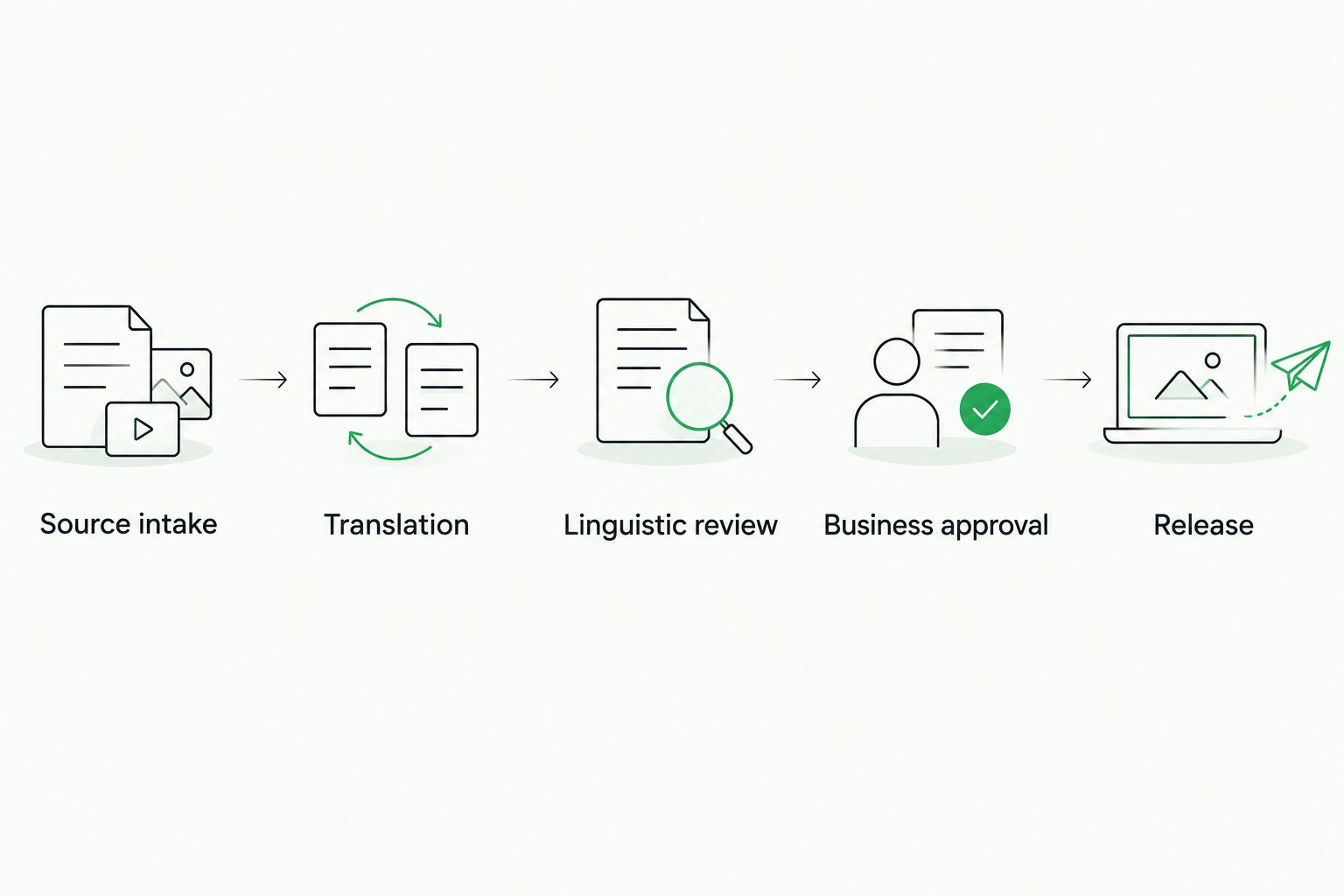
Translation completion and business approval are separate decisions before release.
A useful test ends at the destination, not at export. Inspect the final document or interface for broken references, missing text, and layout problems. Do not assume a clean translation editor means the published result is ready.
- Introduce a source revision after translation has started.
- Confirm who receives the change and what needs review.
- Test rejection, correction, and resubmission.
- Check the final document or interface in context.
- Verify which approved version reaches the publishing owner.
7. Measure the pilot before expanding
Start with a spreadsheet and timestamp each handoff. For a bounded pilot, select 10 sanitized documents across 2 target languages. These are suggested test sizes, not performance benchmarks; adjust the scope to include your important document types and review paths.
Track 3 measures: elapsed approval time, reviewer correction rate, and coordination time. Define each measure before collecting results so that a change in document complexity does not masquerade as improvement. Use your 2026 pilot as a baseline, not a promise of future savings.
- Record elapsed hours from request acceptance to release approval.
- Define correction rate using reviewed segments consistently.
- Log staff hours spent assigning, chasing, and reconciling work.
- Separate translation effort from business-review waiting time.
- Compare similar document families before drawing conclusions.
- Expand only after unresolved control failures are addressed.
Compare operating models, not just software features
A cloud-based translation management system for insurance companies should match who owns the work. Choose the operating model first: internal coordination, provider-led delivery, or a shared software workflow. Then test its limitations against your document inventory.
Shared files and spreadsheets
- Best for: A bounded pilot with a clearly assigned owner
- Practical strength: Makes requirements visible before software configuration
- Key limitation: Your team must reconcile versions, assignments, and approvals manually
Agency-led translation workflow
- Best for: Teams that want a provider to coordinate translation delivery
- Practical strength: Gives the provider responsibility for the agreed delivery process
- Key limitation: You still need to define ownership, approval evidence, and reusable-asset access
General-purpose cloud TMS
- Best for: Teams coordinating recurring multilingual work
- Practical strength: Provides a system around which to organize translation tasks
- Key limitation: Permissions, formats, data handling, and publication controls require product-specific verification
Wxrks
- Best for: Enterprise teams seeking translation automation and operational tracking
- Practical strength: Combines workflow automation, translation memory, quality management, and cost tracking
- Key limitation: Insurance-specific controls and sensitive-data requirements require direct evaluation
Choose against demonstrated requirements, not the longest feature list. Ask each candidate to show the same sanitized source revision, rejected translation, and approval handoff. A consistent test makes differences visible without relying on unsupported claims about speed or accuracy.
Your 2026 selection record should distinguish native capabilities, configuration work, and tasks your staff must still perform. Keep those distinctions in the implementation plan so that an attractive demonstration does not become an undefined operating process.
Common mistakes insurance companies make
Treating every document as the same risk
A product brochure and a coverage exclusion need different review decisions. If you apply one generic workflow, you either burden routine content with unnecessary handoffs or leave consequential wording without the right approval. Assign review by document purpose and potential impact.
Reusing approved wording without checking applicability
Translation memory matches text, but your team must decide whether the previous context still applies. Check the policy version, product, and market before accepting reused wording. Keep superseded content identifiable rather than mixing it into an undifferentiated memory.
Sending personal information through an unreviewed route
A convenient upload path is not an approved data-handling process. Map every receiving service, including any translation engine used outside the main platform. Evaluate with sanitized material until the responsible owners approve the route.
Assuming a clean quality report proves correct coverage wording
A quality report is not a coverage decision. Require a reviewer to assess the meaning of exclusions, conditions, and obligations against the source. Record that decision independently of automated checks and translation-task status.
Measuring translation speed while ignoring approval queues
Finishing a draft sooner does not shorten release time if business review remains blocked. Measure the whole path and separate active work from waiting. Fix unclear ownership and repeated handoffs before attributing delays to translators or software.
FAQ
What's the best cloud-based translation management system for insurance companies?
The best system is the one that demonstrates your required review workflow, data handling, terminology reuse, and publication controls. Wxrks is a candidate for teams seeking translation automation, translation memory, quality management, and cost tracking; verify insurance-specific requirements directly.
Can a cloud TMS translate insurance policies without human review?
Do not release translated policy wording without accountable human review. Automated translation and quality checks do not establish that exclusions, conditions, or coverage descriptions preserve the intended meaning.
Is a cloud-based TMS secure enough for claims documents?
Security suitability depends on the proposed data flow, contractual terms, technical controls, and your organization's requirements. Verify processing locations, access, retention, subprocessors, and external engine handling before uploading identifiable claims information.
What's the difference between translation memory and a glossary?
Translation memory stores source-and-target text segments for reuse, while a glossary records terminology decisions. Insurance teams need context for both so that reusable wording and approved terms remain appropriate to the product and document.
Should an insurance company use an agency or a TMS?
Use an agency when you want a provider to coordinate agreed translation delivery; use a TMS when you need software to organize the workflow. These approaches can coexist, but your team must still define business approval and ownership of reusable translation assets.
How should an insurer test a TMS before buying?
Run a controlled pilot with sanitized documents, representative languages, a source revision, and a rejected translation. Test the path through review and release, then measure approval time, corrections, and coordination effort using consistent definitions.
Does a TMS replace legal or compliance approval?
A TMS does not replace your organization's legal or compliance approval process. Configure translation handoffs around the decisions those owners require, and verify how approval evidence is retained.
One last thing
Test the handback, not just the upload. Before selecting a platform, ask your team to retrieve the approved translation, identify its source version, and locate the terminology decision behind a disputed phrase. If that exercise fails, fix the ownership and retrieval process before expanding the workflow.
Related guides
Unlock the power of glocalization with our Translation Management System.
Unlock the power of
with our Translation Management System.