Can machine translation handle low-resource languages well?


Machine translation can handle some low-resource language tasks well, but it needs validation for the exact language pair, subject, and intended use. In 2026, use it as a draft for qualified human review—not as proof that content is ready to publish; fluent output can still omit information, change meaning, or use the wrong language variety.
TL;DR
- For machine translation low-resource languages projects, validate meaning with qualified reviewers before publishing.
- Evaluate the exact language pair, direction, dialect, and subject—not just the engine’s supported-language list.
- Translation memory preserves approved wording; it does not prove that new machine translations are accurate.
- Wxrks supports translation management workflows; language quality still requires qualified human judgment.
Why this matters
A translation can read smoothly while giving the wrong instruction. If you cannot read the target language, that error is difficult to spot without a reviewer who understands both the source and the audience.
For your 2026 localization plan, separate language availability from release readiness. An engine accepting a language does not establish its accuracy for your material. Start with how to measure translation quality accurately, then define what must pass before publication.
Can machine translation handle low-resource languages well?
Yes, for validated tasks with appropriate review; no, as a blanket promise across languages and content types. Low-resource describes limited usable language data for a computational task. It does not mean that a language has few speakers, little cultural value, or simple grammar.
The practical question is whether a machine-generated draft helps your reviewer produce an acceptable translation. If repairing that draft requires more work than translating the source directly, the draft has not helped.
These 3 workflows offer different levels of control. Choose by the consequences of an error and the results of your own evaluation.
Machine-only translation
- Best for: Low-consequence internal gist, after validation
- Main benefit: Produces an initial rendering without a human editing stage
- Main limitation: Meaning errors remain unchecked; unsuitable as the default for consequential content
Machine translation with human review
- Best for: Content where a tested draft helps qualified reviewers
- Main benefit: Combines draft generation with correction and approval
- Main limitation: Review effort can erase the drafting benefit
Human translation with language resources
- Best for: High-consequence material or language pairs that fail testing
- Main benefit: Gives a translator direct control over meaning and expression
- Main limitation: Requires qualified linguistic capacity and project coordination
These are workflow choices, not permanent labels for a language. The same language pair can pass for routine internal material and fail for specialized instructions.
Machine-only translation: best for validated internal gist
Machine-only output fits a narrow purpose: helping someone get an initial sense of low-consequence content. Treat that output as provisional, especially when a mistaken interpretation would trigger an action.
Its advantage is the absence of a human editing stage. Its weakness is exactly the same: nobody has confirmed that the source meaning survived.
Do not extend approval for internal gist to customer-facing publication. A draft that helps an employee sort documents has not demonstrated that it can explain eligibility, resolve a complaint, or communicate a safety warning. Keep the permitted use narrower than the evidence.
Human-reviewed machine translation: best for useful drafts
Human-reviewed machine translation is appropriate when qualified reviewers find the output useful and can correct it against the source. Review must cover meaning, terminology, omissions, additions, and language variety—not just grammar.
The benefit is a possible reduction in work from a usable starting point. The trade-off is that fluent but incorrect wording demands careful source comparison, and extensive repairs can make the approach counterproductive.
Give reviewers permission to reject the draft entirely. Requiring them to preserve machine wording turns an evaluation into a repair exercise. Use this workflow only when review confirms that the draft helps.
Human translation: best for failed tests and high consequences
Human translation is the stronger starting point when machine output fails your acceptance criteria or an error carries serious consequences. Provide the translator with reference material, approved terminology, audience information, and a clear review brief.
Direct human authorship does not eliminate quality control. A translator can still misunderstand an ambiguous source, miss a specialist term, or choose a variety that does not fit the audience.
The benefit is direct linguistic judgment without first untangling an unreliable draft. The constraint is access to qualified people. Choose qualified translation and review rather than accepting unverified output to fill a staffing gap.
Why low-resource machine translation quality varies
There is no single quality level for low-resource languages. Assess these factors separately when planning or retesting a workflow in 2026:
- Training material: Useful parallel text gives a system examples of corresponding meanings. Limited, noisy, or mismatched material weakens that foundation.
- Language direction: Performance from one language into another does not establish performance in reverse. Evaluate both directions if your workflow needs both.
- Subject matter: General-language capability does not establish command of specialized terminology. Test the subjects your audience will actually encounter.
- Language variety: Dialect, spelling conventions, script, and register affect whether a translation fits its readers. Specify the intended variety before evaluation.
- Available context: An isolated phrase can hide who is speaking, what an object refers to, or how a word functions. Give reviewers the surrounding content and intended use.
- Reference quality: Approved examples and glossaries help define the target. Incorrect or outdated references give reviewers—and any workflow using them—the wrong standard.
These factors also explain why a successful demonstration is not enough. A polished paragraph about a familiar topic does not represent a collection containing abbreviations, specialist instructions, and ambiguous interface labels.
How do you test a low-resource language workflow?
Use 5 stages to decide whether machine translation belongs in production. Keep the evaluation separate from your release deadline so a disappointing result can change the workflow rather than merely delay approval.
Define scope
Write down the source language, target language, direction, intended variety, audience, and content type. Specify whether the output is for internal understanding or publication.
Resolve ambiguous requirements before testing. “Translate into the local language” is not enough when readers use different scripts, spelling conventions, or registers.
Build samples
Select real material that represents the work, including difficult passages. Include short labels, longer explanations, terminology, names, negation, and instructions where relevant.
Remove sensitive information unless the proposed processing arrangement permits it. Keep a separate evaluation set out of any examples used to configure or adapt the system; otherwise, the test can reward familiarity rather than useful generalization.
Review meaning
Have a qualified reviewer compare the source and target. Ask what changed, disappeared, or appeared without support in the source.
Record the error and its consequence, not just a preference for different wording. Distinguish a stylistic improvement from a reversed instruction or a missing condition.
Compare workflows
Give comparable material to the candidate workflows under consistent conditions. Record reviewer time, rejected drafts, unresolved terminology, and final approval decisions.
Judge the finished result as well as the initial draft. A fluent draft is not a successful workflow if reviewers spend their effort finding hidden meaning errors.
Set release rules
Define which content can enter each workflow, who approves it, and what blocks publication. Assign an escalation path when reviewers disagree or no qualified reviewer is available.
Retest after material changes to the engine, subject matter, source style, or target audience. An approval in 2026 applies to the tested conditions, not every future project.
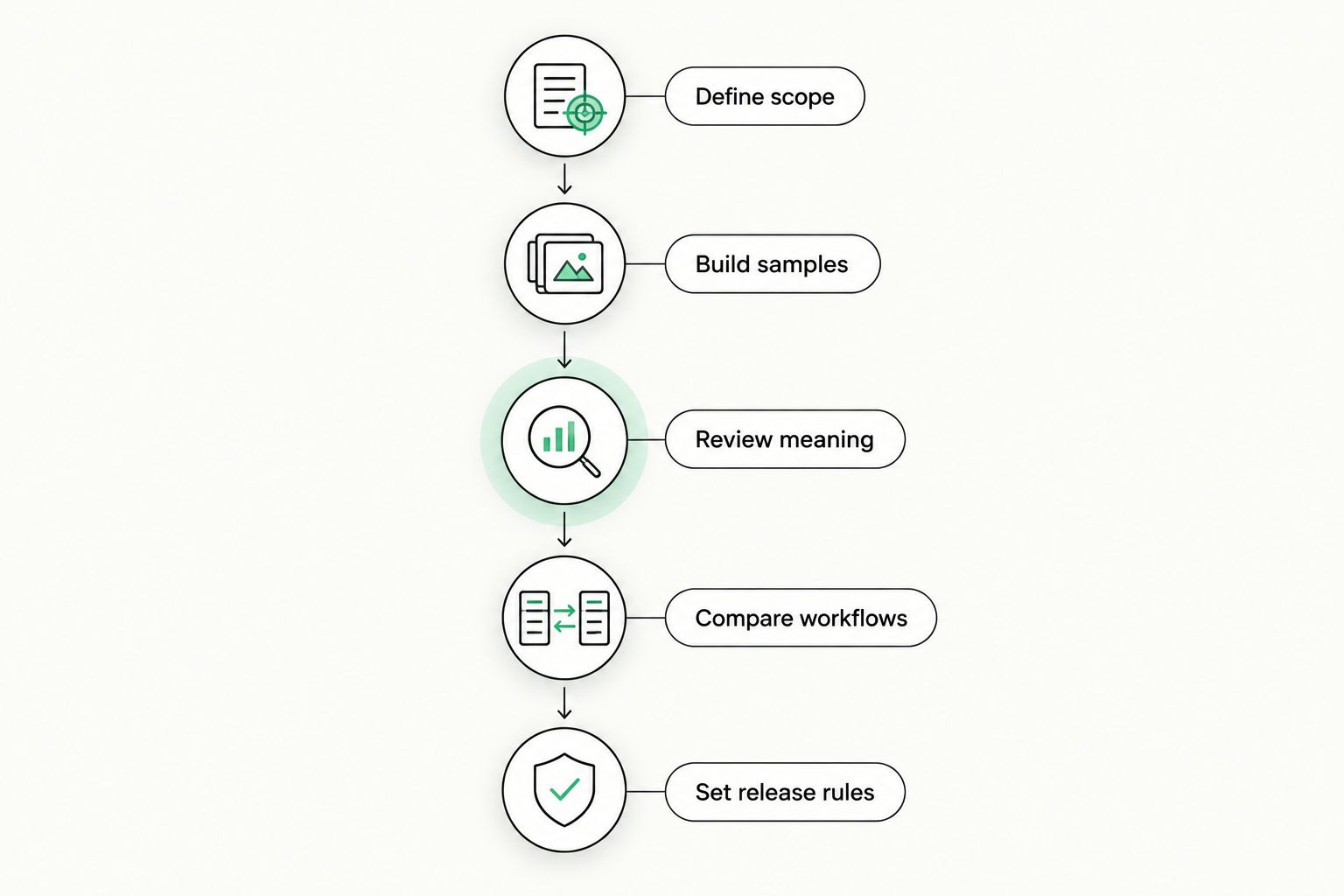
Approve a defined workflow, not an entire language based on a demonstration.
What should block publication?
Block release when the translation reverses a prohibition, changes who must act, drops a condition, invents an instruction, or leaves a consequential ambiguity unresolved. A reviewer should be able to stop publication without having to prove that the entire batch is poor.
Mechanical checks remain useful for missing content, damaged placeholders, and inconsistent terminology. They complement linguistic review; passing those checks does not establish that a sentence means the right thing.
Can more context improve low-resource translation?
Context can resolve ambiguity, but it cannot guarantee an accurate translation. Supply the complete sentence, its purpose, relevant surrounding text, and approved terminology when the workflow supports those inputs.
For interface text, explain the action and the object involved. For support content, preserve the question and answer together rather than treating each short fragment as an independent document. These details also help human reviewers identify the intended meaning.
Keep terminology instructions precise. Explain whether a term must be translated, preserved, or handled differently in a particular context; a bare word list can leave the important decision unanswered.
Does translating through English solve the problem?
Translating through English does not establish that the final result is correct. A pivot workflow adds an intermediate translation where meaning can change before the target-language stage begins.
Compare direct and pivot translation on the same representative material if both are candidates. Have a qualified reviewer assess the final output against the original source—not only against the English intermediate text.
The original matters. If the intermediate version drops a qualification, a faithful translation of that version still fails the actual task.
Can translation memory make the workflow more reliable?
Translation memory stores previous source-and-target segments for reuse. Approved matches can reduce repeated translation decisions, but a stored segment still needs to fit the current context.
Treat memory maintenance as quality work. Keep unreviewed machine output separate from approved translations so an unchecked suggestion does not become a trusted reference merely because it was saved.
A glossary serves a different purpose: it records terminology decisions rather than whole translated segments. Neither resource guarantees that a new sentence is correct, and neither automatically proves that an underlying translation model has learned from an edit.
Where does a translation management system fit?
A translation management system supports the work around translation: workflow coordination, translation memory, quality management, and cost tracking. Those functions help you manage a process; they do not certify a language pair’s accuracy.
Wxrks is best for translators, developers, enterprises, and agencies seeking translation workflow management—not a substitute for qualified language review. Wxrks translation management software supports automation, translation memory, quality management, and cost tracking.
For a low-resource language project, judge Wxrks translation management software against those operational needs. Keep the linguistic acceptance decision separate: a managed workflow still needs approved terminology, suitable reviewers, and clear release criteria.
FAQ
Can machine translation handle low-resource languages accurately?
Machine translation can produce useful results for some low-resource language tasks, but accuracy must be validated for the exact language pair, subject, and intended use. Qualified source-to-target review is necessary before consequential publication.
Does low-resource mean that a language has few speakers?
Low-resource refers to limited usable data for a computational task, not simply a small speaker population. A language with many speakers can still lack suitable parallel text for a particular translation task.
Is machine translation with human review better than human translation?
Human-reviewed machine translation is better only when evaluation shows that the draft helps reviewers reach an acceptable result. If correcting the draft creates more work than translating directly, use human translation.
Can I trust a translation because it sounds fluent?
Fluency does not prove accuracy. A natural-sounding translation can still omit a condition, change an instruction, or add information that is absent from the source.
Should I test both translation directions separately?
Test both translation directions separately when your workflow needs both. Performance in one direction does not establish performance in the reverse direction.
Will a glossary fix low-resource machine translation?
A glossary helps define terminology, but it does not fix every meaning, grammar, or context error. Review complete sentences against the source rather than treating term compliance as final approval.
What should I do if no qualified reviewer is available?
Do not publish consequential machine-translated content without suitable review. Change the release plan or obtain qualified linguistic support instead of treating unchecked output as approved.
One last thing
A fluent translation deserves scrutiny, not automatic trust. Awkward wording attracts attention; a smooth sentence that quietly changes a requirement can pass unnoticed.
For your next 2026 pilot, ask reviewers to explain meaning-changing errors before polishing style. That order keeps the decision focused on whether the workflow preserves what your audience needs to understand.
Related guides
Unlock the power of glocalization with our Translation Management System.
Unlock the power of
with our Translation Management System.