Can localization software handle plural and gendered forms?


Yes. Localization software can handle plural and gendered forms when its file support, editing interface, and your application's message formatter preserve the required variants. The catch is that software cannot select a grammatical form from context your application never supplies, and translators still need to review agreement and wording.
TL;DR
- Can localization software handle plural and gendered forms? Yes, with structured messages, locale-aware formatting, and linguistic review.
- Unicode CLDR defines plural categories; ICU MessageFormat expresses plural and selection branches.
- Gendered messages require explicit context, not guesses from names or grammatical gender.
- Wxrks manages localization workflows, translation memory, and quality; assess message-format handling with your own files.
Can localization software handle plural and gendered forms?
Yes—but support must survive the entire trip from source file to translated interface. An editor that accepts a plural expression is not enough if export flattens its branches or the application renders the wrong one.
For your 2026 evaluation, distinguish message storage, translation editing, and runtime selection. The software localization guide for product teams provides a broader starting point for that workflow.
Separate translation keys
- Best for: Simple messages with explicit application logic
- Strength: Each variant is independently editable
- Limitation: Developers must maintain selection logic and keep related keys together
ICU MessageFormat
- Best for: Messages combining counts and explicit selectors
- Strength: Keeps related alternatives within a structured message
- Limitation: Requires compatible parsing, editing, export, and runtime support
Neutral rewriting
- Best for: Messages that do not need gender distinctions
- Strength: Removes unnecessary branches
- Limitation: Does not replace required grammatical agreement
These approaches are not interchangeable. Choose the structure your application can render correctly, then confirm that the localization software preserves it.
Why this matters
A translated sentence can be fluent in isolation and wrong on screen. The failure often sits between the translation and the data used to display it.
Consider an English notification assembled from a number, a noun, and a verb. Translating those fragments separately prevents translators from changing word order or agreement across the complete sentence. A language-aware formatter cannot repair missing context after the fact.
Treat plural and gender support as an application requirement, not just an editor feature. Translators need complete messages; developers need predictable variables; reviewers need rendered examples. Your 2026 acceptance criteria should cover all three responsibilities.
Plural forms: use the target language's categories
Plural handling is not simply choosing between singular and everything else. Unicode Common Locale Data Repository, or CLDR, defines the categories zero, one, two, few, many, and other; individual languages use different subsets and rules.
English cardinal plurals use 2 categories: one and other. Arabic cardinal plurals use 6 categories. Those category names describe selection rules, not interchangeable labels for particular numbers across every language.
For example, a branch named one is not a universal instruction to use the singular whenever a displayed value looks close to one. Locale rules determine which branch applies, including rules involving fractional values.
What translators need to see
Give translators the complete count-dependent message, its variable, and its purpose. A notification about unread messages needs different context from a billing line that happens to contain the same noun.
The editor should expose the alternatives required by the target locale and protect structural elements from accidental changes. Ask whether the system validates missing branches, malformed syntax, and changed variable names rather than assuming every quality check covers them.
Keep linguistic examples separate from business rules. An exact match for 0 can provide a special empty-state message, but that is not the same thing as a language having a grammatical zero category.
Cardinal and ordinal messages need different rules
Cardinal messages describe quantities. Ordinal messages describe positions, such as a finishing place.
Do not reuse a cardinal selector for an ordinal message. In ICU MessageFormat, plural and selectordinal serve different purposes, and your application's formatter must support the structure you choose.
For a 2026 release, test the message type you actually ship. A successful quantity test does not establish that ordinal formatting works.
Gendered forms: supply context instead of guessing
Gendered language presents distinct problems: grammatical gender attached to nouns, agreement involving people, and wording that depends on an explicitly provided preference or linguistic attribute.
Grammatical gender is not a reliable description of a person's gender. A translation system should not infer personal identity from a name, photograph, account label, or the grammatical class of a noun.
An ICU select expression can choose among explicitly named branches. It does not discover which branch is appropriate. Your application must pass the relevant selector value, and translators must understand what that value means.
Prefer neutral wording when it preserves meaning
Best for notifications that do not need to refer to a person's gender: rewrite the complete message neutrally.
The advantage is simpler message logic and less reliance on personal data. The limitation is linguistic: an English rewrite does not guarantee that every target language avoids agreement elsewhere in the sentence.
Ask translators to assess the target-language sentence rather than mechanically copying the English strategy. Preserve the intended action, tone, and clarity.
Use explicit variants when agreement requires them
Best for messages with a genuine, documented agreement requirement: supply explicit variants and a suitable fallback.
The advantage is control over the complete wording. The limitation is maintenance: each branch needs translation and review, and the application must pass a meaningful selector.
Document what the selector represents. A variable describing the grammatical class of an object is different from a variable describing how a person should be addressed. Ambiguous variable names make those distinctions harder to maintain.
Combined forms: preserve the complete message
A notification can depend on both a count and a selector. ICU MessageFormat supports nested expressions, but your localization editor and runtime must both handle the actual nesting used in your files.
Do not split the sentence into reusable fragments merely to avoid a nested message. Fragments such as a translated subject, action, and object can prevent translators from adjusting agreement or word order.
Keep each meaningful sentence together wherever your message architecture allows. Provide a description of the variables and show the surrounding interface so translators know who is acting and what the count represents.
For 2026 testing, inspect combinations, not just individual selectors. A correct count branch and a correct gender branch do not prove that their combined output reads naturally.
Why plural and gender support varies
Support depends on the implementation, not the feature label. Compare these factors:
- File parsing: The importer must recognize structured messages rather than treating every expression as ordinary text.
- Editor behavior: Translators need access to the relevant branches without accidentally damaging message syntax.
- Locale rules: Plural selection must follow the target locale rather than inheriting English assumptions.
- Context: Screenshots, variable descriptions, and complete sentences explain the grammatical relationships.
- Runtime compatibility: The application's formatter must understand the exported syntax and selector values.
- Quality checks: Structural validation and linguistic review address different errors; neither replaces the other.
A tool can perform well at translation workflow management while requiring separate application-side checks. Build your evaluation around the complete delivery path.
How do you test plural and gender support before release?
Use a representative message from your own application. A polished vendor example proves less than a successful import, edit, export, and render cycle with your actual format.
- Define context. Document the complete sentence, target locale, variable types, and meaning of each selector. Identify who or what controls agreement.
- Import messages. Confirm that the editor recognizes the structure and displays the relevant branches without losing syntax.
- Translate branches. Have a translator complete the target-language variants and assess whether neutral wording is appropriate.
- Validate export. Parse the exported file with the tooling your application uses. Check placeholders, branches, and escaping.
- Render cases. Run the messages in the application with representative counts and selector values. Inspect both wording and layout.
The release check belongs at the end of this sequence. Seeing a complete translation in the editor is not evidence that your application will select it correctly.
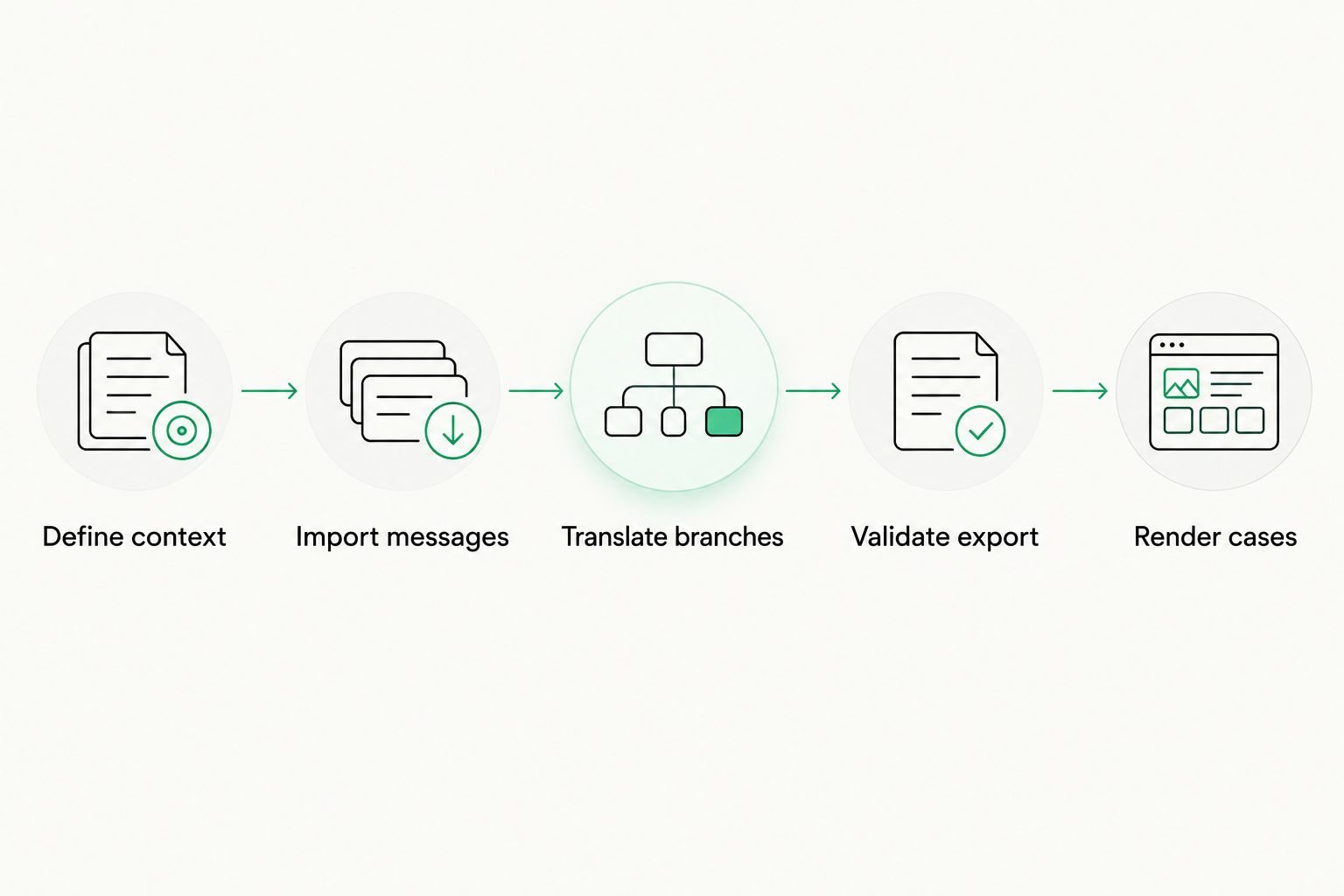
Test the exported message in the application, not only in the translation editor.
Choose test values from the locale rules
For an English count message, values such as 0, 1, and 2 check an empty-state decision, the one branch, and the other branch. They are starting cases, not a universal multilingual test set.
For other locales, derive representative values from CLDR rules or the plural-rule implementation used by your application. Include fractional quantities when your interface permits them. Also test unknown or absent selector values against the fallback behavior you designed.
Separate functional results from linguistic approval. A parser can confirm valid syntax without confirming that an adjective agrees with its noun.
Where does a translation management system fit?
Wxrks fits teams managing localization workflows, translation memory, and translation quality. Those capabilities organize the translation process; message selection still depends on the application's formatter and the information it receives.
When evaluating Wxrks, use the same acceptance test described above. Verify your file format, nested expressions, placeholder protection, branch editing, and exported output with a representative project.
The benefit of a translation management system is coordinated work across translators and developers. Its boundary is equally important: workflow automation does not supply missing runtime context or establish grammatical correctness by itself.
Do not treat a previously approved translation-memory match as automatic approval for a new context. The same visible source text can refer to a different noun, actor, or interface action.
Can machine translation choose the right plural and gender forms?
Machine translation can produce suitable forms when the message and context support them, but it cannot reliably reconstruct information that the application has omitted. A short string with an unexplained placeholder gives the system less to work with than a complete, documented message.
Keep structural validation separate from post-editing. Protect variables, inspect branch coverage, and have a translator review agreement and meaning before publication.
For your 2026 workflow, assign responsibility explicitly: developers own selector data and runtime behavior; translators own target-language wording; release reviewers check the rendered result.
Do you need a separate translation for every number?
No. Plural categories let a formatter choose among grammatical alternatives without requiring a separate translation for every possible quantity.
Exact-value branches serve a different purpose. Use them when a particular value needs special wording, such as an empty state, rather than as a substitute for locale-aware plural rules.
FAQ
Can localization software handle plural and gendered forms automatically?
Yes, when it supports the message structure and your application supplies the count or selector needed to choose a branch. Automatic selection does not replace linguistic review or rendered-interface testing.
Does every language need singular and plural translations?
No. Languages use different plural-category systems, so an English singular-versus-other structure is not a universal template. Use the target locale's rules.
What is the difference between ICU MessageFormat and CLDR?
ICU MessageFormat provides syntax for structured messages, while Unicode CLDR supplies locale data, including plural rules. Your implementation must connect message formatting with the appropriate locale behavior.
Can software work out someone's gender from their name?
A name is not a reliable basis for choosing a person's gendered wording. Use relevant, explicitly supplied context or a linguistically appropriate neutral message.
Can I combine plural and gender selections in one message?
Yes, ICU MessageFormat supports nested selections. Confirm that your editor, file exporter, and application formatter preserve and render the particular structure you use.
Will translation memory prevent agreement mistakes?
Translation memory does not guarantee correct agreement in a new context. Review the complete message, its variables, and its grammatical relationships before approving a reused translation.
What should I ask a localization software vendor to demonstrate?
Ask the vendor to import, translate, export, and render a representative message from your application. Include plural branches, explicit selectors, nested expressions where relevant, and fallback cases.
One last thing
A fallback that renders successfully can still hide an untranslated grammatical branch. Do not stop at checking that the interface displays a sentence; confirm that it displays the intended sentence for each tested condition.
Make that distinction part of your Wxrks evaluation: a completed workflow is a delivery milestone, while correct rendered language is the acceptance criterion.
Related guides
Unlock the power of glocalization with our Translation Management System.
Unlock the power of
with our Translation Management System.