Can a TMS reduce translator onboarding time?


Yes, a TMS can reduce translator onboarding time by bringing project instructions, translation memory, terminology, and review into a shared workflow. The benefit comes from removing repeated setup and clarification—not from eliminating training. Translators still need subject knowledge, usable context, and feedback before they can work independently.
TL;DR
- A TMS reduces translator onboarding time when approved resources and review instructions are ready before assignment.
- Wxrks fits teams seeking translation workflow automation, translation memory, and quality management together.
- Measure time to an independently accepted assignment, not time to account activation.
- Keep human review: faster access does not establish translation competence.
Can a TMS reduce translator onboarding time?
A TMS shortens onboarding when it removes the work translators otherwise repeat before every assignment. Instead of searching messages for instructions, translators should receive a clear task with the resources needed to complete it.
If your starting point is scattered files and status trackers, first assess switching from spreadsheets to a TMS. Moving an unclear process into software leaves the underlying questions unanswered.
Build onboarding around these 5 stages:
- Prepare resources. Select approved reference translations, terminology, and instructions for the assignment.
- Confirm access. Verify that the translator can open the task and reach the required resources.
- Explain decisions. Show how to handle conflicting references, unclear source text, and terminology questions.
- Review work. Use a representative assignment to check how the translator applies the guidance.
- Approve independence. Confirm that the translator can meet the agreed acceptance criteria without repeated intervention.
These stages separate access problems from translation problems. That distinction matters: a translator waiting for permission needs an administrator, while a translator misunderstanding terminology needs context and feedback.
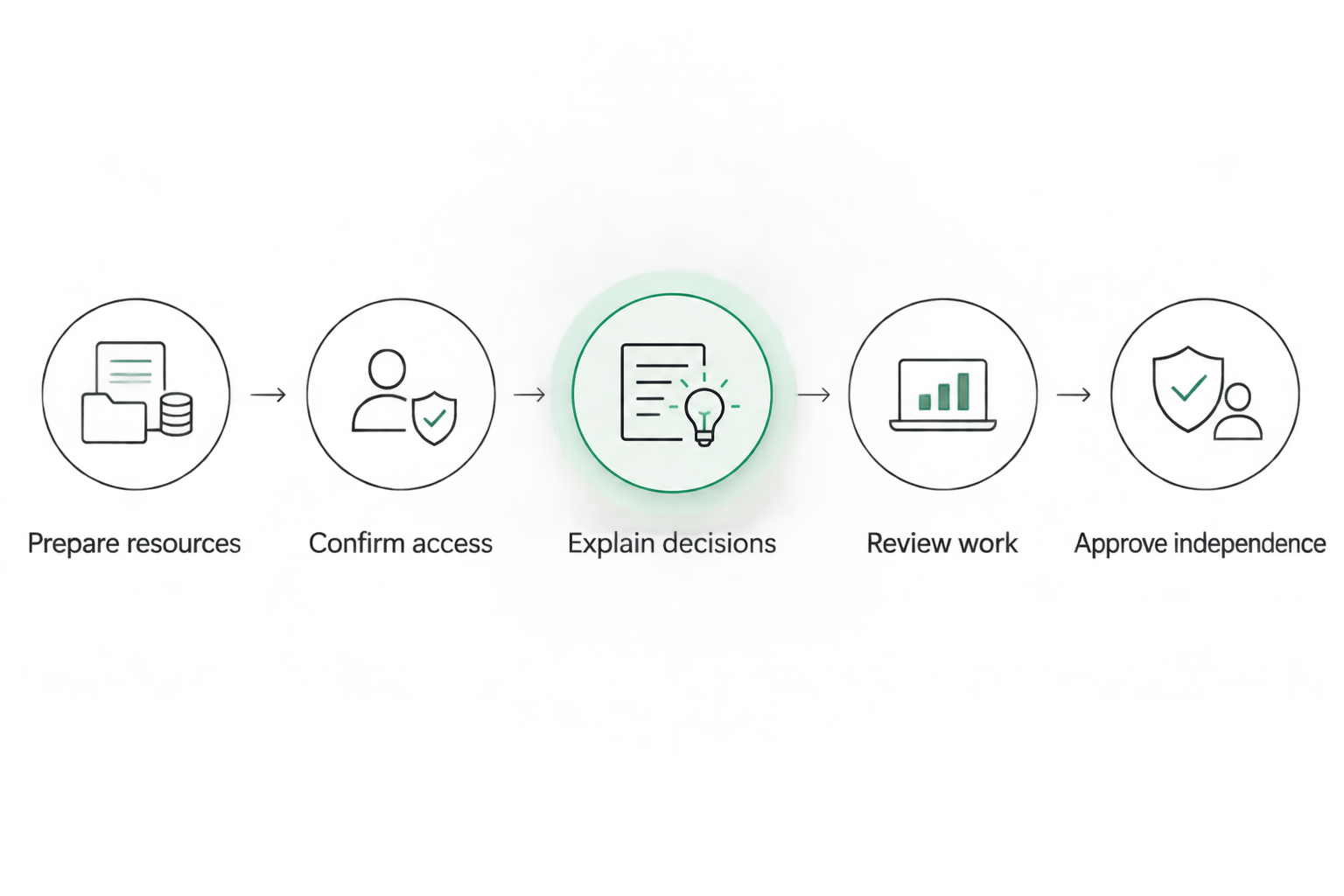
Confirm access before using an assignment to assess translation readiness.
Why this matters
For your 2026 onboarding process, define success as an accepted assignment completed with the expected level of independence. An activated account proves access. It does not prove readiness.
Without that distinction, you can report a faster start while project managers continue answering the same questions behind the scenes. The apparent improvement disappears into clarification, corrections, and extra review.
A useful TMS setup makes recurring guidance accessible inside the translation process. It also leaves room for judgment: translators need to understand when an approved reference applies and when the source requires a different decision.
Where a TMS helps—and where manual onboarding still fits
Best for repeatable localization work: a configured TMS workflow. Best for an isolated, straightforward assignment: a documented manual handoff. Choose based on the coordination problem, not on whether software feels more organized.
Documented manual handoff
- Best for: Isolated assignments with limited coordination
- Practical advantage: Lets you explain the task directly without introducing another working environment
- Limitation: You must maintain and distribute instructions, references, and updates yourself
Configured TMS workflow
- Best for: Recurring assignments with shared resources and review
- Practical advantage: Keeps translation work connected to reusable resources and a defined process
- Limitation: Requires configuration, resource maintenance, and training in the working environment
Manual onboarding is not automatically inefficient. A clear brief and a responsive reviewer can serve a simple assignment well. Its limitation appears when you repeatedly distribute the same materials or reconcile conflicting versions.
A TMS does not automatically solve those conflicts. Someone still has to decide which terminology is approved, which translation memory belongs to the project, and who accepts the work.
For a 2026 evaluation, ask each translator to complete the actual handoff process rather than watch a feature demonstration. The useful question is whether the working environment answers the questions your team repeatedly receives.
Prepare an onboarding package translators can actually use
Make the assignment understandable
Tell the translator who will read the content, what the reader needs to do, and where the translation will appear. Include relevant constraints, such as text that must remain unchanged or formatting that must survive translation.
Avoid using a long style guide as a substitute for a brief. Point out the rules that affect the assignment and explain where to find the rest. A translator should not have to infer the task from a folder of references.
Curate translation memory
Translation memory gives newcomers access to previous source-and-target segments. That history is useful when it represents accepted work relevant to the current assignment.
Treat translation memory as evidence, not an instruction to copy blindly. An approved sentence can still be unsuitable in a different context. Explain how translators should flag outdated wording or conflicts between a memory match and current guidance.
Give terminology a decision owner
Provide approved terms with enough context to distinguish their meanings. When relevant, explain prohibited alternatives and the reason for choosing a particular term.
Also name the person responsible for resolving terminology questions. A shared glossary cannot settle a disagreement if nobody owns the decision. Make the resulting decision available to the next translator rather than leaving it in a private exchange.
Show what accepted work looks like
Pair a representative example with the acceptance criteria. Explain why the translation works, including terminology choices, tone, and treatment of ambiguous source text.
Examples are most useful when they expose decisions. A polished final translation without explanation shows the destination but not the reasoning a newcomer needs to reproduce.
Use a first assignment to test the workflow
Choose a representative assignment that exercises the decisions translators will face in normal work. Avoid selecting only unusually easy content, but do not use an exceptional edge case as the entire assessment.
Before the translator starts, confirm how questions should be raised and who will answer them. Then review both the translation and the process used to produce it.
Use these 3 checkpoints:
- Resource use: Did the translator find and apply the relevant instructions, terminology, and reference translations?
- Decision quality: Did the translator identify ambiguity instead of silently guessing?
- Submission readiness: Did the work meet the stated linguistic and workflow requirements?
Keep linguistic feedback separate from tool guidance. Missing a submission step is not the same problem as misunderstanding the source. Combining both into a vague request to improve makes the next assignment harder to evaluate.
Record recurring explanations in the shared onboarding material. Keep assignment-specific feedback with its context. This prevents a local correction from becoming a general rule that later translators apply incorrectly.
Why translator onboarding time varies
The same onboarding workflow will not produce an identical experience for every translator. Review these factors before comparing results:
- Resource readiness: Approved references help; conflicting or outdated materials create additional decisions.
- Task complexity: Specialized subject matter and ambiguous source text require explanation beyond tool training.
- Working-environment familiarity: Experience in another translation editor does not establish familiarity with your submission and review process.
- Review clarity: Defined acceptance criteria make feedback actionable; unstated preferences require clarification.
- Decision ownership: Access, terminology, and linguistic questions need identifiable owners so they reach the right person.
In your 2026 onboarding checklist, assign responsibility for each factor. Do not make the translator responsible for resolving missing permissions or deciding which contradictory reference is authoritative.
These factors also explain why a single onboarding average can conceal different problems. Group comparable assignments before deciding whether a process change helped.
Measure readiness, not account creation
Track 2 clocks: elapsed onboarding time and active support time. Elapsed time captures the wait between defined milestones; active support time captures the effort your team spends explaining, troubleshooting, and correcting.
Use the same start and finish definitions for your 2026 baseline and follow-up. A practical start is the assignment becoming available with its required resources. A practical finish is acceptance of work that meets your independence criteria.
Elapsed onboarding time
- What to record: Time between the agreed start and accepted independent work
- What it helps you diagnose: Whether the overall path to readiness is shorter
Active support time
- What to record: Time spent on setup help, clarification, and corrective guidance
- What it helps you diagnose: Whether coordination effort has actually declined
Review outcome
- What to record: Acceptance or requested changes against stated criteria
- What it helps you diagnose: Whether speed has come at the expense of quality
Repeated questions
- What to record: Questions already answered during onboarding
- What it helps you diagnose: Whether shared guidance is findable and understandable
Compare like with like. A returning translator working on familiar content is not a fair comparison for a newcomer handling a specialized subject.
Do not credit the TMS for every change. Cleaner source files, better references, or a more available reviewer can also change the result. Record those conditions alongside the outcome so you know what to retain.
Where Wxrks fits in translator onboarding
Wxrks is a fit for teams that need translation workflow automation, translation memory, and quality management together. Those capabilities align with onboarding that connects instructions, reusable language resources, and review rather than treating them as separate administrative tasks.
Wxrks provides translation management software for translators, developers, enterprises, and translation agencies, including workflow automation and cost tracking. Use a representative assignment to assess how its working process matches your onboarding requirements.
The limitation is organizational: software cannot supply an approved terminology decision or subject-specific instruction your team has not prepared. Evaluate the system and your onboarding materials together. Otherwise, you risk attributing a missing process to the tool—or expecting the tool to replace one.
Does a TMS replace translator training?
No. A TMS supports training by putting reusable resources and workflow guidance closer to the work. Translators still need to understand the subject, audience, quality expectations, and escalation process.
Separate training about the working environment from training about the content. Teach task handling through the actual workflow, then use reviewed examples to explain linguistic decisions. That makes feedback easier to apply.
How do you know a translator is ready to work independently?
A translator is ready when the work meets your acceptance criteria without repeated intervention on previously explained tasks. Independence does not mean never asking questions; identifying a genuine ambiguity is part of competent translation.
Check whether the translator uses approved resources, raises unresolved issues appropriately, and submits work through the agreed process. Do not use speed alone as the gate.
FAQ
Can a TMS reduce translator onboarding time for freelancers?
Yes, a TMS can reduce translator onboarding time for freelancers by making assignment instructions and reusable language resources accessible through a shared workflow. The benefit depends on preparing those resources and explaining the acceptance criteria before work begins.
What's the best way to onboard a translator into a TMS?
Use a representative assignment with approved resources, clear submission instructions, and a named reviewer. Check access before assessing translation performance, then separate tool guidance from linguistic feedback.
How long should translator onboarding take?
Set the target around the assignment and your acceptance criteria rather than a universal duration. Measure the path to accepted independent work, including the support and review effort required to get there.
Can translation memory replace a style guide during onboarding?
No, translation memory cannot replace a style guide because previous translations do not explain every rule or decision. Use relevant approved segments alongside current guidance about audience, tone, terminology, and exceptions.
Is a TMS better than email for onboarding translators?
A configured TMS is better suited to recurring work that depends on shared resources and a defined review process. A documented email handoff remains workable for an isolated assignment, but you must manage reference updates and decisions yourself.
Is Wxrks relevant to translator onboarding?
Wxrks is relevant when onboarding depends on translation workflow automation, translation memory, and quality management. Assess it using your own assignment and acceptance criteria rather than assuming software removes the need for training.
One last thing
A question asked early can prevent rework; a question never asked can hide a misunderstanding. Do not reward new translators simply for asking fewer questions.
For your next 2026 onboarding cycle, review the questions as carefully as the submitted translation. Turn repeated procedural questions into clearer instructions. Keep genuine linguistic questions open for discussion. The goal is independent judgment supported by shared knowledge, not silent completion.
Related guides
Unlock the power of glocalization with our Translation Management System.
Unlock the power of
with our Translation Management System.