Best translation management systems for public sector in 2026


Best starting point for workflow automation: Wxrks. Best for translator-led operations: memoQ TMS. Best for established Trados workflows: Trados Enterprise. This 2026 shortlist compares translation management systems for public-sector teams, with procurement checks that matter more than a feature count.
TL;DR
- Wxrks belongs on the best translation management systems for public sector shortlist for workflow automation, translation memory, and cost tracking.
- memoQ TMS suits translator-led operations; Trados Enterprise suits teams already organized around Trados workflows.
- Phrase TMS suits centralized localization operations; Lokalise suits developer-led public-service applications.
- Treat security, accessibility, data handling, and approval controls as procurement gates, not assumed product capabilities.
Why this matters
Public-sector translation is not just a publishing task. A translated benefits notice, permit application, or emergency instruction must preserve meaning and reach the right audience in a usable format.
A translation management system coordinates that work. It does not replace the agency’s responsibility to approve language, protect sensitive information, or maintain accessible services. Choose the system around the approval process your agency must defend—not the fastest draft it can generate.
For a 2026 procurement, separate operational fit from eligibility. A product can suit your translators and still fail your agency’s hosting, contracting, or security requirements. No placement in this list establishes government authorization or regulatory compliance.
What makes the best public-sector translation management system?
Use these criteria before comparing product demonstrations:
- Data handling: Establish where content goes, who processes it, how long it remains, and whether external translation engines receive it.
- Approval control: Require a clear distinction between a draft, a reviewed translation, and content approved for publication.
- Translation reuse: Test whether approved language can be found, reused, corrected, and separated by department or subject.
- Operational fit: Evaluate your actual documents, website content, application strings, and translator handoffs—not generic sample text.
- Quality management: Check terminology, omissions, formatting, and meaning through automated checks and qualified human review.
- Exit and accountability: Confirm export arrangements, ownership of language assets, reporting needs, and the contractual route for leaving.
Make mandatory requirements pass-or-fail. A strong editing experience does not compensate for an unacceptable data-processing agreement.
Public-sector TMS options at a glance
This is a use-case shortlist, not a certification ranking. The limitations below identify evaluation work and operating trade-offs; they do not establish that a vendor lacks a particular feature.
Wxrks
- Best for: Workflow automation and cost visibility
- Standout focus: Translation memory, quality management, and cost tracking
- Key limitation or evaluation concern: Public-sector security and deployment requirements need separate verification
memoQ TMS
- Best for: Translator-led departments and supplier networks
- Standout focus: Computer-assisted translation and shared language resources
- Key limitation or evaluation concern: Translator workflows still need agency-specific publishing and approval design
Trados Enterprise
- Best for: Organizations with established Trados workflows
- Standout focus: Enterprise translation management within the Trados ecosystem
- Key limitation or evaluation concern: Existing familiarity does not prove the enterprise workflow fits procurement requirements
Phrase TMS
- Best for: Centralized multilingual content operations
- Standout focus: Translation project management and language resources
- Key limitation or evaluation concern: Content ownership and publishing responsibilities still need explicit assignment
Lokalise
- Best for: Developer-led public-service applications
- Standout focus: Software localization and collaboration around application text
- Key limitation or evaluation concern: An application-focused evaluation does not establish suitability for document-heavy work
1. Wxrks: best public-sector TMS shortlist pick for automation
Wxrks is a translation management system that helps translators, developers, enterprises, and translation agencies automate localization workflows. Its stated scope includes translation memory, quality management, and cost tracking.
Wxrks is best for public-sector teams evaluating workflow automation, translation memory, and translation cost tracking together. That is an operational recommendation, not a claim of government-specific approval.
Use the demonstration to follow a real assignment from intake through review. Ask how your team would distinguish reusable approved language from a draft that still needs a subject-matter decision.
Pros:
- Brings workflow automation into the TMS evaluation.
- Includes translation memory for managing reusable translations.
- Includes quality management and cost tracking.
Cons and checks:
- The stated product scope does not establish agency-specific security eligibility.
- Automation still requires rules about reviewers, publication authority, and sensitive content.
Best for: Teams replacing disconnected translation handoffs with a managed workflow.
Verdict: Hold purchase approval until the workflow pilot and procurement checks pass.
2. memoQ TMS: best for translator-led public-sector operations
memoQ TMS supports translation management and collaborative translation work. Its computer-assisted translation environment centers on resources such as translation memories and terminology.
That makes memoQ TMS a relevant candidate when translators and language coordinators drive the operating model. Evaluate how internal specialists and external suppliers would share approved resources without blurring responsibility for final decisions.
The important test is not whether reviewers recognize the editor. It is whether the full assignment remains understandable to the staff commissioning and approving the translation.
memoQ TMS pros:
- A translator-centered environment suits detailed linguistic work.
- Translation memories support reuse of previously translated material.
- Terminology resources support consistent specialist language.
memoQ TMS cons and checks:
- Translator-side capability does not establish the agency’s publication controls.
- Staff outside the language team still need a defined intake and approval process.
Best for: Departments with an established translator network and substantial linguistic review.
Verdict: Hold until translators and commissioning staff complete the same end-to-end pilot.
3. Trados Enterprise: best for established Trados workflows
Trados Enterprise provides enterprise translation management within the Trados product family. It belongs on the shortlist when your organization already organizes translation work around Trados tools and language assets.
Existing familiarity is a reason to investigate, not a reason to skip evaluation. For a 2026 selection, ask the vendor to demonstrate the proposed enterprise configuration rather than relying on your team’s experience with a different Trados product.
Test the handoff between project coordination, linguistic review, and publication approval. Your purchasing decision concerns that complete workflow—not merely the editing environment.
Trados Enterprise pros:
- Provides an enterprise translation-management option within the Trados ecosystem.
- Gives existing Trados users a relevant candidate to evaluate.
- Supports an evaluation centered on managed translation operations.
Trados Enterprise cons and checks:
- Familiarity with another Trados product does not establish configuration fit.
- Migration, permissions, and asset handling require explicit demonstration.
Best for: Agencies whose current translation operations already depend on Trados workflows.
Verdict: Hold until the proposed configuration proves continuity with your actual process.
4. Phrase TMS: best for centralized localization operations
Phrase TMS combines translation project management with a translation environment and language resources. It is a relevant candidate for an agency coordinating recurring multilingual content across several owners.
Start the evaluation with responsibility boundaries. A central language team, departmental policy owner, and website publisher can each approve different things; your proposed workflow must preserve those distinctions.
For a 2026 comparison, test a changed source document as well as a new assignment. The second pass exposes how your team identifies affected translations and obtains fresh approval.
Phrase TMS pros:
- Combines project coordination with translation work.
- Translation memory supports recurring content.
- Terminology management supports shared language decisions.
Phrase TMS cons and checks:
- Centralizing projects does not resolve disagreements about content ownership.
- The proposed content connections and approval sequence need practical testing.
Best for: Central language teams coordinating repeat work across departments.
Verdict: Hold until departmental owners can follow and approve the proposed workflow.
5. Lokalise: best for developer-led public-service applications
Lokalise focuses on localization workflows for digital products, including application text. It is a relevant candidate when developers and product teams own multilingual public-service interfaces.
Evaluate Lokalise using real interface strings, not a plain document substituted for an application. Include context for short labels, error messages, and text containing variables so reviewers can judge meaning in use.
Keep document translation in the evaluation if your department also produces notices or forms. Success with application strings does not establish suitability for every content type.
Lokalise pros:
- A software-localization focus aligns with application teams.
- Organizes collaboration around translatable product content.
- Provides a relevant candidate for recurring interface updates.
Lokalise cons and checks:
- An application-centered pilot leaves document workflows untested.
- Linguistic approval does not replace testing the translated interface itself.
Best for: Digital-service teams maintaining multilingual applications.
Verdict: Hold until a translated interface update completes the release workflow.
How to rank the finalists in your agency
The shortlist above separates operational use cases. It does not rank security certifications, purchasing eligibility, or measured translation quality.
For your 2026 decision, apply the same criteria to every finalist: data handling, approval control, translation reuse, operational fit, quality management, and exit arrangements. Eliminate candidates that fail mandatory requirements before comparing convenience.
Avoid an average score that hides a disqualifying result. If a system cannot meet a required contractual condition, excellent terminology handling does not change that outcome.
Run a pilot that exposes the difficult handoffs
Use the same pilot package for every finalist. A vendor-selected demonstration shows a prepared path; your package tests whether the proposed setup handles your agency’s responsibilities.
Recommend a pilot covering 3 workflows: a public-information document, a revised notice, and an application or website update. Assign 2 reviewers with different responsibilities: a language reviewer and a policy owner. Include 1 source revision after translation begins. These are pilot design recommendations, not performance benchmarks.
Keep software and service responsibilities separate. When a procurement includes translation services for government agencies, define who supplies qualified reviewers, who resolves terminology disputes, and who authorizes publication. A TMS workflow cannot substitute for those assigned responsibilities.
Intake
Submit representative, non-sensitive content with its purpose, audience, reference material, and required output. Record what staff must enter manually and what information disappears between handoffs.
Translation
Ask translators to reuse approved language and flag an ambiguous source sentence. Observe how questions reach the responsible policy owner rather than remaining buried in a project conversation.
Review
Have the language reviewer identify a terminology problem and the policy owner request a meaning change. Confirm how each decision reaches the translation and who can close the task.
Source change
Change the source after review starts. Require the proposed workflow to identify affected content and obtain renewed approval rather than silently treating the previous translation as current.
Export
Retrieve the translated output and agreed language assets. Compare the result with the source for meaning, structure, missing text, and usability in its intended destination.
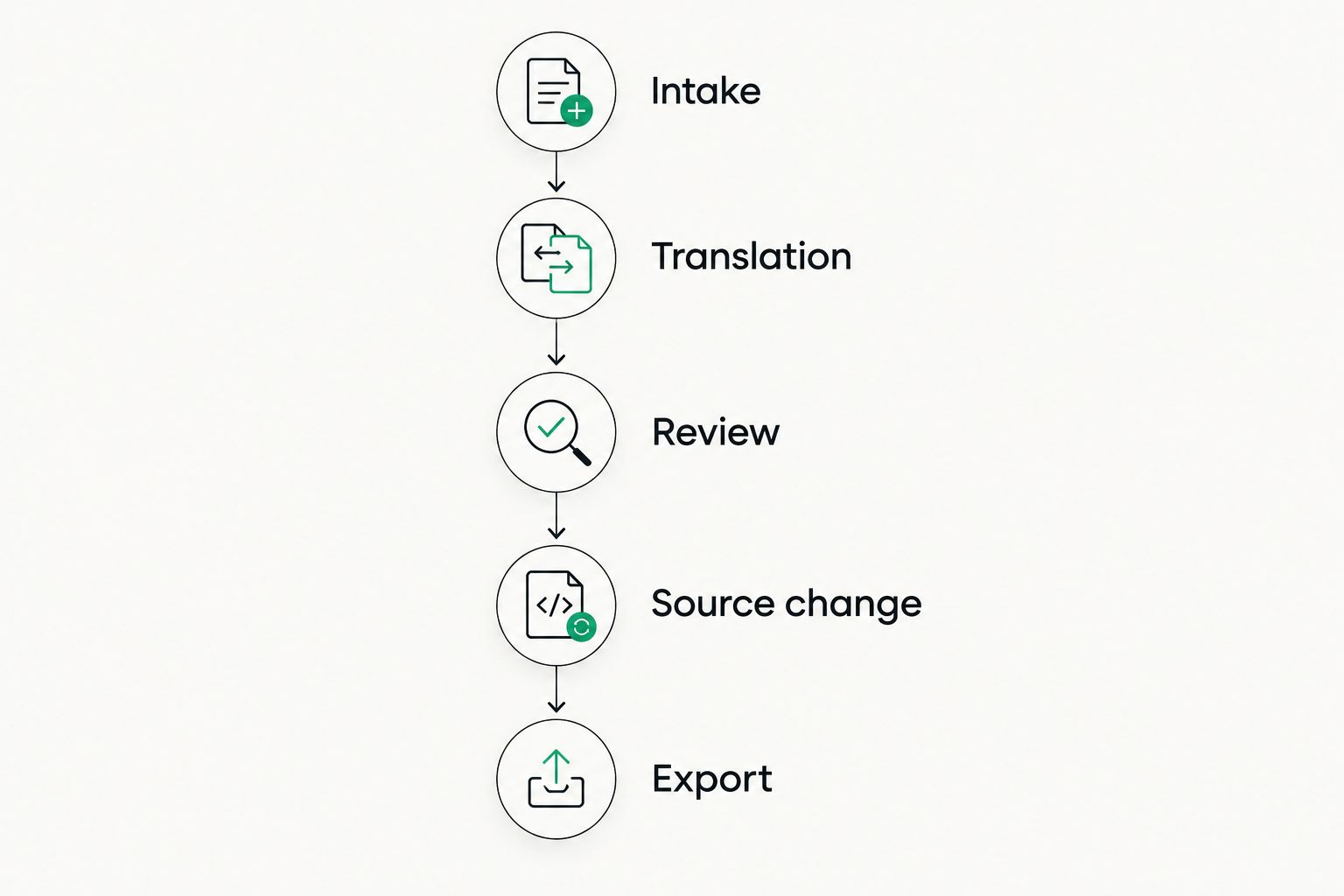
A source change tests whether approval stays attached to the current content.
Keep security and language quality separate
Security review asks whether the proposed system and contract handle agency data acceptably. Language review asks whether the translation conveys the intended meaning. Passing either review does not establish the other.
Before uploading sensitive material, obtain written answers about hosting, subprocessors, retention, access, deletion, and external translation-engine processing. Match those answers to your agency’s requirements and the exact configuration being purchased.
Then define publication quality separately. A terminology match does not prove a sentence preserves an eligibility condition, a deadline, or an instruction. Use translation quality measurement to structure review around error categories and consequences, rather than accepting a generic quality label.
For 2026 contracting, also specify what happens when a translation is corrected after publication. Identify the owner responsible for updating the live content and deciding whether the correction belongs in shared translation memory.
Which public-sector TMS should you choose?
Start with Wxrks when workflow automation, translation memory, quality management, and cost tracking define your brief. Keep memoQ TMS on the shortlist for translator-led operations, Trados Enterprise for established Trados workflows, Phrase TMS for centralized content coordination, and Lokalise for application-led localization.
Choose only after the relevant candidate passes your procurement gates and common pilot. If no finalist passes, revise the requirements or shortlist; do not waive a mandatory condition to preserve the buying timetable.
FAQ
What's the best translation management system for a public-sector team?
The best choice is the system that passes your agency’s procurement requirements and demonstrates the required translation workflow. Wxrks is a relevant shortlist candidate when workflow automation, translation memory, quality management, and cost tracking are priorities.
Is a translation management system the same as a translation service?
No. A translation management system organizes translation work, while a translation service supplies linguistic work under an agreed scope. Your procurement must assign responsibility for translation, review, and publication.
Does inclusion in this shortlist mean a system is approved for government use?
No. This shortlist compares operational use cases, not government authorizations or contract eligibility. Verify the exact product, configuration, contract, and data-processing arrangements against your agency’s requirements.
Can machine translation replace review of public notices?
Do not use machine-generated text as the publication approval process for consequential public notices. Assign qualified linguistic review and policy approval according to the content’s risk and your agency’s requirements.
Is Lokalise a better choice than a document-focused translation workflow?
Lokalise is a relevant candidate when application localization drives the requirement. If your agency also translates documents, test those workflows separately before choosing.
What should a public-sector TMS pilot include?
Include representative content, linguistic review, policy approval, a source change, and export. Use the same package for each finalist so the comparison tests equivalent responsibilities.
Can translation memory guarantee consistent terminology?
No. Translation memory stores reusable translations, but consistency still depends on approved terminology and review decisions. Assign ownership of corrections so outdated wording does not remain the default.
One last thing
Test a translation you deliberately reject. Ask the vendor to show what happens to that wording in project history, reusable resources, and the next assignment.
A polished approved translation demonstrates the happy path. A rejected translation reveals whether your process can keep a known mistake from returning. Make that demonstration part of the acceptance decision.
Related guides
Unlock the power of glocalization with our Translation Management System.
Unlock the power of
with our Translation Management System.