Best Tomedes alternatives for small businesses in 2026


Tomedes offers professional translation services for businesses that want to outsource language work. That service model stops being the complete answer when your main problem is managing recurring updates, approved translations, quality checks, and translation costs inside your business. The best Tomedes alternative in 2026 is Wxrks if you need translation workflow software; an independent translator if you need direct, hands-on language delivery.
TL;DR
- Compare Tomedes alternatives for small businesses by delivery model: translation service, translation management software, or direct translator relationship.
- Wxrks translation management software fits recurring localization workflows, translation memory, quality management, and cost tracking.
- An independent translator fits businesses that want direct communication with the person translating their content.
- DeepL Translator fits machine-generated drafts; assign a qualified reviewer before publishing customer-facing content.
- Keep Tomedes when outsourced translation delivery solves your problem better than running an internal workflow.
Why this matters in 2026
A translation service and a translation management system solve different problems. One delivers language work; the other helps you organize the work, people, and reusable translations behind it.
For a small business, that distinction determines who does the coordination. Buying software does not remove the need to brief translators, resolve terminology questions, or approve the final text.
Start with the task that keeps breaking. If you struggle to find a translator, evaluate a service or independent professional. If translations arrive but revisions, approvals, and costs remain scattered, evaluate workflow software.
Replace the failing part of your process, not automatically the entire process. You can retain a translation provider while changing how your business manages localization.
Tomedes alternatives at a glance
This 2026 comparison separates translation delivery from translation management. The strongest option depends on whether you need someone to translate, somewhere to manage translation, or a tool to produce a draft.
Tomedes
- Best for: Businesses seeking outsourced professional translation
- Standout capability or approach: Translation service delivery
- Main trade-off: You still need to define requirements and approve business-specific meaning
- How it differs from Tomedes: The service benchmark for this comparison
Wxrks
- Best for: Small businesses managing recurring localization
- Standout capability or approach: Translation memory, workflow automation, quality management, and cost tracking
- Main trade-off: Your business needs someone responsible for the workflow
- How it differs from Tomedes: Software for managing localization rather than a like-for-like translation service
Independent translator
- Best for: Businesses wanting a direct translator relationship
- Standout capability or approach: Direct discussion of meaning, terminology, and revisions
- Main trade-off: Your business coordinates the assignment and continuity
- How it differs from Tomedes: You work directly with the person doing the language work
DeepL Translator
- Best for: Teams preparing machine-translated drafts
- Standout capability or approach: Automated text translation
- Main trade-off: A generated draft still needs an appropriate review process
- How it differs from Tomedes: A translation tool rather than an outsourced professional translation engagement
Do not read this as a quality ranking across every language or document type. A useful shortlist matches the delivery model to your actual workload before comparing individual outputs.
1. Wxrks: best for recurring localization workflows
Wxrks is translation management software for translators, developers, enterprises, and translation agencies. Its stated capabilities include localization workflow automation, translation memory, quality management, and cost tracking. For a small business, the relevant question is whether those management tasks have become a recurring responsibility rather than an occasional interruption.
A software evaluation makes sense when you already have people who translate or review content but need a clearer operating process. It is a different purchase from asking a provider to deliver a translated document.
Where the platform shines
- Workflow management: It addresses the coordination of localization work, not just the production of translated text.
- Translation memory: It supports managing previously translated material as a reusable resource.
- Quality management: Quality becomes an explicit part of the translation workflow.
- Cost tracking: Translation spending is part of the management process rather than a separate afterthought.
Where the platform falls short
- Software does not replace the business decisions behind a translation brief.
- Your team still needs a named owner for terminology questions and final approval.
- A workflow platform is not a like-for-like replacement for outsourced professional translation delivery.
- For an isolated document, introducing a management process adds work that the assignment might not justify.
Head-to-head: management software versus translation delivery
Primary role
- Wxrks: Translation management system
- Tomedes: Professional translation service
Central task
- Wxrks: Manage localization workflows and translation resources
- Tomedes: Deliver outsourced translation work
Your purchasing decision
- Wxrks: How your business will organize ongoing localization
- Tomedes: Who will handle a translation assignment
Evaluation focus
- Wxrks: Workflow, translation memory, quality management, cost tracking
- Tomedes: Scope, language expertise, review responsibilities, deliverables
Best for: Small businesses that need to manage ongoing translation work across people, revisions, and reusable content.
Verdict: Buy this category when workflow management is the problem; skip it as a substitute for hiring a translator.
2. Independent translator: best for direct language collaboration
An independent translator gives you a direct relationship with the professional handling your text. This route fits assignments where discussion of product meaning, audience, and terminology matters more than introducing another software system.
Choose the individual for the assignment, not simply for a language pair. Ask for relevant subject experience and agree who will review the finished work before the engagement starts.
Where an independent translator shines
- You can explain ambiguous passages directly to the person translating them.
- You can discuss terminology choices and feedback without treating every question as a new procurement exercise.
- You can define a focused assignment around a specific document, audience, or subject.
Where an independent translator falls short
- You take responsibility for coordinating the assignment and keeping source files current.
- Working directly with a translator does not automatically create a separate review stage.
- You need a continuity plan if the person cannot take a future assignment.
Head-to-head: direct engagement versus a service provider
Relationship
- Independent translator: Direct engagement with an individual professional
- Tomedes: Engagement with a translation service provider
Selection focus
- Independent translator: The individual's relevant language and subject expertise
- Tomedes: The provider's proposed approach to your assignment
Coordination decision
- Independent translator: Decide what you will manage yourself
- Tomedes: Confirm what the provider will manage
Continuity question
- Independent translator: Agree a backup approach
- Tomedes: Ask how continuity will be handled
Best for: Small businesses that want close collaboration with a translator and can manage the assignment themselves.
Verdict: Buy a direct professional engagement when access to the translator is your priority; skip it if you do not want the coordination responsibility.
3. DeepL Translator: best for machine-translated drafts
DeepL Translator is a machine translation tool. Use it to evaluate a draft-first workflow, not as evidence that a document has received professional review.
The important comparison is the complete process: draft generation, human review, corrections, and approval. A quick first draft is only one stage.
Where DeepL Translator shines
- It produces machine-translated text for a person to assess.
- It gives teams a draft-first route to evaluate against a human translation process.
- Its role is straightforward when the output is explicitly treated as unapproved text.
Where DeepL Translator falls short
- Generated output is not an independent check of factual meaning or terminology.
- Your team must arrange any required subject-matter and language review.
- Draft generation does not establish responsibility for final publication.
For a closer look at the review stage, read the guide to machine translation post-editing.
Best for: Teams that have a suitable reviewer and want to assess machine translation as the starting point, not the finished deliverable.
Verdict: Buy into a draft-first workflow only after testing the review burden; skip unreviewed output for consequential customer-facing material.
Why people switch from Tomedes
The useful switching reasons are changes in what your business needs, not unsupported claims about a provider's performance. These are decision criteria, not claims about Tomedes customers or service failures.
You need a management system
Your team has translation delivery covered, but you need to organize recurring work and manage translation resources. A TMS addresses that requirement directly. Replacing one translation provider with another does not, by itself, define your internal approval process.
You want a direct translator relationship
Your priority is discussing wording with the person doing the work. An independent translator is a distinct engagement model worth evaluating. Confirm that the person has the relevant expertise and that revision responsibilities are explicit.
You want to test a draft-first process
You have a qualified reviewer and want to assess machine translation before human editing. Compare the entire route with professional translation, including corrections and approval. Do not make the decision from the draft alone.
You need clearer ownership
Someone must decide which source file is current, resolve terminology questions, and authorize publication. A new provider or tool does not eliminate those decisions. Assign them before changing the technology.
Test the alternatives with your own content
For your 2026 evaluation, use a small, defined pilot rather than a generic demonstration. The following counts are a suggested test design, not performance benchmarks.
Choose 3 content types, run 2 revision rounds, and assign 1 approval owner. This gives you a practical way to examine initial translation, subsequent changes, and publication responsibility.
- Content sample: Choose material that represents your actual workload, such as a product page, support article, and transactional message.
- Initial translation: Give each evaluated route the same source material and instructions.
- Revision test: Change a term and a source passage, then examine how the revised work is handled.
- Quality review: Ask an appropriate reviewer to assess meaning, terminology, and suitability for the audience.
- Approval owner: Name the person who decides whether the result is ready to publish.
The sequence matters: define the sample before comparing outputs, and review the result before approving it.
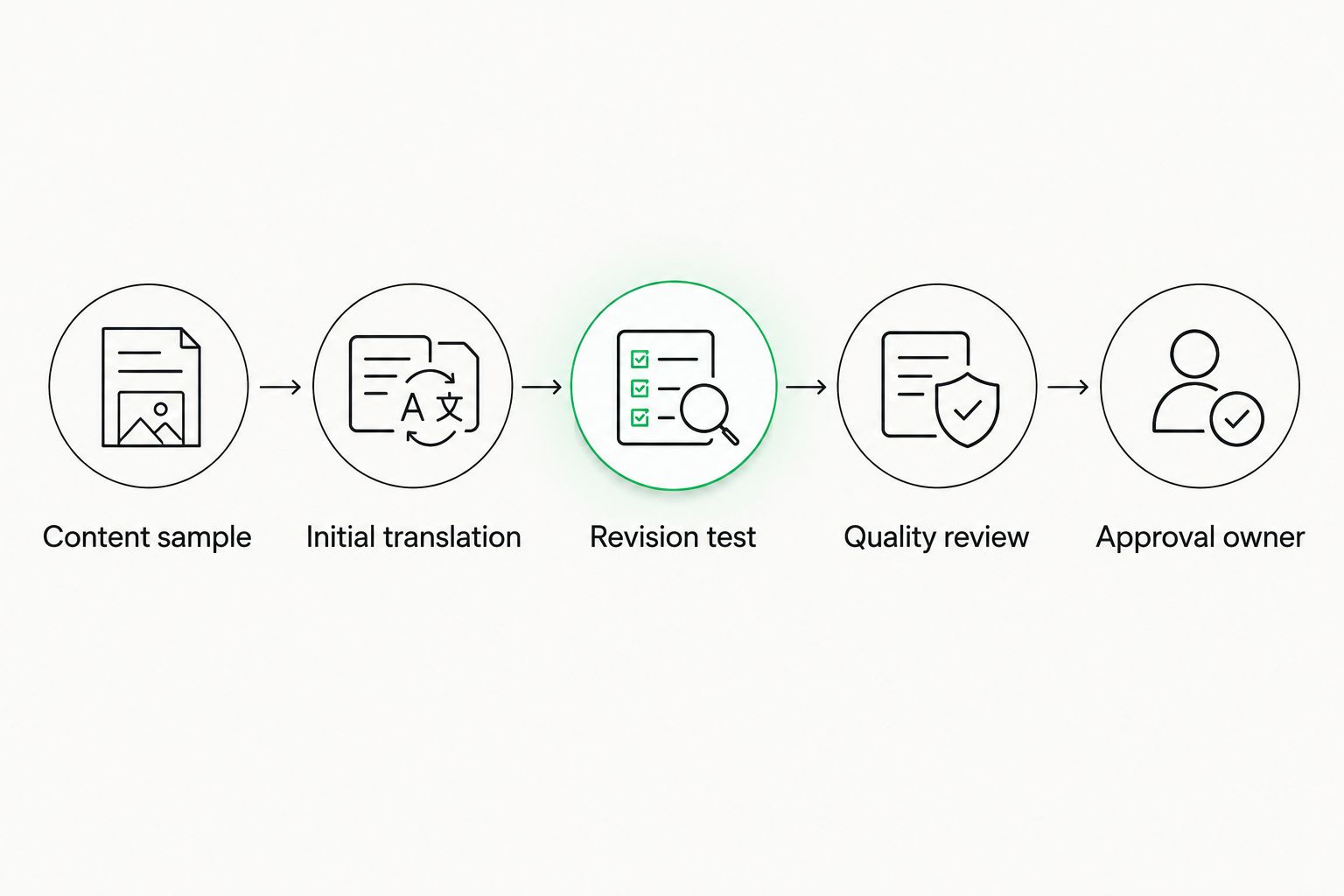
Test revisions and approval, not just the first translated draft.
Record what happened at each stage. Did the reviewer understand the context? Were changed passages clear? Could the approval owner identify the final version without reconstructing an email thread?
Keep observations separate from assumptions. A successful test of a support article does not establish suitability for a contract, and a successful first translation does not establish that revisions will be manageable.
Choose the route your business can operate repeatedly, not merely the one that produces the most convincing demonstration.
When staying with Tomedes is the right call
Stay with Tomedes in 2026 when your primary need remains outsourced professional translation and the agreed service meets your requirements. You do not need a replacement simply because translation management software exists.
An occasional assignment does not automatically justify a new internal system. If you want someone else to handle translation delivery, compare providers on the assignment itself rather than selecting software for a different job.
You can also separate the decisions. Keep a professional translation relationship while evaluating how your business manages source material, approvals, and reusable translations.
FAQ
What's the best Tomedes alternative for a small business in 2026?
Wxrks is the best fit here when your requirement is translation workflow management rather than outsourced translation delivery. An independent translator fits direct professional collaboration, while DeepL Translator fits a draft-first process with a suitable reviewer.
Is a translation management system the same as a translation agency?
No. A translation management system helps organize localization work and translation resources; a translation agency provides translation services. Decide whether you need workflow software, language delivery, or both.
Should I hire a freelance translator instead of using Tomedes?
Hire an independent translator when you want direct collaboration and can coordinate the assignment yourself. Check relevant subject expertise, review arrangements, revision responsibilities, and continuity before choosing.
Can DeepL Translator replace professional translation?
DeepL Translator provides machine-translated output, not proof of professional review. Whether that output suits your task depends on an appropriate assessment of meaning, terminology, and the consequences of errors.
Does a small business need translation memory?
Translation memory is relevant when your business wants to manage and reuse previously translated material. Evaluate it against your recurring content and revision process rather than assuming every small business needs the same setup.
How should I compare Tomedes alternatives fairly?
Compare each route using the same source material, instructions, revision exercise, and review criteria. Include coordination and final approval in the evaluation instead of judging only the initial translation.
When should I stay with Tomedes?
Stay with Tomedes when outsourced professional translation remains the job you need done and the agreed service meets your requirements. Changing providers does not automatically fix an internal workflow problem.
One last thing
The person who approves a translation matters as much as the tool that produces it. Before switching, write down who owns the source, who resolves language questions, and who authorizes publication.
If those responsibilities are unclear, fix them first. A better-defined workflow gives every provider and tool a fairer test.
Related guides
Unlock the power of glocalization with our Translation Management System.
Unlock the power of
with our Translation Management System.